
A graphic design contract is a written agreement between a designer and a client that sets out the scope, deliverables, revision rounds, timeline, fees, payment terms and who owns the finished work. A good one also covers deposits, kill fees, portfolio rights, termination and governing law. This 2026 guide explains every clause in plain English. It also gives you a free graphic design contract template you can copy and adapt, whether you freelance, run a design agency or work as a design consultant.
This article and template are general information for freelancers and design studios. Laws differ between US states, the UK, and other countries. Have a qualified lawyer review your contract before you rely on it, especially for high-value work or rights transfers.
Table of Contents
- What it is: a written agreement that sets the scope, deliverables, revision rounds, timeline, fees, payment terms and who owns the finished work.
- Clauses that matter most: scope and exclusions, revision limits, a deposit, a kill fee, and intellectual property and usage rights.
- Put rights in writing: in the US (17 U.S.C. § 204) and the UK (CDPA 1988, s.90), a copyright transfer or assignment must be in writing and signed.
- Transfer rights on full payment: keep ownership until the final invoice is paid.
- Free template below: 17 sections you can copy, fill in and have reviewed for your location.
Why Does Every Design Project Need a Contract?
A contract answers the three questions behind most design disputes before work starts: what’s included, when the client pays, and who owns the files. Using a graphic design contract template means you don’t have to write those answers from scratch for every project. It helps you:
- Stop scope creep by listing exactly what’s included and what costs extra.
- Get paid on time with a deposit, a payment schedule and late-payment terms.
- Protect your rights by transferring ownership only once the final invoice is paid.
Copyright ownership is a particular reason to put things in writing. In the US, a transfer of copyright ownership isn’t valid unless it’s in writing and signed by the owner (17 U.S.C. § 204). In the UK, an assignment of copyright isn’t effective unless it’s in writing and signed by or on behalf of the assignor (Copyright, Designs and Patents Act 1988, s.90). A handshake or an email saying “the logo is yours” may not be enough.
Who This Graphic Design Contract Template Is For?
The same core clauses work for most design businesses. A few details change depending on who you are and who you work with.
Freelancers and beginners
If this is your first contract, start with the full template and keep every clause. Beginners often delete the kill fee or revision limit because it feels awkward to ask. Those are the two clauses you’ll be most glad you kept.
Design agencies
An agency graphic design contract template should name the agency as the legal party, not the individual designer. It should also cover subcontractors and say who on the client side has authority to approve work.
Design consultants
If you advise on brand strategy or creative direction instead of producing files, list the sessions, reports or workshops as your deliverables. Bill by the day or on a retainer.
Small business clients
A graphic design contract template for small business projects should be short and easy to read. Small business owners are often signing a design contract for the first time, so plain language and a clear payment schedule build trust fast.
SaaS companies
Working with SaaS clients usually means UI design, product launch graphics or ongoing marketing design. For SaaS work, define the licence scope (web, app, ads), add a retainer option for monthly design requests, and agree when launch work can go into your portfolio.
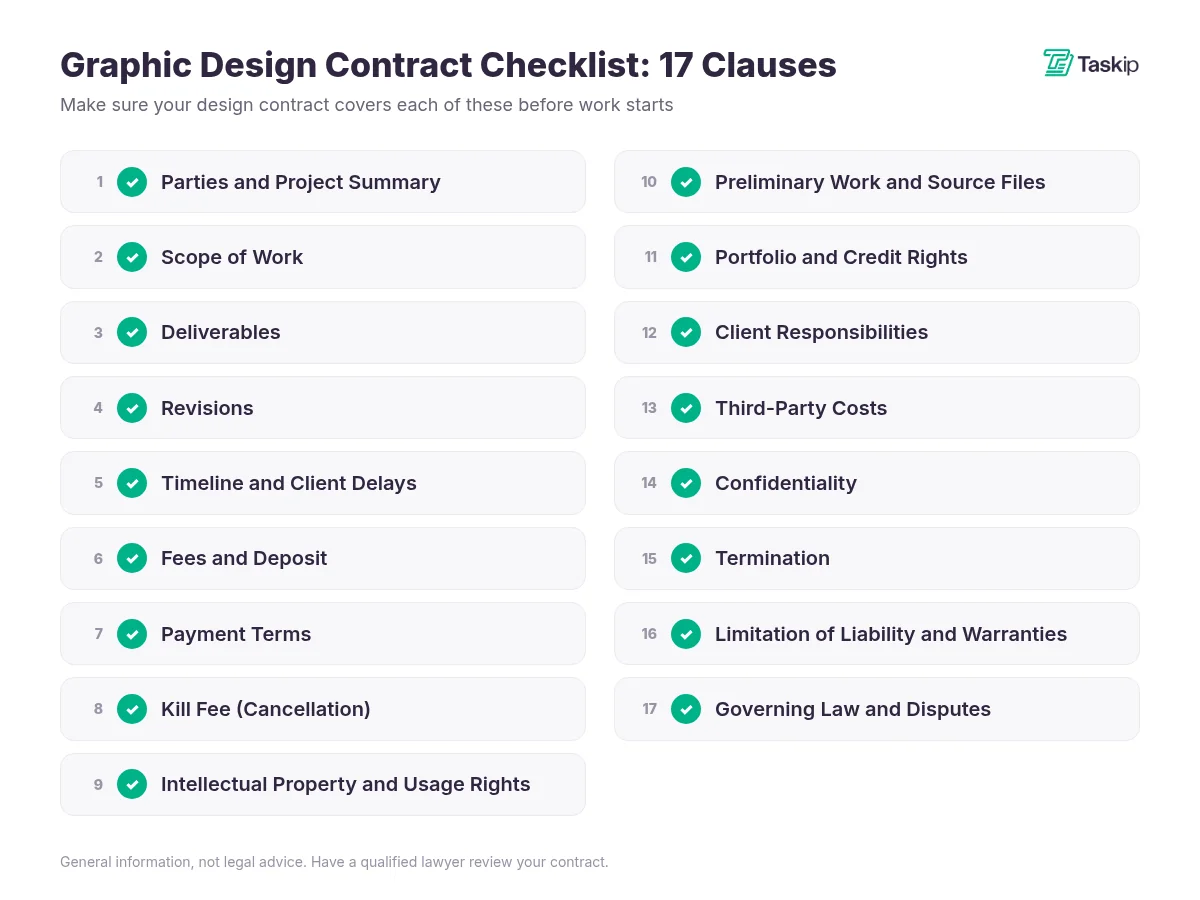
What to Include in a Graphic Design Contract (17 Clauses)
These are the top clauses for design work. The best graphic design contract template covers all 17 of them, and the free template further down includes every one.
1. Parties and Project Summary
Full legal names and addresses of the designer (or studio) and the client, the date, and a one-paragraph summary of the project. If you trade as a company, use the company name, not just your own.
2. Scope of Work
Describe the services: research, concept development, design, file preparation. Be just as clear about what’s not included, such as copywriting, photography, printing, web development or social posting. Anything outside the scope is handled through a change request.
3. Deliverables
List each deliverable with its format and specs. For a logo: primary, secondary and icon versions, in full color, one color and reversed, delivered as AI, EPS, SVG, PDF and PNG. For print: page count, size, bleed and the files the printer needs. Specific deliverables prevent “I thought that was included” conversations.
4. Revisions
State how many revision rounds are included at each stage (for example, three initial concepts, then two rounds of refinements on the chosen concept). Define a “round” as one consolidated set of feedback. Set the rate for extra rounds, either hourly or per round.
5. Timeline and Client Delays
Give milestone dates for concepts, revisions and final delivery. Make the timeline depend on the client’s feedback: if the client takes longer than an agreed number of business days to respond, deadlines move by the same amount. Add a pause clause for projects that go quiet for weeks.
6. Fees and Deposit
State the total fee or the fee structure (project, hourly, day rate or retainer), the currency and whether tax is included. For UK clients, say whether VAT is added. Ask for a non-refundable deposit before work starts and say what it covers, typically your scheduling and the first phase of work.
7. Payment Terms
Set the payment schedule (for example, deposit on signing, a milestone payment on concept approval, the balance on delivery), the due date for invoices (such as 14 or 30 days), accepted payment methods and the late fee. In the UK, if your contract doesn’t set its own rate, businesses can claim statutory interest on late business-to-business payments at 8% plus the Bank of England base rate (GOV.UK). In the US, late fees and interest are set by state law, so check what’s allowed where you and your client are based.
8. Kill Fee (Cancellation)
A kill fee is what the client pays if they cancel the project partway through. It’s usually tied to the stage reached: the deposit if cancelled before concepts, a higher share if cancelled after concepts, and the full fee once final files are prepared. The client normally receives rights only to the work they’ve paid for, or none at all for unused concepts.
9. Intellectual Property and Usage Rights
This is the most important clause for designers. Decide whether you’re assigning copyright (the client owns it) or licensing it (the client can use it in agreed ways, for example “worldwide, for marketing, in perpetuity”). Logos and brand marks are usually assigned so the client can register a trademark. Illustrations and photography are often licensed.
Either way, make the transfer happen on full payment. Until the final invoice is paid, you keep the rights. Also note that in the US, “work made for hire” only applies to contractor work that falls into nine specific categories and is agreed in a signed writing (US Copyright Office, Circular 30). Most standalone graphic design work doesn’t fit those categories, which is why design contracts usually use an explicit assignment instead.
10. Preliminary Work and Source Files
Say who owns rejected concepts and sketches (usually the designer) and whether editable source files are included. Many designers deliver final artwork files and charge extra for layered working files.
11. Portfolio and Credit Rights
Reserve the right to show the work in your portfolio, website, social media and award entries once it’s public. If the client needs confidentiality (for example, an unannounced product), agree an embargo date instead of giving up the right entirely.
12. Client Responsibilities
The client provides content, brand assets, approvals and feedback on time, and confirms they have the rights to anything they supply, such as photos, logos or copy. The client is also responsible for final proofreading and for legal checks such as trademark searches, unless you’ve agreed otherwise.
13. Third-Party Costs
Fonts, stock images, printing, mockups and plugins are billed separately or at cost plus a handling fee. Font and stock licences are usually held in the client’s name.
14. Confidentiality
Both sides keep each other’s non-public information private. Keep it short unless the client has their own NDA, in which case reference it.
15. Termination
Either party can end the agreement with written notice. Spell out what’s owed on termination (the kill fee and any work completed) and what happens to files and rights. Include a right to terminate if the client doesn’t pay or doesn’t respond for an extended period.
16. Limitation of Liability and Warranties
Cap your liability, commonly at the total fees paid under the contract, and confirm the work is original to you except for elements supplied by the client or licensed from third parties.
17. Governing Law and Disputes
Name the state or country whose law applies (for example, “the laws of the State of New York” or “the laws of England and Wales”) and how disputes are handled, such as negotiation first, then mediation, then the courts. When you work across borders, this clause saves arguments about where a dispute is heard.
Graphic Design Contract Template Checklist
Before you send the contract, check that it includes:
- Full legal names and addresses of both parties
- A scope of work with a clear list of exclusions
- Every deliverable with its file formats
- The number of concepts and revision rounds
- Milestone dates and a client delay clause
- The total fee, currency and tax treatment
- A non-refundable deposit and payment schedule
- A staged kill fee
- An IP clause that transfers rights on full payment
- Portfolio rights, with an embargo date if needed
- Termination, liability cap and governing law
- Signature lines for both parties
US vs UK Design Contracts: What Is Different?
The structure of a design contract is the same in both countries. A few points differ, so it’s worth checking them with a local professional:
- Ownership by default: in both countries, a freelance designer generally owns the copyright in their work unless there’s a signed written assignment. Don’t assume the client owns it because they paid.
- Work made for hire: this is a US concept with narrow rules for contractors. UK contracts use an assignment clause instead.
- Late payment: the UK has statutory interest on late business payments. In the US, rules vary by state.
- Tax: UK designers registered for VAT add it to invoices. US sales tax on design services varies by state.
- Moral rights: UK law gives creators moral rights, such as the right to be identified as the author. Clients sometimes ask designers to waive them, so decide whether you’re comfortable doing so.
For a more detailed, modular set of terms, the AIGA publishes a Standard Form of Agreement for Design Services, designed to be attached to your own proposal.
Graphic Design Contract Template Comparison: Your Options
A free template is one way to get a contract in place. Here’s how it compares with the main alternatives.
| Option | Best for | Cost | Trade-off |
|---|---|---|---|
| Free graphic design contract template (this one) | Freelancers, beginners, small projects | Free | Needs local review |
| AIGA Standard Form of Agreement | Studios that want detailed, modular terms | Free from AIGA | Longer and more complex |
| Lawyer-drafted contract | High-value work, big rights transfers | Paid, varies by lawyer and location | Slower, but tailored to you |
| Contract and client portal tool | Agencies sending many contracts | Part of your software plan | Best used with a reviewed template |
A free or cheap graphic design contract template is a smart place to start. Most designers get the best value by adapting a free template, then paying a lawyer once for a review. After that, reuse the reviewed version for every project.
Free Graphic Design Contract Template
This graphic design services contract template works for logos, brand identity, print and digital design projects. Copy the text below into your own document or contract tool, replace everything in [brackets] and delete any clause that doesn’t apply. Then have it reviewed for your location.
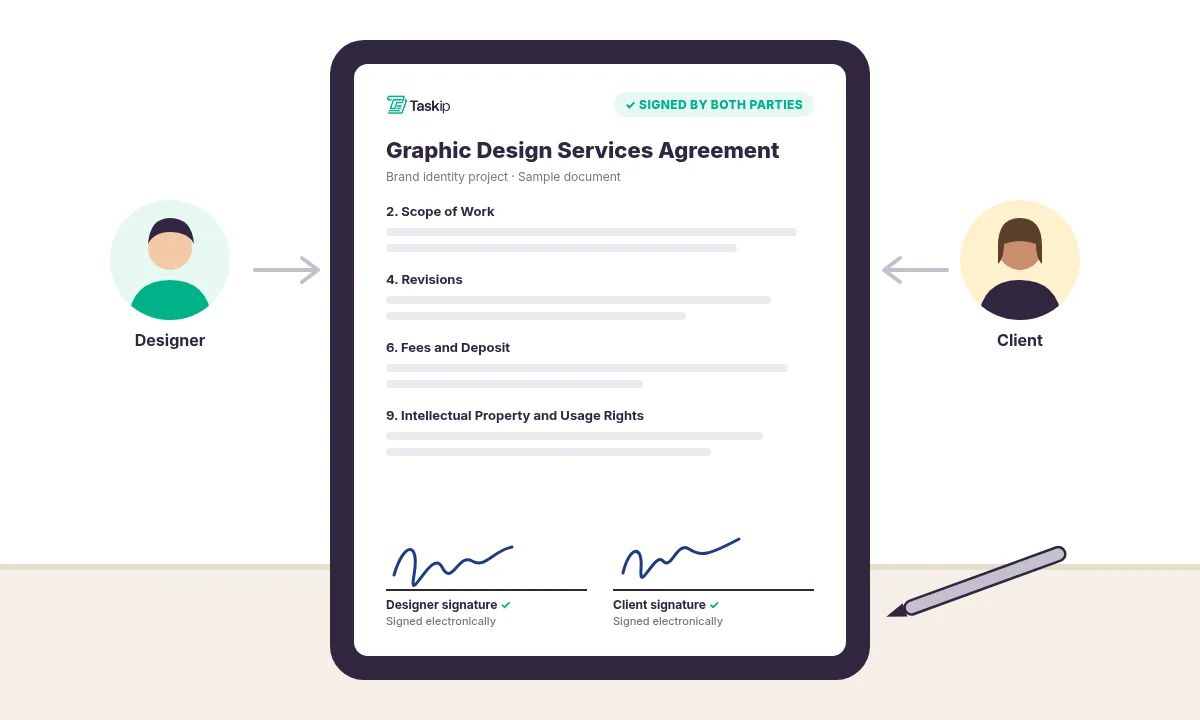
GRAPHIC DESIGN SERVICES AGREEMENT
This Graphic Design Services Agreement (“Agreement”) is made on [Date] between [Designer or Studio Legal Name], of [Address] (“Designer”), and [Client Legal Name], of [Address] (“Client”).
1. Project: The Client engages the Designer to provide graphic design services for [short project description] (“Project”).
2. Scope of Work: The Designer will provide the following services: [list services, e.g. discovery session, research, concept development, design refinement, final file preparation]. The following are not included unless agreed in writing: [e.g. copywriting, photography, printing, website development]. Any work outside this scope will be quoted separately through a written change request.
3. Deliverables: The Designer will deliver: [list each deliverable, format and specification, e.g. “Primary logo, secondary logo and icon in full color, one color and reversed, supplied as AI, EPS, SVG, PDF and PNG”].
4. Revisions: The fee includes [number] initial concepts and [number] rounds of revisions on the selected concept. A round of revisions means one consolidated set of feedback from the Client. Additional revisions will be billed at [rate per hour or per round].
5. Timeline: The Designer will deliver initial concepts by [date], revisions within [number] business days of receiving feedback, and final files by [date]. If the Client takes longer than [number] business days to provide feedback, approvals or materials, deadlines will move by the same period. If the Project is paused by the Client for more than [number] days, the Designer may invoice for work completed and reschedule the remaining work.
6. Fees: The total fee for the Project is [amount and currency, e.g. $4,500 USD / £3,500 GBP], [plus applicable VAT or sales tax / inclusive of tax]. Third-party costs such as fonts, stock images and printing are not included and will be billed [at cost / at cost plus X%] with the Client’s prior approval.
7. Deposit and Payment Terms: The Client will pay a non-refundable deposit of [percentage or amount] on signing this Agreement. Work begins once the deposit is received. The remaining balance is payable as follows: [e.g. X% on concept approval, X% on delivery of final files]. Invoices are due within [number] days of the invoice date. Late payments will incur [late fee or interest rate, as permitted by law]. The Designer may pause work while any invoice is overdue.
8. Cancellation and Kill Fee: If the Client cancels the Project, the Client will pay: [deposit only] if cancelled before initial concepts are presented; [percentage]% of the total fee if cancelled after concepts are presented; and 100% of the total fee if cancelled after final files are prepared. Upon payment of the kill fee, the Client receives [no rights / a license to use] the work completed to date, as stated in Section 9.
9. Intellectual Property and Usage Rights: Upon receipt of full payment of all fees and expenses, the Designer assigns to the Client all copyright in the final approved deliverables [OR: grants the Client a [exclusive/non-exclusive], [worldwide] license to use the final deliverables for [permitted uses] for [duration]]. Until full payment is received, all rights remain with the Designer. Preliminary concepts, sketches and unused designs remain the property of the Designer. Editable source files are [included / available for an additional fee of [amount]]. Third-party materials such as fonts and stock images are licensed under their own terms.
10. Portfolio Rights: The Designer may display the final work in their portfolio, website, social media, presentations and award submissions once the work has been made public by the Client [or after [date]]. The Designer will not disclose confidential information when doing so.
11. Client Responsibilities: The Client will provide all content, brand assets and feedback needed for the Project in a timely manner, and confirms that it owns or has permission to use any materials it supplies. The Client is responsible for final proofreading and for any trademark or legal clearance of the deliverables, unless otherwise agreed in writing.
12. Confidentiality: Each party will keep confidential any non-public information received from the other party in connection with the Project and will use it only for the purposes of this Agreement.
13. Warranties and Limitation of Liability: The Designer confirms that the final deliverables are original work, except for materials supplied by the Client or licensed from third parties. The Designer’s total liability under this Agreement will not exceed the total fees paid by the Client under this Agreement.
14. Termination: Either party may terminate this Agreement with [number] days’ written notice. If the Client terminates, Section 8 applies. If either party materially breaches this Agreement and does not fix the breach within [number] days of written notice, the other party may terminate immediately. On termination, the Client will pay for all work completed and expenses incurred to the termination date.
15. Independent Contractor: The Designer is an independent contractor and not an employee of the Client. The Designer is responsible for their own taxes and insurance.
16. Governing Law and Disputes: This Agreement is governed by the laws of [State / Country, e.g. the State of California / England and Wales]. The parties will first try to resolve any dispute in good faith, then through mediation, before starting court proceedings in [jurisdiction].
17. Entire Agreement. This Agreement, together with any attached proposal or quote, is the entire agreement between the parties. Changes must be made in writing and signed by both parties.
Signed:
Designer: [Name], [Title] | Signature: ____________ | Date: ________
Client: [Name], [Title] | Signature: ____________ | Date: ________
Tips for Using Your Graphic Design Contract Template
- Send it with your proposal: Clients sign faster when the contract arrives while they’re still excited about the project.
- Use a master agreement for repeat clients: A smart contract strategy is to sign one master agreement, then send a short scope document for each new project.
- Write the scope in the client’s language: “Logo in three formats” is clearer than “brand mark asset suite.”
- Never start before the deposit lands: This one habit fixes most late-payment problems.
- Review the template every year: Update your rates, payment terms and legal references every January so your 2026 contract stays current.
Ready-Made Templates for Specific Design Projects
If your project is more specific, start from a graphic design contract template built for that type of work:
- Print design services agreement template for brochures, catalogs and print collateral.
- Packaging design agreement template for labels, boxes and product packaging.
- Brand identity and graphic design SOW to define scope and deliverables for branding work.
- General freelance contract template for other client work.
Tools to Send, Sign and Track Your Graphic Design Contract Template
A contract only protects you if it gets signed before work begins. The right tools turn your graphic design contract template into a signed agreement in minutes. Instead of emailing PDFs back and forth, send it from the same place you manage the project.
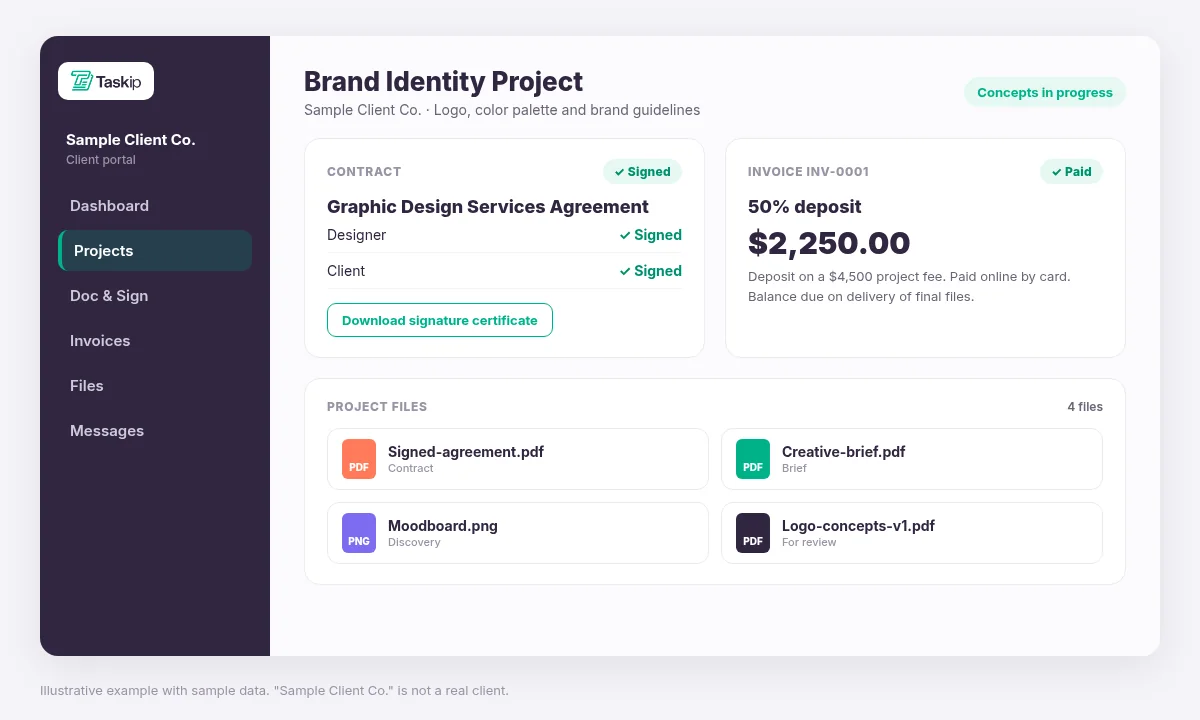
With Taskip, you can turn this template into a reusable document, send it with your proposal, collect an e-signature, take the deposit online and keep the signed copy in the client’s portal next to the files and invoices. See how it works in the client portal for design agencies, or start free with Taskip.
Final Thoughts
A graphic design contract template does not need to be long, but it does need to be specific. Spell out the scope and what is excluded, cap the revision rounds, take a deposit, agree a kill fee and make the transfer of rights depend on full payment. Do those five things and your contract will protect you on almost every project in 2026.
Use the free template above as your starting point, adapt it to each project, and have it reviewed for your location. When you are ready to send it with your proposal, collect an e-signature and take the deposit in one flow, start free with Taskip or compare plans.
FAQs on Graphic Design Contracts
What should a graphic design contract include?
The scope of work and exclusions, deliverables, revision rounds, timeline, fees and deposit, payment terms, a kill fee, intellectual property and usage rights, portfolio rights, client responsibilities, confidentiality, termination, liability and governing law.
Do I need a contract for small design jobs?
Yes, though it can be short. Even a one-page agreement or a signed quote that covers scope, revisions, payment and rights prevents most disputes. For repeat clients, a master agreement with a short scope document per project saves time.
Who owns the copyright in a design if there’s no contract?
In general, the freelance designer who created it. In both the US and the UK, copyright transfers need to be in writing and signed. Without that, the client may only have an implied right to use the work, which can cause problems later, for example when registering a trademark.
What is a kill fee in a design contract?
A kill fee is the amount the client pays if they cancel the project before completion. It compensates you for the time reserved and the work done, and is usually scaled to the stage the project reached.
Should I transfer copyright or grant a license?
For logos and brand identities, clients usually need full ownership, so an assignment on full payment is common. For illustration, photography or templates you might reuse, a license for specific uses lets you keep ownership and sometimes charge more for wider use.
Can I use this graphic design contract template for clients in other countries?
You can use it as a starting point, but set the governing law clause carefully and check local rules on tax, late payment and rights transfers. For clients in Germany, the Netherlands or elsewhere in the EU, get local advice before relying on it.
How much does a graphic design contract template cost?
The template in this guide is free. Paid templates and lawyer reviews vary in price. Many designers use a free template and pay once for a local legal review, then reuse it.
What is the best graphic design contract template?
The best one is specific to your work and has been reviewed for your location. It should cover scope, revisions, deposit, kill fee and IP rights at a minimum.
Can I find a graphic design contract template near me?
You don’t need a local template, because the clauses are the same almost everywhere. What you need locally is a review. Search for a contract or small business lawyer near you to check the governing law, tax and late payment terms.
Is this graphic design contract template good for beginners?
Yes. It’s written in plain English and every clause is explained above. Fill in the brackets, keep every clause and have it reviewed before your first project.
Do agencies need a different graphic design contract template?
The core clauses are the same. Agencies should add subcontractor terms, name the agency as the contracting party and define who can approve work on the client side.