
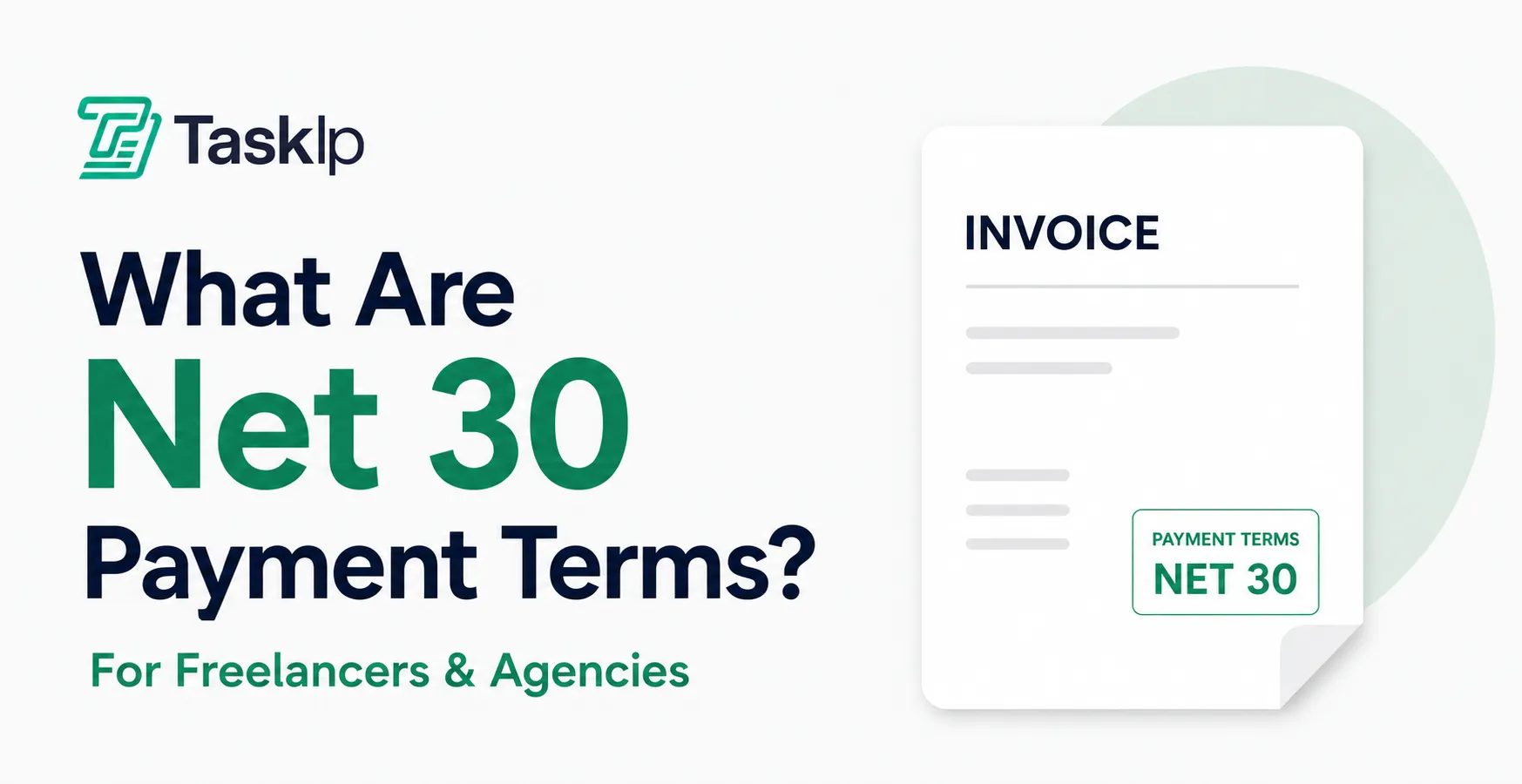
Net 30 payment terms mean the full invoice amount is due within 30 calendar days of the invoice date. It’s one of the most common payment terms used between businesses (B2B), and it gives the client time to pay while giving the freelancer or agency issuing the invoice a predictable, agreed-upon payment window.
If you invoice clients for freelance or agency work, understanding net 30 matters for two reasons. First, larger clients often expect it as a standard part of doing business, so refusing to offer it can cost you contracts. Second, offering it without a plan can quietly wreck your cash flow, since you’re doing the work now but not getting paid for up to a month. This guide walks through what net 30 actually means, how to calculate the due date, how it compares to other terms, and how to offer it without putting your business at risk.
- Net 30 means the full invoice amount is due 30 calendar days after the invoice date, not the delivery date.
- It’s one of the most common B2B payment terms, alongside net 15, net 60, and net 90.
- The main benefit is client trust and competitiveness for larger contracts. The main risk is cash flow strain, especially for solo freelancers.
- 2/10 net 30 is a variation that offers a 2% discount if the client pays within 10 days instead of 30.
- You can reduce the risk of net 30 by vetting clients, stating terms clearly, and using invoicing software that tracks due dates automatically.
Table of Contents
What Are Net 30 Payment Terms?
“Net” refers to the full amount owed, with no discount applied. “30” refers to 30 calendar days, not business days, counted from the invoice date. So net 30 simply means: the client owes the full invoice total, and it’s due 30 calendar days after the invoice was issued.
A common point of confusion is whether the 30-day clock starts on the invoice date or the date the client receives the work or goods. Standard practice is that it starts on the invoice date, not the delivery date, though this should always be stated explicitly on the invoice or in the contract to avoid disputes.
For example: if you send an invoice dated August 1, the payment is due by August 31 under net 30 terms.
How To Calculate a Net 30 Due Date?
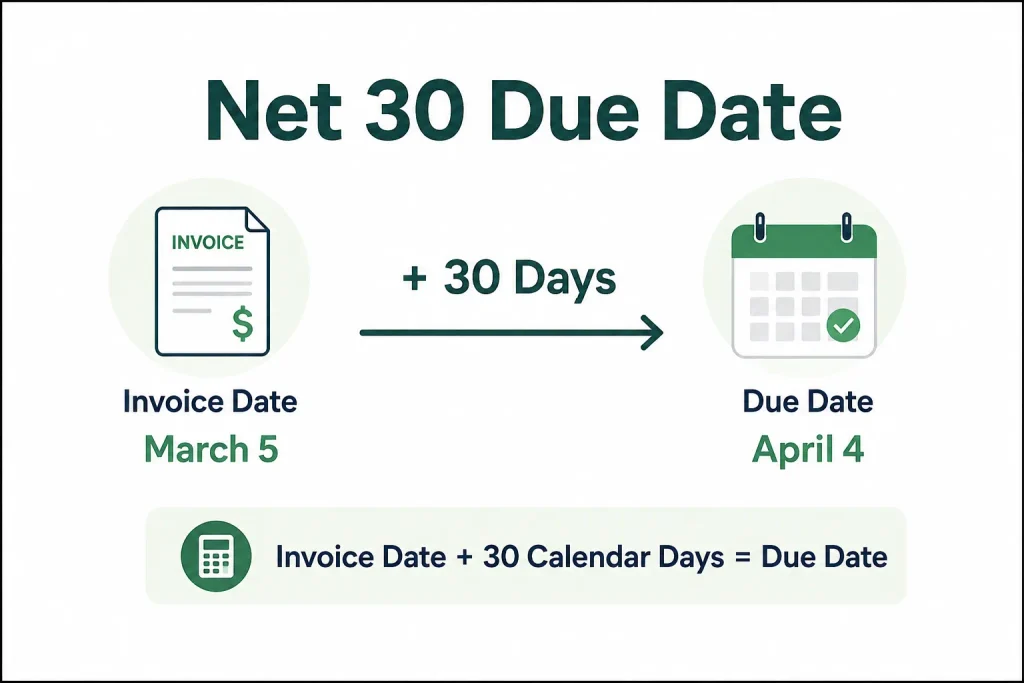
The formula is simple: invoice date plus 30 calendar days equals the due date.
So if you issue an invoice on March 5, the due date is April 4. If you issue one on November 20, the due date is December 20.
One edge case worth planning for: if the calculated due date lands on a weekend or a bank holiday, most businesses treat the due date as the next business day, but this isn’t universal. If it matters for your business, state your policy on the invoice itself so there’s no ambiguity.
Net 30 vs. Other Payment Terms
Net 30 is just one option on a spectrum of payment terms. Here’s how the common ones compare.
| Term | Due Date | Typical Use |
|---|---|---|
| Due on receipt | Immediately | Small jobs, new clients, one-off projects |
| Net 15 | 15 days | Fast-turnaround freelance work |
| Net 30 | 30 days | Standard B2B and agency terms |
| Net 60 | 60 days | Larger enterprise clients |
| Net 90 | 90 days | Government contracts, large procurement |
| 2/10 Net 30 | 30 days (2% discount if paid within 10) | Incentivizing early payment |
2/10 net 30 deserves a closer look since it’s often misunderstood. It means the client can take a 2% discount if they pay within 10 days, or pay the full amount by day 30. So on a $5,000 invoice, a client paying within 10 days would pay $4,900. Pay after day 10 (but before day 30), and the full $5,000 is due.
Net 30 vs. Net 60: What’s the Difference?
The difference between net 30 and net 60 is simply the length of the payment window: net 60 gives the client an extra 30 days beyond net 30. Net 60 is more common with larger enterprise clients and government-adjacent contracts, and it can meaningfully slow down cash flow for a freelancer or small agency that isn’t prepared for the longer wait.
What Are the Pros and Cons of Net 30 Payment Terms?
Offering net 30 is ultimately a tradeoff between client relationships and cash flow.
On the plus side, net 30 builds trust with clients and is often a baseline expectation for landing larger contracts, especially with agencies, enterprise clients, and procurement departments that have standardized payment policies. Refusing to offer any net terms at all can make a freelancer or small agency look less established, which can cost you deals before negotiations even start.
On the downside, net 30 creates a real cash flow gap. You’re completing work now but not getting paid for up to 30 days, and if a client pays late (which happens often), that gap stretches further. For solo freelancers and small teams without much of a cash buffer, this is the single biggest risk of offering net terms.
| Pros | Cons |
|---|---|
| Builds trust with clients and signals an established business | Creates a real cash flow gap of up to 30 days between finishing the work and getting paid |
| Often a baseline expectation for landing larger contracts with agencies, enterprise clients, and procurement departments | Late payments are common, and each one stretches that gap even further |
| Refusing to offer any net terms can cost you deals before negotiations even start | The biggest risk for solo freelancers and small teams without much of a cash buffer |
Is Net 30 Payment Terms Negotiable?
Yes, payment terms are negotiable. A client requesting net 30 doesn’t mean you have to accept it as-is. Freelancers and agencies can propose shorter terms (like net 15), request a deposit upfront, or set milestone payments for larger projects instead of one lump sum at the end.
Negotiating is especially worth doing with new clients or unusually large invoices, where the risk of a late or missed payment is higher. A simple compromise many freelancers use is: net 30 for repeat clients with a solid payment history, and a deposit plus shorter terms for anyone new.
How Do Net 30 Payment Terms Affect Cash Flow?
Net 30 terms mean revenue is earned but not collected for up to 30 days, which creates a gap between when you pay your own expenses and when money actually comes in. For a large company with cash reserves, this gap is manageable. For a solo freelancer or a small agency running close to the margin, it can mean scrambling to cover rent, contractor payments, or software subscriptions while waiting on an invoice that’s still technically “on time.”
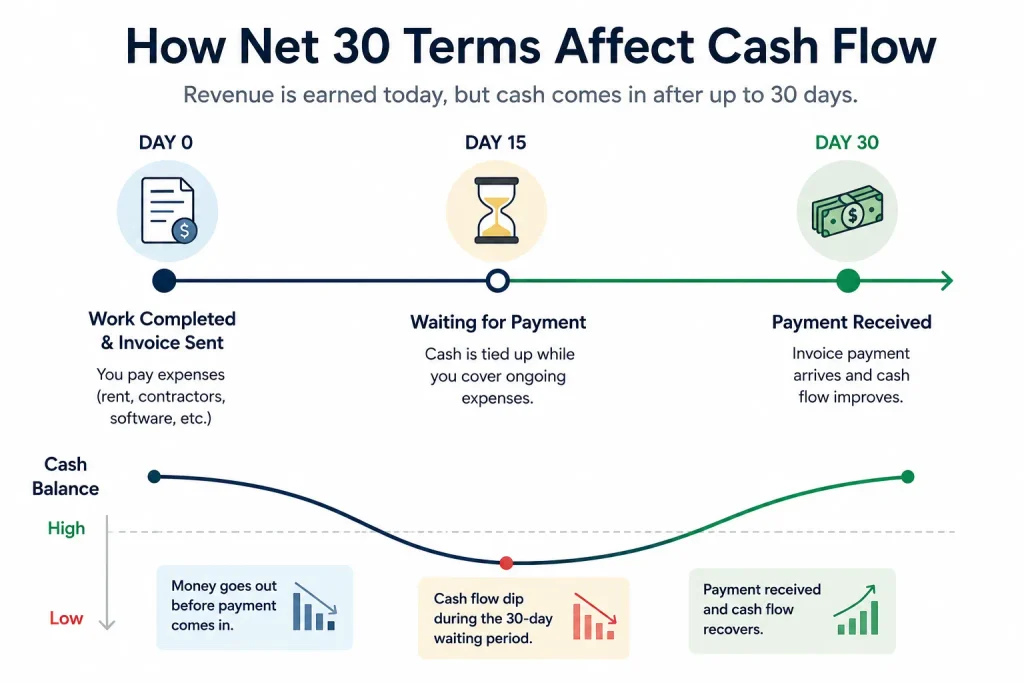
This is the core reason net 30 needs a system behind it rather than just a line on an invoice. Knowing exactly what’s owed, by whom, and when it’s due (without manually checking a spreadsheet) is what turns net 30 from a cash flow risk into a manageable part of doing business.
Who Typically Uses Net 30 Terms?
Net 30 is most common in B2B relationships: agencies working with larger clients, wholesalers and suppliers, freelancers working with established businesses, and vendors dealing with enterprise or government clients. It’s rare in B2C transactions, where payment is typically expected immediately at the point of sale.
What Is a Net 30 Vendor Account?
A net 30 vendor account is a business credit arrangement where a supplier lets a company purchase goods or services now and pay the balance within 30 days. Making on-time payments on a net 30 vendor account can help a business build its credit history, similar to how on-time payments build personal credit. This is a distinct topic from invoicing clients as a freelancer or agency, since it’s about a business receiving credit from a vendor rather than extending it to a client.
How to Offer Net 30 Payment Terms Safely?: Step-by-Step
If you’re going to offer net 30, a few practical steps significantly reduce the risk:
1. Vet New Clients Before Extending Terms
Ask for references, check reviews, or start with a smaller first project before offering full net 30 on a large one. This single step filters out most clients who are unlikely to pay on time, before you’ve invested real hours in the work.
2. State the Terms Clearly on Every Invoice and in the Contract
“Net 30” should appear explicitly on the invoice, along with the exact due date, not just the term itself. Stating it in the contract or SOW as well removes any ambiguity if a payment dispute comes up later.
3. Set a Late Fee Policy Upfront
Decide your late fee (commonly 1% to 1.5% per month on the overdue balance) and state it on the invoice before work begins, not after a payment is already late. A late fee disclosed in advance is far easier to enforce than one added after the fact.
4. Consider a Deposit for New or Large Clients
A 25% to 50% deposit upfront reduces your exposure if a client doesn’t pay the remaining balance on time. It also filters out clients who aren’t serious about the engagement before you’ve done the work.
5. Use Invoicing Software That Tracks Due Dates Automatically
Manually tracking who owes what and when across multiple clients is where net 30 terms tend to fall apart. Taskip’s invoicing tools track due dates automatically and send payment reminders, so nothing slips through unless the client actually misses the deadline, and the Taskip client portal gives clients a clear view of what they owe and when, which cuts down on the “I didn’t realize it was due” emails.
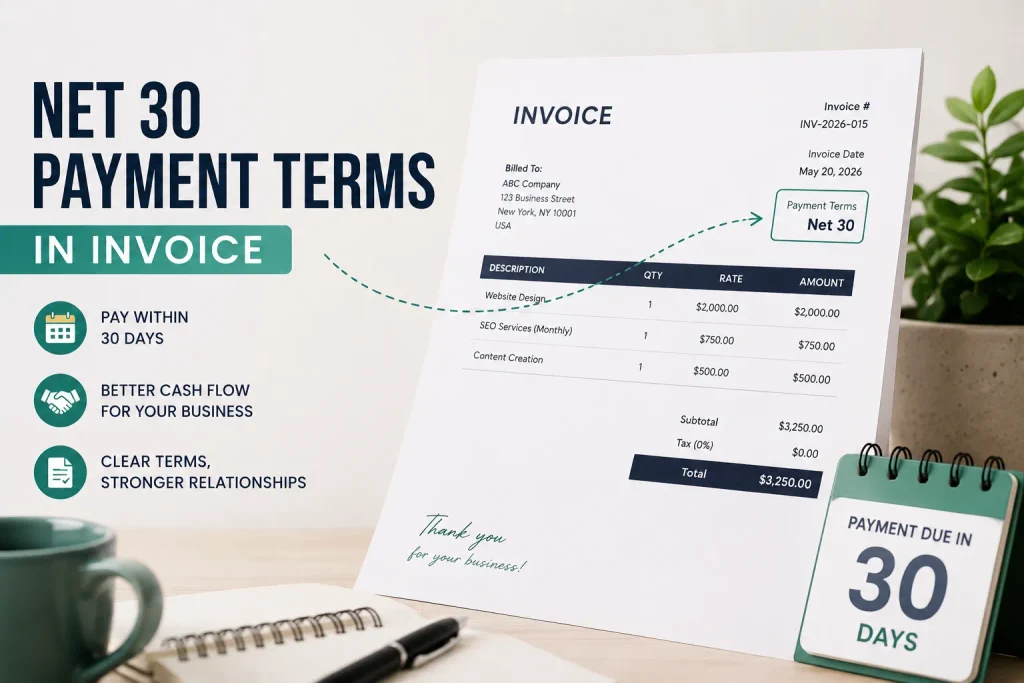
What Does a Net 30 Invoice Look Like?
A net 30 invoice needs a few specific elements to avoid confusion or disputes:
- The invoice date
- The calculated due date (not just the words “net 30”)
- The payment terms stated explicitly (“Net 30” or “Due within 30 days of invoice date”)
- Any late fee policy, stated in advance
- Clear line items and total amount due
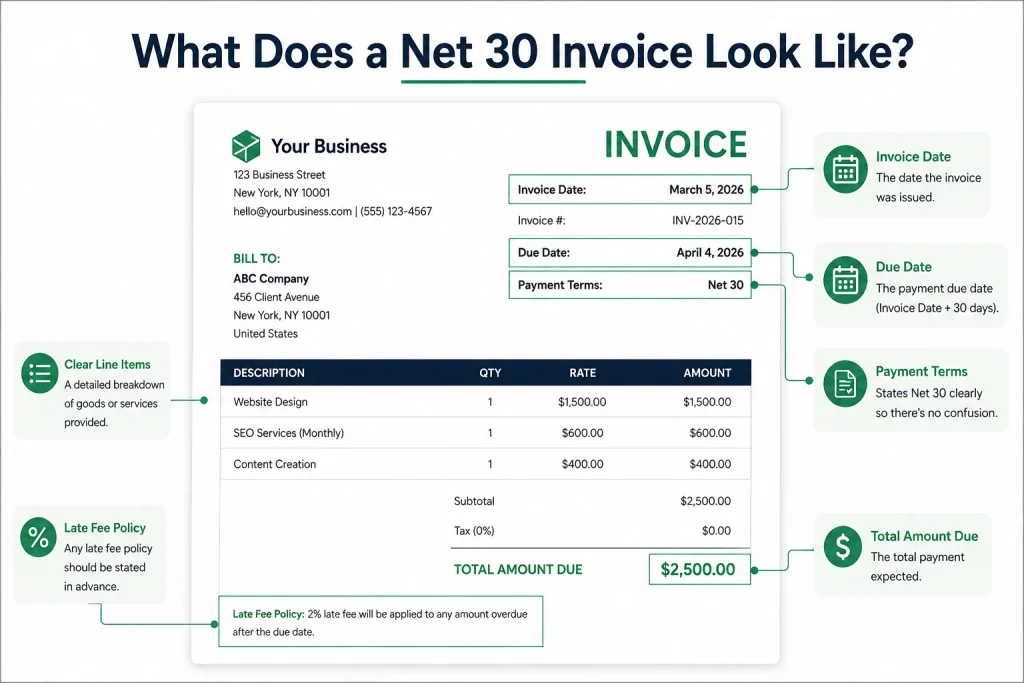
Showing the due date explicitly, rather than making the client calculate it themselves, removes one of the most common sources of late payments: the client genuinely not knowing when the money is due.
What Happens If a Client Pays Late on Net 30 Terms?
Most businesses build in a short grace period before taking action on a late net 30 payment, followed by a reminder, then a formal late notice if the invoice remains unpaid. A late fee (commonly 1% to 1.5% per month on the outstanding balance) typically applies once the invoice passes its due date, if that policy was disclosed in advance. Late fee limits vary by state and by contract terms, so it’s worth checking your local requirements before setting a rate (see this guide to charging late fees and interest on unpaid invoices for a broader overview).
For a client who pays late occasionally, a polite reminder is usually enough. For a client who pays late repeatedly, it’s worth reconsidering whether to keep offering net 30 terms at all, and in more serious cases, considering a collections agency or invoice factoring for the outstanding balance.
Final Thoughts
Net 30 payment terms are simple in concept (30 days to pay the full invoice), but they carry real risk if you offer them without a plan. Vetting clients, stating terms clearly, and tracking due dates automatically are what separate net 30 as a useful business tool from net 30 as a cash flow problem.
If you’re offering net 30 terms to clients, Taskip’s invoicing and client portal tools can handle the tracking and reminders for you, so you can focus on the work instead of chasing payments.
Frequently Asked Questions
What does net 30 mean on an invoice?
Net 30 on an invoice means the full amount is due within 30 calendar days of the invoice date, with no discount applied.
Is net 30 calculated from the invoice date or the delivery date?
Net 30 is standardly calculated from the invoice date, not the delivery date, though this should be stated clearly on the invoice to avoid confusion.
What’s the difference between net 30 and 2/10 net 30?
Net 30 means the full amount is due in 30 days with no discount. 2/10 net 30 offers a 2% discount if the client pays within 10 days, with the full amount due by day 30 if they don’t.
Can I charge a late fee on a net 30 invoice?
Yes, as long as the late fee policy is disclosed on the invoice or in the contract before the work begins. Common late fees range from 1% to 1.5% per month, though limits vary by state.
Is net 30 a good idea for freelancers?
It depends on the freelancer’s cash flow buffer and the client’s payment history. Net 30 can help win larger clients, but it works best when paired with client vetting, clear terms, and automated payment tracking.
How do you write net 30 on an invoice?
Write “Net 30” clearly in the payment terms field, and include the exact due date next to it (not just the term itself), so the client doesn’t have to calculate it themselves.
What does 2% 10 net 30 mean on an invoice?
2% 10 net 30 (also written 2/10 net 30) means the client gets a 2% discount if they pay within 10 days of the invoice date, or they can pay the full amount within 30 days with no discount.
Is net 30 or net 45 better?
Neither is better in every case. Net 30 gets you paid faster and is the more common standard, while net 45 gives the client more flexibility, which can help win larger or slower-paying enterprise clients at the cost of a longer wait for payment.
Is net 30 counted from the invoice date or the due date?
Net 30 is counted from the invoice date. The due date isn’t a separate starting point; it’s simply the result of adding 30 calendar days to the invoice date.
Does net 30 only include business days?
No, net 30 payment terms is calculated in calendar days, not business days, so weekends and holidays count toward the 30. A due date can land on a Saturday or a holiday, which is why it’s worth stating on the invoice whether payment is expected to shift to the next business day in that case, since practice varies and it isn’t automatically assumed.
What are net 20 payment terms?
Net 20 means the full invoice amount is due within 20 calendar days of the invoice date, the same structure as net 30 or net 15, just a shorter window. It’s less common than net 15 or net 30, and tends to show up as a middle-ground option when a business wants to give the client more breathing room than net 15 but still get paid faster than a full net 30.