How to Build a Digital Marketing Team
Want better marketing results without the hassle of freelancers or agency involvement? Building a dedicated digital marketing team can solve this problem. It delivers focus, speed, brand consistency, and real growth. In this blog, we’ll explain exactly how to structure it, who to hire, what it actually costs, and the tools that make it work in 2026 and beyond. Keep reading.
Why Build a Dedicated Digital Marketing Team?
A dedicated digital marketing team brings consistency and focus to a company’s marketing efforts. Unlike freelancers or outsourced agencies who handle multiple clients at once, an in-house team works only for one brand. This focus translates into a more aligned strategy, quicker decision-making, and the ability to react faster to market trends or changing algorithms. They know the brand inside out, its strengths, weaknesses, and customer expectations—allowing them to create campaigns that truly connect with the intended audience.
Moreover, building a digital marketing team fosters long-term growth and data-driven improvement. The team continuously tests, refines, and evolves strategies based on performance data and feedback. This ongoing cycle helps the company not just attract attention but also build trust, loyalty, and measurable business results. In-house professionals can experiment with platforms like SEO, paid ads, influencer marketing, and email automation without the constant need for third-party approval or coordination delays.
Another major benefit lies in cross-department collaboration. A digital marketing team can easily share insights with sales, product development, and customer service departments. This creates a unified customer experience and ensures that every marketing effort supports the overall business direction.
Key Roles and Responsibilities in a Digital Marketing Team
Every role in a digital marketing team contributes to a larger story, one that combines the result with a powerful, unified digital presence that resonates with audiences and delivers results.
1. Digital Marketing Manager
The digital marketing team manager acts as the strategist and coordinator of the entire team. They oversee campaigns from planning to performance review, ensuring every activity aligns with the company’s goals. They often analyze market trends, manage budgets, and collaborate with other departments to maintain brand consistency. In essence, they serve as the bridge between creative ideas and business objectives.
2. Content Creator or Copywriter
Content creators are the storytellers. They craft engaging blog posts, videos, social media updates, and website copy that speak directly to the target audience. Their work focuses on making content not only interesting but also useful and optimized for search engines. A good content creator knows how to balance creativity with strategy ensuring every piece contributes to the brand’s voice and message.
3. SEO Specialist
The SEO specialist’s job revolves around visibility. They analyze keywords, optimize website structure, and improve content performance to help the brand rank higher on search engines. Their role involves staying updated with algorithms, identifying technical issues, and collaborating with writers and developers to implement best practices. Essentially, they make sure the brand can be found by the right people at the right time.
4. Social Media Manager
The social media manager lives and breathes engagement. They plan, post, and monitor content across platforms like Instagram, LinkedIn, and TikTok. Beyond posting, they track analytics, respond to audience interactions, and run paid campaigns to boost reach. Their mission is to build meaningful relationships with online communities while maintaining a consistent brand tone and personality.
5. Graphic Designer and Multimedia Specialist
Visuals are the heart of digital storytelling, and this is where designers step in. They create eye-catching graphics, videos, animations, and layouts for online channels. Whether it’s a banner ad or an infographic, these professionals ensure the visual style aligns with the brand identity. Their creativity brings marketing ideas to life and keeps audiences visually engaged.
6. Paid Advertising Specialist (PPC Expert)
A PPC (Pay-Per-Click) or paid advertising specialist focuses on generating traffic and leads through targeted campaigns on platforms like Google Ads or Meta Ads. They analyze data, design ad strategies, manage budgets, and continuously test variations to improve return on investment. Their analytical mindset helps determine which campaigns are worth scaling and which need reworking.
7. Data Analyst or Marketing Analyst
Data analysts turn numbers into insights. They collect performance data from different campaigns, interpret patterns, and create reports that guide better decision-making. Their expertise helps the team understand what’s working, what’s not, and how customers behave online. In a data-driven field like digital marketing, their work is critical to continuous improvement.
8. Email Marketing Specialist
This role focuses on building and nurturing relationships through email. Email marketing specialists design newsletters, run automated campaigns, and track engagement metrics. They understand how to segment audiences and personalize content to increase open and conversion rates. Their goal is to keep customers informed, loyal, and connected to the brand.
Digital Marketing Team Structures
The ideal setup should align with the company’s size, industry, and long-term goals. Below is an in-depth look at how different organizations can structure their teams effectively.
By Company Size
Startups and Small Businesses
For startups, agility is everything. These businesses often operate with tight budgets and high ambitions, which makes a lean, hybrid model the most practical choice. Typically, a small digital marketing team of three to five people covers multiple roles—think one person handling both social media and content creation, another juggling paid ads and analytics, and a third coordinating partnerships or SEO.
To stretch their capabilities without inflating payroll, startups frequently rely on fractional experts—freelancers or part-time specialists—who bring advanced skills at a fraction of the cost. This flexible structure keeps overhead low while allowing the business to scale quickly as opportunities arise.
Growth-Stage Companies
Once a business moves beyond the startup phase, its marketing needs become more specialized. Growth-stage companies generally expand to eight to twelve team members, each focusing on key areas such as content marketing, acquisition strategies, or customer retention.
At this point, cross-functional collaboration becomes essential. Teams often work together across product development, design, and sales to ensure campaigns are aligned with broader business goals. The emphasis shifts from simply getting noticed to optimizing every stage of the customer journey.
Enterprises
In large organizations, marketing becomes a complex ecosystem of roles and departments. With 20 or more positions, enterprise-level teams often include regional and departmental managers, data analysts, automation specialists, and AI strategists.

The focus is on consistency, scalability, and efficiency across global operations. Advanced technologies especially AI-driven tools—play a significant role in personalizing customer experiences and managing multichannel campaigns at scale. At this level, structure and strategic governance matter as much as creativity and communication.
By Industry
E-commerce
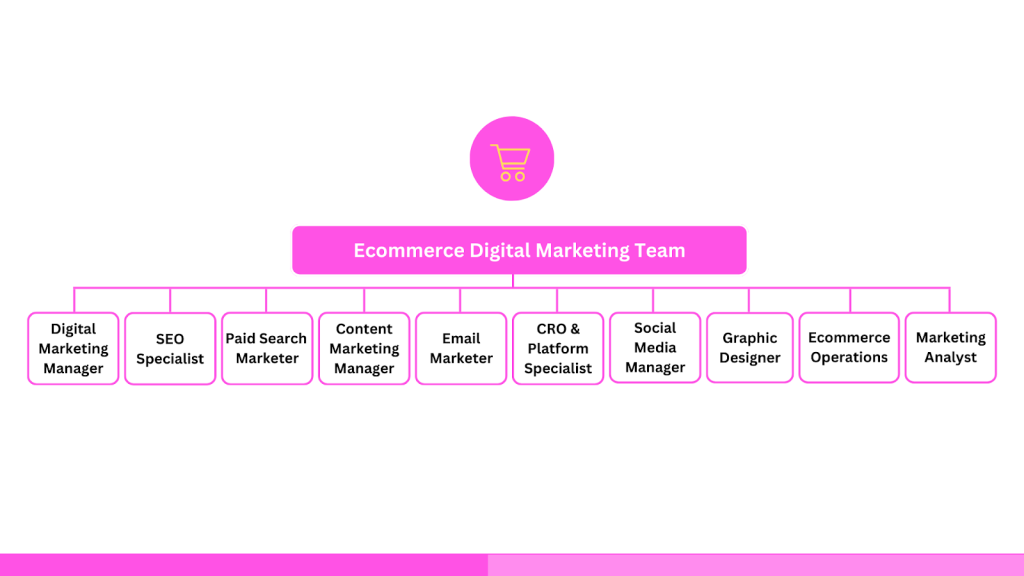
E-commerce marketing teams live and breathe numbers. Their goal is performance, so their structure leans heavily on PPC (pay-per-click) experts, conversion rate optimization (CRO) specialists, and analytics-driven campaign managers. Every team member contributes to one main objective: turning clicks into sales. Real-time testing and data-driven decision-making guide their daily work.
B2B (Business-to-Business)
In B2B settings, marketing is less about instant conversions and more about building long-term relationships. Teams here focus on lead nurturing, thought leadership, and account-based marketing. Product marketers, content strategists, and CRM managers work together to move potential clients through longer sales cycles. The emphasis lies on trust, credibility, and personalized communication.
Agencies
Marketing agencies operate like multi-skilled SWAT teams. They are client-facing, adaptable, and strategically diversified. Account managers handle communication and strategy alignment, while writers, designers, SEO experts, and paid media specialists execute the work. The beauty of agency structures lies in flexibility—they can scale and pivot quickly based on project scope or client demand.
Local Businesses
For local companies, community relationships and visibility are the lifeblood of success. Their ideal marketing structure centers around a strong social media presence, local SEO, reputation management, and engagement with nearby audiences. Team members often wear many hats—balancing event promotions, social storytelling, and partnerships with local influencers to maintain authenticity and relevance within the community.
Based on Models
There’s no one-size-fits-all approach to how digital marketing teams are built. It mostly depends on the balance between control, cost, and flexibility:
- In-House Model: Offers deep control and cultural alignment but comes with higher costs for salaries, benefits, and tools. Great for brands that value consistency and have long-term resource commitment.
- Outsourced/Agency Model: Provides instant access to specialized expertise and broader skill sets. However, agencies may lack the same brand alignment or internal insight as in-house teams.
- Hybrid/Fractional Model: Blends the best of both worlds. By combining core in-house staff with fractional experts or agency support, businesses can remain flexible and cost-efficient. According to insights from O8, fractional setups can be two to five times cheaper than maintaining full-time equivalents—without sacrificing quality or strategic depth.
Step-by-Step Guide to Building Your Digital Marketing Team
Step 1: Define Goals and Needs
Every successful team starts with a clear sense of purpose. Before a single hire is made, leaders need to understand where the brand is and where it wants to go. The RACE framework—Reach, Act, Convert, Engage—offers an effective method to map this out.
By assessing each stage, a business can identify performance gaps and opportunities. For example, if the “Reach” stage underperforms, the team may need stronger SEO or paid media experts. If “Engage” is weak, community management and retention strategies might become a bigger priority. This structured approach doesn’t just clarify goals—it illuminates the specific capabilities a team must develop to achieve them.
Step 2: Budget and Resource Planning
Once goals are defined, practical pricing planning takes over. Budget allocation sets the boundaries for what’s possible. This means accounting not just for salaries, but also for marketing tools, software subscriptions, and training programs. A modern rule of thumb, as marketer Chris Walker often notes, is that around 10% of all employees act as marketers in some capacity—whether through direct campaigns or brand advocacy online.
This broader view of resourcing ensures that marketing becomes an organizational mindset, not just a department. Adequate financing also supports agility; teams can invest in data tools or experiments without waiting on long approval chains.
Step 3: Hiring Strategies
Hiring the right people makes or breaks a marketing operation. Tim Soulo, known for his work at Ahrefs, emphasizes hiring for expertise and mindset over polished resumes. The focus should be on adaptability, data literacy, creativity, and cultural fit. Marketing evolves rapidly—tools change, algorithms shift—so the best team members are those who learn fast and stay curious.
Platforms like MarketerHire or similar vetted marketplaces make finding specialized contractors far easier, allowing leaders to scale their teams dynamically. A diverse mix of full-timers, freelancers, and consultants provides flexibility as strategies and campaigns evolve.
Step 4: Onboarding and Training
Building a strong team doesn’t end after hiring—it begins there. Effective onboarding introduces new members not only to company policies but also to brand storytelling, customer insights, and collaborative tools. More importantly, continuous training ensures long-term performance.
As 2026 approaches, businesses are increasingly focused on AI ethics, inclusive marketing, and sustainability narratives. Regular workshops and skill updates enable teams to stay ahead of these trends, turning learning into a part of their culture rather than a once-a-year activity.
Step 5: Fostering Collaboration
Great teams thrive on communication and empathy. Collaboration tools like Slack, HubSpot, and Google Analytics streamline workflows and keep information transparent. But tools alone aren’t enough—leaders must create psychological safety where every voice matters.
Clear roles help prevent confusion, while regular team check-ins maintain alignment across projects. Encouraging empathy among departments reduces friction and helps marketing operate as a unified ecosystem rather than isolated silos. A shared sense of purpose turns individual tasks into collective progress.
Step 6: Integrating Diversity and Remote Work
In today’s workforce, innovation and inclusion go hand in hand. Diverse teams—through gender, background, and thought—generate more creative solutions and deeper audience understanding. Embracing diversity isn’t just ethical; it’s a strategic advantage.
The rise of remote and hybrid work allows brands to recruit global talent, giving them access to specialists regardless of geography. However, managing such teams requires inclusive leadership, strong communication norms, and cultural sensitivity. When done right, these dynamics produce teams that are both highly adaptive and creatively rich, ready to meet the challenges of modern marketing.
Essential Tools for Digital Marketing Team Success
Streamline workflows, boost collaboration, and deliver measurable results. These essentials go beyond basic software, forming a cohesive ecosystem that keeps everyone aligned amid fast-paced campaigns and client demands.
Project Management Powerhouses
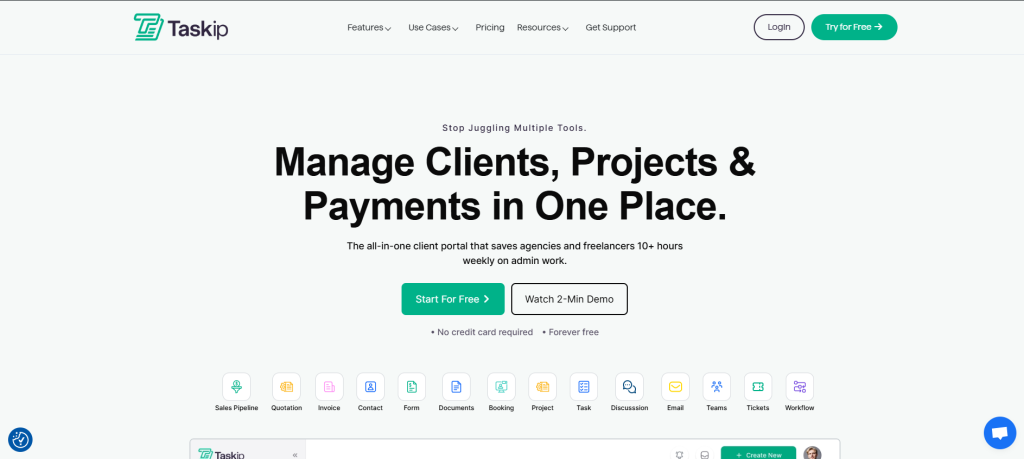
Teams need robust project management tools to juggle multiple campaigns without chaos. Platforms like Taskip offers comprehensive project management solution for digital marketing teams and agencies. The pros swear by these because they turn scattered ideas into structured sprints, imagine assigning SEO audits or ad creatives with real-time updates, so nothing falls through the cracks.
CRM and Client Portals
A solid CRM keeps client relationships front and center, tracking leads from pitch to retainer. HubSpot stands out with its free tier for contact management and email tracking, integrating seamlessly with marketing automation. For agencies craving an all-in-one solution, Taskip.net shines by combining CRM with a dedicated client portal—clients log in to view project updates, invoices, and files in one spot, cutting down on endless email threads. Taskip’s sales pipeline lets teams nurture deals effortlessly, while features like custom proposals and automated invoicing handle billing without the hassle, making it a game-changer for scaling operations affordably starting at $59 per user monthly.
Analytics and SEO Essentials

Data drives decisions, so Google Analytics 4 remains indispensable for tracking user behavior across channels. Pair it with Semrush for keyword research, site audits, and competitor insights marketers use it to spot content gaps and climb rankings. These tools reveal what’s working, like which social posts convert best, empowering teams to refine strategies on the fly.
Social Media and Email Automation
Hootsuite simplifies scheduling and monitoring across platforms, saving hours on manual posting. Mailchimp excels in email campaigns with segmentation and automation, perfect for nurturing leads into loyal customers. Together, they create a rhythm where content flows from planning to inbox without missing a beat.
Emerging Tech Boosters
AI-powered tools like those in SurferSEO optimize content for search intent automatically. Taskip.net weaves in automation for workflows, such as turning emails into tasks or tickets, freeing teams for creative work. As agencies grow, these integrations over 80 with tools like Google Ads and HubSpot—build a future-proof stack that scales effortlessly.
FAQs for How to Build a Digital Marketing Team
What is the ideal size for a digital marketing team?
The ideal size varies by company scale: for startups and small businesses (under 100 employees), 2-5 versatile generalists suffice. Mid-sized to growth-stage companies often need 8-15 members with more specialization, while enterprises may require 20+ for full departments.
How much does it cost to build a digital marketing team?
In-house digital marketing teams for 4-5 core roles can cost $450,000-$550,000 annually (including salaries, benefits, tools, and overhead). Fractional or outsourced/agency options are significantly cheaper, ranging from $60,000-$180,000 per year for equivalent expertise and scalability.
What takes are most important in 2026?
AI integration and data-driven analytics are essential for personalization, automation, and predictive insights. Creativity, storytelling, and adaptability remain crucial to blend human empathy with tech for authentic, high-engagement campaigns.
How do I enhance my digital marketing team?
Start by auditing current tools and data quality, then adopt accessible AI platforms for content, ads, and analytics. Provide team training to amplify skills, focusing on ethical use and human oversight for creative strategy.
Is there any Pros and Cons of such a digital marketing team?
Yes, pros include cost savings, access to specialized expertise, scalability, and reduced overhead without full-time hires. Cons involve less direct control, potential communication challenges, and dependency on the agency’s performance and alignment.

Get Summary On: