
When you’re working out how to structure an agency team by department, start with one idea: department structure isn’t bureaucracy, it’s what lets you see workload and assign the right person without guessing.
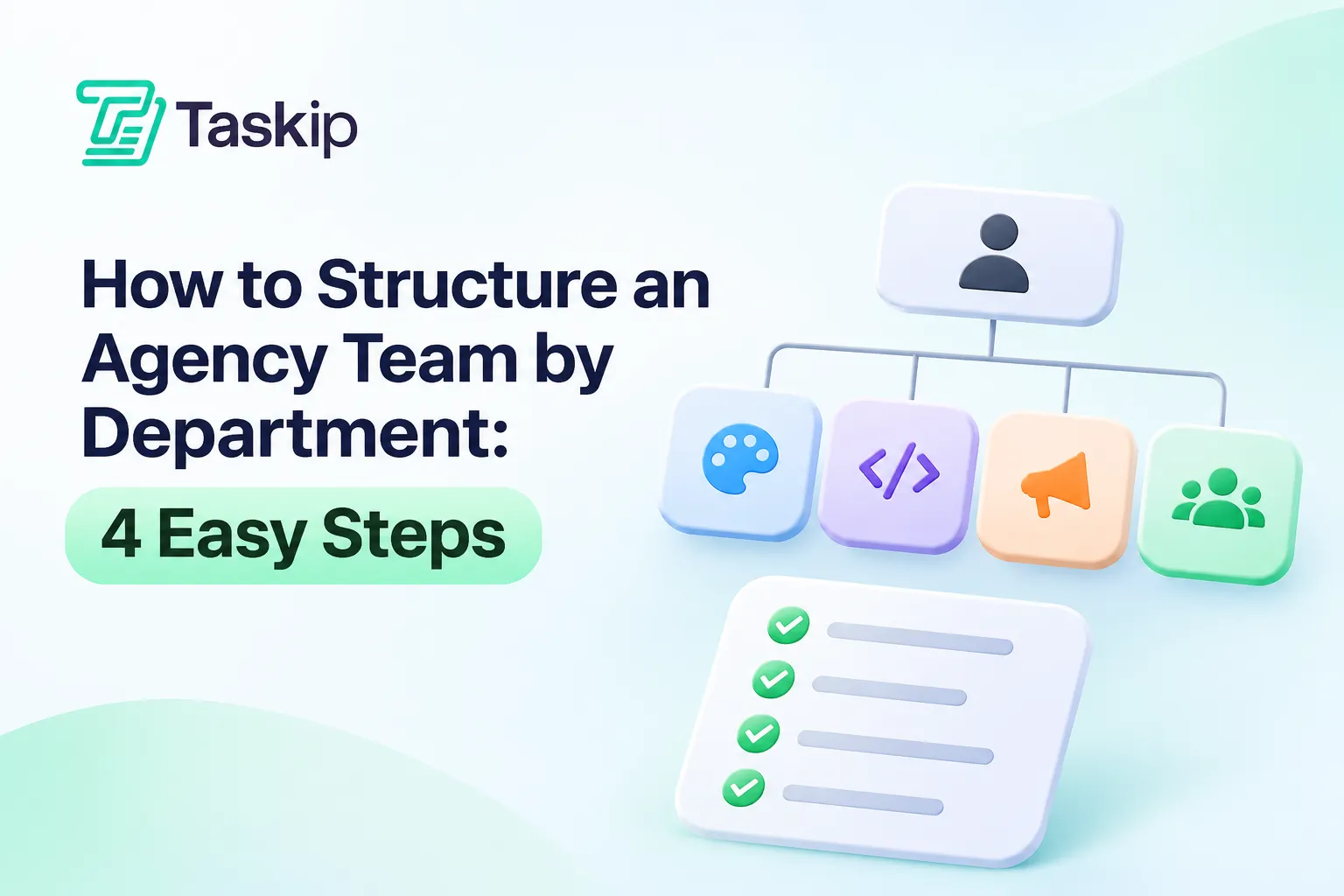
Structuring an agency team by department means grouping people by the type of work they do, such as design, development, marketing, and client success, and giving each group one lead who owns assignments and capacity.
Most small agencies start with everyone doing everything. That works at three people. At eight or ten, it turns into missed handoffs, overloaded designers, and project managers asking “who’s on this?” every morning.
This guide gives you a starter framework and org chart, examples by agency size and type, what each department owns and measures, and the signal that tells you it’s time to formalize.
Table of Contents
- Group people by the type of work they do, not by who happens to be free.
- Start with three or four departments: Design, Development, Marketing, and Client Success.
- A department can be one person. Every type of work just needs a clear owner.
- Formalize when “who’s doing this?” takes longer than doing the work itself, then add departments in stages and layer pods on top only for large accounts.
Why Does a Flat Team List Stop Working?
A flat team list stops working because it shows who works at your agency but not who owns what. Once you pass a handful of people, work goes to whoever answers first, workload becomes invisible, and clients get passed between people who each know only part of the story.
When every request goes to “the team”, three things happen:
Work Lands on Whoever Answers First
The person who replies fastest gets the task, not the person best suited to it.
Workload Stays Invisible
Nobody can see who is stretched until someone is already overloaded and a deadline slips.
Clients Get Passed Around
Clients bounce between people who each know only part of the story.
The Fix: Group People by the Work They Do
A clear agency org structure fixes this by grouping people around the type of work they do. Requests go to a department, the department lead assigns them, and you can see at a glance which group is stretched and which has room.
A flat list also leaves people unsure of their own role. Gallup research has found that only about half of employees strongly agree they know what is expected of them at work. Departments answer that question by default: you know your area, and you know who owns everything else.
What Departments Should an Agency Have?
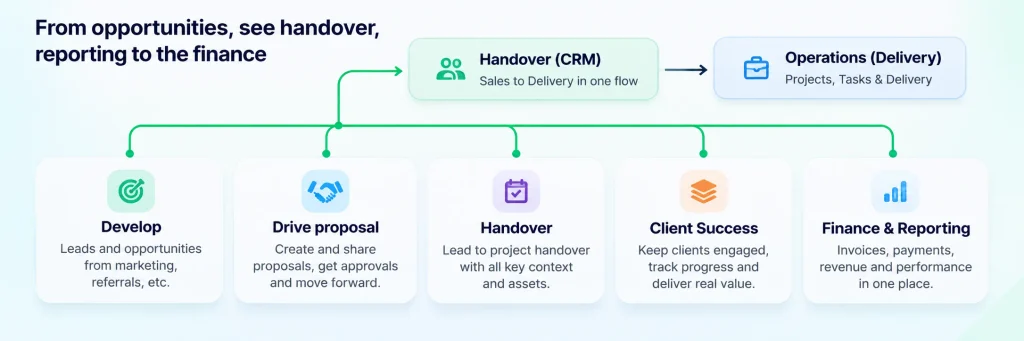
Most agencies need four departments to start: Design, Development, Marketing, and Client Success. This department structure for agencies covers nearly every type of client work, and each department has one clear job.
| Department | What it owns | Typical roles |
|---|---|---|
| Design | Branding, UI/UX, website and campaign creative | Designers, art director |
| Development | Building and maintaining websites, apps, and integrations | Developers, QA |
| Marketing | SEO, content, paid ads, and social for clients | Marketers, content writers, ad specialists |
| Client Success | Onboarding, account management, communication, and renewals | Account managers, project managers |
Each department has one lead who owns assignments and capacity. Operations sits beside the founder as a shared service until the agency is big enough to give it its own lead.
A Department Can Be One Person
If your only developer is a part-time contractor, they’re still your Development department. The point is that every type of work has a clear owner, not that every box holds a full team.
Use the Departments That Match What You Sell
If you’re figuring out how to organize a creative agency team, you might split Design into Brand and Web. A content agency might split Marketing into Content and SEO. A dev shop might run Frontend, Backend, and QA. Start with three or four and add more only when a department gets too broad for one lead to manage.
Client Success Usually Owns Onboarding
Client Success is the first department a new client works with, so it usually owns onboarding. If that process still runs on scattered emails, our guide on how to onboard new clients shows how to move it into one place.
How Should Departments Change as Your Agency Grows?
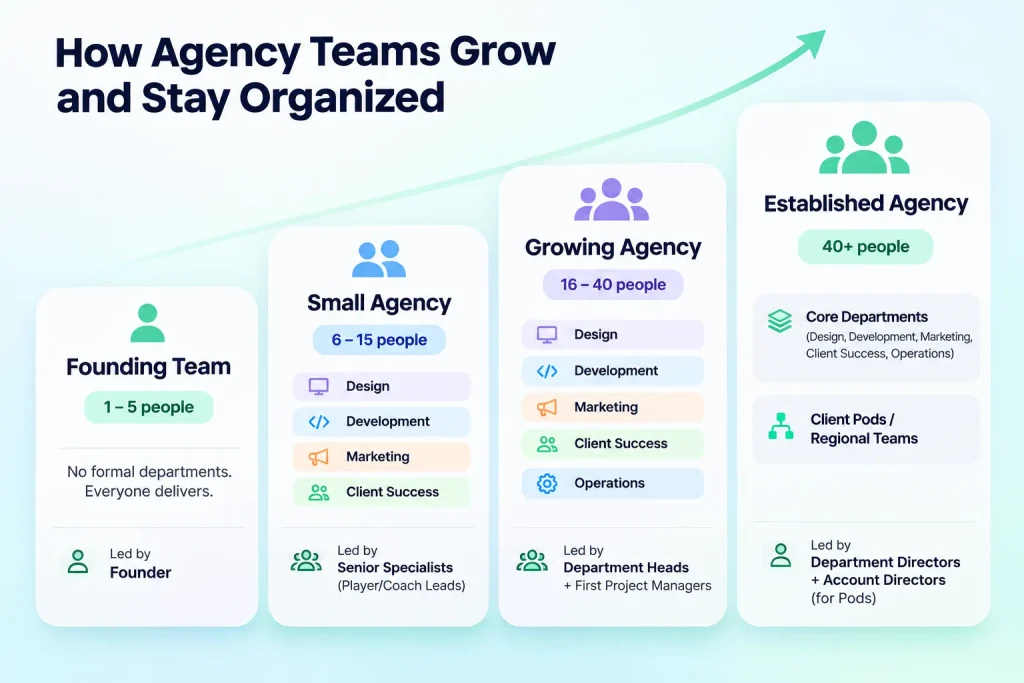
Departments should grow in stages. A founding team of 1-5 people needs no formal departments, a small agency of 6-15 needs three or four, and a growing agency of 16-40 adds department heads and an Operations team. Here’s the typical path:
| Stage | Team size | Departments | Who leads them |
|---|---|---|---|
| Founding team | 1-5 | None formal. Everyone delivers; the founder owns sales and clients | Founder |
| Small agency | 6-15 | 3-4 departments, such as Design, Development or Marketing, and Client Success | Senior specialists as player/coach leads |
| Growing agency | 16-40 | 4-6 departments, plus Operations for finance, HR, and tools | Dedicated department heads and the first project managers |
| Established agency | 40+ | Departments plus client pods or regional teams | Department directors, with pods led by account directors |
These ranges are a guide, not rules. Use the signal in the “When to formalize” section below, not headcount, to decide when to move up a stage.
Department Structure Examples by Agency Type
The right departments depend on what your agency sells. A creative agency splits by brand and web, a development agency by frontend, backend, and QA, and a marketing agency by channel. Use these as starting points:
| Agency type | Departments | Key roles |
|---|---|---|
| Creative or design agency | Brand, Web and UI, Client Success | Creative director, designers, copywriter, account manager |
| Web development agency | Frontend, Backend, QA, Client Success | Developers, QA tester, project manager |
| Digital marketing agency | SEO and Content, Paid Media, Social, Client Success | SEO specialist, content writer, ads specialist, account manager |
| Social media agency | Content, Community, Paid Social, Client Success | Content creator, community manager, video editor |
| Full-service agency | Design, Development, Marketing, Client Success, Operations | Department heads, project managers, account managers |
Notice that Client Success appears in every model. Whatever you deliver, someone has to own the relationship, the scope, and the handoffs between delivery teams.
What Each Department Owns, Measures, and Hands Off
Each department owns one type of work, one set of numbers its lead tracks, and a clear handoff to the next team. Design and Development measure on-time delivery, Marketing measures client results, and Client Success measures onboarding time and retention.
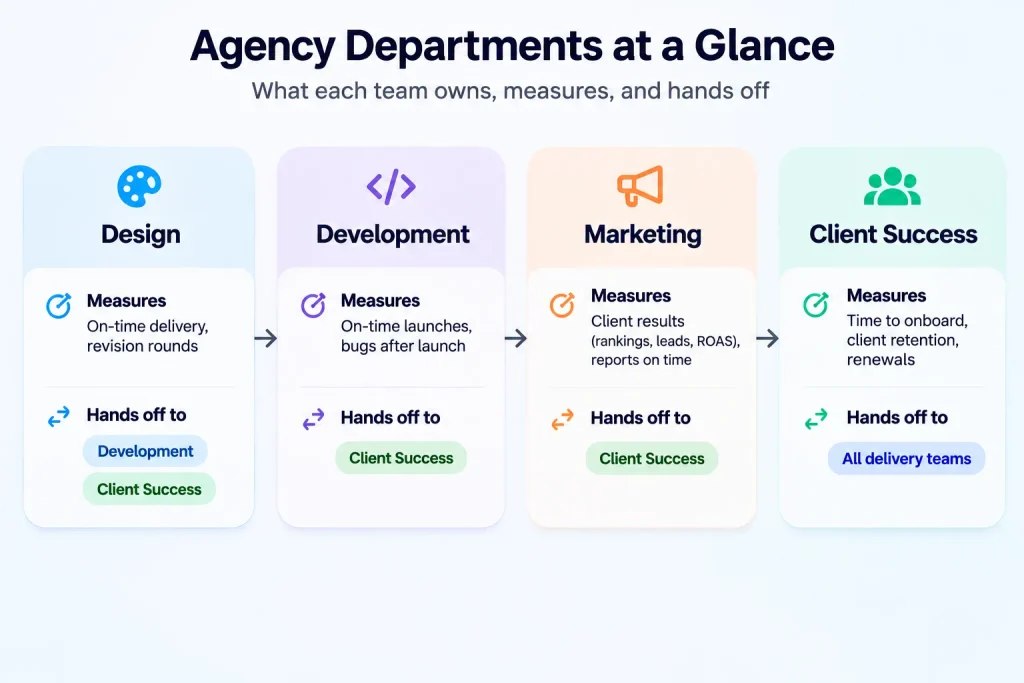
| Department | What the lead measures | Hands work to |
|---|---|---|
| Design | On-time delivery, revision rounds per project | Development (approved designs) and Client Success (client review) |
| Development | On-time launches, bugs found after launch | Client Success (handover and sign-off) |
| Marketing | Client results such as rankings, leads, or ROAS; reports sent on time | Client Success (monthly reports) |
| Client Success | Time to onboard, client retention, renewals | Every delivery department (briefs and approved scope) |
Work tends to stall at the handoffs between departments, so agree in writing what “done” means before work moves on. If you also track time by department, you can compare how profitable each one is with our agency profit margin calculator.
Departments vs Pods vs Matrix: Which Structure Fits?
Departments are the right agency team structure for most agencies under 40 people. The other common structures either come before them or sit on top of them.
| Structure | How it works | Best for | Watch out for |
|---|---|---|---|
| Flat | Everyone reports to the founder and covers several roles | 1-5 people | The founder becomes the bottleneck |
| Department (functional) | People grouped by skill, one lead per department | Most agencies from about 6 people | Slow handoffs if departments don’t share one system |
| Pod | Small cross-functional teams per client or account | Agencies with several large retainers | Some pods get overloaded while others sit idle |
| Matrix | People report to a department lead and a project lead | Larger agencies running many projects at once | Two managers can mean conflicting priorities |
| Freelance network | A small core team plus contractors on demand | Lean agencies with uneven workload | Quality and availability vary |
Most growing agencies end up with a hybrid: departments as each person’s home base, with pods or project teams on top for their biggest clients.
When Should You Formalize Your Agency Structure?
Formalize your agency structure when coordinating the work starts costing more time than the work itself. The usual signs are daily “who owns this?” questions, uneven workload, confused new hires, and clients getting mixed answers. For most agencies, that happens somewhere between six and fifteen people.
The Signal Isn’t Headcount
The signal isn’t headcount. It’s when “who’s doing this?” starts taking longer than doing the work itself.
5 Warning Signs You’ve Outgrown a Flat Team
Watch for these signs:
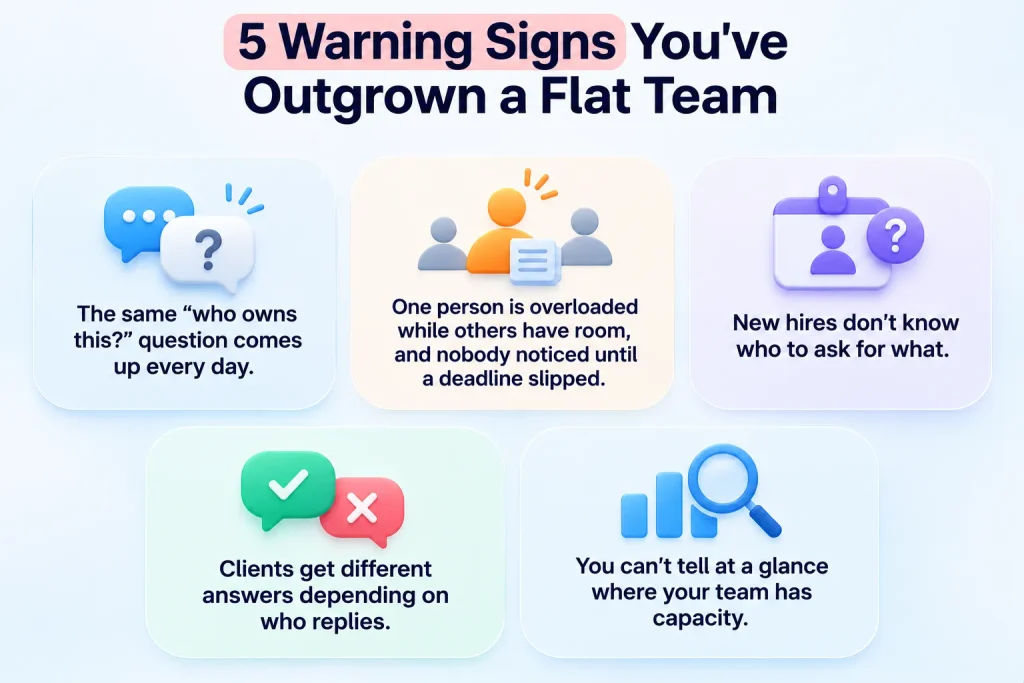
- The same “who owns this?” question comes up in chat every day.
- One person is overloaded while others have room, and nobody noticed until a deadline slipped.
- New hires don’t know who to ask for what.
- Clients get different answers depending on who replies.
- You can’t tell at a glance where your team has capacity.
If two or more of these sound familiar, it’s time to organize teams by department, not just a flat member list. Keep the structure in the same place your projects and tasks live, so assignments follow it without anyone checking a separate org chart. Most agency management software now lets you set this up in a few minutes.
How to Structure an Agency Team by Department in 4 Steps
To structure an agency team by department, list your recurring work, group it into three or four departments, name one lead per department, and route new requests through those departments. Then review the setup every quarter as your services change.
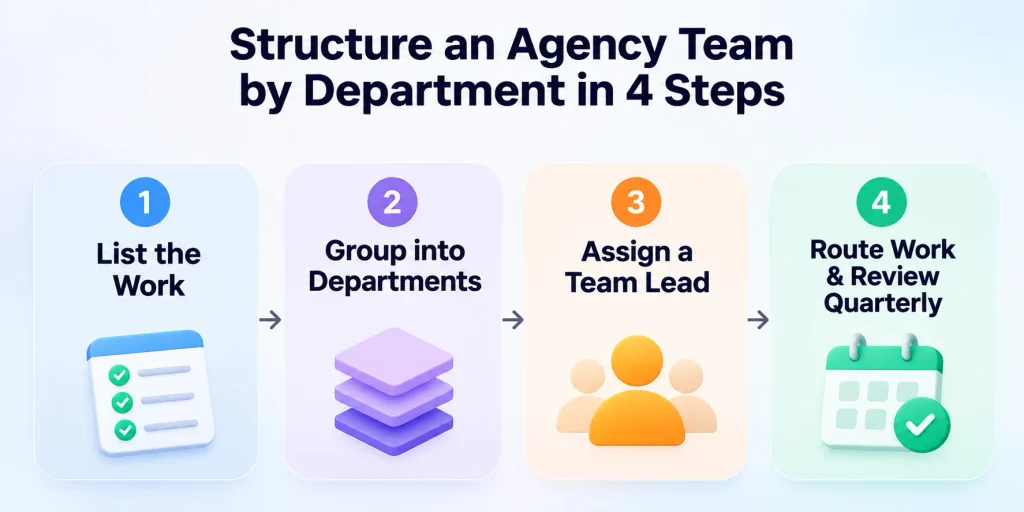
Step 1: List the Work, Not the People
Write down every recurring type of work from the last three months: logo projects, landing pages, monthly SEO, client calls. This shows what your departments really need to cover.
Step 2: Group the Work Into Three or Four Departments
Put similar work together. Use the starter framework above as a base and rename anything that doesn’t fit how you sell.
Step 3: Name One Lead per Department
The lead owns assignments and capacity for that group, even if they’re the only member. In small agencies, leads still do client work themselves. McKinsey calls this a “player/coach” manager and puts the typical span at three to five direct reports, so split a department once its lead manages more than that.
Step 4: Route New Work Through Departments, Then Review Quarterly
New requests go to a department first, then to a person. Every quarter, check whether a department has grown too broad or too quiet and adjust.
Common Mistakes When Structuring Agency Departments
The most common mistakes are building departments around people instead of work, creating too many departments too early, giving one department two co-leads, keeping handoffs in chat, and never revisiting the structure. Each one blurs ownership, which is the exact problem departments are meant to solve.
1. Building Departments Around People, Not Work
Start from the recurring work, then place people in it. Otherwise the structure breaks the day someone leaves.
2. Creating Too Many Departments Too Early
A six-person agency with five departments has five leads and no team.
3. Giving One Department Two Co-Leads
When two people share capacity, nobody owns it. Pick one lead.
4. Keeping Handoffs Only in Chat
Agree what “done” looks like before work moves to the next department.
5. Never Revisiting the Structure
Your services change every year, so your departments should too. Review them every quarter.
Conclusion: Start Small, Then Let the Structure Grow
Learning how to structure an agency team by department isn’t about building an org chart for its own sake. It’s about making sure every type of work has a clear owner, so you can see workload at a glance and give each request to the right person without guessing.
Start with three or four departments, even if some of them are one person. Name one lead for each, write down what they own and hand off, and review the setup every quarter. As you grow, add departments in stages and layer pods on top only for your biggest clients. The right agency team structure isn’t the most complex one. It’s the one your team can follow without asking “who’s on this?”
FAQs
How many departments should a small agency have?
Three or four is enough to start. Most agencies begin with Design, Development, Marketing, and Client Success, then split a department only when it gets too broad for one lead.
Can one person belong to more than one department?
Yes, and in small agencies it’s common. Give each person a primary department so there’s always one place their work is assigned and tracked.
What are the core agency team roles?
Most agencies need people who create the work (designers, developers, marketers), people who manage it (project managers), and people who own the client relationship (account managers). In a small team, one person often covers two of these.
Is a department structure the same as a hierarchy?
No. Departments group people by the type of work they do. You can keep a flat, collaborative culture and still have clear owners for each kind of work.
Should an agency use pods instead of departments?
Pods are small cross-functional teams built around a client or account, such as one designer, one developer, and one account manager. Many agencies use both: departments are each person’s home base for skills and capacity, and pods pull people from those departments for specific clients. If you’re under ten people, start with departments and add pods once you have several large accounts.
How do you structure departments for a remote or hybrid agency?
Keep the same departments, but write more down. Every department needs a documented lead, one shared place for its tasks and files, and a few core hours that overlap across time zones for handoffs. Structure matters even more remotely, because nobody can lean over a desk to ask who’s on what.