

Building a successful digital marketing agency requires more than marketing skills. You need the right business model, pricing strategy, services, team, tools, CRM, and systems to grow sustainably.
This complete guide covers everything you need to build, manage, and scale a digital marketing agency from creating a business plan and choosing your services to setting pricing, building a team, selecting software, and improving operations with AI and automation.
If you are at the very beginning and want a step-by-step walkthrough of the launch process specifically, read how to start a digital marketing agency alongside this guide. This pillar covers the full arc from foundation to scale.
Table of Contents
What Is a Digital Marketing Agency and How Does the Business Model Work?
A digital marketing agency is a services business that helps other companies grow their online presence, generate leads, and drive revenue through digital channels. At the service level, that means some combination of SEO, paid advertising, content marketing, social media management, email marketing, web design, and analytics. At the business level, it means buying labor and tools, applying them to client problems, and charging more than your total cost to deliver.
The distinction between a freelancer and a digital marketing agency is not headcount. It is structured. A freelancer sells their time. An agency sells a system. When you build a real digital marketing agency, clients are buying your process, your team, and your ability to deliver consistent results, whether or not you personally execute the work.
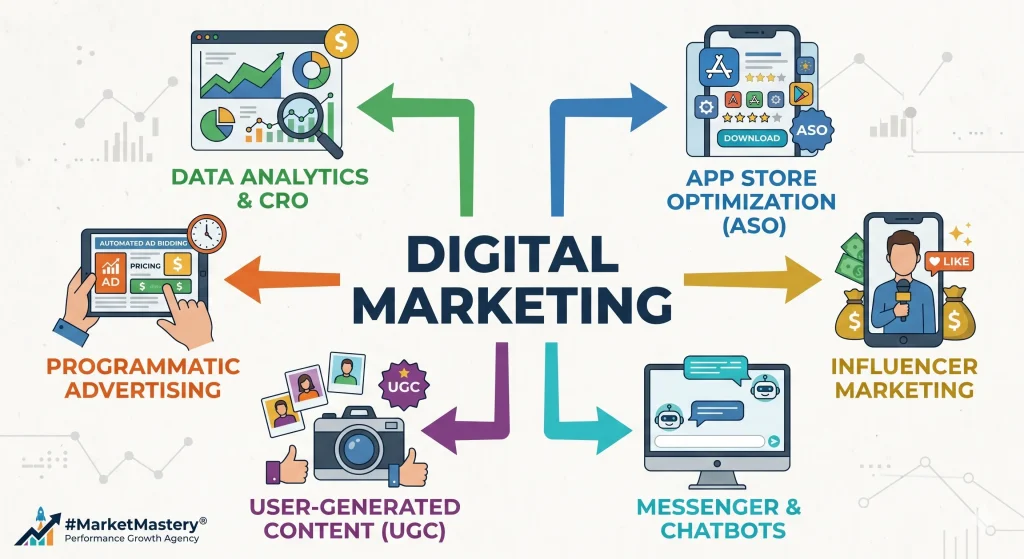
There are four main business models a digital marketing agency can operate on:
| Business Model | How It Works | Best Stage to Use |
| Hourly or project-based | Charge per hour or per defined deliverable | Solo operators, early stage |
| Monthly retainer | Fixed monthly fee for ongoing scope of work | Growth stage, 3+ clients |
| Productized packages | Fixed scope, fixed price, repeatable delivery | Scaling stage, 10+ clients |
| Performance or revenue share | Fee tied to results (CPL, CPA, percentage of revenue) | Established agencies with full funnel control |
Most digital marketing agencies start on a project or hourly basis, convert their best clients to retainers, and build productized packages once they know exactly what they can deliver consistently. Jumping straight to performance pricing without a proven delivery system is one of the fastest ways to lose money.
The global digital advertising market is projected to exceed $870 billion by 2026, according to Statista’s digital advertising outlook. A meaningful portion of that spend flows through agencies. The demand is real. The agencies that capture a lasting share of it are the ones with the strongest operating systems underneath their creative work.
How to Write a Digital Marketing Agency Business Plan: Step-by-Step
Most agency founders skip the business plan because they see it as a document for investors. Since they are not raising money, they assume they do not need one. That assumption costs them.
A digital marketing agency business plan is not a pitch deck. It is a thinking document that forces you to answer the questions that will cause problems later if left unexamined. The founders who revisit their business plan every quarter are the ones who catch misaligned pricing, wrong-fit clients, and team gaps before those problems become expensive.
Your digital marketing agency business plan should cover these core sections:
- Business model: How you make money (retainers, projects, or hybrid) and what a typical client engagement looks like
- Target clients: Ideal industry, company size, budget, and key pain points
- Services: What you offer—and what you intentionally exclude
- Revenue plan: 12-month projections (conservative, base, optimistic)
- Costs: Team, tools, contractors, and operations
- Positioning: Why clients choose you over competitors
- Operations: How work is delivered, managed, and measured
The digital marketing agency business model section deserves the most attention. It determines your cash flow, your hiring timeline, and your growth ceiling. A retainer model creates predictable revenue that lets you staff ahead of demand. A project model creates feast-or-famine cycles that make planning almost impossible.
For a detailed walkthrough of every section, see how to write a digital marketing agency business plan.
What Types of Digital Marketing Services Should an Agency Offer?
Service selection is a strategic decision, not a sales decision. The instinct when launching a digital marketing agency is to say yes to every service a prospect mentions. That instinct is understandable and expensive.
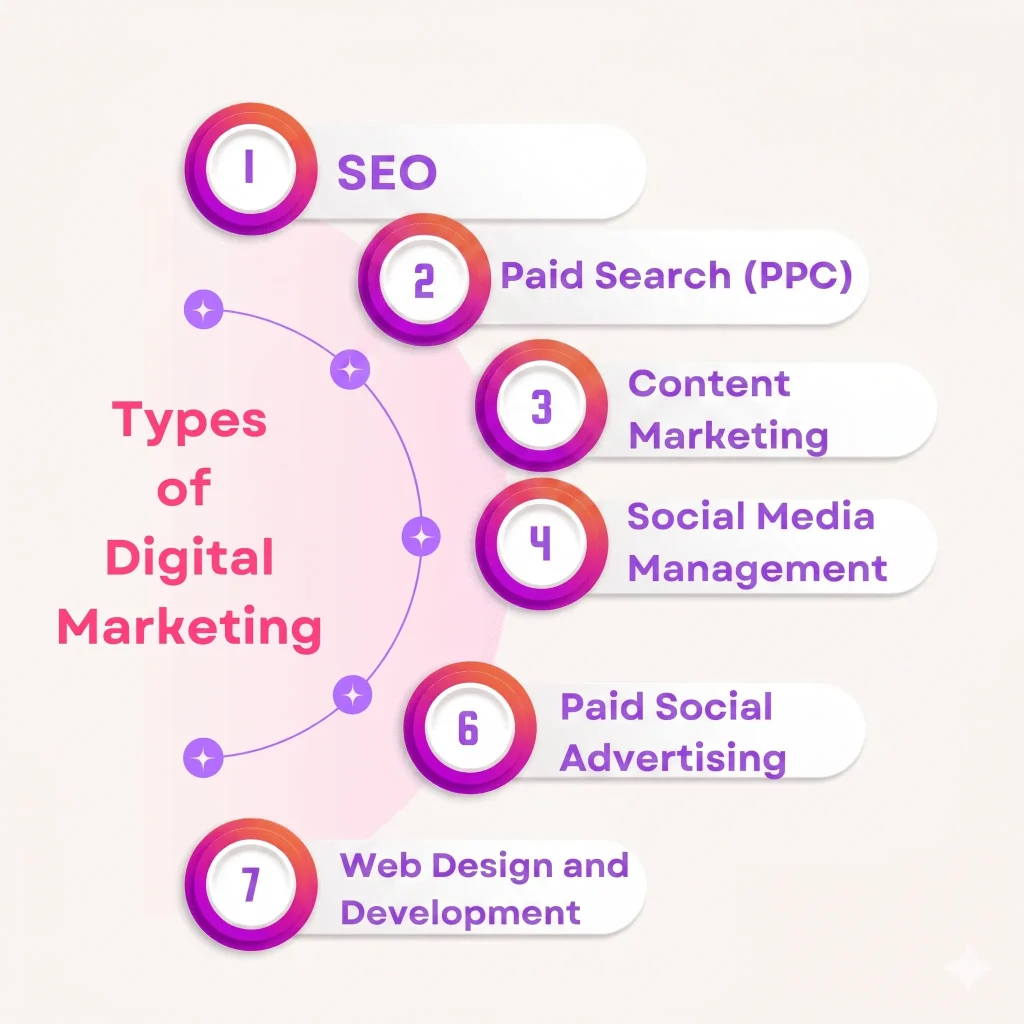
Agencies that offer everything to everyone end up with an incoherent delivery team, inconsistent margins, and no case studies that speak to a specific buyer. The agencies that grow fastest pick two or three services, master them, build repeatable delivery around them, and expand only when the foundation is solid. Here are the most common types of digital marketing services:
| Service | What It Delivers | Typical Monthly Retainer |
| SEO | Long-term organic traffic and lead generation | $1,500 to $5,000 |
| Paid Search (PPC) | Fast-turn traffic and leads via Google Ads | $1,500 to $6,000 |
| Social Media Management | Brand awareness, community, and engagement | $1,000 to $4,000 |
| Content Marketing | Authority building and long-term organic growth | $2,000 to $7,000 |
| Email Marketing | Retention, nurture, and revenue reactivation | $800 to $3,000 |
| Web Design and Development | Online presence, conversion, and brand | $3,000 to $20,000 (project) |
| Paid Social Advertising | Direct response across Meta, LinkedIn, TikTok | $1,500 to $6,000 |
When picking your initial service offering, consider three things:
- First, where do you have existing proof? Your first case studies will come from the category you already know.
- Second, where is the average contract value high enough to support your team’s cost? Content marketing and full-service retainers carry higher margins than social-only management.
- Third, what can you replicate? A service is only worth offering if you can deliver it consistently across multiple clients simultaneously.
How Do Digital Marketing Agencies Charge for Their Services?
Pricing is where most digital marketing agencies leave money on the table. The goal is not to be the cheapest option in the market. It is to build a pricing structure that reflects the value you deliver, protects your margins, and does not create the wrong incentives between you and your clients. There are different digital marketing pricing models, such as:
- Hourly Rate Pricing
- Monthly Retainer Pricing
- Project-Based (Fixed Fee) Pricing
- Performance-Based Pricing
What Is a Monthly Retainer for a Digital Marketing Agency?
A monthly retainer is a fixed fee paid by the client each month in exchange for an agreed scope of ongoing services. It is the most common pricing model for established digital marketing agencies because it creates predictable cash flow, allows you to staff and plan ahead, and builds long-term client relationships.
Retainer ranges by client size:
- Small business retainers: $1,500 to $5,000 per month for a focused service (SEO, social media management, or email marketing)
- Mid-market retainers: $5,000 to $15,000 per month for multi-channel campaigns
- Enterprise retainers: $15,000 and above for full-service digital marketing agency management
Retainer compression is real. More clients are pushing for 3-month commitments instead of 12-month contracts as budgets tighten. The agency response that protects your revenue is a stronger onboarding process that proves value in the first 30 days, making renewal a natural outcome rather than a renegotiation.
When Does Hourly or Project-Based Pricing Make Sense?
Hourly billing runs between $75 and $200 per hour, depending on your market and specialization. It is transparent but creates a structural problem: you make more money when work takes longer, which is the opposite of what your client wants. Reserve hourly billing for strategy consulting, audits, and ad hoc work where the scope is genuinely unknown.
Project pricing is a fixed fee for a defined deliverable, most commonly a website build, a campaign launch, or a content audit. Project work is good for starting relationships. It is not good for building recurring revenue. The best use of project pricing is as a foot-in-the-door that converts into a retainer once the client sees results.
What Is the Percentage of the Ad Spend Pricing Model?
The percentage of ad spend is standard in paid media management. You charge 10% to 20% of the client’s monthly advertising budget, typically with a minimum floor of $1,000 per month, regardless of spend. This model aligns your incentives with scaling their campaigns, but it creates revenue volatility as budgets fluctuate.
A flat management fee ($1,500 to $2,500/month) plus 10% to 15% of spend above a defined threshold. This protects your baseline when clients cut budgets and rewards you when they scale.
How Does Performance-Based Pricing Work for Marketing Agencies?
Performance-based pricing ties your fee to a specific outcome: a cost per lead, cost per acquisition, or percentage of attributed revenue. It is appealing to clients because the risk sits with the agency. It is difficult for agencies because it only works when you have full control over the variables that drive results.
What is the typical revenue share percentage for marketing agencies? Most performance arrangements run between 5% and 15% of attributed revenue, depending on the category and average order value. Lead generation arrangements typically run $20 to $150 per qualified lead, depending on the industry.
Performance pricing is best suited to established digital marketing agencies with a proven funnel, strong attribution tracking, and enough data to set realistic expectations. It is not a good model for an agency still learning its delivery system.
How Do Marketing Agencies Charge Fees and Share Revenue?
This is one of the most searched questions in agency research, and most published answers are vague. Here are the real numbers by model.
| Fee Structure | Typical Range | Industry Use |
| Monthly retainer (small business) | $1,500 to $5,000/month | SEO, social, email |
| Monthly retainer (mid-market) | $5,000 to $15,000/month | Multi-channel campaigns |
| Hourly consulting rate | $75 to $200/hour | Strategy, audits |
| Percentage of ad spend | 10% to 20%, floor $1,000/month | Paid media management |
| Revenue share | 5% to 15% of attributed revenue | Performance campaigns |
| Project rate (website) | $3,000 to $25,000 per project | Web design and development |
| Project rate (campaign launch) | $2,000 to $10,000 per project | New channel launches |
A few agency fee comparison points are worth knowing. Retainer-based digital marketing agencies in the US charge more per engagement than equivalent agencies in the UK or Australia, primarily because of higher salary baselines for talent. Niche-specialist agencies (legal, medical, SaaS) consistently command 20% to 40% higher retainers than generalist agencies because clients pay for domain knowledge, not just marketing execution
The best fee structure is the one your ideal client trusts, and your margin survives. Never price below a 40% gross margin on retainer work. Below that threshold, you cannot afford to hire the talent required to deliver what you sold.
How Do You Build a Digital Marketing Team for an Agency?
The digital marketing team’s question arrives earlier than most founders expect. You win your third or fourth client, the work piles up, and you realize that you cannot personally execute everything and simultaneously run the business. The founder who tries to do both ends up doing neither well.
Who Should You Hire First at a Digital Marketing Agency?
The first three hires at a digital marketing agency follow a consistent pattern among agencies that scale well:
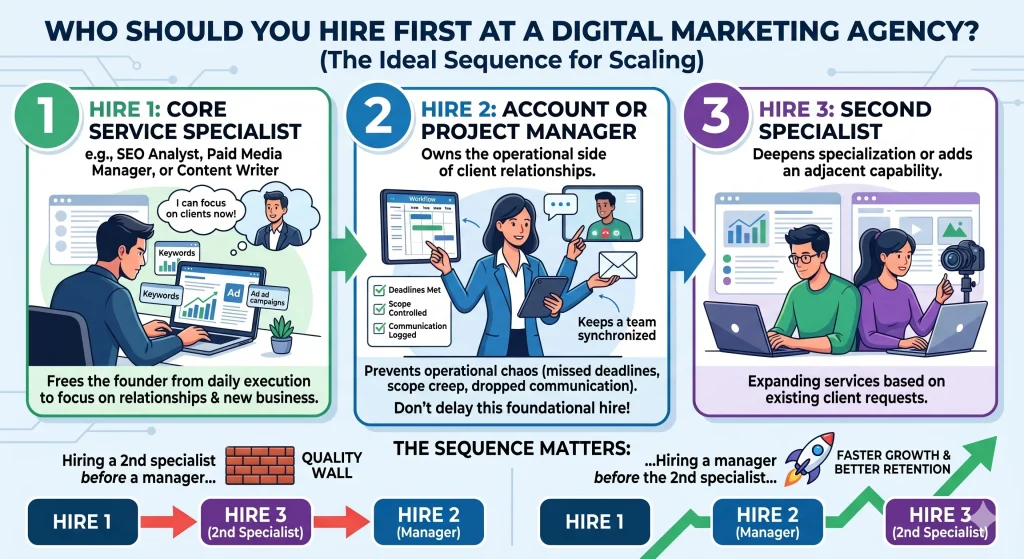
Hire 1: Core service specialist
An SEO analyst, paid media manager, or content writer, depending on your primary service. This hire frees you from daily execution so you can focus on client relationships and new business.
Hire 2: Account or project manager
This is the hire most founders delay longest and regret most. The cost of poor workflow at a digital marketing agency is invisible until it is catastrophic. Missed deadlines, scope creep, and dropped client communication trace back to a lack of someone owning the operational side of client relationships.
Hire 3: Second specialist
Either deeper specialization in your core service or an adjacent capability that your existing clients are already requesting.
The sequence matters. Founders who hire a second specialist before an account manager usually hit a quality wall. Whereas the founders who hire an account manager before a second specialist usually grow faster because client retention improves immediately.
Digital Marketing Agency: Team Size
| Agency Size | Team Composition |
| 1 to 3 people | – Founder – 1specialist plus – 1 generalist |
| 4 to 8 people | – Founder – 2-3 specialists – 1 account manager – 1 ops |
| 9 to 15 people | – CEO – Service leads – 3/4 specialists – 2 account managers – 1 ops |
| 15 or more | – Department heads – Dedicated sales function – HR function |
Remote versus in-office matters less than most founders think. What actually determines team performance is clarity of ownership, a documented delivery process, and consistent communication cadence. A remote digital marketing team with clear SOPs outperforms an in-office team with no process.
According to the Bureau of Labor Statistics, advertising and marketing manager roles are growing faster than average. Competition for good digital marketing talent is real, which means your retention strategy matters as much as your hiring strategy.
How to Create a Digital Marketing Agency Website? – Essential Elements
Your agency website is your most important sales asset and your most visible proof of skill. A digital marketing agency that cannot execute its own web presence is sending a weak signal to every prospect who visits before a call.
The website does three jobs: it communicates what you do and who you do it for, it demonstrates that you can actually do it, and it makes the next step obvious. Defining a clear niche can also help agencies develop more specialized expertise; for example, Manaferra, an SEO and GEO agency for colleges and universities, focuses on helping higher education institutions improve their visibility across traditional and AI-driven search. Most agency websites fail at all three.
A converting digital marketing agency website needs these pages:
- Homepage: a clear headline that names your niche and the outcome you deliver, not a generic statement about helping businesses grow. “We help SaaS companies generate a qualified pipeline through content and SEO” is the homepage. “We are a full-service digital marketing agency” is not.
- Services page: plain-language descriptions of each service, what is included, and ideally a pricing range or starting price. Agencies that publish pricing ranges report higher inbound conversion because prospects self-qualify before the call.
- Case studies or results page: specific numbers, named clients where possible, before-and-after metrics. A testimonial that says “they did a great job” is not a case study.
- About page: real people, real photos, real backgrounds. Prospects buy from people they trust.
- Contact or book-a-call page: one clear CTA, no friction. A form with six fields loses half its submissions.
For online marketing web design, the technology choice matters less than the content. A WordPress site with strong copy and real proof outperforms a custom-built site with vague messaging every time.
Your own website should also be doing SEO work on your behalf. Target long-tail keywords your ideal client searches: “digital marketing agency for law firms,” “paid search management for ecommerce,” “SEO agency for SaaS startups.” If your digital marketing agency website does not rank for its own target terms, that is the first credibility gap you need to close. As your agency grows and you start hiring support staff, resources like this guide from Jooble can help candidates put their best foot forward
What Software Do Digital Marketing Agencies Use to Run Operations?
The right software stack is the difference between a team that can handle 20 clients efficiently and one that maxes out at 8 while constantly firefighting. Tools compound: the right ones make your team faster, reduce errors, and generate the data trail that makes reporting easy. The wrong ones create extra work and cost money you cannot justify.
What Project Management and Reporting Tools Do Agencies Need?
Every digital marketing agency needs a project management tool and a reporting layer. The project management tool is where every client task, deadline, and deliverable lives. If work is tracked in email threads or Slack messages, things will fall through.
For reporting, the goal is a single view of performance across all client channels without manual data pulling every month. Automated dashboards save senior team members three to five hours per client per month on reporting alone.
| Tool Category | Options | Approx Monthly Cost |
| Project management | Asana, Monday.com, ClickUp, Notion | $10 to $25 per user |
| Client reporting | AgencyAnalytics, Looker Studio, Databox | Free to $60/month |
| Communication | Slack | Free to $8 per user |
| Design and creative | Canva, Figma | Free to $15 per user |
What SEO and Paid Media Tools Should a Digital Marketing Agency Use?
SEO tools and paid media platforms are table stakes. The question is not whether to use them but which combination fits your service mix and client volume.
- Ahrefs or Semrush: keyword research, rank tracking, backlink analysis, and competitive research. Both run $99 to $229 per month. Most agencies pick one and stick with it.
- Google Search Console and Google Analytics 4: free, essential, non-negotiable for any client with a website.
- Screaming Frog: technical SEO audits. Free up to 500 URLs, $259 per year for unlimited.
- Google Ads and Meta Ads Manager: platform-native, free to use. Most paid media agencies also add a third-party bidding or creative testing tool at scale.
What Is a Marketing Agency Management System and Do You Need One?
A marketing agency management system is an integrated platform that combines project management, client communication, time tracking, and sometimes CRM and billing in one place. Examples include AgencyZoom, Teamwork, Function Point, and Productive.
Whether you need one depends on your size. Under 10 clients, a good project management tool, and a separate CRM are usually sufficient. Above 15 to 20 clients, the coordination overhead of disconnected tools starts costing more than a dedicated agency platform.
For a full comparison of agency management platforms, see digital marketing agency management software.
Best CRM for a Digital Marketing Agency
A CRM is not just a sales tool. For a digital marketing agency, it is the system of record for every client relationship: the history of every conversation, the contract value, the renewal date, the health signals that tell you a client is at risk before they actually cancel.
Most agencies skip the CRM until something breaks. A missed renewal, a forgotten proposal follow-up, or a client who churned because nobody noticed the warning signs. By then, the cost is already paid. The right time to set up a CRM is before you lose something important, not after.
Here are the top CRM tools for digital marketing agencies:
| CRM | Best For | Starting Price |
|---|---|---|
| Taskip | Digital marketing agencies that want CRM, client management, invoicing, projects, and team collaboration in one platform | $12/month (Check detailed price) |
| HubSpot CRM | All-in-one solution, agencies under 30 clients | Free plan available; paid plans from ~$15/user/month (annual billing) |
| Pipedrive | Longer sales cycles, clean visual pipeline | ~$14/user/month (annual billing) |
| Zoho CRM | High-volume, smaller client base, built-in automation | ~$14/user/month (annual billing) |
| Monday CRM | Agencies already using Monday.com for project management | ~$12/seat/month (3-seat minimum) |
| ClickUp | Agencies running everything in one workspace | Free plan; paid plans from ~$10/user/month |
What Should a Digital Marketing Agency Track in Its CRM?
Beyond the standard sales pipeline, a digital marketing agency CRM should track:
- Contract start and renewal dates for every active client
- Monthly retainer value and cumulative client revenue
- Last meaningful communication date (not just email opens)
- Client health signals: payment history, support ticket volume, NPS score if you collect it
- Red flags: any client who has asked about pausing, reduced their scope, or missed a payment
- Reasons prospects did not convert: This data improves your sales process over time
 Taskip
The CRM Built for Growing Agencies
Manage leads, clients, projects, invoices, and your team from one workspace—without switching between multiple tools.
No credit card is required!
How Do You Reduce Workflow Costs at a Digital Marketing Agency?
The ceiling most digital marketing agencies hit is not a demand ceiling. It is a systems ceiling. The founder is the bottleneck on every important decision, the team is reinventing processes for each new client, and the agency cannot grow past what one person can personally oversee.
Building workflow systems is the work that makes scaling possible. It is also the work that most founders postpone because it feels less urgent than serving clients. That postponement is a choice to stay small.
What Should a Digital Marketing Scope of Work Template Include?
Vague scope of work documents are the leading cause of margin erosion at growing agencies. Every hour of unpaid scope creep traces back to something that was not written down clearly at the start.
A digital marketing scope of work template should include:
- Summary of services: specific services by name, not broad categories
- Monthly deliverables: quantities, formats, and word counts where applicable (e.g., “4 blog posts of 1,000 to 1,200 words each, SEO-optimized, delivered by the 25th of each month”)
- Client responsibilities: what the client must provide and by when, including access, approvals, and feedback
- Out of scope: an explicit list of what is not included, so there is no room for ambiguity
- Revision rounds: how many revisions are included before additional charges apply
- Reporting format and cadence: how and when performance data is delivered
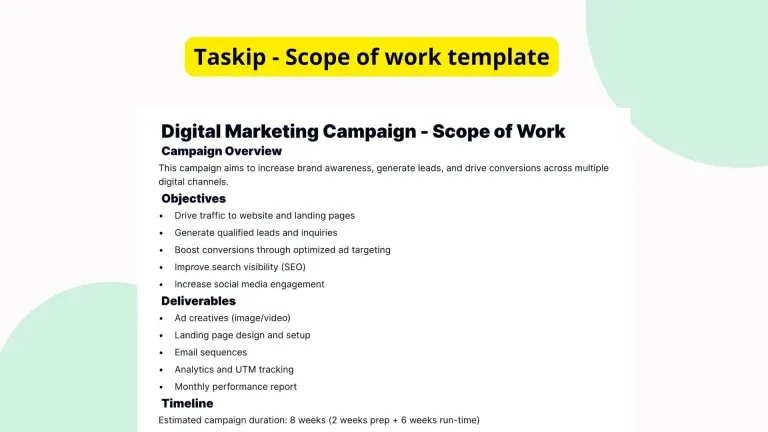
Get Free Scope Of Work Template
Build one reusable scope of work template for each service type you offer. Adapt it per client in 20 minutes rather than writing from scratch for two hours per new engagement. A marketing scope of work template for advertising should also specify the platforms covered, the ad formats included, and who owns the creative assets at the end of the engagement.
How Do Digital Marketing Agencies Automate Client Communication Workflows?
Client communication is often one of the biggest time drains in a digital marketing agency. Without a system, updates become reactive, inconsistent, and dependent on manual follow-ups, making it hard to scale and maintain a strong client experience.
Successful agencies solve this by turning communication into structured, automated workflows instead of ad-hoc inbox management.
- Client onboarding: Automatically trigger a step-by-step sequence after contract signing, including welcome emails, kickoff agenda, required access requests, and a 30-day success roadmap. Automatic client onboarding is a must to save your time and accelerate client handling.
- Monthly reporting: Send automated performance reports on a fixed schedule, paired with a short summary that highlights key results, insights, and next actions.
- Renewal management: Start renewal conversations 60–90 days before contract expiry to allow time for performance review, alignment, and upsell opportunities.
- Client feedback loops: Automate check-ins at 30 days, 90 days, and annually to capture satisfaction, identify issues early, and improve retention.
By systemizing communication, agencies reduce manual workload, improve consistency, and create a smoother client experience that scales with growth.
For agencies with above 15 clients, outsourcing the administrative layer of client communication (scheduling, document management, approval tracking) to a specialist or a VA is worth considering. The account manager’s time is better spent on relationships and strategy than on calendar management.
How Much Do Digital Marketing Agencies Charge for AI Services in 2026?
How do agencies productize AI marketing operations and price them? This is the most common new question from agency founders in 2026, and it reflects a real shift in how digital marketing services are being packaged and sold.
AI tools have changed the cost structure of several core agency services. Content production that used to take 8 hours can now take 2. Ad creative testing that required a designer for every variation now generates 10 variations from a single brief. Reporting that involved manual data pulls now runs automatically. The agencies figuring out how to capture that efficiency gain in their pricing, rather than just passing it to clients, are building meaningful margin improvements.
Common AI-powered packages digital marketing agencies are selling in 2026:
- AI content production packages: a defined number of SEO-optimized articles per month, produced with AI assistance and human editing, at a lower price point than traditional content retainers. Typical range: $800 to $2,500 per month.
- Automated reporting dashboards: replacing manually produced monthly reports with live dashboards that clients can check anytime. Priced as an add-on: $200 to $500 per month.
- AI ad creative testing: generating and testing 8 to 12 creative variants per campaign instead of 2 to 3. Included in paid media retainers or priced as an optimization add-on.
- Automated client communication workflows: onboarding sequences, check-in triggers, and renewal reminders built in the agency’s CRM and running without manual initiation. Sold as part of a premium service tier.
AI agency pricing models for high-ticket clients in 2026 are trending toward tiered productized packages where AI efficiency is baked into the delivery cost rather than charged separately. The agencies winning premium clients are the ones that frame AI as a capability that improves their output, not a cost-saving measure that reduces their rates.
Top 4 Digital Marketing Agency Trends in 2026
The digital marketing agency landscape in 2025 and 2026 is being reshaped by four forces that affect how agencies win clients, deliver work, and retain talent. Here are the top four digital marketing agency trends:
1. Niche Specialization is Outperforming Generalism
Agencies that serve a specific vertical (legal, medical, SaaS, ecommerce, hospitality) consistently command higher retainers and win more inbound leads than full-service generalists. The specialist can show a prospect case studies from their exact industry, speak their language in discovery calls, and price accordingly.
2. Transparent Pricing is Becoming a Competitive Advantage
Agencies that publish pricing ranges on their website report higher inbound conversion rates. Prospects who cannot afford your rates filter themselves out before the call, which means your sales time goes to qualified conversations. The “contact us for pricing” model is losing ground to published ranges, even if the final number is custom.
3. AI Integration is Separating Fast-Moving Agencies from Slow Ones
This is not about replacing human judgment. It is about capacity. Agencies that have integrated AI tools into their content, reporting, and creative workflows are handling 30% to 40% more client work with the same headcount. That is a structural margin advantage that compounds over time. However, unchecked automation carries real risk, making it essential to back AI production with human oversight and verification tools like an AI checker.
4. Shorter Retainer Commitments are the New Normal
Three-month contracts are replacing 12-month ones as clients manage budgets more conservatively. The agencies adapting well are building their own onboarding and month-one delivery process to demonstrate ROI before the first renewal conversation, not after.
The Bottom Line
A digital marketing agency is one of the most accessible and scalable service businesses available to anyone with genuine marketing skills and the discipline to build a real operating system underneath the work.
The framework in this guide covers every layer: business model, business plan, service selection, pricing, team, website, tools, CRM, workflow systems, AI integration, and the trends shaping where the industry is heading. None of it is complicated. All of it requires consistent execution over time.
The founders who build digital marketing agencies that last are not uniquely talented. They are the ones who chose a niche and defended it, priced for margin from the start, hired before it was desperate, documented their processes before they needed them, and used a CRM before they lost a client to a forgotten follow-up.
Build the system. Then build the business on top of it.
Ready to Scale Your Agency?
Whether you’re launching your first agency or scaling to dozens of clients, Taskip helps you stay organized and deliver a better client experience.
FAQs About Building a Digital Marketing Agency
How Much Does It Cost to Start a Digital Marketing Agency?
Starting a digital marketing agency has a lower upfront cost than most service businesses. Your core costs are software subscriptions ($200 to $500 per month for a basic tools stack), a website ($500 to $3,000 to build properly), legal setup ($500 to $1,500 for an LLC and a standard client contract), and your time. Most digital marketing agency founders launch with less than $5,000 and fund growth from early client revenue. The cost scales with how quickly you hire. The first full-time employee is typically the point where outside funding or a strong client base becomes necessary.
What Is the Most Profitable Pricing Model for a Digital Marketing Agency?
The monthly retainer model produces the most predictable and scalable revenue for most digital marketing agencies. A well-run retainer-based agency targets 40% to 50% gross margin on each engagement. Performance-based pricing can generate higher revenue per client but carries more risk and is harder to operate at scale without a proven attribution system. The most profitable digital marketing agency pricing approach for most founders is retainer-first, with performance bonuses tied to clearly defined KPIs once the baseline relationship is established.
How Long Does It Take to Build a Digital Marketing Agency to $10k Per Month?
Most digital marketing agency founders reach $10,000 per month in revenue within 6 to 12 months if they are actively selling and have priced their services correctly. Reaching $50,000 per month typically takes 18 to 36 months, depending on niche, average contract value, and how systematically the founder approaches growth. The bottleneck is almost never demand. It is almost always systems and hiring. Agencies that document their delivery process early scale faster because they can bring in help without retraining from scratch.
What Is the Typical Monthly Retainer for a Small Business Digital Marketing Agency in 2026?
The typical monthly retainer for a small business digital marketing agency in 2026 runs between $1,500 and $5,000 per month for a focused service like SEO or social media management. Full-service retainers that cover multiple channels run $3,500 to $8,000 per month for small businesses with reasonable budgets. These ranges have held relatively steady in 2025, though AI-augmented services are creating a new tier of lower-cost productized offerings in the $800 to $1,500 range that compete with the bottom of the traditional retainer market.
What Is the Typical Monthly Retainer for a Small Business Digital Marketing Agency?
The typical monthly retainer for a small business digital marketing agency runs between $1,500 and $5,000 per month for a focused service like SEO or social media management. Full-service retainers that cover multiple channels run $3,500 to $8,000 per month for small businesses with reasonable budgets. These ranges have held relatively steady in 2025, though AI-augmented services are creating a new tier of lower-cost productized offerings in the $800 to $1,500 range that compete with the bottom of the traditional retainer market.
How Do You Compare Digital Marketing Agency Proposals With Different Pricing?
When comparing digital marketing agency proposals that use different pricing models, structure the comparison around three questions. What specific deliverables am I getting each month? How is success measured and reported? What happens if results do not meet expectations? A retainer proposal that defines deliverables clearly is comparable to a performance proposal that defines the cost-per-lead target. Both can be evaluated if the terms are specific. Avoid comparing agencies purely on the monthly fee without accounting for what is included. A $2,000 retainer with a clear scope is usually a better deal than a $1,200 retainer with ambiguous deliverables.
How Do You Scale a Digital Marketing Agency Past 10 Clients?
Scaling a digital marketing agency past 10 clients requires three things operating in parallel. A documented service delivery process so that new team members can execute without direct supervision from the founder. A CRM that tracks client health so you catch problems before they become cancellations. And a new business process that runs independently of the founder, whether through inbound content, referral systems, or a dedicated salesperson. The agencies that reach 20, 30, and 50 clients are the ones where the founder has systematically removed themselves from daily delivery. That transition starts at client one, not client ten.