
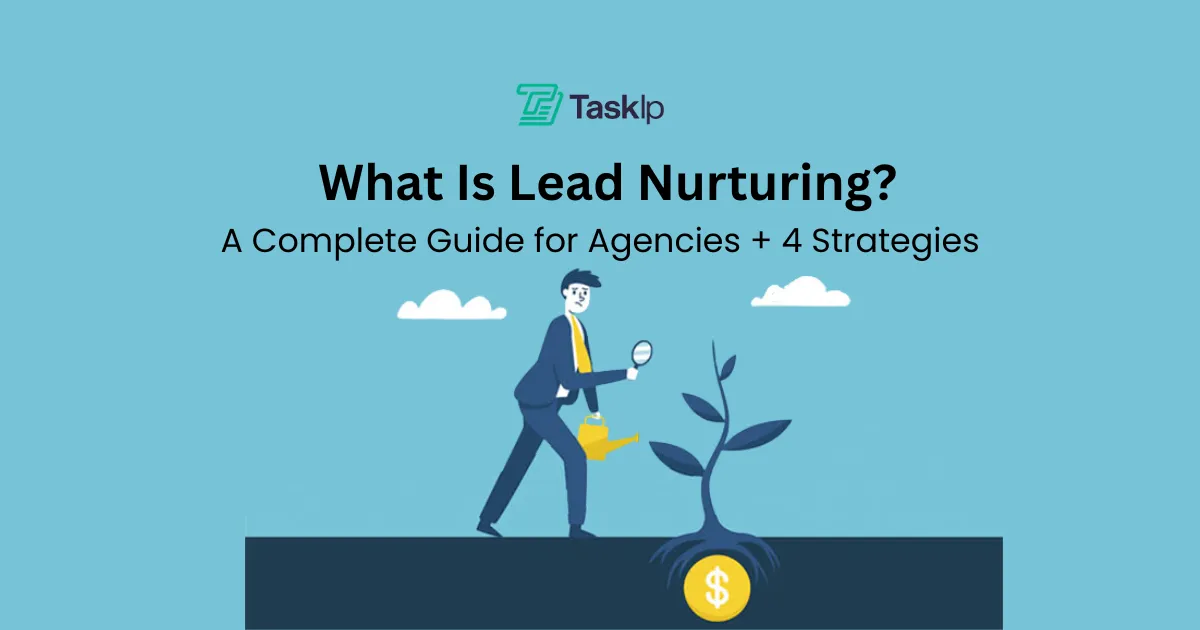
Lead nurturing is the process of building relationships with potential customers by providing relevant information, follow-ups, and useful resources until they are ready to take the next step. For agencies, lead nurturing helps turn interested prospects who are not ready to buy today into qualified sales opportunities over time.
A lead may download a resource, request information, contact your agency, or attend a webinar without being ready to sign a contract. Instead of treating that lead as lost, an agency can use relevant communication to educate the prospect, build trust, understand their needs, and recognize when they are ready for a sales conversation.
Table of Contents
- Lead nurturing means building relationships with prospects until they are ready to buy.
- Agency lead nurturing works best when communication is based on the prospect’s needs, interests, buying stage, and behavior.
- A good nurture workflow combines useful content, personalized follow-ups, lead scoring, and clear sales handoff rules.
- Lead nurturing is different from lead generation, lead follow-up, and lead scoring, although all four processes work together.
- Agencies should measure nurturing by engagement, qualified opportunities, meetings, conversions, and revenue, not just email opens.
What Is Lead Nurturing?
Lead nurturing is the process of building a relationship with a potential customer who isn’t ready to buy yet. Instead of pushing for a sale, you keep them engaged with useful information and relevant communication.
For example, someone might download a guide from your website but not be ready to contact your sales team. You can follow up with helpful content, a case study, or other information that answers their questions and builds interest.
A simple lead nurturing journey might look like:
New lead → Helpful content → Engagement → Qualification → Sales conversation
The goal for lead nurturing is to stay relevant until the prospect is ready to take the next step.
Why Is Lead Nurturing Important for Agencies?
Not every prospect who contacts an agency is ready to buy right away. They may still be comparing agencies, waiting for budget approval, defining the project, or getting input from other decision-makers.
Without follow-up, these leads can easily go cold or get forgotten.
Lead nurturing helps agencies stay in touch while the prospect works through these decisions. For example, a web development agency could share relevant case studies, website redesign examples, planning tips, or answers to common pricing questions.
That way, when the prospect is finally ready to move forward, the agency is still part of the conversation.
How Does Lead Nurturing Work?
Lead nurturing works by delivering the right communication to the right prospect at the right stage. It is about staying relevant as a prospect moves through the buying process. You start by capturing the lead, then use their needs and interactions to decide what to share and when to involve sales.
For an agency, the process usually looks like this:
- Capture the lead
- Segment the lead
- Identify their buying stage
- Share relevant content
- Track their engagement
- Assess buying intent
- Pass sales-ready leads to sales
The process should also have clear entry and exit points. For example, once a prospect books a call or becomes sales-ready, they should move out of the nurturing sequence instead of continuing to receive the same emails.
How To Nurture Leads for Agencies?
A lead nurturing process helps an agency keep track of prospects as they move from initial interest toward a buying decision. Instead of sending the same message to everyone, the agency can use what it knows about each prospect to decide what information or follow-up makes sense.
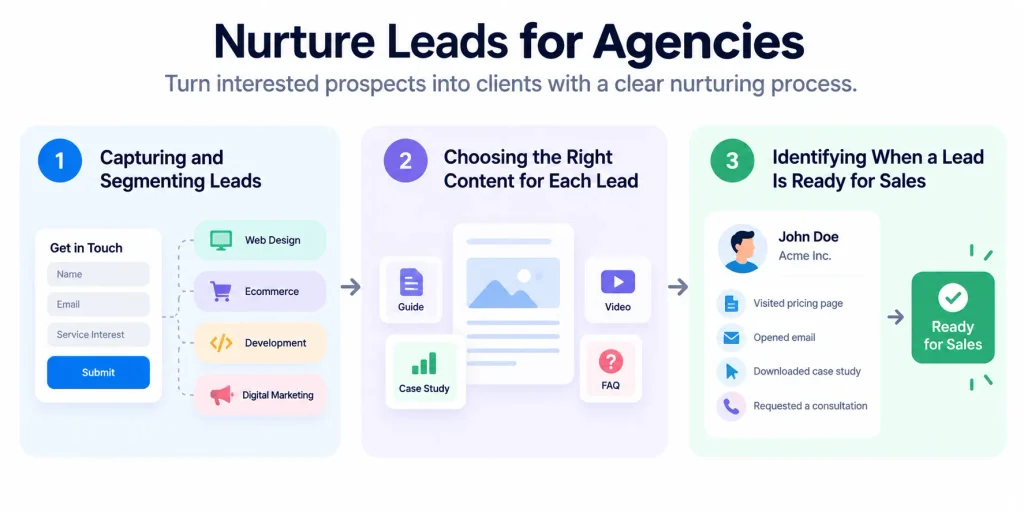
1. Capturing and Segmenting Leads
Start with the information that helps you understand the lead. This could include their company, industry, company size, service they’re interested in, project type, budget, timeline, requirements, and lead source.
You don’t always need to ask for all of this information in the first interaction. A simple contact form might collect basic details, while the sales team can learn more about the project later.
Once you have enough information, you can group similar leads together.
For example, a software agency might have segments for:
- SaaS development
- Ecommerce development
- WordPress development
- Laravel development
- Mobile app development
- Website redesign
A marketing agency could use segments such as SEO, paid advertising, content marketing, social media, and email marketing.
This simple step makes follow-up much more relevant. A prospect looking for SEO services doesn’t need the same content as someone asking about mobile app development.
2. Choosing the Right Content for Each Lead
What you send should depend on what the prospect needs to know at that point.
Someone planning a website redesign might be looking for a redesign checklist, UX tips, conversion optimization advice, or examples of similar projects. A prospect comparing software development agencies may want to see case studies, technology comparisons, project estimates, security information, or details about the development process.
The goal isn’t to fill their inbox with content. It’s to give them something useful when they have a reason to look for it.
As the prospect moves closer to a decision, the content can become more specific. General educational content might work early on, while case studies, pricing information, and service details can become more useful later.
3. Identifying When a Lead Is Ready for Sales
Not every active lead is ready to talk to sales. Someone might read several articles or visit different pages simply because they are researching their options.
Look for stronger buying signals, such as:
- Asking about pricing
- Requesting a proposal
- Sharing project requirements
- Booking a discovery call
- Requesting a consultation
- Visiting pricing or service pages repeatedly
- Replying to sales communication
These actions give the agency a better idea of where the prospect is in the buying process. But engagement is only one part of the picture.
Fit matters too. A prospect who visits ten pages but has no relevant project may not be a strong opportunity. Another prospect might interact with less content but already have a clear need, budget, and timeline. Looking at both factors helps the sales team decide when a lead is actually worth a conversation.
Lead Nurturing Workflow for a Web Development Agency: 8 Step Guide
Let’s say a company is looking for a new website and submits an inquiry to a web development agency. That first form submission doesn’t necessarily mean the company is ready to hire. They may still be defining the project, comparing agencies, discussing the budget internally, or figuring out what they actually need.
A lead nurturing workflow helps the agency stay connected during that period. Here’s how a simple process can work.
Step 1: Capture the Inquiry
The journey starts with the website inquiry. The agency can use the form to collect a few details that help the team understand the project before reaching out.
For example, the form might ask about the prospect’s current website, business type, required features, project goals, expected timeline, and budget range.
These details give the agency something to work with from the beginning. They also make it easier to decide which content, follow-up, or sales process is appropriate for that particular lead.
Step 2: Identify the Project Type
Not every website inquiry is the same. A business looking for a simple company website has different needs from an ecommerce business or a company planning a custom web application.
The agency can categorize the lead based on what they shared in the form:
- Website redesign
- New website
- Ecommerce development
- Custom web application
Once the project type is known, the agency can use it to personalize the rest of the nurturing journey.
Step 3: Send an Immediate Response
The first follow-up doesn’t need to be a sales pitch. A simple confirmation can let the prospect know that their inquiry was received and explain what happens next.
The agency might also share a relevant resource or give the prospect an expected response time. This small step keeps the conversation active while the team reviews the inquiry.
Step 4: Provide Educational Content
If the prospect isn’t ready to speak with sales, useful content can keep the agency on their radar.
For a website redesign lead, this could be a guide to planning a redesign, common UX mistakes, website performance tips, or a checklist for preparing content. The idea is to answer questions that naturally come up while the prospect is researching the project.
This also gives the agency more context. If the prospect consistently engages with redesign and UX content, that behavior can help indicate what they care about.
Step 5: Share a Relevant Case Study
Once the prospect has shown some interest, a relevant case study can make the agency’s experience more tangible.
Suppose the prospect runs an e-commerce business. Instead of sending a generic portfolio, the agency could share a case study about an e-commerce project that involved similar challenges. The prospect can then see how the agency approached the problem, what was delivered, and what changed after the project.
The closer the case study is to the prospect’s situation, the more useful it becomes.
Step 6: Track Engagement
The agency can then look at how the prospect interacts with its emails and website. Useful signals might include:
- Email clicks
- Website visits
- Service-page visits
- Pricing-page visits
- Consultation requests
- Replies to emails
These actions shouldn’t be treated as automatic proof that someone is ready to buy. A prospect might visit several pages while doing early research. But repeated activity around pricing, services, or consultations can provide a stronger indication of buying interest.
Step 7: Qualify the Lead
At this stage, the agency can look at the bigger picture instead of relying on engagement alone.
Consider the prospect’s fit, project scope, budget, timeline, business need, and buying intent. For example, someone may be highly engaged with the agency’s content but have a project that falls outside the agency’s services. Another prospect may have visited only a few pages but already have a clear project, budget, and deadline.
Qualification helps the agency separate genuine sales opportunities from general interest.
Step 8: Hand the Lead to Sales
When the prospect meets the agency’s qualification criteria, they can move from nurturing into the sales process. The sales team should have the relevant information gathered along the way, including the original inquiry, project type, requirements, and meaningful interactions.
That makes the handoff much smoother. Instead of starting the conversation from scratch, the salesperson already has some context about what the prospect needs and why they reached out.
The workflow is simple: understand the lead, keep the conversation relevant, watch for meaningful buying signals, and bring in sales when there’s a real opportunity.
Top 4 Most Effective Lead Nurturing Strategies for Agencies
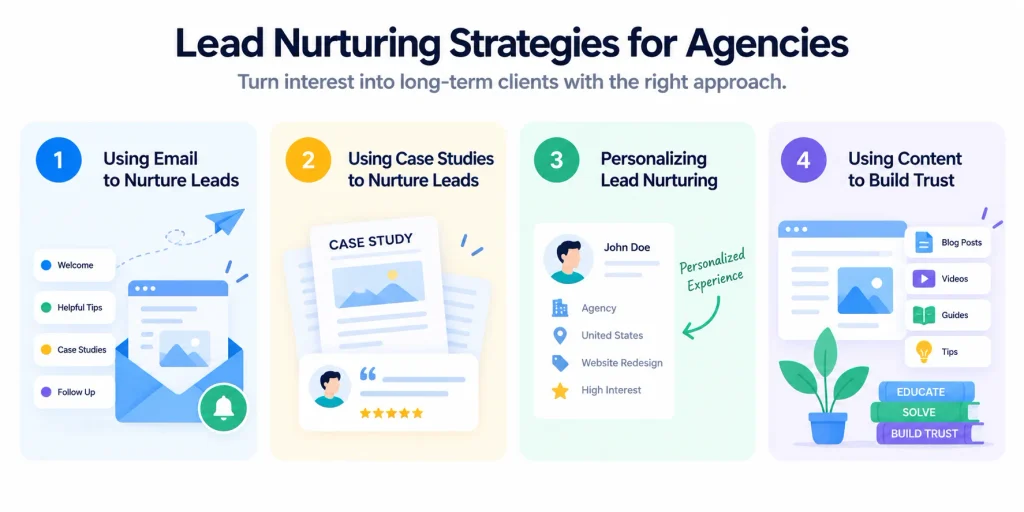
Good lead nurturing comes down to one thing: staying useful while a prospect decides whether, when, and who to hire. For agencies, that means understanding what the prospect is interested in, giving them relevant information, and knowing when to step in with a sales conversation.
There isn’t one sequence that works for every agency or every lead. The right approach depends on the service, sales cycle, and where the prospect is in their decision-making process. Below are the strategies you can follow for nurturing leads:
Strategy 1: Using Email to Nurture Leads
Email gives agencies a simple way to keep the conversation going after a prospect’s first interaction. Rather than asking for a meeting in every email, the agency can use the space to answer questions, share useful resources, and gradually introduce the prospect to its services.
For example, a basic sequence could look like:
Day 1: Send the requested resource and introduce the agency.
Day 3: Share a helpful guide or article related to the prospect’s interest.
Day 7: Send a relevant case study.
Day 12: Answer common questions about the service.
Day 18: Invite the prospect to discuss their project.
These timings aren’t fixed rules. A prospect who has requested a proposal may need a completely different follow-up from someone who downloaded a general guide. Their actions should help determine what happens next.
Strategy 2: Using Case Studies to Nurture Leads
A case study can answer a question that prospects often have before contacting an agency: “Have they actually handled something like this before?”
Instead of simply showing the finished work, a useful case study walks the reader through the project. It should explain the client’s problem, what they needed, how the agency approached it, what was implemented, and what changed as a result.
Relevance matters here. If a SaaS company is considering a website redesign, a case study about another SaaS website project gives them a much better idea of what the agency can do than an unrelated portfolio piece.
Strategy 3: Personalizing Lead Nurturing
Personalization doesn’t have to mean writing a completely different email for every prospect. Even small details can make follow-up more relevant.
An agency can use information such as the prospect’s industry, service interest, project type, previous conversations, and interactions with its content. Their behavior can then determine what they receive next.
For example:
- Reads a WordPress case study → Share another WordPress resource.
- Asks about pricing → Move them toward a more sales-focused follow-up.
- Books a consultation → Remove them from the general nurture sequence.
- Stops engaging → Try a re-engagement campaign.
This keeps the communication connected to what the prospect is actually doing instead of putting everyone through the same automated sequence.
Strategy 4: Using Content to Build Trust
Prospects often have questions long before they’re ready to hire an agency. Helpful content gives them a way to find those answers while also showing that the agency understands the problem they’re trying to solve.
Depending on the service, this could include blog posts, case studies, guides, checklists, tutorials, videos, webinars, FAQs, industry reports, project planning resources, or service comparisons.
The content doesn’t need to promote the agency in every paragraph. Sometimes a detailed guide that helps a prospect understand their options can do more to build trust than another piece of content focused entirely on the agency’s services.
Lead Nurturing vs. Lead Generation vs. Lead Follow-Up
Lead generation attracts potential customers, lead nurturing develops relationships with interested prospects, and lead follow-up moves active prospects toward the next sales action.
| Activity | Purpose | Typical stage | Example |
|---|---|---|---|
| Lead generation | Attract potential customers | Before or at initial contact | A prospect downloads an agency guide |
| Lead nurturing | Build interest and trust | Prospect is interested but not ready | Send relevant case studies |
| Lead follow-up | Move an active prospect forward | Prospect has shown stronger intent | Follow up after a consultation |
| Lead scoring | Prioritize prospects | Throughout the buying journey | Increase score after a pricing-page visit |
| Pipeline management | Track active opportunities | After qualification | Move a proposal to the next pipeline stage |
These activities work together.
A lead may first enter through lead generation. Nurturing keeps the relationship active. Lead scoring helps identify increasing intent. Follow-up then moves the qualified prospect into the sales process.
How Can Agencies Automate Lead Nurturing?
Agencies can automate many of the repetitive parts of lead nurturing, such as sending welcome emails, sorting leads into segments, scheduling follow-ups, updating lead scores, and notifying sales when someone shows stronger buying intent.
For example, imagine a company submits a form about a website redesign. Instead of someone manually tracking every step, an automated workflow could move the lead through the process:
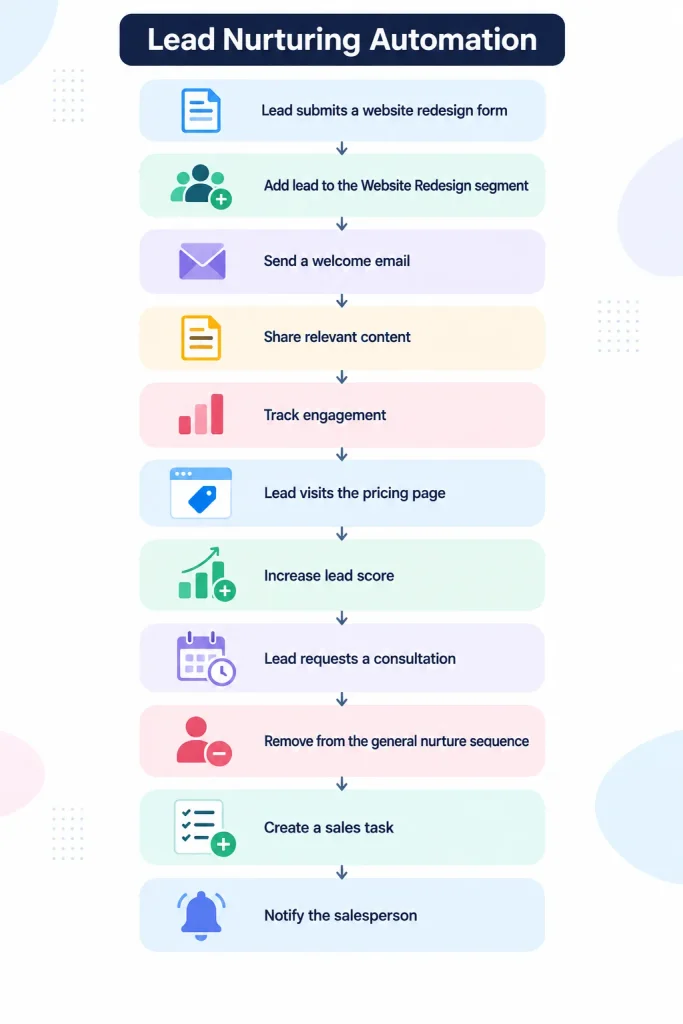
The benefit is not just saving time. It also reduces the chance of a promising lead being missed because someone forgot to follow up or update their status.
But automation shouldn’t take over every interaction. Once a prospect starts asking specific questions, discussing project requirements, or showing clear buying intent, a personal response from the sales team can be much more useful.
Automate the routine work. Keep the important conversations human.
What Metrics Should Agencies Track for Lead Nurturing?
Agencies should measure lead nurturing based on meaningful business outcomes, including engagement, qualified leads, opportunities, conversions, and revenue.
| Metric | What it measures |
|---|---|
| Email click-through rate | Whether content generates interest |
| Content engagement | Which resources attract attention |
| Lead score changes | Changes in buying intent |
| Meetings booked | Sales conversations generated |
| Qualified leads | Leads that meet your criteria |
| Opportunities created | Leads entering the sales pipeline |
| Conversion rate | Leads becoming customers |
| Sales cycle length | Time required to close opportunities |
| Revenue from nurtured leads | Business generated through nurturing |
Email opens can provide useful directional information, but they should not be the primary measure of success. The most useful question is: Did nurturing help create more qualified opportunities and customers?
Common Lead Nurturing Mistakes Agencies Should Avoid
- Sending the same content to every lead: Match content to the prospect’s needs and buying stage.
- Making every email promotional: Mix sales messages with useful, educational content.
- Following up without context: Refer to the prospect’s previous interaction or project.
- Ignoring buying signals: Treat pricing requests and proposal requests as stronger intent.
- Keeping sales-ready leads in automated campaigns: Remove qualified leads from general nurture sequences.
- Creating overly complicated workflows: Start simple and add automation when needed.
- Measuring activity instead of outcomes: Focus on qualified opportunities, conversions, and revenue.
How to Build a Lead Nurturing Strategy for Your Agency?
A practical lead nurturing strategy doesn’t need to be complicated. Start with a clear understanding of your customers, then build the process around their questions, needs, and buying behavior.
1. Define Your Ideal Customer
Identify the industries, company sizes, project types, budgets, and problems your agency can handle best. This gives you a clear idea of which leads are worth nurturing.
2. Map the Buying Journey
Think about what prospects usually want to know before hiring your agency. These questions can help you understand what information they need at each stage.
3. Create Lead Segments
Group leads based on factors such as service interest, industry, project type, buying stage, and behavior. This helps you send more relevant communication.
4. Create Content for Each Stage
Match your content to where the prospect is in the buying process.
- Awareness: Guides, educational articles, checklists
- Consideration: Case studies, comparisons, process guides
- Decision: Pricing information, proposals, consultations, FAQs
5. Define Qualification Criteria
Decide when a lead should move to sales. Consider customer fit, business need, project scope, budget, timeline, and buying intent.
6. Build the Workflow
Set the basic rules for your nurture process, including entry conditions, messages, timing, behavioral triggers, lead scoring, sales handoffs, and exit conditions.
7. Measure and Improve
Track what happens after nurturing, not just email opens and clicks. Look at qualified leads, sales opportunities, conversions, and revenue, then adjust your content and workflow based on what you learn.
What Tools Do Agencies Need for Lead Nurturing?
Agencies can use different tools to manage lead nurturing, depending on their size and sales process. The basic setup should make it easy to store lead information, organize prospects, schedule follow-ups, track activity, and manage opportunities.
Common tools include:
- Lead capture forms
- Contact management
- Lead segmentation
- Email automation
- Lead scoring
- Follow-up reminders
- Sales pipeline management
- Task management
- Reporting
- Website analytics
A smaller agency may manage these activities with a CRM, email platform, and task management tool. Larger teams may use a dedicated marketing automation platform to connect lead data, campaigns, scoring, and sales activity.
Some platforms combine several of these functions. Taskip, for example, includes CRM features for managing leads and contacts, sales pipelines for tracking opportunities, task management, forms, and workflow automation.
Ready to nurture more leads without losing track?
Capture, organize, and nurture every prospect in one place with Taskip. Track interactions, schedule follow-ups, score leads, and move qualified prospects into your sales pipeline.
- Capture and organize every lead
- Track every interaction
- Automate follow-ups and workflows
- Convert qualified leads into clients
The right setup depends on how an agency handles its leads. A simple process may be enough for a small team, while agencies with a higher lead volume may need more automation and reporting.
For a practical approach to lead scoring, see how to score leads without a big CRM. You can also read lead management vs. pipeline management to understand how lead nurturing connects with the sales process.
How Long Should a Lead Nurturing Campaign Last?
There isn’t a fixed length for a lead nurturing campaign. The right timeframe depends on how long your agency’s typical buying process takes. Some prospects may be ready to talk within a few days, while others may need several weeks or months before they make a decision.
Instead of focusing on the number of emails or days, ask:
What does this prospect need to know before taking the next step?
The campaign should also have clear exit conditions. A lead should usually leave the general nurture sequence when they:
- Book a meeting
- Request a proposal
- Become an active sales opportunity
- Become a customer
- Unsubscribe
- Are found to be unqualified
For leads that stop responding, a lower-frequency re-engagement sequence can be more appropriate than continuing regular promotional emails. This gives inactive prospects another chance to engage without overwhelming them.
How Do Lead Nurturing and Lead Scoring Work Together?
Lead nurturing keeps prospects engaged over time, while lead scoring helps agencies understand which prospects may be closer to making a decision.
The two work well together because a prospect’s actions during the nurturing process can provide useful signals about their level of interest.
For example, an agency might use an illustrative scoring model like this:
| Lead behavior | Example score |
|---|---|
| Downloads an educational guide | +5 |
| Clicks an email | +2 |
| Visits a service page | +5 |
| Views pricing information | +10 |
| Requests a consultation | +20 |
These scores are only examples, not universal benchmarks. Each agency should set its own scoring criteria based on its sales process, customer profile, and historical data.
Engagement alone isn’t enough. Lead scores should also be considered alongside customer fit. A prospect who visits several pages and downloads multiple resources may be highly engaged, but if they don’t match the agency’s target market, they may not be a strong sales opportunity.
This is where lead temperature can also help. Agencies can group prospects as hot, warm, or cold leads based on factors such as engagement, fit, and buying intent.
The basic idea is simple: nurturing builds the relationship, while scoring helps the agency decide where to focus its sales effort.
How Does Lead Nurturing Fit Into the Sales Pipeline?
Lead nurturing supports the transition from initial interest to a qualified sales opportunity.
A simplified agency journey looks like this:
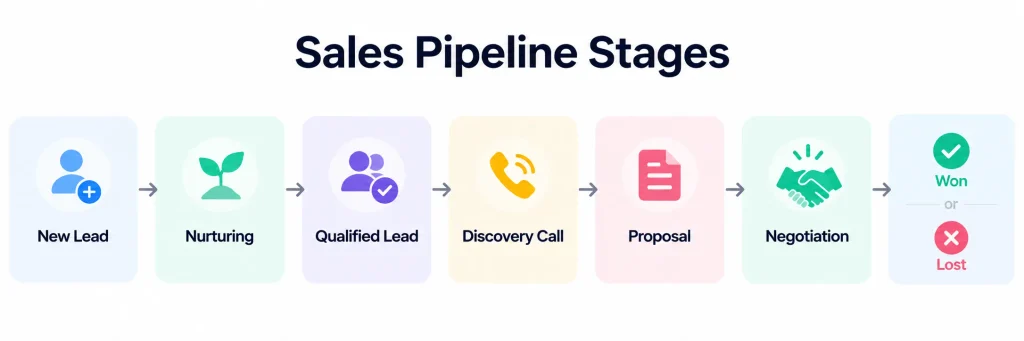
Nurturing is especially useful before a prospect becomes an active sales opportunity.
Once the prospect enters an active sales process, communication should become more personalized and directly connected to the opportunity.
Clear pipeline stages help teams understand where a lead is and what should happen next. A defined set of sales pipeline stages can make the handoff from nurturing to sales easier to manage.
Final Thoughts on Lead Nurturing
Lead nurturing helps agencies stay connected with prospects until they’re ready to move forward. The focus should be on relevant content, timely follow-ups, and meaningful interactions, not simply sending more messages.
With the right system, agencies can capture leads, track engagement, identify buying intent, and hand qualified prospects to sales at the right time.
Taskip brings CRM, pipeline management, tasks, and workflow automation together, helping agencies keep lead management and follow-ups organized in one place.
Ready to simplify your lead management? Explore Taskip and see how it fits your workflow.
Frequently Asked Questions About Lead Nurturing
What Is Lead Nurturing in Simple Terms?
Lead nurturing means staying useful and relevant to potential customers until they are ready to take the next step. It involves providing helpful information, following up on relevant interactions, and recognizing when a prospect’s buying intent becomes stronger.
What Is an Example of Lead Nurturing?
An example of lead nurturing is a web development agency following up with someone who requested information about a website redesign. The agency might send a planning guide, share a relevant case study, answer common project questions, and eventually invite the prospect to book a consultation.
Is Lead Nurturing the Same as Email Marketing?
No. Email marketing is a communication channel, while lead nurturing is a broader process for developing relationships with prospects. Email can be part of lead nurturing, along with sales calls, website content, webinars, personalized outreach, social media, and automated tasks.
How Many Emails Should Be in a Lead Nurturing Campaign?
There is no universal number of emails that works for every agency. The appropriate sequence depends on the agency’s sales cycle, prospect needs, content, and engagement. A practical starting point is a short sequence of three to five useful communications, followed by adjustments based on actual performance.
When Should a Lead Stop Being Nurtured?
A lead should generally leave a general nurture sequence when the prospect becomes sales-ready, enters an active sales conversation, requests a proposal, becomes a customer, unsubscribes, or is determined to be unqualified. Clear exit rules prevent prospects from receiving irrelevant automated messages.
What Is the Difference Between Lead Nurturing and Lead Scoring?
Lead nurturing is the process of developing a relationship with a prospect through relevant communication and content. Lead scoring assigns values to lead characteristics and behaviors so a business can prioritize prospects. Agencies can use both together to determine what communication a prospect needs and when sales should follow up.
Can Small Agencies Automate Lead Nurturing?
Yes. Small agencies can automate basic lead nurturing without implementing a complicated marketing system. Useful starting points include automated welcome emails, segmentation, follow-up reminders, lead scoring, sales notifications, and rules that move qualified leads into the sales pipeline.