
Lead management is the process of capturing, qualifying, and nurturing potential customers before they become a sales opportunity. Pipeline management is the process of tracking and moving those opportunities through defined stages until they close. Lead management happens earlier in the funnel. Pipeline management picks up once a lead is qualified into a deal.
If you only remember one thing from this article, remember that: lead management decides who is worth pursuing, and pipeline management decides how you win them.
Table of Contents
What Is Lead Management?
Lead management is the process of capturing, scoring, and nurturing potential customers until they’re qualified enough to hand off to sales.
It covers everything that happens before a prospect is treated as a real deal. In practice, that usually looks like five stages:
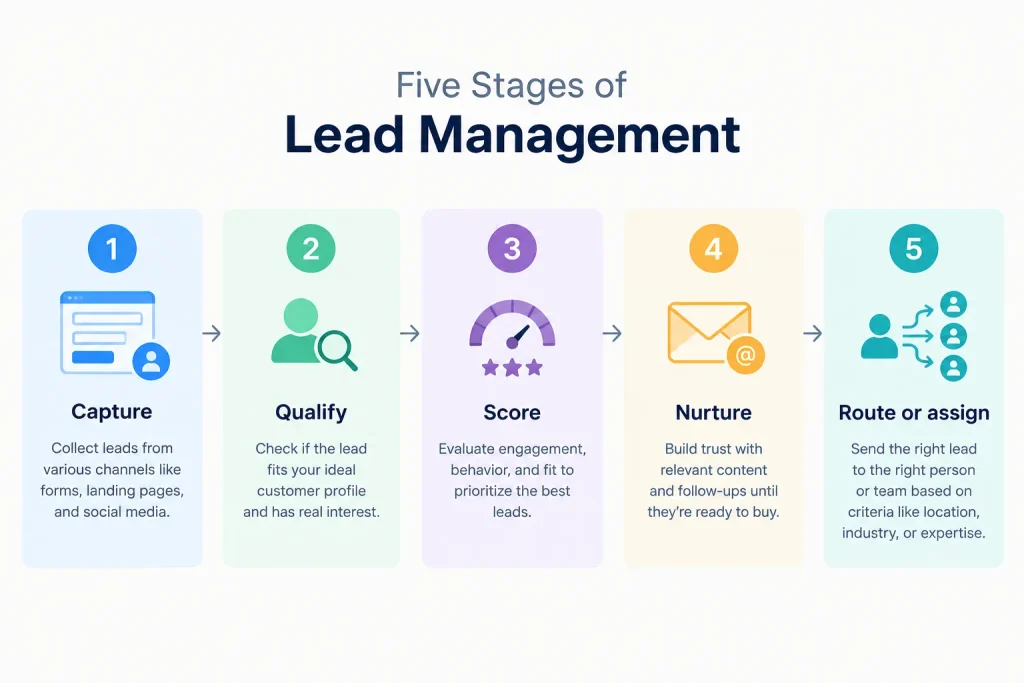
- Capture: A form fill, a chat message, a referral, an inbound call, or a signup.
- Qualify: Checking whether the lead actually fits your ideal customer profile (budget, need, timing, authority).
- Score: Ranking leads by how likely they are to convert, often based on behavior (email opens, page visits) and fit (industry, company size, role).
- Nurture: Sending follow-ups, content, or check-ins until the lead is ready to talk seriously.
- Route or assign: Handing a qualified lead to the right person or team.
At a small agency or freelance shop, one person often does all five steps by hand: a founder answering a contact form inquiry, deciding if it’s a fit, and following up a few times before the conversation turns into an actual proposal.
Lead management doesn’t require expensive software. It requires a consistent process so leads don’t fall through the cracks between “someone reached out” and “we’re actually talking business.”
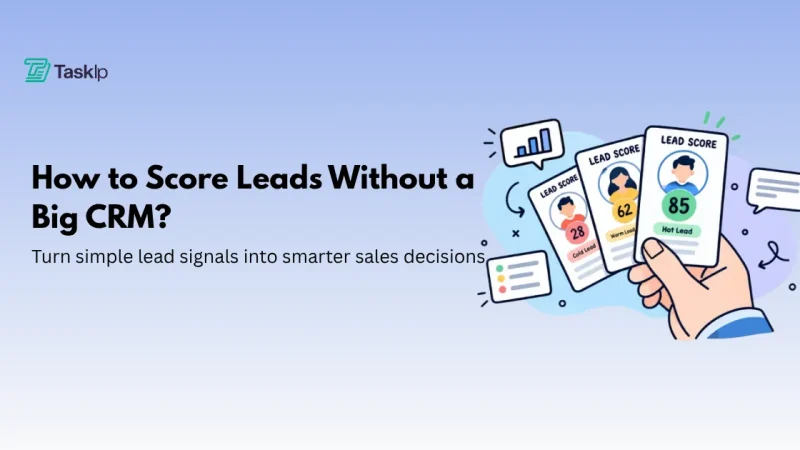
Lead scoring is the step inside lead management that assigns a numerical value to a lead based on fit and behavior, so you know which leads deserve attention first.
It isn’t a separate discipline competing with pipeline management. It’s one input that decides whether a lead moves forward at all. Scoring usually draws on two kinds of signals:
- Fit signals: Industry, company size, budget range, and whether the person reaching out actually has the authority to say yes.
- Behavior signals: Email opens, reply speed, pages visited, and how specific their initial message was.
The exact criteria change by context. A startup taking inbound demo requests might score on job title and company size. A consulting shop might score on whether the inquiry mentions a real budget and timeline. A creative agency might score on project scope and whether the lead came through a referral versus a cold form fill. The scoring model should match how your business actually qualifies work, not a generic template.
What Is Pipeline Management?
Pipeline management is the process of tracking and moving qualified opportunities Pipeline management is the process of tracking and moving qualified opportunities through defined stages, from first serious conversation to closed deal.
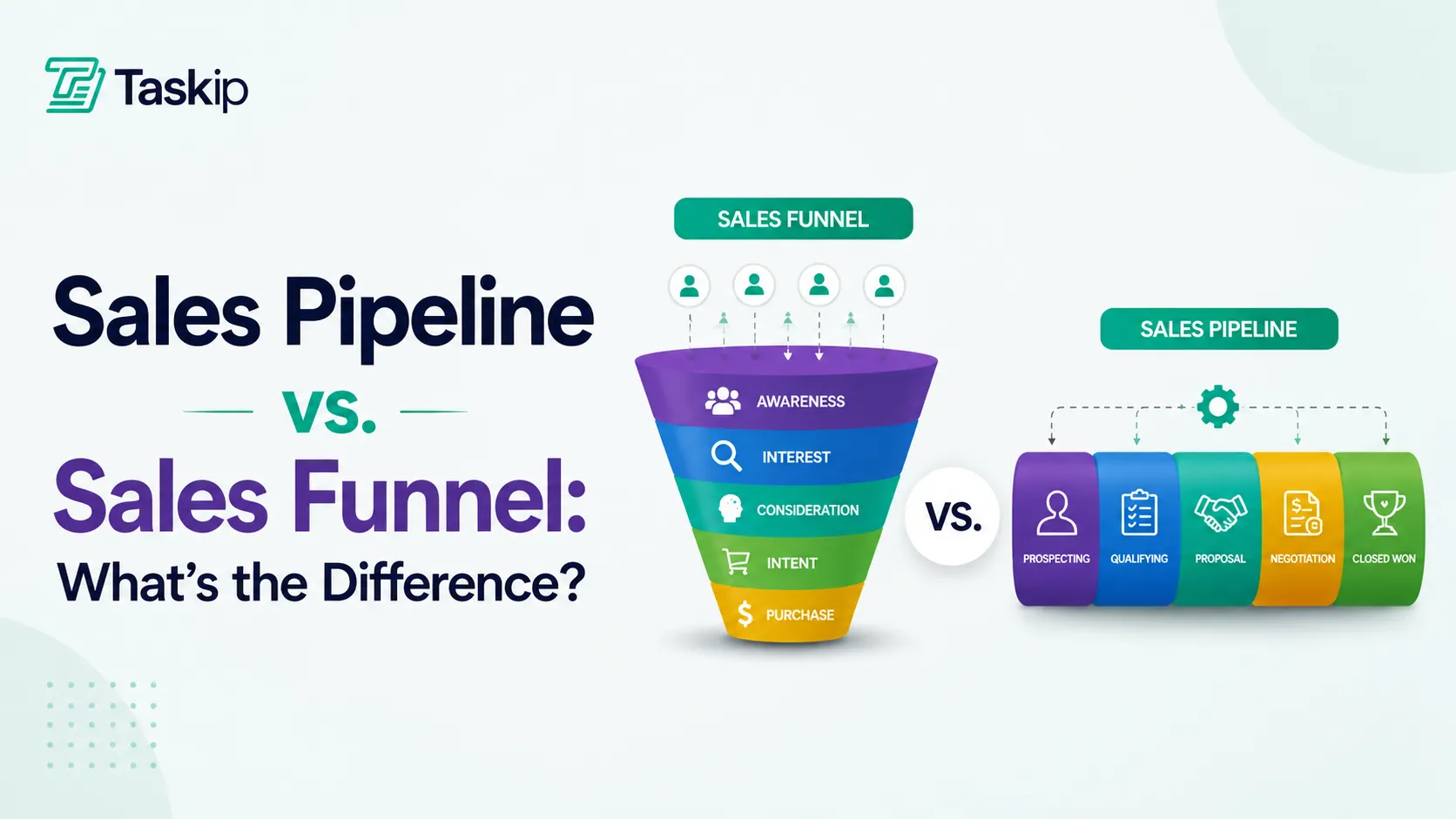
Where lead management asks “is this worth pursuing,” pipeline management asks “where does this deal stand, and what needs to happen next?” A common seven-stage pipeline looks like this:
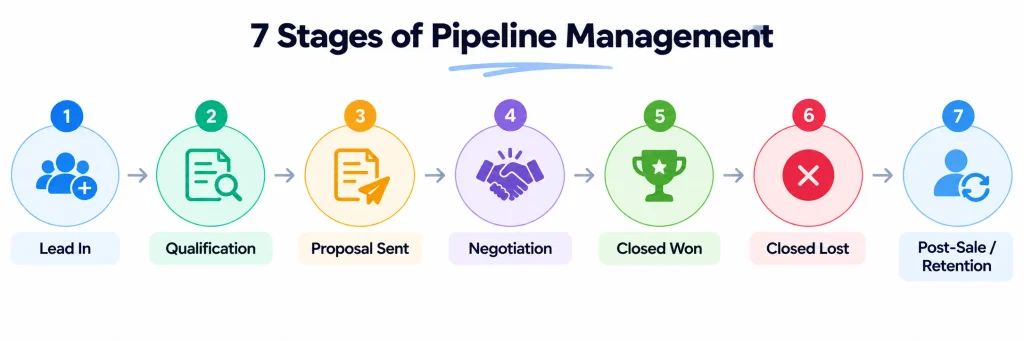
- Lead In: The lead has passed the lead management stage and enters the pipeline as a real opportunity.
- Qualification: Confirming budget, need, timing, and authority before investing more time.
- Proposal Sent: Scoping the work and sending a quote or proposal.
- Negotiation: Working through scope, price, or terms.
- Closed Won: The deal is signed.
- Closed Lost: The opportunity is dropped or goes with another vendor.
- Post-Sale / Retention: Keeping the relationship healthy after the deal closes, since a signed deal isn’t the end of the pipeline’s job.
For a closer look at what happens inside each of these seven stages, see our guide to sales pipeline stages.
Pipeline management is usually visualized as a board (columns for each stage, cards for each deal) or a table with a stage field. That visual format is exactly why board-style tools have become the default way small teams manage pipelines: it makes it obvious at a glance which deals are stuck and which are moving.
Moving a deal through the pipeline is more than dragging a card from one column to the next. Three things happen underneath that make the pipeline actually work:
- Capturing the right details up front: Each deal card should carry enough information (contact, source, budget signal, deal size) that anyone on the team can pick it up without asking around.
- Prioritizing and routing by criteria you set: Bigger deals, faster-moving leads, or a specific service line might need to go straight to a specific person instead of sitting in a shared queue.
- Automating the busywork at each stage: Moving a card to Proposal Sent can automatically create a follow-up task, send a template, or notify the account owner, so nothing depends on someone remembering to do it manually.
The seven stages listed above are a starting point, not a fixed rule. A solo freelancer might collapse Qualification and Proposal Sent into one step. A larger agency might split Negotiation into a separate legal or procurement review stage. The right pipeline is the one that matches how deals actually move through your business, not a template copied fr
Lead Management vs. Pipeline Management: Side-by-Side Comparison
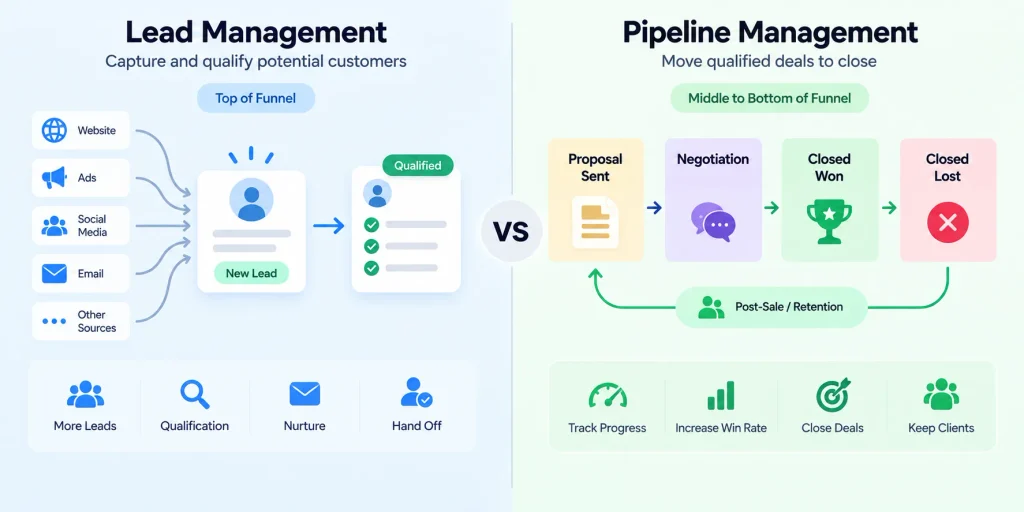
The two aren’t interchangeable, and mixing them up is a common reason teams either lose leads before they’re qualified or lose deals after they are. Here’s how they differ across the dimensions that actually matter day-to-day.
| Dimension | Lead Management | Pipeline Management |
|---|---|---|
| Where it sits in the funnel | Top of funnel, before qualification | Middle to bottom of funnel, after qualification |
| Primary goal | Capture and qualify interest | Move qualified deals to close |
| Who usually owns it | Marketing, growth, or a founder wearing that hat | Sales, account management, or the same founder wearing a different hat |
| Key metrics | Lead volume, lead score, response time | Deal velocity, win rate, stage conversion |
| Common tools | Forms, lead scoring, email nurture sequences, marketing automation | Kanban or deal boards, CRM pipeline stages, forecasting |
| What “done” looks like | Lead qualified and handed off | Deal won or lost, and closed out |
In short: lead management decides who’s worth pursuing, and pipeline management decides how you win them once they are.
How Lead Management and Pipeline Management Work Together?
The two connect at a single handoff point. A lead “graduates” out of lead management and into the pipeline the moment it’s qualified, meaning someone has confirmed there’s real budget, need, and timing behind the interest. Before that point, it’s a lead. After that point, it’s an opportunity.
The most common failure mode is doing only one half of the job well. A team can run great lead generation, filling the top of the funnel every month, but if there’s no consistent pipeline discipline, qualified leads sit untouched and go cold. The reverse also happens: a team manages its open deals carefully on a board but never qualifies leads consistently on the way in, so the pipeline fills up with deals that were never a real fit and were always going to stall.
The numbers make the stakes clear. According to First Page Sage’s lead-to-opportunity conversion benchmarks, the average B2B SaaS company converts roughly 6.2% of leads into real opportunities, and that figure swings from under 3% in categories like IT services up to nearly 12% in others, which shows how much a disciplined qualification step (lead management) actually matters before a lead ever reaches the pipeline.
Once a deal is in the pipeline, Landbase’s 2026 win rate benchmarks put the average B2B win rate at 21% across all deals and 29% for deals that were properly qualified first, while smaller, high-velocity deals (the kind most agencies and freelancers run) close at a much higher 30 to 45%. Qualify well, and the pipeline stage has a real shot at converting. Skip qualification, and even a well-run pipeline is fighting an uphill battle.
Lead Management vs. Pipeline Management: Which One Does Your Business Need First?
There’s no universal answer, but the stage you’re in points to an answer:
- Pre-revenue or just starting outreach: Focus on lead management first. Without a steady, qualified stream of leads, there’s nothing for a pipeline to manage.
- Getting inbound interest but deals keep stalling: Focus on pipeline management. The lead flow is fine, but deals are dying somewhere between “interested” and “signed,” which is a pipeline discipline problem, not a lead volume problem.
- Both feel thin: Don’t go buy two separate tools. Set up one lightweight system that covers lead capture and qualification on one side and a simple deal board on the other. Most small teams overcomplicate this step by adopting heavy, sales-only software before they’ve even standardized how a lead becomes a deal.
What Happens After the Deal Closes: Lead Management vs. Pipeline Management?
Almost every guide on this topic stops at “closed won.” For agencies and freelancers, that’s actually the least interesting part of the story, because winning the deal isn’t the finish line. It’s the start of delivery.
Once a deal closes, it needs to become a project with tasks, deadlines, and a clear owner, and the client needs a way to see progress without a dozen back-and-forth emails. That handoff, from “we won the deal” to “the work is organized and underway,” is where a lot of agencies lose time and look disorganized to a brand new client, even after doing the sales part well.
A board-style workspace like Taskip can carry a deal straight from a closed pipeline stage into an actual project board, so the same visual format used to track the deal (columns and cards) becomes the format used to track the work. It’s one practical way to keep that handoff from becoming its own separate mess, alongside general-purpose CRMs that also offer project modules.
If you’re deciding what to use on the sales side in the first place, our guide to CRMs for creative agencies compares ten options built for exactly this kind of retainer and project mix. And because clients judge an agency by what they see after signing just as much as before, our breakdown of client portal tools for agencies is worth a look for keeping that post-close experience professional.
If your team is still figuring out who owns each step of that handoff, writing it down helps more than any tool choice. Our guide on creating agency SOPs includes free templates for documenting exactly this kind of sales-to-delivery process, so it doesn’t live only in one person’s head.
The Bottom Line
Lead management and pipeline management sit on either side of one handoff point: qualification. Lead management captures and qualifies interest before a deal exists. Pipeline management tracks and moves that deal once it does. Most teams don’t need two separate heavyweight systems; they need clear ownership of both steps and a simple way to see leads and deals move from first contact through to delivery.
If you’re running that whole flow by hand right now, from lead to deal to project, Taskip lets you track leads, manage your pipeline on a simple board, and carry a closed deal straight into a project with your client, all in one place.
FAQs
Is lead management the same as a CRM?
No. A CRM is software that can support lead management, but lead management is the process itself, capturing, qualifying, scoring, and nurturing leads, regardless of what tool you use to do it.
Is pipeline management the same as a sales pipeline?
Not quite. A sales pipeline is the visual structure (the stages themselves). Pipeline management is the ongoing work of moving deals through that structure and keeping it accurate.
Can you do pipeline management without lead management?
You can, but it usually means your pipeline fills up with deals that were never properly qualified, which drags down win rate and wastes time on prospects who were never a real fit.
What comes first, lead management or pipeline management?
Lead management comes first. A lead only enters the pipeline once it’s been qualified as a real opportunity.
Do freelancers and small agencies need both?
Yes, even if it’s the same person doing both. The two are still distinct jobs: deciding who’s worth pursuing, and then tracking how each pursuit is going.
What tools handle lead management vs. pipeline management?
Lead management typically uses forms, lead scoring, and email nurture sequences. Pipeline management typically uses a Kanban-style deal board or CRM pipeline stages. Many small teams use one lightweight tool that covers both instead of stitching two systems together.