How to Set Pricing of Digital Marketing Services
Pricing of digital marketing services can be one of the toughest parts of running an agency or freelance business. Set your rates too low, and you risk undervaluing your expertise; go too high, and you might scare off potential clients.
Striking the right balance requires more than guesswork; it demands a clear understanding of your value, market positioning, and the results you deliver.
In this blog, we’ll break down practical strategies to help you confidently price your digital marketing services, ensuring profitability, transparency, and trust in every client relationship.
Define Before You Set The Pricing of Digital Marketing Services
Setting the pricing of digital marketing services isn’t about costs or hours worked; it’s about the value clients perceive from your unique expertise. Agencies that position themselves as “generalists” (handling everything from social posts to SEO) often compete on price and settle for low retainers of $1,000–$2,000 per month.
In contrast, those who niche down to “eCommerce revenue growers” or “B2B lead machines” charge $5,000–$15,000+ because they own a clear outcome in the client’s mind. Think of it like this: a heart surgeon doesn’t price like a general practitioner. Nail your positioning first, and clients stop haggling—they just say yes.
Step 1: Define Your Ideal Client Profile (ICP)
Start by picking one tight audience, not a broad net. Ask: Who gets the biggest wins from my skills?
For example:
- ECommerce store owners scaling Shopify sales? Focus on SEO, email flows, and CRO.
- B2B SaaS founders chasing demos? Target LinkedIn ads, content funnels, and ABM.
- Local gyms or dentists? Home in on Google Maps, reviews, and local PPC.
Narrow it further: revenue size ($500K–$5M ARR), pain points (stuck at 20% MoM growth), and location (US agencies vs. global freelancers).
It lets you speak their language in proposals, like “We’ll turn your 5% cart abandonment into 2% with targeted upsells,” making your $8K retainer feel like a steal.
Step 2: Own Your Core Expertise and Outcomes
Clients buy results, not tactics. Shift from “I do social media” to “I grow TikTok-driven revenue for fashion brands by 30% in 90 days.” List your top 3 strengths:
- Proven track record: Share case studies (e.g., “Doubled leads for a SaaS tool using entity-based SEO”).
- Unique method: Your “Growth Flywheel” framework combines content, tech audits, and retention emails.
- Tools edge: Leverage platforms like Taskip for transparent reporting, so clients see real progress and trust your process.
This builds authority. Post threads on LinkedIn, guest on podcasts, or create free audits tailored to your ICP. Over time, your name becomes shorthand for success in that niche.
Step 3: Price by Value Layers, Not Competition
Once positioned, layer your pricing of digital marketing services around client ROI. A generalist might charge $50/hour; a positioned expert bills $300+ because:
- Low tier (Starter clients): $2K–$4K/month for basics, proving quick wins.
- Mid tier (Growth clients): $5K–$10K for full-stack execution.
- High tier (Scale clients): $15K+ with profit-share, reserved for high-ROI niches.
Benchmark against peers subtly: tools like Clutch show averages—but adjust up 20–50% if your positioning delivers 3–5x client return.
Use Taskip proposals and portals to showcase milestones, reducing objections and justifying premiums through visible value
Map the Main Models of Pricing Digital Marketing Services
Models for the pricing of digital marketing services can help agencies and freelancers charge in ways that match their services, client needs, and business goals. Choosing the right one keeps your revenue steady while building trust with clients who see clear value. Below, each model breaks down with real-world pros, cons, and when it fits best.

Hourly or Day Rates
This model charges a set rate per hour or full day worked, like $100–$250 per hour for strategy sessions or audits. Track time with tools to bill accurately.
- Pros: Simple to calculate and start with; clients pay only for actual work; easy to adjust for extras like urgent fixes.
- Cons: Caps your earnings since time limits income; clients watch the clock and push for speed; hard to predict total costs upfront.
- Best for: One-off tasks like SEO audits, consulting calls, or quick optimizations where scope stays small and results tie directly to hours spent.
Project-Based Pricing
Quote a fixed fee for the whole job, such as $5,000 for a website redesign or $10,000 for a launch campaign, based on estimated effort and deliverables.
- Pros: Clients love the upfront price tag with no surprises; you can build in profit margins; clear start and end keeps projects focused.
- Cons: Scope creep happens if changes pile up without extra fees; underestimating time eats your profits; not ideal for ongoing work.
- Best for: Defined projects like building landing pages, running a single ad campaign, or content audits where outcomes are measurable and finite.
Monthly Retainer
Clients pay a recurring fee, say $2,000–$10,000 monthly, for ongoing services like SEO maintenance or social media management.
- Pros: Predictable cash flow for your business; builds long-term relationships; clients get priority access and steady progress.
- Cons: Must deliver consistent value to justify renewal; over-servicing without boundaries drains time; harder to exit bad fits.
- Best for: Agencies handling continuous work like content calendars, email nurturing, or performance tracking, especially for growing SaaS or eCommerce clients.
Value-Based Pricing
Set fees based on the results you deliver, like 10–20% of revenue lift from a funnel or a flat fee tied to projected ROI.
- Pros: Aligns pay with client wins, so they cheer your success; scales with high-value outcomes; positions you as a partner, not a vendor.
- Cons: Proving your impact takes strong tracking; risky if external factors hurt results; needs trust and case studies to sell.
- Best for: High-stakes services like lead gen for eCommerce or revenue funnels where you can measure clear business impact, like doubled sales.
Performance or Hybrid Models
Pay ties to metrics (e.g., pay-per-lead at $50/qualified lead) or mixes models, like setup fee plus retainer.
- Pros: Motivates results-focused work; lowers client risk on trials; hybrids blend stability with upside bonuses.
- Cons: Attribution fights (was it your ads or their sales team?); short-term tactics over strategy; complex contracts.
- Best for: Risk-sharing pilots, like PPC where clicks or sales track easily, or scaling agencies adding bonuses to retainers for loyalty.
Packages and Subscriptions
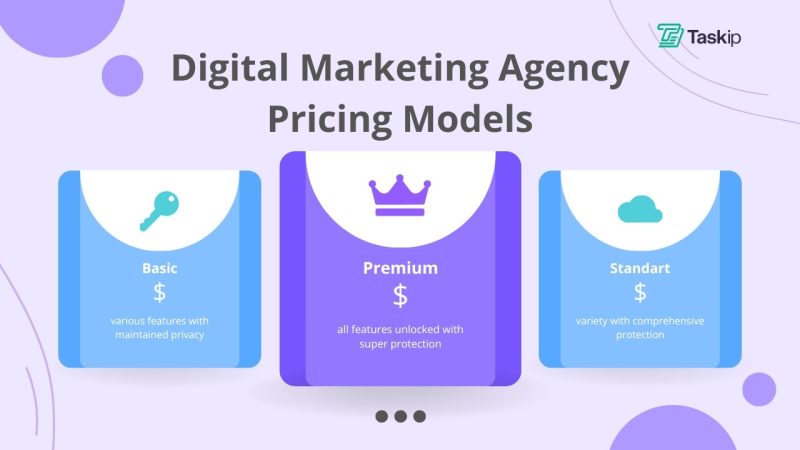
Bundle services into tiers (Starter $1,500/mo, Pro $5,000/mo) or ongoing access like SaaS plans.
- Pros: Easy to sell and scale; clients pick what fits; recurring revenue with upsell paths.
- Cons: Less flexible for custom needs; perceived as cookie-cutter; value must match tiers.
- Best for: Freelancers or small agencies productizing offers, like bundled SEO + content, using portals like Taskip for delivery and upgrades
Typical Price of Digital Marketing Services
Most pricing of digital marketing services is hiked, in that term, in 2026, average agencies charge within broad “normal” ranges, but the spread is wide because prices depend on scope, expertise, and market, not just a fixed menu of services. Think of the numbers below as benchmarks you can use to position your own offers, not rules you must follow.
Hourly, project, and package pricing
If you look at hourly rates, many agency set their pricing of digital marketing services in the 25–150 USD per hour range, with a large concentration in the 25–49 USD band for general digital marketing across global markets and higher rates in premium segments.
Senior specialists, strategic consulting, or high-end agencies can charge significantly more per hour because clients pay for speed, judgment, and risk reduction, not just time.
Project-based work (like website builds, funnel projects, or one-off campaigns) often runs from around 10,000 USD up to the high five figures for mid-market clients, depending on scope and complexity.
Many agencies now turn those one-off projects into structured packages (for example Starter, Growth, and Premium tiers) with clear inclusions and fixed price ranges, which makes buying easier and keeps your margins more predictable.
What pushes your prices up or down
Four levers explain most pricing of digital marketing services: market, expertise, scope, and client size. Agencies in high-cost regions or working with enterprise accounts usually charge more than teams in lower-cost locations or those focused on local businesses.
Depth of specialization and proof of results also matter a lot: a niche agency with strong outcomes in a specific vertical can sit at the top of the range, while generalists with weaker proof often compete at the bottom.
Finally, complex scopes (multiple channels, several markets, heavy creative) and high-risk environments (aggressive growth targets, large media budgets) justify higher retainers because the impact and responsibility are greater.
Set Up Your MPR Rate Based on The Pricing
Calculating your Minimum Profitable Rate (MPR) is the foundation of sustainable pricing of digital marketing services. It ensures every project or retainer covers your costs and leaves room for growth, preventing the common trap of working for free. Think of it as your pricing floor; no quote goes below this number without risking your business.

Why MPR Matters for Agencies and Freelancers
Many digital marketers undercharge because they ignore hidden costs like non-billable time or tools, leading to burnout and inconsistent income. Your MPR factors in salary goals, overhead, taxes, and profit, so pricing of digital marketing services is based on value delivered rather than hours logged. Agencies targeting 25% net profit margins use this to stay profitable even on complex projects.
Step-by-Step Formula to Calculate Your MPR
Start with your annual financial targets, then break them down into hourly or monthly baselines. Use this simple equation:
MPR (Hourly) = (Target Annual Income + Overhead Costs + Taxes + Profit Margin) ÷ Billable Hours per Year
Here’s how to plug in real numbers—adjust for your situation:
- Target Annual Income: What you want to pay yourself (e.g., $100,000 for a solo freelancer or agency owner).
- Overhead Costs: Fixed expenses like software (Taskip, Google Workspace), office rent, marketing, and admin—aim for 20-30% of revenue (e.g., $40,000).
- Taxes: Set aside 25-35% of income for taxes (e.g., $35,000).
- Profit Margin: Reinvest 15-25% for growth or emergencies (e.g., $25,000).
- Billable Hours: Realistic work time—1,200-1,500 hours/year after subtracting sales calls, emails, and holidays (not 2,000).
Example Calculation:
- Total Needs: $100,000 + $40,000 + $35,000 + $25,000 = $200,000
- Billable Hours: 1,440 (120 hours/month x 12)
- MPR Hourly: $200,000 ÷ 1,440 = $139/hour
Convert to projects (e.g., $139 x 40 hours = $5,560 minimum for a website audit) or retainers ($139 x 20 hours/month = $2,780).
| Component | Example Amount | Notes |
| Target Income | $100,000 | Your salary goal |
| Overhead | $40,000 | Tools, rent (20-30%) |
| Taxes | $35,000 | 25-35% buffer |
| Profit | $25,000 | 15-25% reinvestment |
| Total | $200,000 | Divide by billable hours |
| Billable Hours | 1,440 | 75% utilization rate |
| MPR Hourly | $139 | Your pricing floor |
Choose The Right Pricing of Digital Marketing Services
Choosing the right pricing of a digital marketing services model depends on where you are in your business journey, from solo freelancer to scaling agency. Early on, simplicity keeps you moving fast without getting bogged down in negotiations, while later stages let you charge based on results and build steady revenue streams.
Freelancers and Early-Stage Agencies
Start with clear packages or simple project-based pricing of digital marketing services to win clients quickly and avoid custom quotes every time. These models work best when you’re proving your skills, as they set fixed expectations—like a $2,000 website audit or a $5,000 starter SEO package with 10 optimized pages and keyword research.
Packages reduce decision fatigue for clients and let you batch similar work, freeing time for more projects; just define limits clearly, like “up to 2 revisions” or “one month of support,” to prevent scope creep.
Hourly rates ($75–$150) can fill gaps for quick audits or consulting, but cap your income since clients watch the clock—use them sparingly as you transition to fixed fees.
Growing Teams (3–10 People)
Shift to monthly retainers around $3,000–$10,000 to stabilize cash flow and focus on long-term results like ongoing SEO or content marketing.
Retainers suit teams because you can assign specialists (e.g., one for PPC, one for reporting) while billing predictably, often with tiered options: Basic ($4k for core tasks), Pro ($7k adding A/B testing), and Elite ($12k with full-funnel strategy).
This stage thrives on retainers since they cover non-billable time like team meetings or client calls—aim for 60–70% utilization to stay profitable, and include milestones for payments (e.g., 50% upfront, monthly thereafter).
Hybrid setups, like a $2k setup fee plus $4k/month retainer, ease clients in while protecting your upfront effort.
Established Agencies (10+ People)
Move to value-based or performance pricing of digital marketing services to charge 10–20% of client revenue generated, such as $10k+ retainers tied to leads or sales from campaigns.
This aligns your success with theirs, justifying premiums for niches like eCommerce, where you deliver $100k+ ROI—use data from past wins to benchmark, like “our clients see 3x return in 6 months.”
Subscription models with points (e.g., 100 points/month at $8k, redeemable for services) add flexibility for diverse needs, while performance bonuses (e.g., base retainer + 15% of ad revenue lift) motivate scaling.
At this level, tools like client portals streamline delivery—share dashboards for transparency, so clients see value and renew happily without nickel-and-diming.
Turn services into clear, premium packages by shifting from vague hourly work to defined offers that highlight your value and make buying easy for clients.
Prepare The Right Package for The Pricing of Digital Marketing Services
Most digital marketing pros struggle with custom quotes that drag on forever, leading to price haggling and scope creep. Packaging turns your expertise into ready-to-buy products, like “Growth Accelerator” or “Revenue Booster,” that clients can pick based on their needs. This approach boosts perceived value, cuts sales time, and lets you charge 20-50% more because clients see exact outcomes, not just hours logged.
Steps to Build Your Packages
Follow these straightforward steps to create packages that sell themselves.
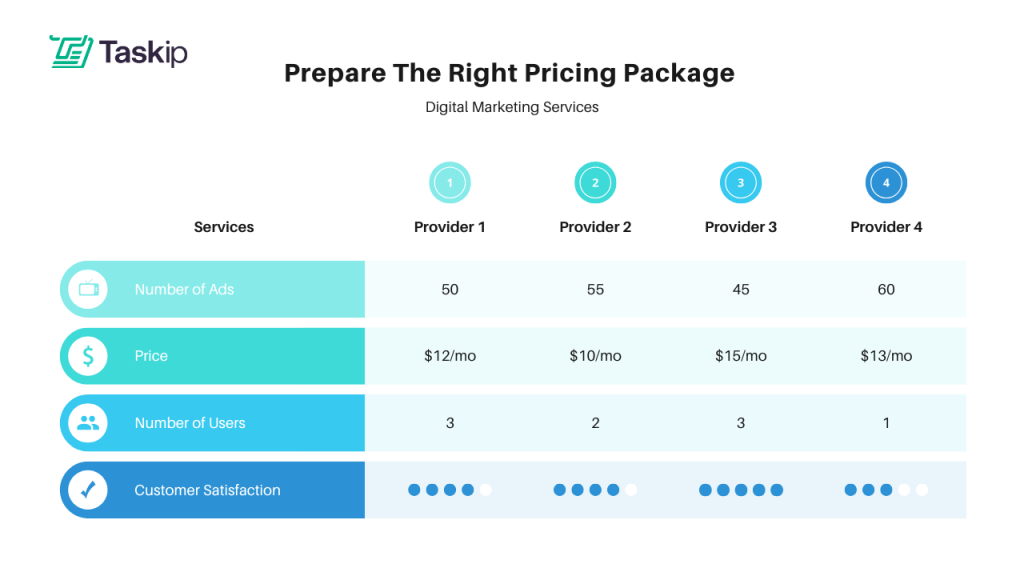
- Define your core outcomes first: Start with what clients really want—more leads, higher sales, or better rankings. For example, a “Lead Gen Package” promises 50 qualified leads per month, not “we’ll do social ads.”
- Pick 3 tiers for simplicity: Offer Starter (basic setup, $1,500/month), Growth (full execution + tweaks, $3,000/month), and Scale (custom strategy + team access, $5,000+/month). Each tier builds on the last with clear upgrades.
- List deliverables and limits: Spell out exactly what’s included—e.g., 10 posts/week, 2 reports/month, 1 strategy call. Add boundaries like “up to 2 revisions” to prevent endless changes.
- Set timelines and proof points: Attach 30-90 day ramps with milestones, backed by case studies showing real results, like “Client X gained 30% revenue in 3 months.”
Package Examples for Digital Marketing
Tailor these to your niche, like SEO for eCommerce or ads for SaaS.
| Package Name | Price Range | Key Deliverables | Ideal For |
| Starter SEO Boost | $1,000-$2,000/mo | Keyword research, 5 optimized pages/mo, monthly report | Small shops testing SEO |
| Growth PPC Engine | $2,500-$4,000/mo | Ad campaigns on 2 platforms, A/B tests, 20% traffic goal | Mid-size brands scaling leads |
| Scale Content Mastery | $4,000-$7,000/mo | Full funnel content (blog, email, social), CRO audits, revenue tracking | Agencies wanting full ownership |
Turn Your Services into Clear, Premium Packages
Using the right tools and systems turns your pricing of digital marketing services strategy from a guesswork game into a smooth, client-trusting machine that boosts your agency’s profits and retention. These setups handle proposals, client updates, billing, and proof-of-work, so you spend less time chasing payments and more time delivering results.
Client Portals for Transparent Pricing
Client portals like Taskip create a shared space where clients see real-time progress on tasks, milestones, and deliverables tied to their package or retainer. This builds trust fast—clients pay higher rates willingly when they watch their investment turn into leads or sales, rather than wondering what you’re doing with their money.
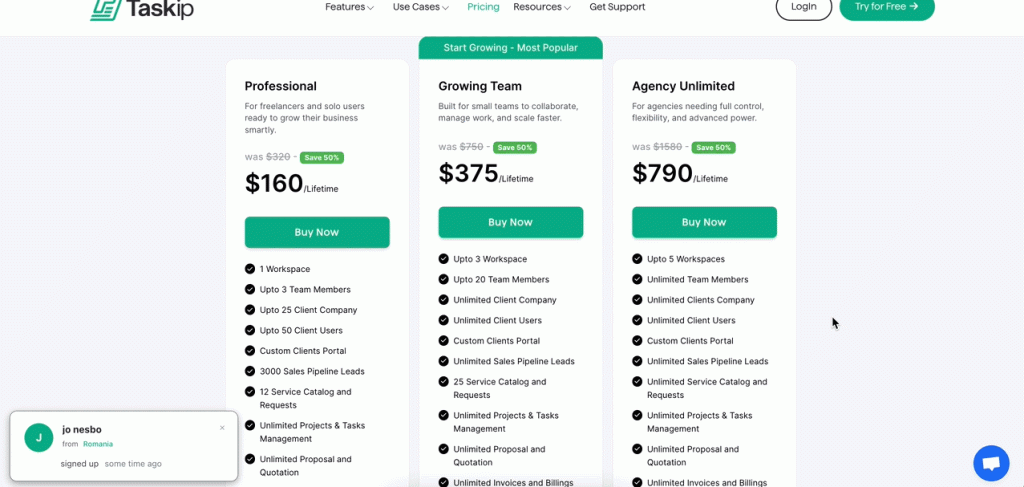
- Share custom dashboards for SEO rankings, ad spend ROI, or content calendars without endless email chains.
- Set up approval workflows for campaigns or reports, which locks in scope and stops sneaky scope creep that eats your margins.
For example, a $5,000 monthly retainer feels rock-solid when clients log in and see weekly wins, making renewals a no-brainer.
Streamlined Proposals and E-Signatures
Gone are the days of PDF ping-pong for quotes—tools with built-in proposal builders let you create, send, and sign pricing packages in minutes. Taskip’s proposal features bundle your services (like SEO audits at $2,500 or full-funnel retainers at $8,000/month) with clear timelines and outcomes, then get digital signatures on the spot.
This speeds up sales cycles by 50% or more, as clients commit faster without friction.
Track opens and views to follow up smartly, turning “thinking it over” into signed deals that justify the premium pricing of digital marketing services.
Automated Invoicing and Payments
Link your pricing of digital marketing services model directly to effortless billing: turn approved quotes into invoices automatically, schedule recurring retainers, and send reminders without lifting a finger. Taskip handles this seamlessly, integrating quotes to invoices so a $3,000 project fee hits your bank on time.
- Avoid cash flow gaps common in project-based pricing of digital marketing services by setting milestones (e.g., 30% upfront, 40% mid-project, 30% on delivery).
- Clients love the portal view of unpaid invoices next to their progress updates, which cuts disputes and late pays.
This setup alone can increase your effective hourly rate by freeing 10-20 hours a month from admin drudgery.
Reporting and Proof-of-ROI Dashboards
Premium pricing of digital marketing services demand proof—use integrated reporting to show clients hard numbers like traffic growth or conversion lifts against their retainer spend. Taskip’s document sharing and real-time updates make it easy to upload GA4 screenshots or custom ROI calculators right in the portal.
- Monthly recaps tied to pricing tiers (Starter: basic metrics; Premium: full attribution) reinforce value and open doors for upsells.
- When clients see “Your $4,000 retainer generated $25,000 in pipeline,” they rarely negotiate renewals down.
Ticketing and Communication to Protect Margins
Scope creep kills profits, but centralized ticketing in tools like Taskip logs every client request as a ticket linked to their package limits. Need extra ad creative beyond the retainer? It becomes a clear upsell opportunity.
- Real-time chat and @mentions keep discussions on-topic, reducing “quick favor” emails that turn into free work.
- For teams, assign tickets with deadlines, so your pricing covers actual delivery without overtime surprises.
Agencies using these systems report 20-30% higher retention, as clients feel involved without overwhelming your team.
Meeting Scheduling and Workflow Automation
Book strategy calls or reviews via shared calendars in the portal—clients pick slots, get confirmations, and see how it fits their service timeline. Taskip’s scheduling simplifies this, ensuring billable meetings align with the pricing of digital marketing services’ scopes.
Automate workflows too, like turning client feedback emails into tasks or forms for new projects, so your hybrid pricing of digital marketing services (setup fee + retainer) runs like clockwork.
This professional polish makes even freelancers look like big agencies, commanding $150+ hourly equivalents.
Focus on The Value Against the Pricing of Digital Marketing Services
Communicate the pricing of digital marketing services by focusing on the value and results clients will achieve, rather than just listing costs. Start proposals with clear outcomes like “Generate 50 qualified leads per month” to shift the conversation from expense to investment. Use simple visuals, such as ROI projections or past case studies, to back up your rates and address objections head-on with phrases like “This covers dedicated strategy, execution, and weekly reporting to ensure we’re on track.”
Defend the pricing of digital marketing services confidently by anchoring to client-specific ROI, not competitor rates. If pushback arises, ask “What outcome are you aiming for?” then tie your fee directly to that goal, explaining the process: audits, optimizations, and measurable wins. Tools like client portals make defense easier—share real-time progress dashboards so clients see the work justifying the price, reducing disputes and building trust.
When to Raise Pricing of Digital Marketing Services and How
Raise pricing of digital marketing services when your calendar fills up consistently, case studies prove strong results, or costs like tools and team salaries climb. Target a 10-20% increase annually for top performers, but act sooner if demand outpaces capacity. Watch for signs like clients renewing easily or requesting more services—these signal room to charge more without losing deals.
Roll out increases first to new clients via updated packages, then notify existing ones 60-90 days before renewal with a value-add letter: “We’ve enhanced reporting and added AI insights, reflected in our new tier.” Offer grandfathered rates for loyal clients or bundle extras like faster support to ease the transition. Track retention post-raise; if it dips below 80%, refine your communication or add more proof of value.
Final Thought: Build a Pricing Engine for Your Digital Marketing Services
Ditch one-off quotes by creating standardized packages in a client portal, think tiered retainers (Starter: $2K/mo for basics; Scale: $10K+ for full growth). Automate proposals, e-signatures, and invoicing to cut admin time by 50%, freeing you for billable work. Integrate sales pipelines to track deals from quote to close, turning pricing of digital marketing services into a repeatable system that scales with your agency.
FAQ on How to Set Pricing of Digital Marketing Services
What Are the Best Pricing Models for Digital Agencies?
Digital agencies thrive with monthly retainers or hybrid models (setup fee + retainer), as they provide predictable revenue and align with ongoing client growth like SEO or PPC campaigns. Project-based pricing suits one-offs like audits, while value-based ties fees to ROI for high-trust niches. Use a client portal like Taskip to track deliverables and justify retainers through transparent progress updates.
How Do I Calculate My Minimum Profitable Rate?
Start with a formula: (desired salary + overheads + tools + taxes + 20-30% profit margin) ÷ billable hours (typically 1,000-1,200/year after non-billable time). This yields your hourly baseline, then scale to projects (e.g., 10x hourly x hours) or retainers ($3K-$10K/month for mid-tier services). Taskip streamlines invoicing from quotes to reduce admin drag on your margins.
Should Freelancers Use Hourly or Package Pricing?
Freelancers should prioritize fixed packages or retainers over hourly rates to avoid undervaluing expertise and scope creep—e.g., “SEO Growth Package” at $2K-$5K/month with defined deliverables. Packages build perceived value; pair them with Taskip’s proposals and e-signatures for quick client buy-in without endless revisions.
How Can Taskip Help Justify Higher Prices?
Taskip’s all-in-one portal lets you share real-time project updates, reports, and milestones, proving ROI and reducing price objections—clients see the work, not just the invoice. Features like automated quotes-to-invoices and ticket management prevent disputes, letting you charge premium retainers confidently.
When Should I Raise Pricing of Digital Marketing Services?
Raise prices when you’re fully booked, have strong case studies, or costs rise—introduce new rates to prospects first, then notify retainers 30-60 days ahead with added value like enhanced reporting. Tools like Taskip’s sales pipeline and client communication centralize this process for smoother transitions.



Get Summary On: