Top Digital Marketing Agency Trends Need to Know in 2026
The digital marketing agency trends are moving fast, really fast. If your agency isn’t staying on top of the latest trends, you’re already falling behind. From AI revolutionizing campaign optimization to social commerce hitting trillion-dollar milestones. Let’s break down the trends that matter most for your agency and what you need to do to capitalize on them.
1. AI Agents Are The New Addition in Digital Marketing Agency Trends
Here’s the reality: 2024 was all about large language models, but 2026? This is the year of AI agents. These aren’t just chatbots or basic automation tools, they’re intelligent software systems that can process multiple types of information, reason through problems, and think several steps ahead to manage complex workflows.
Think about what this means for your agency. Instead of juggling multiple tools, AI agents can handle customer inquiries, optimize ad campaigns in real-time, score leads, and even extract data from documents automatically. One example: AI agents can improve lead conversion by 58% by scoring leads based on multiple criteria, updating your CRM, triggering follow-up sequences, and alerting your sales team to high-priority opportunities.
What your agency should do: Start experimenting with AI agents for routine client work. Whether it’s content creation, campaign optimization, or customer support automation, these tools can free up your team to focus on strategy and high-value creative work.
2. Hyper-Personalization Is The New Key
Forget generic emails and one-size-fits-all marketing. In 2026, personalization has evolved far beyond just adding someone’s name to an email. Agencies that succeed are using AI-powered hyper-personalization to deliver tailored experiences across every touchpoint.
The numbers tell the story: 73% of business leaders agree that AI will redefine personalization strategies, and 92% of businesses are already using AI-driven personalization. Personalized calls-to-action outperform generic ones by 202%. That’s not just incremental improvement—that’s transformative.
Here’s what hyper-personalization looks like in practice to follow digital marketing agency trends:
- Product recommendations based on machine learning that predict what customers actually want to buy
- Real-time messaging that triggers based on user location, behavior, or activity
- Tailored ads that display based on search history and demographic data
- Customized landing pages where different audience segments see content designed specifically for them
Your clients’ customers expect this level of personalization. They want to feel understood, not stalked. When done right, it builds loyalty and drives conversions.
3. Social Commerce Is Becoming Your Revenue Goldmine
Social commerce isn’t a trend anymore—it’s a fundamental shift in how people buy. By 2026, social commerce sales are projected to hit $2 trillion globally, with Gen Z and Millennials leading the charge. In the U.S. alone, social commerce is expected to surpass $90 billion in sales.
What’s driving this? Simple: 82% of consumers use social media for product discovery, and 53% of global users now purchase directly through social platforms. The friction is gone. People discover a product, see the price, make a purchase—all without leaving the app.
For agencies, this means your content strategy has to evolve. You’re not just creating engagement anymore. You’re creating shoppable experiences. Live shopping events, shoppable posts, AR try-ons, and AI-driven product recommendations are now essential components of social commerce strategy.
What your agency should do: Help your e-commerce clients leverage shoppable posts on Instagram, TikTok, and Facebook. Train them on live shopping events. Show them how to use influencers to drive direct sales, not just awareness. This is where the real revenue is.
4. Content Quality & Uniqueness Over Quantity
Here’s something agencies need to hear: the days of pumping out mediocre AI-generated content are over. Google’s evolving algorithms and changing user expectations mean that quality and uniqueness now dominate the content game.
In 2026, marketers are getting creative about sourcing unique data and insights that AI simply can’t replicate. Why? Because original insights create competitive advantages—what experts call “uniqueness moats.” Generic, AI-generated content without human perspective doesn’t cut it anymore.
This doesn’t mean you abandon AI. Rather, you use it as a tool—to brainstorm, outline, and speed up the drafting process. Then humans come in to add the authentic voice, emotional connection, and strategic thinking that makes content actually resonate.
The formula that works: AI efficiency + human creativity = exceptional content.
Short-form video, evergreen content, and search-intent-driven content also remain critical. But the key is that everything should be built with strategic purpose. Match the intent behind search queries. Build topic clusters. Structure content for featured snippets. Make every piece count.
5. Email Marketing Gets Smarter (And More Personal)
Email remains one of the highest-ROI channels for agencies, and in 2026, it’s getting powered up with AI.
What’s new? Instead of just using AI to generate subject lines, agencies are now using AI for:
- Behavior-based segmentation that groups people by what they actually do, not just demographics
- Predictive send times that identify when each subscriber is most likely to engage
- AI-optimized inbox previews that increase open rates
- Automated content personalization that tailors messaging based on past purchases and browsing behavior
The result? Higher engagement, better conversions, and more efficient campaigns. Personalized campaigns drive significantly higher engagement—72% of consumers engage only with relevant marketing messages.
But here’s the catch: AI-generated emails still need the human touch. Over-reliance on AI makes emails feel generic and inauthentic. Your best results come from blending AI efficiency with genuine human insights about what your clients’ audiences actually care about.
6. SEO and AI Are Merging Into One Strategy
The intersection of traditional SEO and AI is creating entirely new opportunities for visibility. In 2026, structured data, schema markup, and AI-driven insights are becoming inseparable from SEO strategy.
Here’s why: Large language models need structured data to function properly. When you optimize your site with clear schema markup and comprehensive structured data, you’re not just helping Google understand your content—you’re helping AI models (used in search engines, AI overviews, and other platforms) recognize you as a credible source.
The future goes like this: Websites with robust data structures serve as input, AI models function as analytical instruments, and companies that harmonize both areas achieve significant outreach not just in traditional search results, but in AI-generated answer boxes too.
What your agency should do: Make schema markup and structured data a core part of your SEO strategy. Focus on featured snippets and zero-click searches. Help clients answer the exact questions their audience is asking.
7. Influencer Marketing Shifts to Performance & Authenticity
The era of one-off influencer campaigns is dead. In 2026, digital marketing agency trends are making a clear shift toward performance-based partnerships and long-term collaborations with creators.
Brands are moving away from paying flat fees and instead focusing on commissions based on actual results. They’re investing in long-term ambassador relationships with nano and micro-influencers rather than chasing one big celebrity partnership. Why? Because authenticity resonates, and smaller creators often have higher engagement rates.
Here’s what’s changing:
- Nano and micro-influencers (1K-100K followers) are becoming more valuable than mega-influencers
- UGC creators (user-generated content specialists) are rising because they know how to create content that converts
- Cross-channel campaigns that start on TikTok, expand to YouTube, and spark discussions on X are becoming standard
- AI tools are making it easier to identify the right creators, predict campaign performance, and optimize real-time
The winning strategy: Build long-term relationships with creators who genuinely align with your clients’ brands. Measure performance by actual conversions, not just impressions.
8. Marketing Mix Modeling (MMM) Is Becoming More Accessible
With budgets tight and stakeholders demanding proof of ROI, marketing mix modeling is no longer just for big enterprises. It has entered the digital marketing agency trends.
What’s changed? Today’s MMM tools are smarter, faster, and more affordable. They provide real-time insights instead of waiting weeks for analysis. They’re evolving to include always-on channels like Search, giving you a holistic view of how different marketing channels actually drive business impact.
For agencies managing multiple clients with varying budgets, MMM helps answer the crucial question: “Where should we spend the next dollar to get the best return?” It cuts through the noise and shows what’s actually working.
What your agency should do: Invest in understanding your clients’ marketing mix. Align on KPIs, map media spend, and build an experiment calendar. This data-driven approach demonstrates real value to clients and positions your agency as strategic, not just tactical.
9. Privacy-First Data & First-Party Data Strategy
Third-party cookies are gone. In 2026, first-party data information collected directly from customer interactions is the new foundation for targeting and personalization as a part of digital marketing agency trends.
This is actually good news for agencies. First-party data is more reliable, more compliant, and gives you a clearer picture of your customers. The challenge? Collecting and organizing it effectively. Consent-first targeting, zero-trust architecture, and built-in data governance are becoming default requirements.
The smart agencies are helping clients build loyalty programs, email lists, and direct relationships that generate zero-party data (data customers voluntarily share). These digital marketing agency trends fuel better personalization without the privacy risks.
10. Workflow Automation & Agency Management Tools
Here’s something that directly impacts your agency operations: workflow automation is becoming one of the core digital marketing agency trends for scaling without hiring endlessly. AI, RPA (robotic process automation), and low-code/no-code platforms are converging to automate complex, multi-step processes.
Think about your agency’s pain points:
- Client onboarding takes too long
- Reporting is manual and time-consuming
- Invoicing and follow-ups get lost in email threads
- Project tracking across multiple clients is chaotic
The solution to keep up with digital marketing agency trends? All-in-one client management and workflow platforms that centralize communication, automate routing, and keep everything organized. Agencies using client management software report a 25% increase in client satisfaction, a 30% reduction in administrative workload through automation, and a 15% improvement in project performance metrics.
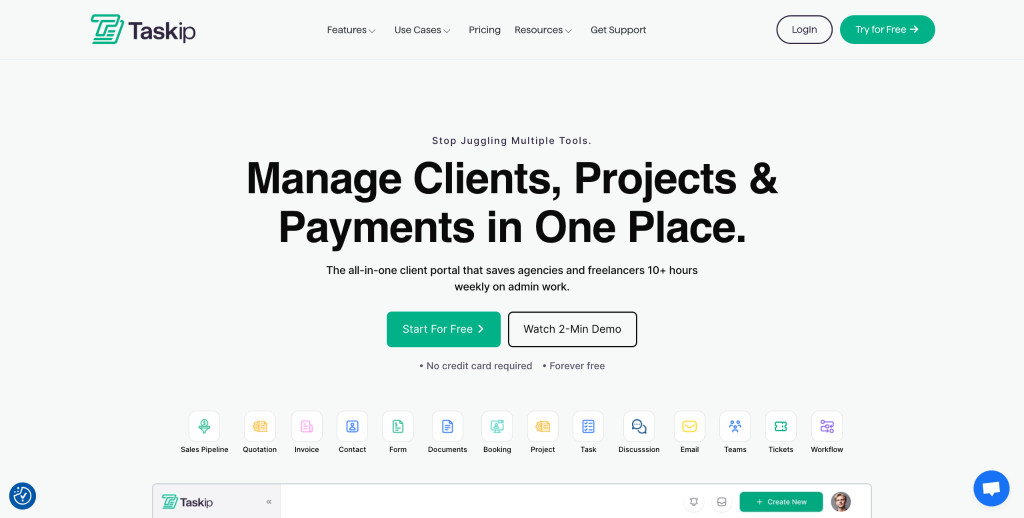
For example, platforms like Taskip are designed specifically for agencies and freelancers. Instead of juggling Trello for projects, Zoho CRM for client data, Calendly for meetings, Typeform for forms, and DocuSign for signatures,
Taskip consolidates all of this (and more) into one streamlined platform. You get task management, client portals, invoicing, proposal creation, meeting scheduling, and document management in a single space. The result? Less context-switching for your team, better client experience, and significantly reduced operational overhead.
Think about it: if you’re replacing 8+ tools with one platform, you’re not just saving money on subscriptions, you’re saving your team hours every week that they can spend on actual client work and strategy.
11. Interactive & Personalized Content Formats
Static blog posts and standard emails? They’re losing power. In 2026, digital marketing agency trends are winning with interactive content that engages audiences and makes them active participants.
What works:
- Quizzes that help customers find the right product or service
- Calculators that provide immediate value (ROI calculators, pricing tools)
- Dynamic CTAs that change based on visitor behavior
- Gamification in emails and on-page content
- Personalized video that speaks directly to individual customers
Interactive content doesn’t just get more engagement, it also gives you rich data about what your audience cares about, which you can feed back into personalization strategies.
Bonus Tip: AI-Driven Marketing Strategies: Using AI-Powered Tools
AI-driven marketing strategies in 2026 use AI-powered and AI-based tools to move from third-party data dependency to first-party data mastery, blending AI-generated content with creator-led content through co-creation and co-create workflows that power short-form video, cross-channel campaigns, and smarter AI-generated experiences, outgrowing the 2024 era of basic AI tools and using AI for generic outputs.
Bringing All Digital Marketing Trends Together: Your 2026 Agency Action Plan
The digital marketing trends shaping 2026 aren’t separate silos; they work together. AI powers personalization. First-party data enables targeted campaigns. Unique content builds authority. Performance-based partnerships prove ROI. Workflow automation keeps your operations lean.
The agencies thriving in 2026 are those that can orchestrate all of these elements for their clients while managing their own operations efficiently. That means having the right technology in place—not scattered across a dozen tools, but integrated into a seamless workflow.
If you haven’t already, audit your current tech stack. Are you and your team context-switching between too many platforms? Are client communications scattered across email, Slack, and scattered documents? Is reporting a manual nightmare?
The best investment you can make this year isn’t in the latest marketing tool—it’s in operational efficiency. Use workflow automation to free up your team’s mental energy. Then, let them focus on what they’re actually good at: strategy, creativity, and client relationships.
FAQ on Top Digital Marketing Trends Agencies Need to Know
What are AI agents in 2026 marketing?
AI agents autonomously reason, plan, and execute workflows like campaign optimization and lead scoring, boosting conversions by 58%. Agencies use them for real-time ads and CRM updates via tools like Talkwalker Yeti.
How does hyper-personalization boost ROI?
AI delivers 1:1 experiences like dynamic recommendations, outperforming generics by 202% in conversions with 91% consumer preference. Blend Predictive analytics across emails and sites for authenticity.
What drives 2026 social commerce growth?
Sales hit $900B+ globally, with 82% product discovery on platforms; agencies adapt via shoppable posts, live events on Instagram/TikTok. Focus influencers for direct Gen Z sales.
Why prioritize structured data for SEO?
Schema markup aids AI parsing for overviews and rich snippets, enhancing visibility in semantic search over keywords. Audit sites for topic clusters to target zero-click results.
Best tools for agency workflow automation?
Taskip, FloTorch consolidate tasks, portals, invoicing; cut admin 30%, boost satisfaction 25% for Shopify/SaaS scaling. Replace fragmented tools like Trello/Zoho.

Get Summary On: