AI Automation Agency Cost: How Much Should You Budget in 2026?
You’ve seen the demos and read the case studies. Now you’re looking at a proposal for $4,500/month with no clear way to know if it’s fair or just an arbitrary number.
That’s the challenge with automation consulting costs: they’re rarely transparent. Agencies don’t publish standard pricing, and proposals vary widely. One might show a $1,200 setup fee, another demands $15,000 upfront, while others bundle everything into a single retainer with no breakdown.
This guide breaks down how much the AI automation agency costs, what drives pricing up or down, the common proposal structures you’ll encounter, and how to quickly spot a fair quote.
If you’re evaluating vendors, this is your buyer’s map.
TL;DR — What You Need to Know in 60 Seconds
- A basic automation build costs $1,500 to $12,000 one-off. A full-service monthly retainer runs $4,000 to $12,000/month.
- The biggest cost driver is integration complexity, not workflow length.
- Three structures exist: project-based, monthly retainer, and productized package. Each shifts risk differently.
- An agency at $5,000/month is often cheaper than one in-house hire when you account for benefits, management overhead, and redundancy.
- Before signing, confirm: itemized scope, post-launch support period, named account contact, and a 30-day exit clause.
- Red flags: no line-item breakdown, locked tooling, opaque reporting, and urgency pressure on pricing.
Table of Contents
How Much Do AI Automation Agencies Cost in 2026? (Pricing Breakdown)
Based on our review of pricing pages, proposals, and public rate information from AI automation agencies in the US and EU in Q1–Q2 2026, here is what buyers are actually paying:
| Engagement Type | Typical Range (USD) | Best For |
| One-off automation build | $1,500 – $12,000 | Single workflow, defined scope |
| Monthly retainer — light | $1,000 – $3,500/mo | Maintenance, small automation stack |
| Monthly retainer — full-service | $4,000 – $12,000/mo | Multi-workflow ops, reporting included |
| Enterprise custom AI stack | $15,000 – $60,000+ build | Large orgs, compliance, deep integrations |
| Productized package | $500 – $4,000/mo | Standardized deliverable, fast deployment |
A well-scoped engagement at the low end of a range will outperform an overpriced one at the high end every time. The ranges matter less than the scope behind them.
What Affects AI Automation Agency Pricing?: Key Cost Drivers Explained
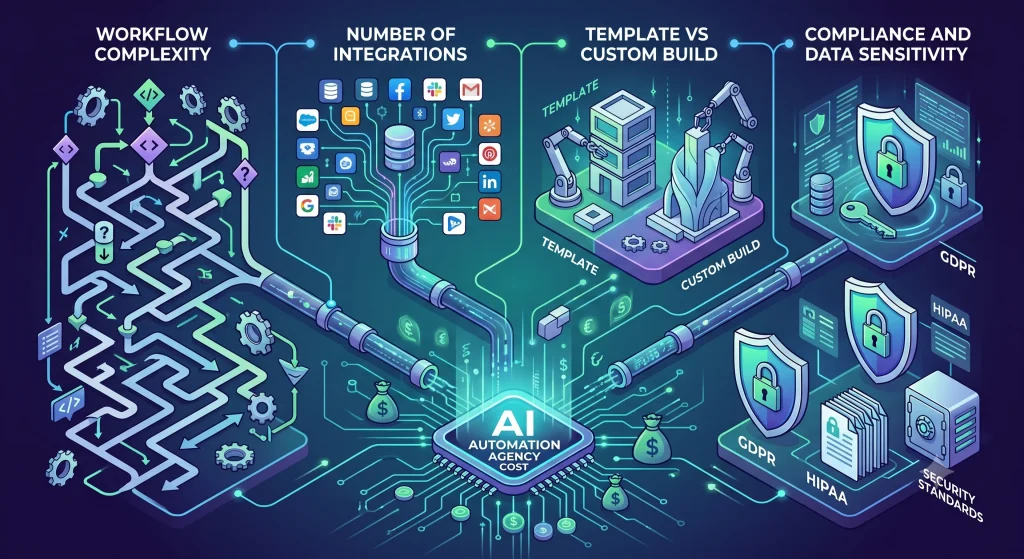
The headline number in any proposal is the output of four inputs. Understand them, and you can negotiate on what actually matters.
1. Workflow Complexity
A simple trigger-and-action automation that connects two SaaS tools usually takes two to four hours to build. A more advanced AI workflow that pulls CRM data, processes it through an LLM, scores outputs, and routes results into multiple systems can take 30 to 60 hours or more. This difference in complexity is one of the main reasons pricing varies so widely.
2. Number of Integrations
Connecting tools like HubSpot and Slack is actually straightforward. However, integrating a legacy ERP system with a custom API and an AI layer is significantly more complex. Poor documentation, rate limits, and non-standard systems all increase build time. Thus, integrations without clean APIs often add 20 to 40 percent to the overall cost.
3. Template vs Custom Build
Some agencies rely on pre-built automation frameworks. If your use case fits their existing system, the work is faster and more affordable. If not, they need to build custom logic from scratch, which increases both time and cost. A useful question to ask is whether the solution is a custom build or an adaptation of an existing system.
4. Compliance and Data Sensitivity
Industries like healthcare, legal, and finance introduce additional requirements. Security reviews, data handling agreements, and specialized infrastructure often add overhead. If your workflows involve PHI, PII, or regulated financial data, expect pricing to increase by 25 to 50 percent.
3 Popular AI Automation Price Models
When you request a quote from an AI automation agency, you will get different pricing models. They shift risk differently between you and the agency. Here are the top three most popular AI automation price models:
| Structure | How It Works | Risk Profile | Typical Cost |
| Project-based | Fixed price for a defined deliverable | Scope risk on agency | $1,500 – $40,000 |
| Monthly retainer | Fixed monthly fee, defined hours or deliverables | Ongoing commitment risk on you | $1,000 – $25,000/mo |
| Productized package | Pre-built workflow applied to your context | Fit risk on you | $500 – $6,000/mo or one-off |
- Project-based suits you when the problem is specific and bounded. “Automate our lead qualification process from form fill to CRM record to sales rep notification” is a good project brief. “Make our marketing ops more efficient” is not. Watch for vague scope, no post-launch support period, and missing handover documentation.
- Monthly retainer suits ongoing work: tuning existing automations, building new workflows as needs arise, and monthly reporting. Watch for retainers that grow without revised scope agreements, and “unlimited” retainers that are really capped at an undisclosed internal limit.
- Productized packages are faster to deploy and usually cheaper than custom builds. Watch for agencies selling a template as custom work. If the discovery call was under 30 minutes and the proposal arrived the same day, you probably received a template without anyone checking whether it fits your situation. If the productized package does not fit your situation, ask the agency what alternatives they offer. Most can shift to a project-based scope or a light retainer without changing the underlying build cost significantly.
For agencies managing these structures with clients, Taskip’s retainer vs. project tools keep the billing and scope expectations clear on both sides.
For B2B outbound automation, agencies usually sell productized packages instead of custom builds. These packages often include lead research, prospect enrichment, outreach sequencing, and reply management. Pricing usually ranges from $1,500 to $4,000 per month.
Automation Services Pricing by Business Size
Automation agency fees scale with what you are asking the agency to do. Here is what buyers at different tiers commonly spend, and what they should expect for that investment.
| Business Size | Typical Monthly Investment | What’s Usually Included |
| Small business | $1,000 – $3,500/mo | 1–2 workflows, build + light maintenance |
| Mid-market | $4,000 – $10,000/mo | Multi-workflow stack, reporting, and new builds |
| Enterprise | $8,000 – $25,000/mo | Dedicated team, compliance, custom integrations |
Small Business
At this tier, you are mainly automating one or two core workflows such as lead capture, invoice generation, appointment scheduling, or social media publishing. The agency handles the build and documentation, and you manage the system after handover, with break-fix support available on call.
What good looks like is a clearly scoped build, proper documentation, and a 30-day post-launch check-in. What to avoid is agencies bundling excessive scope into a small retainer and later blaming you when deliverables are unclear or underutilized.
Mid-Market
At this level, the agency functions less like a build shop and more like an ongoing operations partner. Monthly work usually includes new automation builds, performance reporting, prompt tuning, and integration maintenance. Tools like Taskip’s client portal help buyers at this stage track delivery without relying on scattered email threads.
A common risk here is scope creep disguised as added value. If the agency continues adding deliverables without updating the agreement, either the original scope was poorly defined, or the work is being underpriced to retain the account.
If you’re hiring an AI marketing agency for content production, SEO workflows, paid media reporting, or social media automation, expect to pay around $3,000–$8,000 per month. Most agencies also charge a one-time setup fee of $3,000–$10,000, depending on how many channels and workflows need to be automated.
Enterprise
Enterprise and high-ticket projects usually require custom integrations, compliance reviews, multi-team coordination, and dedicated engineering support. High-ticket clients with annual marketing or operations budgets of $500K+ often receive a dedicated agency team rather than a shared retainer, leading to higher costs.
According to Gartner’s 2025 research on intelligent automation adoption, enterprise organizations allocate an average of 12 to 18 percent of their IT services budget to automation work, including both internal teams and external agencies. For a $1M IT budget, this translates to roughly $120,000 to $180,000 per year. For a $500K budget, expect $60,000 to $90,000.
Be cautious of enterprise-level pricing applied to mid-market problems. If the statement of work lacks clear deliverables, request a milestone breakdown before signing.
Taskip’s quotation tools help structure these complex proposals so both sides agree on what “done” looks like.
Manual vs. Freelancer vs. AI Agency vs. In-House: The Real Cost Comparison
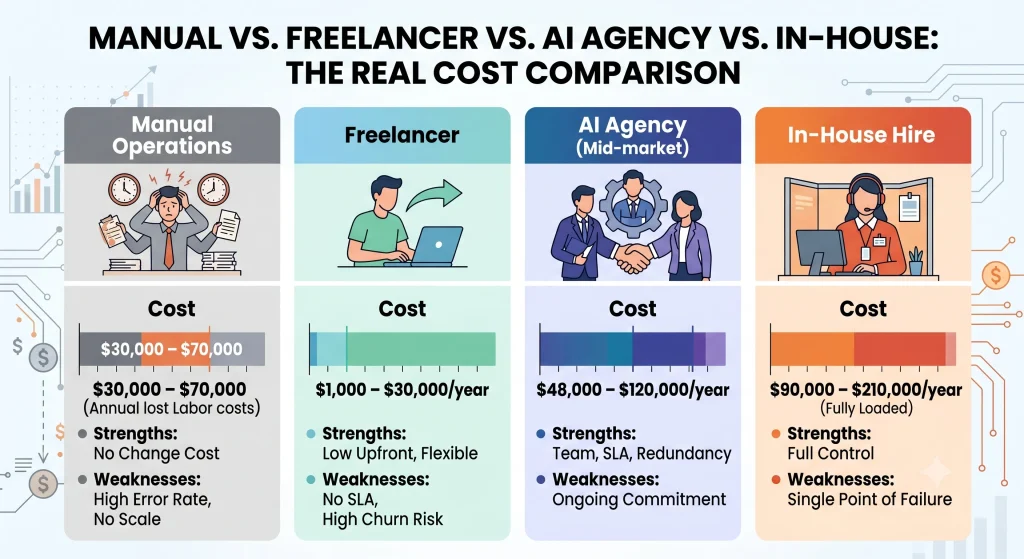
The AI automation agency cost question only makes sense relative to the alternatives. Most buyers choose between three options. Here is what each actually costs.
| Option | Typical Annual Cost (USD) | Strengths | Weaknesses |
| Manual operations | $30,000 – $70,000 in lost labor | No change cost | High error rate, no scale |
| Freelancer | $1,000 – $30,000/year | Low upfront, flexible | No SLA, high churn risk |
| Agency (mid-market) | $48,000 – $120,000/year | Team, SLA, redundancy | Ongoing commitment |
| In-house hire | $90,000 – $210,000/year | Full control | Single point of failure |
Manual Operations
Manual workflows persist mainly because their cost is invisible. For example, a coordinator spending four hours a day on tasks that could be automated represents roughly $30,000 to $50,000 per year in loaded labor cost.
McKinsey research on automation potential estimates that 60 to 70 percent of tasks across most business functions are technically automatable. The real question is not whether automation delivers value, but whether your team can build and maintain it consistently without external support.
Freelancer
Freelancers usually charge $50 to $150 per hour. A single workflow build may cost $1,000 to $6,000, which can make freelancers competitive with agencies for smaller projects.
The main limitation is maintenance. A freelancer who builds your system in March may not be available months later when an API change breaks it. According to Zapier’s State of Business Automation 2024 report, 43 percent of businesses using freelancers for automation experienced at least one critical workflow failure due to a lack of ongoing support.
AI Automation Agency
Agency engagements usually run $4,000 to $10,000 per month at the mid-market level, or roughly $48,000 to $120,000 per year. In return, you get a team that usually includes a project manager, one or two automation engineers, and a prompt specialist, along with built-in redundancy and a structured delivery process.
If one person leaves the agency, the engagement continues without disruption. If your requirements shift, the team adapts. The trade-off is commitment: retainers are ongoing costs, not one-time expenses, and they only make sense when there is consistent automation work to support them.
An agency at around $5,000 per month, or $60,000 per year, provides a team structure with multiple skill sets, built-in redundancy, and established delivery processes.
In-House Hire
An in-house automation hire generally costs $70,000 to $140,000 in base salary, with a fully loaded annual cost of $90,000 to $210,000. This provides dedicated capacity but only from a single skill set.
It also introduces dependency risk. If the hire leaves, the entire automation system can become difficult to maintain or extend.
For most mid-market businesses, the agency model is the strongest economic option. The balance only shifts toward in-house when automation workload consistently requires more than two full-time equivalents.
Real Example: AI Automation Cost for a Content Workflow
Here is a realistic engagement based on projects scoped by AI automation agencies for content-heavy B2B businesses.
The Business
A 25-person content marketing agency producing around 40 pieces per month across 15 B2B clients. Two content managers currently handle coordination manually using Google Sheets and email.
The Problem
Approximately 24 hours per week is spent on repetitive coordination tasks, including brief assignments, approval follow-ups, client status updates, and monthly reporting.
Workflows Built
- Brief-to-assignment workflow: New content briefs automatically trigger writer assignment based on capacity rules, with instant client notifications.
- Approval routing workflow: Completed drafts are automatically sent to the client contact, with a 48-hour follow-up reminder if no response is received.
- Monthly reporting workflow: Performance data is pulled from Google Analytics, processed through an AI summarization layer, and converted into a draft report every four weeks.
Cost Breakdown
| Item | Cost |
| Build phase (6 weeks) | $9,500 one-off |
| Monthly retainer (maintenance + new workflows) | $2,800/month |
| AI tool subscriptions (pass-through) | $180/month |
| Year one total | $43,660 |
Return on Investment
| Metric | Value |
| Hours saved per week | ~20 hours |
| Loaded hourly cost | $38/hour |
| Monthly labor savings | ~$3,040 |
| Net benefit (month 1) | ~$60 |
| Net benefit (month 6, post-build amortization) | ~$1,860/month |
| Estimated 12-month net benefit | ~$9,420 |
Key Takeaway
This is a conservative model. It does not include harder-to-measure gains such as improved strategic focus for managers, fewer client reporting errors, or faster approval cycles. These benefits mostly compound over time but are difficult to quantify in the first month.
Taskip’s invoicing tools track retainer billing and monthly deliverables so nothing falls through the cracks when multiple workflows are running simultaneously.
How to Evaluate an AI Automation Agency Proposal: 6 Questions to Ask
A proposal with a number on it is not a complete quote. A real quote includes pricing, scope, timeline, billing structure, and a clear definition of what happens when something breaks. Most proposals are missing two or three of these elements.
Before responding to any automation agency proposal, check these six questions:
1. Is the scope of an AI automation proposal clearly defined?
“Automate your marketing operations” is not a clear scope. A proper scope should describe exactly what will be built, such as connecting HubSpot forms to a lead scoring system and sending results to Slack and the CRM.
If you cannot verify whether the deliverable is complete, the scope is too vague.
2. What should be included in an AI automation agency proposal deliverables?
The proposal should clearly list what will be delivered, including workflows built, integrations connected, documentation, and support response times.
If deliverables are vague or descriptive, the proposal is not measurable.
3. Do AI automation agencies include post-launch support?
A proper engagement includes 30 to 60 days of post-launch support. If support is missing, it is a red flag unless explicitly removed for pricing reasons.
4. Who is the account manager or escalation contact in an automation agency?
You should always know who to contact when something breaks. A named account manager is a sign of accountability. A generic inbox is a warning sign.
5. How do AI automation agencies handle scope changes?
A professional agency uses a formal change order process where new work requires a new quote. If changes are handled informally, it creates risk for cost overruns.
6. What is a normal exit clause in an AI automation agency contract?
Most retainers allow cancellation with 30 days’ notice after the initial term. Longer notice periods on monthly retainers should be reviewed carefully.
According to PwC’s 2025 Digital Operations Survey, 61 percent of businesses dissatisfied with automation vendors cited unclear scope and poor change management, not technical execution.
5 Red Flags in AI Automation Proposals
Some proposals look competitive on the surface while hiding the real automation implementation cost. These five patterns should make you slow down.
1. No Itemization
A proposal with a single line total and no breakdown is a negotiation tactic. Ask for line items. Any agency that refuses is betting on your inability to compare.
2. “AI-powered” with No Specifics
In 2026, AI means something specific: an LLM call, a classification model, a retrieval system, or computer vision. If the agency uses “AI-powered” without naming the model, platform, or integration, ask for specifics. Many “AI” proposals describe conditional logic that any standard automation tool handles without a model.
3. Locked Tooling
Some agencies build on proprietary platforms and charge platform fees in addition to the retainer. When you exit, your automations stop working because they only run inside the agency’s tool. Ask directly: “If we stop working together, can we take the automations with us?” A legitimate agency should be able to migrate work to tools you own.
4. Artificial Urgency
“This rate is only valid for 48 hours” has no legitimate basis in professional services. Reputable agencies do not manufacture urgency. Walk away from any proposal that uses this framing.
5. Unclear Reporting
You should have independent visibility into what your automations are doing: run counts, error rates, and performance trends. If the agency controls all reporting and you have no direct access to the data, you are dependent on them for evidence that the work is working.
Deloitte’s 2024 Intelligent Automation survey noted that organizations with independent performance monitoring of their automation vendors reported 34 percent higher satisfaction than those relying solely on vendor-provided reporting.
How to Compare the Price of Automation Agencies Side by Side
Once you have two or three proposals, comparison is hard because they are rarely structured the same way. This framework normalizes them.
| Criteria | What to Compare |
| Year-one total cost | Build fee + (12 × monthly retainer) + tool pass-throughs |
| Scope per dollar | Number of workflows ÷ year-one total |
| Support terms | SLA hours, response time, named contact, exit notice |
| Tooling ownership | Can you take the automations if you leave? |
| Proof of similar work | Case study with real numbers in your industry |
| Team structure | Named roles, not “our team of experts.” |
When two agencies have a similar year-one total, the differentiator is almost always support terms and team structure. The agency that can name your account manager and explain what happens when something breaks is the one treating the engagement seriously. The agency that cannot is planning to handle it reactively.
IBM’s 2024 Cost of Automation Failure research found that the average cost of a single critical automation outage for a mid-market business is $14,000 in direct and indirect costs. Support terms are not a nice-to-have.
Use Taskip’s project management tools to track agency deliverables, log approvals, and keep the engagement accountable month to month without building a spreadsheet from scratch.
Conclusion: What a Fair AI Automation Pricing Looks Like
The AI automation agency price you pay should reflect the value, expertise, and long-term results you receive, not just the number on the proposal. While pricing can range from a few thousand dollars for simple workflows to enterprise-level retainers for complex automation systems, the right investment depends on your business goals, integration needs, and expected ROI.
Instead of choosing the cheapest option, focus on agencies that provide transparent pricing, clearly defined deliverables, ongoing support, and measurable outcomes. A well-scoped automation project can save hundreds of hours of manual work, improve operational efficiency, and deliver returns that far outweigh the initial cost.
Ultimately, understanding AI automation agency price is less about finding the lowest quote and more about finding the right partner, one that can build reliable, scalable automation solutions that grow with your business.
Frequently Asked Questions About AI Automation Agency Cost
How much does an AI automation agency cost per month on average?
Based on our review of agency pricing across the US and EU in 2026, the median monthly retainer for small to mid-market businesses sits between $2,800 and $7,000. Small businesses automating two or three workflows should budget $1,000 to $3,500 per month. Mid-market businesses running a multi-workflow AI stack with reporting and ongoing builds should plan for $4,000 to $10,000 per month. Enterprise retainers with dedicated teams range from $8,000 to $25,000 per month.
How much does an AI automation agency cost per month on average?
Based on our review of agency pricing across the US and EU in 2026, the median monthly retainer for small to mid-market businesses sits between $2,800 and $7,000. Small businesses automating two or three workflows should budget $1,000 to $3,500 per month. Mid-market businesses running a multi-workflow AI stack with reporting and ongoing builds should plan for $4,000 to $10,000 per month. Enterprise retainers with dedicated teams range from $8,000 to $25,000 per month.
Is there a setup fee on top of the monthly retainer?
Usually yes. Most agencies charge a build fee for initial workflow development, separate from the ongoing retainer. A typical setup fee runs $2,000 to $12,000, depending on scope. Some agencies waive it with a minimum six-month retainer commitment, shifting the cost into the monthly rate. Neither structure is inherently better. What matters is whether the year-one total is competitive.
What is included in a standard retainer?
A well-structured retainer covers: maintenance of existing automations, a defined number of new workflow builds per month (usually one to three for small retainers), monthly performance reporting, prompt tuning for AI-powered steps, and integration update management. It should also include a named account contact and a break-fix SLA. If a retainer does not specify what is included, ask for it in writing before signing.
How does automation agency pricing compare to hiring in-house?
An in-house automation engineer costs $70,000 to $140,000 in base salary, with a loaded cost of $90,000 to $210,000 per year. A full-service agency retainer at $5,000 to $8,000 per month runs $60,000 to $96,000 per year and provides a team with multiple skills and built-in redundancy. For most mid-market businesses, the agency is the stronger economic choice. The math shifts toward in-house only when the workload justifies more than two full-time hires.
Can I negotiate automation consulting costs?
Yes, and you should. Pricing flexibility in AI services is more common than agencies let on. The areas with most room to move: the build fee (agencies often reduce it for longer retainer commitments), the scope of the initial build (fewer workflows upfront with an agreed roadmap), and the exit notice period on the retainer. Agencies rarely negotiate day rates or out-of-scope hourly rates because those are tied to their actual cost structure. If an agency refuses any flexibility at all, that is itself a signal worth noting.
Why are AI automation agencies expensive compared to DIY tools?
The price covers labor that most businesses cannot do themselves: scoping workflows correctly, building integrations that do not break, writing prompts that behave reliably at scale, and maintaining everything as the underlying tools change. Zapier and Make cost $50 to $500 per month in tool fees. The agency charges for the expertise to use them correctly. Businesses that attempt DIY automation without the right expertise spend an average of 11 hours per week managing failures and rebuilds, according to Zapier’s State of Business Automation 2024. The agency fee often costs less than the internal time lost to DIY maintenance.
Is automation worth the cost for a small business?
It depends on where the manual bottleneck is. A small business spending 15 or more hours per week on repeatable tasks that do not require judgment: data entry, follow-up emails, appointment reminders, report compilation will see a positive return within three to six months at a $1,500 to $3,000 per month engagement. Businesses where most work requires human judgment on every step will see lower returns. The key question is: what is the loaded cost of the time being spent on the manual task, and how does that compare to the monthly AI workflow automation fees?
How long does implementation take?
A single workflow build usually takes two to four weeks from scoping to live deployment. A multi-workflow engagement runs six to twelve weeks for the build phase. Enterprise projects with compliance requirements and complex integrations can take three to six months before the first workflow is in production. Productized packages deploy fastest, often within one to two weeks, because the agency has already solved the build problem for your use case.
What affects automation pricing the most?
The single biggest driver of automation services pricing is integration complexity. A workflow that connects two well-documented APIs is a fraction of the cost of a workflow that touches a legacy system with poor documentation, rate limits, or non-standard authentication. After complexity, the next biggest driver is whether the agency is building custom logic or adapting something they have already built. Template-based work is faster and cheaper. Custom AI logic is slower and more expensive. Everything else, including the number of steps in a workflow, the volume of data it processes, and the industry you are in, is secondary.
How do I hold an automation agency accountable month to month?
Request a monthly reporting cadence that includes the number of automation runs, error rates by workflow, tasks completed under the retainer, and work in progress. Ask for independent access to the automation platform, not just the agency’s report. Define what a “successful month” looks like in the retainer agreement, so there is no ambiguity at renewal time.

Get Summary On: