
AI automation agency pricing ranges from $500/month for small business retainers to $20,000+ for mid-market setup projects. Most agencies charge using one of six models: fixed price, usage-based, subscription plus usage, outcome-based, productized, or hybrid pricing.
Whether you call it AI automation agency pricing, AI agency pricing, or AI automation services pricing, the same six models apply. This guide covers all of them with real dollar ranges, plus hourly rates for AI automation consultants and freelancers.
AI automation agency pricing ranges from $500/month for small business retainers to $20,000+ for mid-market setup projects. Enterprise builds can exceed $100,000. The right price depends on your model; most agencies use one of six structures: fixed price, usage-based, subscription plus usage, outcome-based, productized, or hybrid.
| Pricing model | Typical range | Best for |
|---|---|---|
| Fixed price | $3,000–$20,000 per build | Defined one-off builds |
| Usage-based | $80–$300 per unit | Variable monthly workloads |
| Subscription plus usage | $1,500–$4,000/month base | Steady retainer clients |
| Outcome-based | $1,000/month base + per result | Clients with measurable results |
| Productized | $1,500–$5,000/month | Scalable, repeatable services |
| Hybrid | $2,000–$6,000/month + variable | Mid-size to large clients |
Table of Contents
How Much Does AI Automation Cost? (Quick Answer)
AI automation costs $500 to $1,500 per month for a small business, $1,500 to $4,000 per month for a mid-market company, and $3,000 to $8,000+ per month for enterprise, plus a one-time setup fee. Setup fees run from $1,500 for a single workflow to $100,000+ for enterprise builds. Productized packages usually land between $1,800 and $4,500 per month. For a buyer-side budget breakdown, see our guide to AI automation agency cost.
| Client size | Monthly retainer | One-time setup fee | Best-fit model |
|---|---|---|---|
| Small business | $500–$1,500 | $1,500–$5,000 | Productized or fixed price |
| Mid-market | $1,500–$4,000 | $5,000–$20,000 | Subscription plus usage or hybrid |
| Enterprise | $3,000–$8,000+ | $20,000–$100,000+ | Hybrid or value-based |
The real earning driver isn’t any one client’s price. It is running more clients per delivery hour with productized or hybrid pricing once AI cuts execution time.
Why Your Current AI Pricing Is Working Against You
Reason 1: Hourly Billing Punishes Speed
Charging by the hour carries a flaw that AI has made impossible to ignore. It quietly rewards slow work. Picture a job that used to take ten hours, and now, with AI, you finish in two. If you bill by the hour, you earn a fraction of what you used to, even though the work is the same and the client is just as satisfied.
No business survives on a model that punishes its own efficiency, and that is the corner many agencies now find themselves backed into.
Reason 2: Flat Retainers Hide the Real Cost
A flat monthly retainer feels safer, and for a while it is. The trouble is that it slowly drifts from reality. Because the fee never moves, it stops matching either the effort behind the work or the results the client receives. In practice, you end up overcharging for AI-assisted tasks and undercharging for the deep strategic thinking AI cannot touch. Neither outcome is healthy for a long-term client relationship.
Reason 3: Clients Already Know What AI Can Do
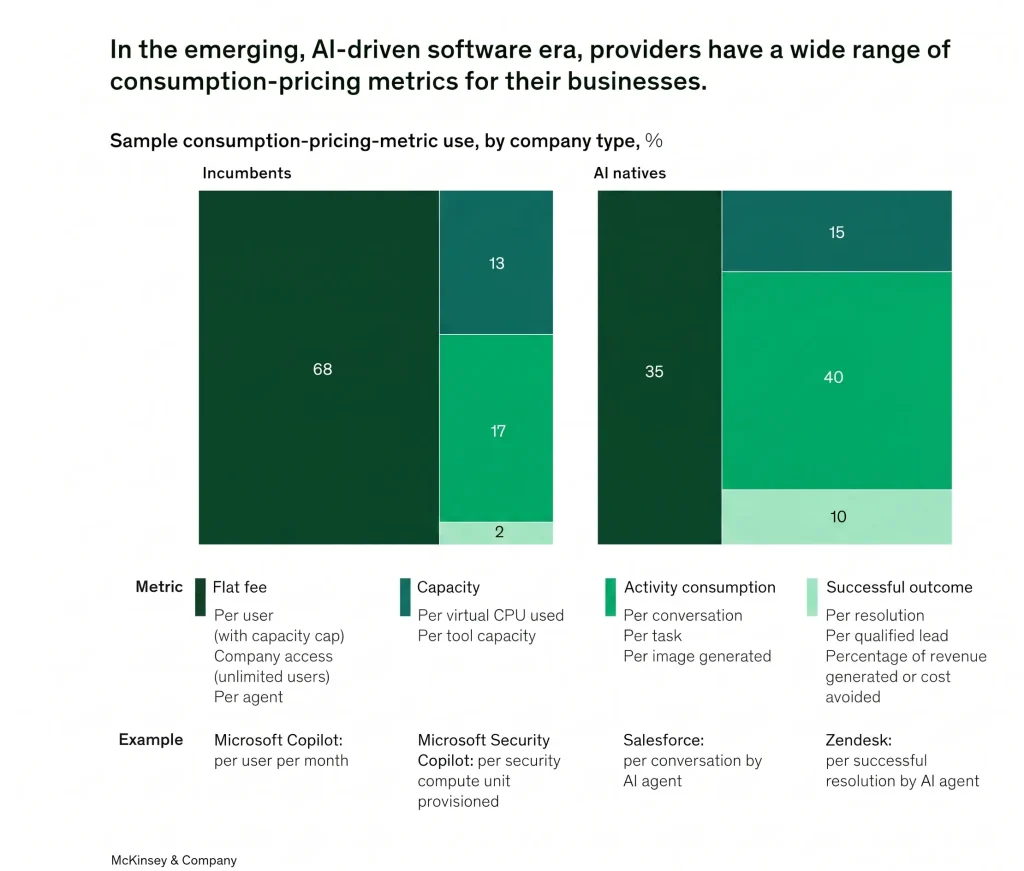
McKinsey revealed in late 2025 that about a quarter of its global fees are now tied to measurable client outcomes rather than hours worked. When the world’s largest consulting firm rewires its pricing around outcomes, the rest of us should pay attention. You can see the full picture in McKinsey’s own analysis, The AI Price Is Right. The direction is clear: buyers want to pay for results, not time.
How AI Actually Changes Your Cost Structure
AI did not simply make your work faster. It reshaped where your money goes, and once your costs change, your pricing has to follow.
What Goes Down
First drafts, lead routing, campaign briefs, report generation: AI now handles much of the execution work in a fraction of the time it used to take. A smaller, more senior team can carry the same client load that once needed a much bigger crew. Thus, your per-project labour cost on the execution side drops significantly.
What Goes Up
AI is not free. Every time you use it, a real cost runs in the background. Most AI tools charge by tokens, the small units of text they process. As Nvidia explains, every input and every output costs tokens, and those costs compound across a full client workload. A content-heavy client can consume ten times more tokens than a lighter one, yet if you have quoted a flat price, the difference comes entirely out of your margin.
Why This Demands a New Approach to Pricing
The old model assumed predictable costs. AI breaks that assumption. Your costs now move with usage, which means your pricing needs to move with it too. That is the core argument for every flexible pricing model in the next section.
| What changed | Old way | New way with AI |
| Biggest cost | Staff hours | Staff plus AI tool costs |
| Team size | Many junior people | Fewer, more senior people |
| Speed | Tied to team capacity | Decoupled from team size |
| Monthly cost | Predictable | Varies with client usage |
| What clients pay for | Time | Results and speed |
The lesson is simple, even if the balancing act is not. Your price now has to cover both sides of the equation. You save money because AI is fast, yet you also spend money because AI is not free. Ignore that second half, and your profit will shrink so slowly that you may not notice until it starts to hurt.
AI Pricing by Client Tier: Small Business, Mid-Market, and Enterprise
The same pricing model does not work at both ends of the market. Here is how each tier thinks, what they are actually buying, and which model fits best. Checked on 20 October 2026: agencies are still landing in three broad pricing bands, and the ranges below track closely with what comparable 2026 industry pricing guides report for retainer-based AI automation work:
Small Business ($500 to $1,500 per Month)
Small business clients want results without complexity. They have one or two workflows that need automating, a limited budget, and no appetite for lengthy scoping conversations. Productized packages work best here because the fixed scope removes the friction from the sales process.
| AI Pricing for Small Businesses | |
| Pricing Component | Typical Range |
| Typical Setup Fee | $1,500 – $5,000 (one-time) |
| Typical Monthly Retainer | $500 – $1,500 per month |
| Best Pricing Model | Productized Services or Fixed-Price Projects |
| What Clients Are Buying | One automated workflow, predictable outcomes, and minimal internal overhead |
The most common mistake agencies make at this tier is over-engineering the engagement. A small business does not need a $25,000 AI infrastructure build. They need one workflow that removes five hours of manual work per week. Price for that specific value, not for everything you could theoretically build.
Mid-Market ($1,500 to $4,000 per Month)
Mid-market clients have more systems, more stakeholders, and higher expectations around reporting and support. They are comfortable with a more complex engagement model and willing to pay for a dedicated support structure.
| AI Pricing for Mid-Market Businesses | |
| Pricing Component | Typical Range |
| Typical Setup Fee | $5,000 – $20,000 (one-time) |
| Typical Monthly Retainer | $1,500 – $4,000 per month |
| Best Pricing Model | Subscription + Usage, Hybrid Pricing, or Outcome-Based Pricing |
| What Clients Are Buying | Multi-system integrations, reliable post-launch ownership, and measurable performance reporting |
At this tier, your retainer conversation should centre on what you own after launch, not just what you build. Mid-market clients have often been burned by vendors who delivered a tool and then disappeared. Your ownership model is the differentiator.
Enterprise and High-Ticket Clients ($3,000 to $8,000+ per Month)
Enterprise engagements involve procurement cycles, security review, compliance requirements, and cross-team rollout. The complexity is genuinely different from a small business build, and the pricing reflects that.
| AI Pricing for Enterprise & High-Ticket Clients | |
| Pricing Component | Typical Range |
| Typical Setup Fee | $20,000 – $100,000+ (one-time) |
| Typical Monthly Retainer | $3,000 – $8,000+ per month |
| Best Pricing Model | Hybrid Pricing with Outcome-Based Components or Bespoke Value-Based Pricing |
| What Clients Are Buying | Governance, auditability, SLA-backed support, risk management, and implementation certainty |
At this tier, price is rarely the main concern. The real questions are about risk: who owns the workflow after launch, what happens when something breaks in production, and how the automation handles regulated or sensitive data. Your pricing should answer those questions explicitly.
For agencies looking to position at the higher end of the market, our guide on how to offer white-label services for agencies covers how to structure premium delivery models that justify enterprise-level pricing.
The 6 AI Automation Agency Pricing Models Explained
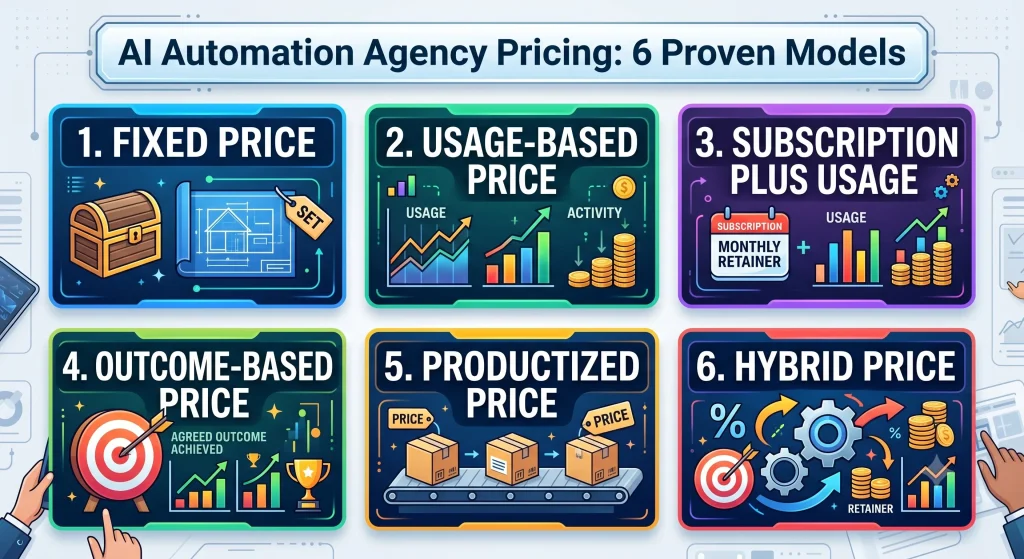
In a 2025 survey by Metronome, around 85% of SaaS companies had already adopted usage-based pricing or were actively testing it, up from a small minority two years earlier. You can read the full findings in their State of Usage-Based Pricing 2025 report. AI automation agency pricing is heading in the same direction.
| Model | Best for | Typical range | Main risk |
| Fixed price | Defined one-off builds | $3,000 to $20,000 | Scope gaps |
| Usage-based | Variable workloads | $80 to $300 per unit | Unpredictable bills |
| Subscription plus usage | Steady retainer clients | $1,500 to $4,000/mo base | Vague usage caps |
| Outcome-based | Measurable result clients | $1,000 base + per result | Attribution disputes |
| Productized | Repeatable services | $1,500 to $5,000/mo | No scope flexibility |
| Hybrid | Mid to large clients | $2,000 to $6,000/mo | Contract complexity |
Here are the six models worth knowing, each with a real USD example. These build on the traditional digital marketing agency pricing models but adapt them for AI-era delivery costs.
1. Fixed Price
You quote a set amount for a defined build. Scope, timeline, and deliverables are locked before work starts.
Pros:
- Predictable budget for the client
- Clean acceptance criteria
- AI efficiency flows directly into your margin
Cons:
- Scope changes trigger renegotiation
- Agencies often pad the price to cover uncertainty
Best for: well-understood, contained builds where both sides can describe success before work starts.
Example: A single CRM lead-routing automation with a two-week build, quoted at $6,500 flat. Scope is defined clearly upfront, and the handoff is fully documented. Typical range: $3,000 to $20,000.
2. Usage-Based
With usage-based pricing, the client pays for what they actually consume. You choose a unit that is easy to count, such as a finished deliverable, a campaign, or a batch of work, and then you charge per unit.
Pros:
- Price rises and falls with your real AI costs
- Clients pay more only when they use more
- Easy to track and explain
Cons:
- Client bills are harder to predict month to month
- Requires clean usage tracking on your side
Best for: clients with variable monthly workloads where a flat fee would either overcharge or undercharge.
Example: $180 per AI-assisted blog post, fully researched and formatted. A client who needs 8 posts pays $1,440. A client who needs 20 pays $3,600. Typical range: $80 to $300 per unit, depending on complexity.
3. Subscription Plus Usage
This model hands you a steady floor and a flexible ceiling. The client pays a fixed monthly fee for the core work, and anything above an agreed limit is billed as overage.
Pros:
- Steady baseline income for you
- Predictable core budget for the client
- Heavy-use months do not erode your margin
Cons:
- You must define the usage cap clearly, or overages feel like hidden fees
Best for: long-term retainer clients with a stable core workload and occasional peaks.
Example: $1,800 per month base covers strategy, reporting, and up to 10 deliverables. The 11th deliverable onwards is billed at $140 each. Typical base range: $1,500 to $4,000 per month.
4. Outcome-Based
The fee is tied to a result, not effort. You and the client agree on a metric that matters to their business, and your pay follows that number.
Pros:
- Your incentives align directly with the client’s goals
- Trust builds faster than in any other model
- You share in the upside you create
Cons:
- Requires clean measurement and honest attribution
- Results take time to materialize in some categories
Best for: clients with measurable, agreed metrics where attribution is clean.
Example: $1,200 base per month plus $45 per qualified lead delivered. At 60 leads per month, you earn $3,900. At 100 leads, you earn $5,700. Best for outbound, lead generation, and growth-focused engagements where the output is countable.
5. Productized Services
A fixed-scope package at a fixed price. The same deliverable is sold to multiple clients without rescoping from scratch each time.
Pros:
- No lengthy scoping calls
- AI efficiency flows straight into the margin
- Predictable, repeatable, and scalable
Cons:
- Scope cannot flex without repricing
- Works best for work you have already done several times
Best for: agencies that do the same work repeatedly and want to remove the overhead of custom scoping.
Example: AI Content Engine at $1,800 per month. Includes 12 SEO-assisted posts, topic briefs, and formatted output. Seven-day turnaround. Client provides brand guidelines and an approved keyword list. Typical range: $1,500 to $5,000 per month.
6. Hybrid
A deliberate combination of two or more models. Usually, a stable base fee plus a variable element, such as a usage charge or performance bonus.
Pros:
- Gives the client a predictable floor
- Protects your margin on heavy-use months
- Flexible enough to handle most engagement types
Cons:
- More moving parts, so keep the contract language simple
Best for: mid-size to large retainer clients who want predictability with a performance upside baked in.
Example: $2,000 monthly retainer for core delivery plus a 5% bonus when the client passes an agreed revenue target. Typical base range: $2,000 to $6,000 per month with a variable element on top.
The honest answer is that you do not pick the trendiest model. You pick the one that fits the client sitting in front of you. Three questions usually settle it:
1. How predictable are the client’s needs?
If the work is steady, lean on a subscription or retainer base. If it swings from month to month, usage-based pricing protects you.
2. Can you measure the result clearly?
If you can, and the client truly cares about that number, outcome-based pricing is worth testing. If you cannot measure it cleanly, leave it alone.
3. Is the work repeatable?
If you do the same job again and again, package it. Productized pricing is where AI speed turns directly into profit.
When you are still unsure, start with hybrid pricing. A base fee plus a variable part is forgiving, because it gives the client a floor while it still protects your margin.
AI Automation Agency Setup Fees and Monthly Retainers: What to Charge and When
Before picking a pricing model, you need to understand how an engagement is structured. Most clients confuse setup fees and retainers, and that confusion leads to undercharging, scope creep, and strained relationships.
What a Setup Fee Covers
A setup fee covers the one-time cost of building the automation. This includes:
- Workflow audit and process mapping
- Systems integration and data connections
- Build, testing, and QA
- Exception handling and edge-case logic
- Handoff documentation and team onboarding
This is the fee that makes the automation exist. Without it, there is nothing to run or maintain.
Setup Fee Ranges:
- Single workflow: $1,500 to $5,000
- Multi-system integration: $5,000 to $20,000
- Enterprise or compliance-sensitive build: $20,000 and above
What a Monthly Retainer Covers
A monthly retainer covers what happens after launch:
- Monitoring and error alerts
- Prompt tuning as model behaviour shifts
- Bug fixes and edge-case handling
- Small expansions and iteration requests
- Performance reporting
An automation that launches and never gets touched will drift. AI model behaviour changes, connected systems update, and client processes evolve. The retainer is what keeps the system healthy and the relationship intact over time. For the formula behind a retainer price, see our guide on how to price retainer services.
Retainer Ranges:
- Single workflow: $500 to $1,500 per month
- Multi-system setup: $1,500 to $4,000 per month
- Enterprise support tier: $3,000 to $8,000 per month
Retainer vs. Project Fee: Which One to Use
Use a project fee when:
- The workflow has a clear endpoint and defined acceptance criteria
- The client wants to own the automation internally after launch
- The engagement is genuinely a one-time build with no ongoing dependency
Use a retainer when:
- The workflow will evolve after launch, which most real workflows do
- The automation touches revenue, support, or operations; the client cannot afford to let it drift
- The client expects additional automations over time
The hybrid path most agencies miss: use a project fee to launch, then move to a retainer once the automation is live and delivering value. The client pays a defined amount to get the workflow into production. Once it is working and paying for itself, the retainer conversation becomes easy because you are selling continued ownership of something that already has a measurable return, not a promise about future performance.
For a deeper look at how this plays out across different agency types, see the guide on retainer vs. project-based pricing for agencies.
AI Automation Consulting and Freelance AI Services Pricing
AI automation consulting pricing is usually hourly or per project, not a monthly retainer. Freelancers typically charge $40 to $150 per hour, boutique AI agencies $125 to $250, and large consulting firms $250 to $500. Rates were checked on 20 October 2026 against current 2026 rate guides.
| Who you hire | Typical hourly rate | Usually hired for |
|---|---|---|
| Offshore freelancer or team | $25–$75 | Simple builds from a clear spec |
| Freelance automation builder (n8n, Make, AI integrations) | $40–$150 | Single workflows and fixes |
| Boutique AI automation agency | $125–$250 | Multi-system builds with ongoing support |
| Enterprise consulting firm | $250–$500 | Strategy, governance and large rollouts |
Sources: Layer3 Labs AI consulting rates (updated September 2026) and AdSnipper’s n8n developer rates (updated July 2026).
Freelance AI Services Pricing by Project
On freelance marketplaces, small AI integration gigs typically run $200 to $1,200 and ongoing support retainers $300 to $1,200 a month, according to Fiverr’s 2026 AI expert cost guide. Consulting firms usually charge $2,000 to $5,000 for a discovery or automation audit before any build starts.
How Consultants and Freelancers Should Price
- Bill strategy and discovery by the hour or as a fixed audit. That work is hard to scope until you have seen the client’s systems.
- Switch to a fixed price once the workflow is defined. AI makes the build faster, and a fixed price lets you keep that speed as margin.
- Add a retainer after launch for monitoring and changes, using the tier ranges earlier in this guide.
Not sure where your rate should sit? Our free service pricing calculator compares time-based, value-based and package pricing for the same job.
How to Set Your AI Automation Agency Price: 5 Steps
Choosing a model tells you how to charge. It does not tell you how much. Always price from your costs upward, never from a competitor’s rate or a number you used last year.
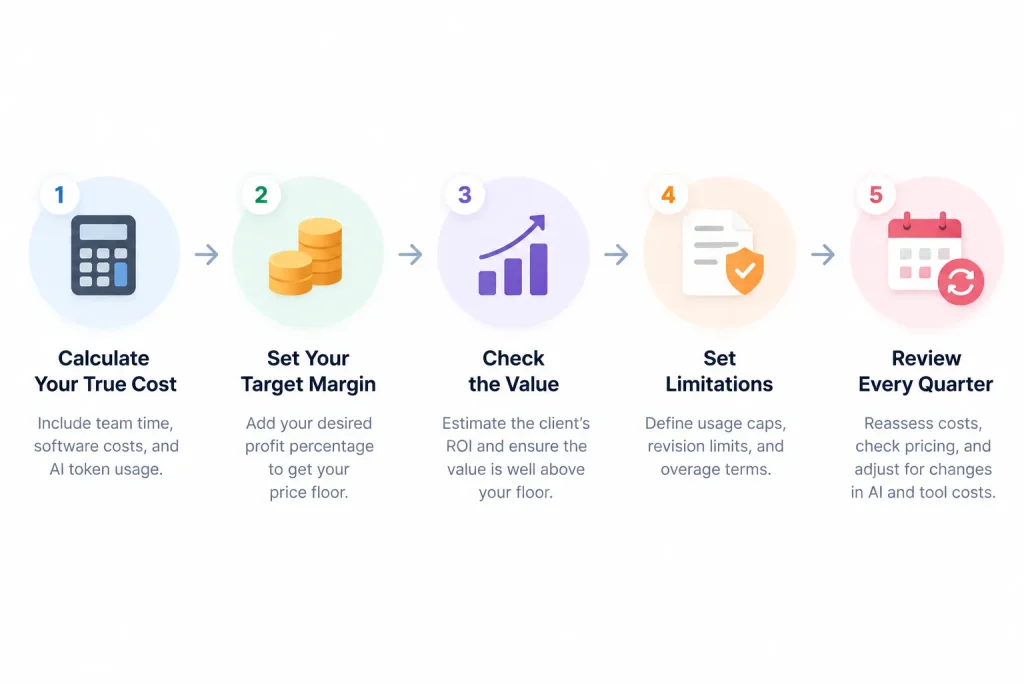
Step 1: Add Up Your True Delivery Cost (AI Token Cost Matters)
Count team time, software subscriptions, and your AI and token costs for that specific type of engagement. Token usage varies significantly by client. A content-heavy client costs more to serve than a reporting-only client, even at the same volume, so do not average across clients when you are setting a new price.
Step 2: Set Your Target Margin
Decide the profit percentage you need, then add it to the cost. The total is your price floor. That is the number you never go below, regardless of what a prospect says they want to pay or what a competitor appears to charge. Our free agency profit margin calculator shows margin and markup side by side, so you don’t confuse the two.
Step 3: Check the Value
Ask what the finished result is worth to the client. Use a payback calculation like the one in the worked example later in this guide. When the value sits well above your floor, you have room to charge more, and you should. Value-based pricing is only sustainable when you can quantify the value independently, so build that calculation before the sales call, not during it.
Step 4: Set Limitations
Build usage caps, revision limits, and overage terms into every contract before work starts. A heavy-use client can quietly double your AI costs without either side noticing until the invoice arrives. Clear limits stop that from becoming a relationship problem as well as a margin problem.
Step 5: Review Every Quarter
AI model costs and tool pricing shift often enough that annual reviews create real margin risk. A quarterly check catches drift before it compounds. It does not mean repricing every client every three months. It means reviewing your cost structure, checking whether current prices still hold, and adjusting new quotes and renewals accordingly.
With that in mind, it is worth reviewing the best AI tools for agency workflows and tightening the way you automate client onboarding before you change how you charge.
Research from OpenView confirms that pricing tied to usage and value links to better client retention and lower churn. The reason is straightforward: when a client’s fee grows as they get more value, the relationship feels fair to both sides, and fair relationships renew.
How to Productize AI Automation Services: 4 Package Examples With USD Pricing
Productizing is the fastest path to scaling an AI automation agency without scaling headcount at the same rate. It means packaging a repeatable AI service into a fixed-scope offer at a fixed price, then selling that same package to multiple clients.
For AI automation agencies, productizing works best with marketing operations because the underlying tasks (content production, lead processing, campaign management, and reporting) are high-volume and repetitive. That is exactly where AI delivers the most efficiency, and exactly where a fixed package captures the most margin.
These four productized packages reflect current 2026 market pricing for the most commonly sold AI automation bundles. Here’s what each one typically includes and costs per month:
Example 1: AI Content Engine — $1,800 per month
What it includes: 12 AI-assisted blog posts with SEO briefs, one round of edits, and distribution-ready formatting. Seven-day turnaround per post.
Client provides: brand guidelines, approved keyword list, and 48-hour approvals.
Best for: content-led B2B agencies and SaaS companies running ongoing content programs.
Example 2: Lead Automation Starter — $2,500 per month
What it includes: CRM routing automation, lead enrichment via a connected data tool, and AI-drafted follow-up sequences for up to 500 leads per month.
Client provides: CRM access, ICP definition, and lead source integrations.
Best for: outbound-focused agencies and SDR teams looking to cut manual qualification time.
Example 3: AI Marketing Ops Bundle — $4,500 per month
What it includes: 8 AI-assisted blog posts, automated campaign brief processing, weekly performance reporting, and one new automation build per quarter.
Client provides: tool access, campaign data, and a weekly 30-minute sync.
Best for: mid-market marketing teams that want to offload operations without adding headcount.
Example 4: AI B2B Outbound Package — $3,200 per month
What it includes: AI-personalized email sequences across up to three active campaigns, reply detection and routing, and a weekly performance digest. Client provides: lead lists, tone guidelines, and email account access.
Best for: B2B outbound agencies running cold email and LinkedIn outreach at volume.
A note on B2B outbound specifically: because outbound results are measurable, you can layer an outcome component on top of this package. A base fee plus $40 per qualified meeting booked is a common structure at agencies that run high-volume outreach. That hybrid approach gives the client a floor and gives you a share of the upside you are directly generating.
n8n / Make Automation Retainer Packages
Agencies that build on n8n or Make usually sell three retainer tiers, priced on how many live workflows they monitor and maintain. The ranges follow the client tiers earlier in this guide:
Package Typical retainer What’s included Starter $500–$1,500/month Up to 3 live workflows, error monitoring and fixes, one small change request a month Growth $1,500–$4,000/month Up to 10 workflows across several systems, prompt tuning, a monthly report, one new workflow a quarter Scale $3,000–$8,000+/month All production workflows, SLA response times, security and governance reviews Platform fees sit on top of your retainer. Checked on 20 October 2026: n8n Cloud costs €20/month for Starter (2,500 executions) and €50/month for Pro (10,000 executions), billed annually, and the self-hosted Community Edition is free apart from the server. Make has a free plan with 1,000 credits a month, then Core at $12/month and Pro at $21/month for 10,000 credits. Say in the contract whether you bill these at cost or include them, and set an execution or credit cap so one busy client cannot eat your margin.
Before you finalize any package price, answer these three questions:
1. What is the total AI and tool cost to deliver this package every month? That is your cost floor.
2. What would a client pay to get this output without AI? That is your value ceiling.
3. What is the minimum margin you need to make the package worth running at scale?
Set your price between floor and ceiling, closer to the ceiling when you can demonstrate output quality. If you cannot answer question one with a real number, you are not ready to productize yet.
A Real Pricing Example: The Math Behind a Fair Engagement
Most AI automation agency pricing conversations stay abstract until someone puts real numbers on the table. Here is a modelled example that shows how to frame an engagement so the math does the persuading.
The Scenario
A 35-person B2B marketing agency manually qualifies 1,200 leads per month. Each qualification takes roughly 8 minutes of SDR time. The blended hourly cost of an SDR, including salary, benefits, and overhead, is $45.
Monthly Manual Cost: 1,200 leads x 8 minutes / 60 x $45 = $7,200 per month. Annual: $86,400.
The Proposal
An AI automation routes, enriches, and classifies leads before any human touches them. The build includes CRM integration, an LLM classification layer for ambiguous leads, a human review queue for low-confidence outputs, and full handoff documentation.
- Setup fee: $12,000
- Monthly retainer: $1,500 (monitoring, prompt tuning, and support)
- Expected automation rate: 70% of leads handled without manual intervention
The AI Automation Pricing Math
Monthly labour value recovered: 1,200 x 8 / 60 x $45 x 70% = $5,040 per month
Net monthly value after retainer: $5,040 minus $1,500 = $3,540
Payback period on the setup fee: $12,000 divided by $3,540 = 3.4 months
First-year net benefit after all costs: ($3,540 x 12) minus $12,000 = $30,480
The client is not being asked whether $12,000 is expensive. They are being asked whether a 3.4-month payback on a system that frees $5,040 of monthly labour makes sense for their business. That is a completely different conversation, and almost always a much shorter one. Put this payback math near the top of your proposal; our free agency proposal template is a good place to start.
If you cannot build this calculation with a prospect, the engagement is not ready to scope. If the calculation depends on heroic adoption assumptions, start with a smaller pilot and a defined success threshold before committing to the full build.
Stop Selling Hours: What Should You Sell Instead?
If AI can handle the execution, then execution is no longer where your value sits. The work worth paying a premium for in 2026 is the work AI cannot do on its own. So when I price for value rather than hours, here is what I am really putting on the invoice.
Strategy
AI can produce the work, but it cannot decide which work is worth doing. Strategy is knowing what to build and why: which campaign to run, which market to chase, and which idea to quietly drop. That thinking shapes every result the client eventually sees, and it is yours to sell.
Judgment
A model will hand you ten options without ever telling you which one is right. Judgment is the experienced filter that spots which AI output is sharp, which is subtly wrong, and which is simply off-brand. Clients are not really paying for the raw output anymore. They are paying for the person who knows which version to ship.
Creative Quality
Generic AI output tends to feel, well, generic. Real creative quality comes from taste, fresh ideas, and a clear point of view, the things that make a brand feel like itself rather than like everyone else. That spark is hard to automate, which is exactly why it is easy to charge for.
Accountability
When a project succeeds or fails, software does not answer for it. You do. Accountability means being the partner who owns the result, explains the setbacks honestly, and stands behind the work when it matters most. Clients will always pay a premium for someone they can trust with the outcome.
Notice the difference this makes in how you talk to a client. You never lead with “we are cheaper because we use AI.” Instead, you explain that AI takes care of the routine work so your people can focus on the thinking that grows their business. Framed that way, your price stays strong even as the basic work gets cheaper.
How Taskip Helps You Run These AI Automation Pricing Models
Changing your pricing model is one thing. Running it day after day without drowning in admin is another challenge entirely. This is where an all-in-one agency management platform earns its keep, and it is why I use Taskip to keep modern AI automation agency pricing practical.
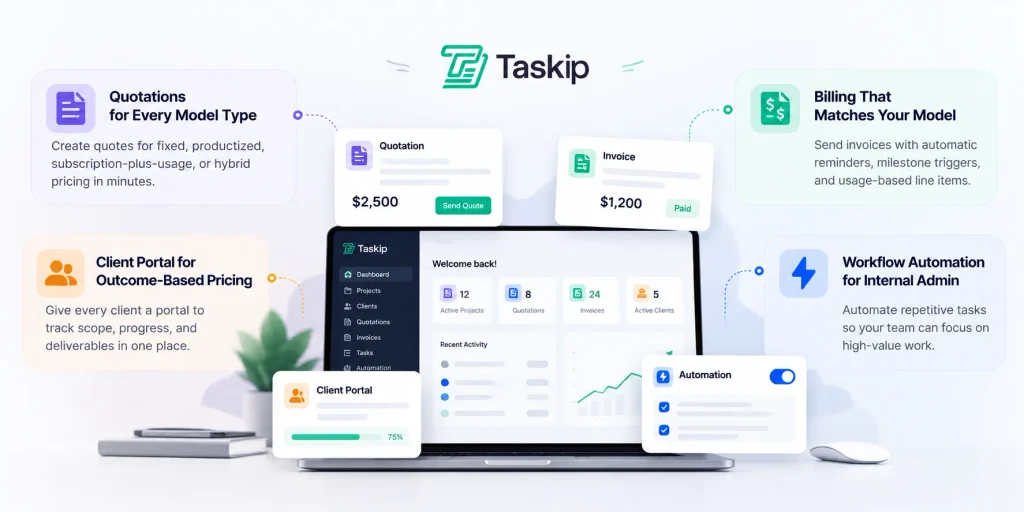
Quotations for Every Model Type: Build quotations for fixed, productized, subscription-plus-usage, or hybrid pricing in minutes. Setup fees and retainers sit as separate line items so the client sees exactly what they are paying for and when. Approved quotes convert to invoices with one click.
Billing That Matches Your Model: Send invoices with automatic reminders, milestone triggers, and usage-based line items. Whether you are billing a flat retainer, a project fee, or per-unit usage, the billing process stays clean and on time without manual chasing.
Client Portal for Outcome-Based Pricing: Give every client a client portal where they can track scope, progress, and deliverables in one place. When you are charging for outcomes and results, that visibility is what makes the price feel fair and the relationship feel honest.
Workflow Automation for Internal Admin: Hand the repetitive internal admin to workflow automation so your team’s hours stay on the strategy and judgment you now charge a premium for, not on chasing approvals and sending reminders.
Taskip starts at $12 per month and is built specifically for agencies and freelancers, so you can test new agency pricing models without tearing apart your whole tool stack. If you want to compare the options, take a look at the Taskip pricing page.
Conclusion
AI is nudging all of us toward pricing that is smarter, fairer, and far more honest about where value really comes from. The hourly rate punished me for being fast. The flat retainer ignored both effort and results. Neither one belongs in a world where AI tools cost real money and save real time.
So here is what I believe. The agencies that win in 2026 will stop selling time and start selling results. They will keep an eye on their AI costs, lean on flexible pricing, and charge with quiet confidence for the strategy and judgment that no model can copy. In short, smart AI agency pricing means charging for value, not for hours. And the best moment to make that change is now, while it is still your choice and not something a shrinking margin forces on you.
Frequently Asked Questions
How is AI changing agency pricing in 2026?
AI has made delivery dramatically faster, which breaks the old link between hours worked and money earned. Because of that, agencies are stepping away from hourly rates and rigid retainers and moving toward usage-based, outcome-based, and hybrid models that charge for results rather than time.
What are AI tokens, and why do they matter for agency pricing?
A token is a small unit of text that AI tools use to measure and price their work. Since token costs rise with usage, AI turns service delivery into a variable cost rather than a fixed one. Ignore that, and a heavy-usage client can quietly erase your profit on a fixed-price deal.
Should agencies charge clients separately for AI tokens?
Usually not as a separate line item, because clients care about outcomes, not technical details. The better approach is to track token costs yourself and choose a pricing model, such as usage-based or subscription-plus-usage, that naturally grows with how much the client uses.
Is usage-based pricing better than retainers for agencies?
Neither one wins in every case. Usage-based pricing protects your margin when AI costs swing, while retainers give clients a predictable budget. That is why many agencies now settle on hybrid pricing, a fixed base fee plus a usage or results charge, which captures the strengths of both.
What is the best pricing model for an AI-powered agency?
There is no single answer. Outcome-based pricing suits clients focused on results, productized services suit smaller clients who want speed and clarity, and hybrid pricing suits long-term retainer clients. The trick is to match the model to the client’s size and how predictable their needs are.
How can agencies protect their profit from rising AI costs?
Start by tracking AI and token usage for each client, then set clear usage limits in your contracts. Price from real cost data instead of guesswork. Tying fees to outcomes helps as well, since the price then follows the value delivered rather than a fixed pool of hours.
Will AI make agencies cheaper?
AI does lower the cost of routine execution, but it does not lower the value of strategy, judgment, and accountability. Agencies that reframe their pricing around those strengths can stay healthily profitable, even as the basic work gets faster and cheaper.
How do I explain AI-based pricing to clients?
Keep the conversation on results and value rather than tools or hours. Be transparent about what the client is paying for, use clear quotes and contracts, and give them real visibility into progress, so the price always feels connected to what they receive.
What is a typical setup fee for an AI automation agency?
Setup fees vary by project complexity. Small business AI automation projects often range from $1,500–$5,000, mid-market implementations from $5,000–$20,000, and enterprise engagements can exceed $20,000–$100,000+ when multiple systems, compliance, and custom integrations are involved.
How should AI agencies price small business vs enterprise clients?
Small businesses usually prefer fixed-price packages or productized services, while enterprise clients expect hybrid or value-based pricing that reflects strategic impact, governance, and ongoing support requirements.
Can AI automation agencies still charge hourly rates?
Yes, but hourly pricing is becoming less effective as AI speeds up delivery. Many agencies now use hourly billing only for consulting or discovery sessions while using project, subscription, or outcome-based pricing for implementation work.
How often should an AI agency review its pricing?
At least quarterly. AI model costs, token pricing, and client usage patterns change frequently, so regular reviews help protect margins and keep pricing aligned with delivery costs.
What is productized AI service pricing?
Productized pricing packages a repeatable AI service into a fixed deliverable with a clear scope and price, making it easier to sell, deliver, and scale compared to custom hourly engagements.
How do agencies calculate AI automation project pricing?
Most agencies combine labour costs, AI tool expenses, token usage, software subscriptions, integration complexity, maintenance requirements, and the business value delivered before setting a final price.
When should agencies use value-based pricing instead of fixed pricing?
Value-based pricing works best when the AI system creates a significant business impact, such as revenue growth or cost savings, that far exceeds implementation costs. Fixed pricing is better suited for standardized and repeatable projects.
What is a typical AI automation agency monthly retainer?
Small business retainers typically run $500–$1,500/month, mid-market retainers $1,500–$4,000/month, and enterprise support $3,000–$8,000+/month, depending on automation complexity and support level.
How much do AI automation agencies actually charge or earn per client?
Most AI automation agencies charge $500–$1,500/month for small business retainers, $1,500–$4,000/month for mid-market clients, and $3,000–$8,000+/month for enterprise engagements. Productized packages typically run $1,800–$4,500/month per package. Actual agency earnings depend more on how many clients you can run per delivery hour than on any single client’s price, which is why more agencies are shifting to productized or hybrid pricing as AI cuts their execution time per client.
What’s the difference between AI automation services pricing and AI automation consulting pricing?
In practice, “services,” “consulting,” and “automation agency” pricing all describe the same market and use the same six pricing models covered in this guide (fixed, usage-based, subscription plus usage, outcome-based, productized, and hybrid). Consulting engagements lean more toward hourly or project-fee billing for strategy work, typically $40 to $250 per hour for freelancers and boutique agencies, while ongoing automation services more often use retainer or productized pricing. See the consulting and freelance pricing section above for the full rate table.