Digital Marketing Agency Pricing Models: The Complete 2026 Guide to Choosing What’s Right for Your Business
Choosing the digital marketing agency pricing models can make or break your marketing investment. The pricing landscape has become increasingly complex in 2026, with agencies offering everything from basic $1,000 monthly packages to comprehensive $50,000+ enterprise solutions. The challenge? Understanding what you’re actually paying for and which pricing structure delivers the best return on your investment.
Digital marketing agency pricing models are the frameworks agencies use to structure their fees and charge clients for digital marketing services. These models have evolved significantly as artificial intelligence tools reshape workflows, clients demand greater accountability, and transparency becomes non-negotiable in agency-client relationships.
This comprehensive guide breaks down every pricing model used by digital marketing agencies in 2026. Whether you’re a startup founder evaluating your first marketing partner or an established business looking to optimize your agency relationship, understanding these pricing structures will help you make informed decisions, negotiate better contracts, and maximize your marketing ROI.
TL;DR
The right digital marketing agency pricing models depend on your project scope, budget, business goals, and need for flexibility. Most agencies in 2026 are moving toward transparent, hybrid models that combine predictable base fees with performance incentives. Digital marketing agency pricing models utilize five core pricing structures:
- Hourly Rates: Typically range from $75 to over $400 per hour.
- Monthly Retainers: Averages between $1,500 and $30,000+ per month.
- Project-Based Fees: Can vary widely, from $2,500 up to $100,000 per project.
- Performance-Based Pricing: A percentage of results, usually 10-30%.
- Value-Based Pricing: Directly tied to the client’s Return on Investment (ROI).
Understanding Digital Marketing Agency Pricing Models: The Foundation
Before diving into specific pricing models, it’s essential to understand what influences the cost of digital marketing agency pricing models. Unlike traditional advertising with standardized rate cards, digital marketing agency pricing models vary dramatically based on several key factors.
What Determines Digital Marketing Agency Pricing Models And Costs in 2026?
The cost of digital marketing agency pricing models depends on multiple interconnected variables that agencies consider when structuring their pricing.
| Factor | Description | Typical Cost Range (Monthly or Hourly) | Notes / Impact |
| Agency Size & Expertise | The scale, reputation, and track record of an agency heavily influence pricing. | – Large agencies: $20,000+ monthly- Mid-sized: $5,000–$15,000- Small agencies / freelancers: $500–$2,000 | Larger agencies offer more resources and proven systems; smaller ones are budget-friendly but may have limited scope. |
| Service Complexity & Scope | Costs vary depending on whether the engagement covers one service or a multi-channel strategy. | – Basic (e.g., social media): $1,000–$3,000- Multi-channel (SEO, PPC, content): $15,000–$30,000+ | Comprehensive campaigns with multiple teams, analytics, and optimization drive higher costs. |
| Geographic Location | Market location still affects pricing, even with remote work. | – Major cities (NYC, SF, London): $150–$400+ per hour- Smaller markets / international: $50–$150 per hour | 2026 trend: Gradual pricing standardization due to remote collaboration. |
| Industry Specialization | Agencies with domain expertise in heavily regulated industries charge more for specialized knowledge. | Typically 20–40% higher than generalist agencies | Compliance, data protection, and niche strategies justify the premium (common in healthcare, finance, legal). |
The Shift Toward Pricing Transparency
The digital marketing industry has undergone a significant transformation regarding pricing transparency in recent years. Clients now demand clear breakdowns of costs, deliverables, and expected outcomes before committing to agency partnerships.
Transparent pricing practices include detailed proposals outlining specific deliverables, clear explanations of what’s included versus add-on services, measurable KPIs tied to costs, regular reporting schedules, and upfront disclosure of potential additional expenses. This shift benefits both agencies and clients by reducing misunderstandings, setting realistic expectations, building trust from the outset, and creating accountability mechanisms.
Forward-thinking agencies recognize that pricing transparency isn’t just an ethical imperative but a competitive advantage that attracts sophisticated clients who value honesty over hidden fees.
The Five Core Digital Marketing Agency Pricing Models
Digital marketing agency pricing models primarily use five pricing structures, each with distinct advantages, challenges, and ideal use cases. Understanding these models helps businesses select the approach that aligns with their goals, budget, and project requirements.
1. Hourly Rate Pricing Model
2. Monthly Retainer Pricing Model
3. Project-Based (Fixed Fee) Pricing Model
4. Performance-Based Pricing Model
5. Value-Based Pricing Model
1. Hourly Rate Pricing Model
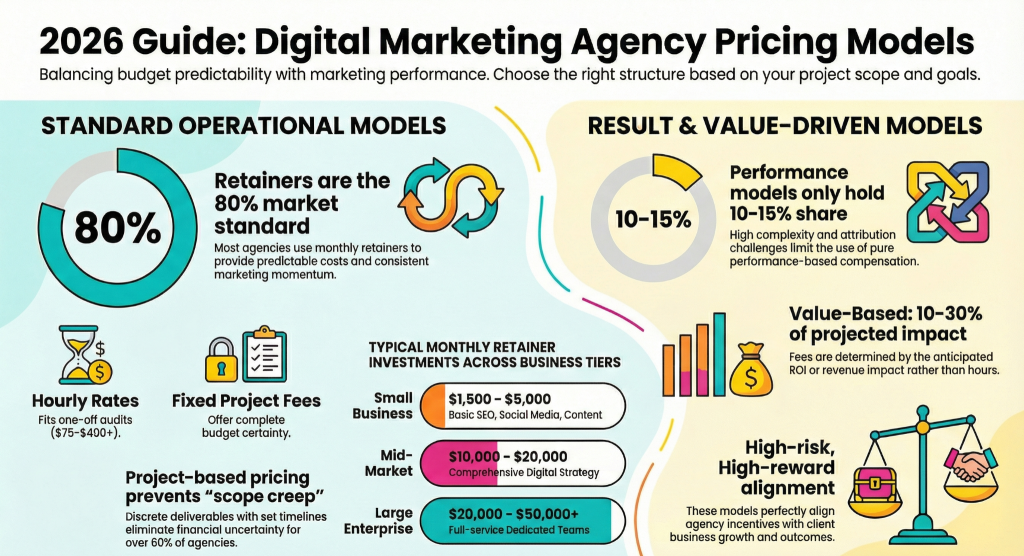
The hourly rate model is the most straightforward pricing structure, where agencies charge clients based on the actual time spent on their projects. In 2026, hourly rates for digital marketing services range from $75 to $400+ per hour, depending on the agency’s expertise, location, and service complexity.
How hourly pricing works: Agencies track time spent on client work using project management tools and bill accordingly. Some agencies provide hourly estimates upfront and bill actual hours after project completion, while others work within predetermined hourly budgets with overages invoiced separately.
Typical hourly rate ranges in 2026:
- Junior specialists and freelancers: $50-$100 per hour
- Mid-level agencies and experienced practitioners: $100-$200 per hour
- Senior strategists and specialized experts: $200-$300 per hour
- Premium agencies and industry leaders: $300-$400+ per hour
When hourly pricing makes sense: This model works exceptionally well for one-off projects like website audits, campaign reviews, consulting sessions, short-term strategic planning, troubleshooting specific marketing challenges, and testing new agency relationships before committing to larger engagements.
Advantages of hourly pricing: The model offers transparency into exactly what you’re paying for, flexibility to scale hours up or down based on needs, clear justification for costs with detailed time tracking, and the ability to start small and expand as confidence builds.
Disadvantages to consider: Hourly pricing provides unpredictable total costs that complicate budgeting, potential inefficiency penalties where slower work costs more, limited earning potential for agencies which can create misaligned incentives, and administrative overhead tracking and disputing billable hours.
Pro tip: If working with hourly pricing, request detailed time logs and establish clear scope boundaries upfront. Consider setting hourly caps or requiring approval before exceeding estimated hours to prevent budget surprises.
2. Monthly Retainer Pricing Model
Monthly retainers have become the dominant pricing model in digital marketing, with nearly 80% of agencies using this structure as their primary or supplementary offering. Under this model, clients pay a fixed monthly fee in exchange for a predetermined set of services or allocated hours.
How retainer pricing works: Agencies and clients agree on a monthly fee that covers specific deliverables, service categories, or a bank of hours. The retainer provides predictable costs for clients and steady revenue for agencies, creating stability for both parties.
Typical monthly retainer ranges in 2026:
| Business Size | Monthly Retainer | Typical Services Included |
| Small businesses | $1,500-$5,000 | Basic SEO, social media, content |
| Growing SMBs | $5,000-$10,000 | Multi-channel campaigns, analytics |
| Mid-market companies | $10,000-$20,000 | Comprehensive digital strategy |
| Large enterprises | $20,000-$50,000+ | Full-service, dedicated teams |
Table 1: Monthly retainer pricing by business size (2026 data)
When retainer pricing makes sense: This model excels for ongoing marketing needs like continuous SEO optimization, regular content creation and distribution, social media management, monthly campaign optimization, brand building and awareness initiatives, and long-term strategic partnerships.
Advantages of retainer pricing: Retainers provide predictable monthly costs that simplify budgeting, priority access to agency resources and expertise, better value compared to hourly rates for ongoing work, consistent marketing momentum without project gaps, and a deeper agency understanding of your business over time.
Disadvantages to consider: Clients face commitment to monthly payments regardless of immediate needs, potential for paying for unused hours or services, scope creep challenges when boundaries aren’t clearly defined, and the need to continuously demonstrate value to justify ongoing costs.
Expert insight: The most successful retainer relationships include clear monthly deliverables, regular performance reviews, flexibility to adjust scope as needs evolve, and transparent reporting that demonstrates ROI. Agencies that proactively communicate value and adapt strategies based on results retain clients longer.
3. Project-Based (Fixed Fee) Pricing Model
Project-based pricing involves charging a flat fee for specific projects with defined scope, deliverables, and timelines. This model is used by over 60% of agencies, particularly for discrete marketing initiatives.
How project-based pricing works: Agencies estimate the time, resources, and expertise required to complete a project, then quote a fixed price. The client knows the total cost upfront, eliminating financial uncertainty regardless of how long the project actually takes.
Typical project-based fee ranges in 2026:
- Website audits and technical SEO reviews: $2,500-$10,000
- Website design and development: $5,000-$50,000
- Comprehensive content marketing campaigns: $5,000-$25,000
- Brand strategy and repositioning: $10,000-$50,000
- Marketing automation setup and integration: $7,500-$30,000
- Large-scale marketing initiatives: $25,000-$100,000+
When project-based pricing makes sense: This model works ideally for website launches or redesigns, campaign creation with specific deliverables, one-time strategic planning initiatives, marketing audits and assessments, content library development, and projects with clear beginning and end points.
Advantages of project-based pricing: Fixed fees provide complete cost predictability for budget planning, clear scope definitions that prevent misunderstandings, simplified decision-making with a single price point, ability to test agency capabilities before long-term commitment, and no ongoing obligations once project is completed.
Disadvantages to consider: Projects carry risk for agencies if the scope expands unexpectedly, limited flexibility once the project begins without renegotiation, challenges in estimating complex project requirements accurately, and potential for agencies to rush work to protect margins.
Best practice: Detailed project scopes with specific deliverables, milestones, and exclusions prevent disputes. Include revision rounds in the initial quote and establish a clear change order process for scope additions. For Taskip users, project-based pricing aligns perfectly with task management workflows where discrete deliverables can be tracked, assigned, and completed with clear accountability.
4. Performance-Based Pricing Model
Performance-based pricing ties agency compensation directly to achieving specific, measurable results. While appealing in theory, this model represented only 10-15% of agency pricing structures in 2026 due to implementation complexity.
How performance-based pricing works: Agencies receive payment when predetermined KPIs are achieved—such as leads generated, revenue increases, ranking improvements, or conversion rate gains. Compensation structures typically include base fees plus performance bonuses, pure commission on results, or tiered payments based on achievement levels.
Typical performance-based pricing structures:
- Cost-per-lead (CPL): $10-$500 per qualified lead depending on industry
- Cost-per-acquisition (CPA): $50-$5,000+ per customer acquired
- Revenue share: 5-20% of attributed revenue generated
- Bonus structures: Base fee plus 10-30% bonuses for exceeding targets
When performance-based pricing makes sense: This model works best for lead generation campaigns with clear attribution, e-commerce businesses with trackable sales, paid advertising where results are measurable, established businesses with baseline metrics, and situations where risk-sharing benefits both parties.
Advantages of performance-based pricing: Performance models align agency and client incentives perfectly, minimize upfront financial risk for clients, create powerful motivation for agencies to drive results, and enable businesses to pay primarily for outcomes rather than activities.
Disadvantages to consider: Performance pricing carries significant risk for agencies during algorithm changes or market shifts, requires sophisticated tracking and attribution systems, creates disputes over what constitutes a qualified result, may exclude strategic work that doesn’t directly drive immediate metrics, and can incentivize short-term tactics over sustainable growth.
Critical considerations: Performance-based models work only when success factors are largely within the agency’s control, attribution can be clearly established, baseline metrics exist for comparison, and both parties agree on result definitions before engagement begins. Many agencies now prefer hybrid models combining modest base fees with performance incentives to balance risk.
5. Value-Based Pricing Model
Value-based pricing represents the most sophisticated and consultative pricing approach, where fees are determined by the anticipated business value and ROI the agency delivers rather than time invested or activities performed.
How value-based pricing works: Instead of calculating costs based on hours or resources, agencies assess the potential revenue impact, cost savings, or competitive advantage their strategies will generate. Pricing is then set as a percentage of that anticipated value, typically 10-30% of projected first-year impact.
Example of value-based pricing: If an agency projects its SEO and content strategy will generate $500,000 in additional annual revenue for a client, they might charge $75,000-$100,000 (15-20% of projected value). The focus shifts from “what does this cost to deliver” to “what is this worth to the client.”
When value-based pricing makes sense: This model excels for strategic consulting and business transformation, clients with clear revenue or cost-saving opportunities, agencies with proven track records and case studies, situations where the business impact significantly exceeds delivery costs, and mature client relationships built on trust.
Advantages of value-based pricing: This approach rewards agencies for expertise and results rather than just time, aligns pricing with client success and business outcomes, allows agencies to capture fair share of value created, incentivizes innovative solutions over billable hours, and typically results in higher client satisfaction when results materialize.
Disadvantages to consider: Value-based pricing requires sophisticated business understanding and analytics, depends on client transparency about business economics, can be difficult to quantify value precisely upfront, may create disputes if projected results don’t materialize, and demands strong trust between agency and client.
Making value-based pricing work: Successful implementation requires thorough discovery to understand client economics, collaborative goal-setting with agreed-upon success metrics, transparent reporting demonstrating value delivered, and regular check-ins to adjust strategies based on results. This model works best when agencies think like business partners rather than service providers.
Hybrid Pricing Models: The Best of Multiple Worlds
The most sophisticated agencies in 2026 recognize that no single pricing model serves all clients or projects perfectly. Hybrid models combine elements from multiple pricing structures to create flexible, fair arrangements that adapt to evolving needs.
Popular Hybrid Pricing Structures
Base retainer plus performance bonuses has emerged as the most popular hybrid model. Clients pay a monthly base fee covering core services and guaranteed agency availability, plus additional bonuses when campaigns exceed predetermined performance targets. For example: $8,000 monthly retainer plus $1,500 bonus for each 25% increase in qualified leads above baseline.
This structure balances security for agencies with incentive alignment for clients. The base fee covers operational costs and core deliverables, while bonuses reward exceptional performance without putting the entire engagement at risk.
Base retainer plus percentage of spend works particularly well for paid advertising management. Clients pay a lower base fee than traditional retainers plus a percentage of media spend as campaigns scale. For example: $3,000 monthly base plus 10% of advertising spend. As campaigns grow and spend increases, agency compensation grows proportionally while the percentage is lower than pure commission models.
Tiered service packages offer predefined service levels at different price points, allowing clients to select the package matching their needs and budget while creating clear upgrade paths. Typical structure includes:
- Starter tier ($3,000/month): Core services with standard deliverables
- Growth tier ($7,500/month): Expanded services with optimization and reporting
- Premium tier ($15,000/month): Comprehensive services with dedicated strategist and priority support
Stage-based pricing evolution adapts pricing models as relationships mature and trust deepens. Year one might use fixed monthly fees while building foundational strategies and learning the business. Year two shifts to base plus performance as the agency proves impact. Year three evolves to value-based or percentage-based models as the relationship becomes truly strategic.
When Hybrid Models Make the Most Sense
Hybrid pricing structures excel in several situations. Clients with growing businesses need pricing that scales with their success rather than fixed costs that become constraints. Companies wanting predictable costs but also performance accountability benefit from base plus bonus structures. Agencies managing both strategic planning and execution services can charge differently for each component.
Businesses testing new marketing channels appreciate fixed fees for experimental initiatives with performance bonuses if channels prove successful. Long-term agency relationships benefit from evolving pricing that reflects deepening partnership value over time.
Implementing Hybrid Pricing Successfully
The key to successful hybrid models lies in crystal-clear documentation. Contracts must specify base fees and what they cover, performance metrics and how they’re measured, bonus structures and payment triggers, reporting frequency and format, and processes for adjusting arrangements as needs change.
Transparency remains critical. Both parties should understand exactly how pricing works, when payments occur, and how performance is evaluated. Regular reviews ensure the pricing structure continues serving both parties fairly as circumstances evolve.
For businesses using task management platforms like Taskip, hybrid models align perfectly with modern workflow management. Core retainer services can be tracked as recurring monthly tasks, while performance bonuses tie directly to completed deliverables and achieved milestones tracked within the platform. This integration of pricing structure and operational workflow creates unprecedented transparency and accountability.
Comparing Pricing Models: Which One Is Right for You?
Selecting the optimal pricing model requires careful evaluation of your specific situation, goals, and constraints. No single model is universally superior—each serves different needs and circumstances.
Decision Framework: Matching Models to Situations
| Your Situation | Best Pricing Model | Why It Works |
| Testing a new agency | Project-based or hourly | Limited commitment, clear scope |
| Ongoing marketing needs | Monthly retainer | Predictable costs, consistent work |
| Tight budget, need results | Performance-based | Pay for outcomes, minimize risk |
| One-time campaign launch | Project-based fixed fee | Clear deliverables, known cost |
| Strategic transformation | Value-based pricing | Aligns with business impact |
| Scaling paid advertising | Base plus percentage of spend | Grows with campaign success |
| Complex multi-channel marketing | Hybrid (retainer plus performance) | Balances stability with incentives |
Table 2: Pricing model selection guide based on business needs
Key Questions to Ask Before Choosing
Before committing to a pricing model, ask yourself and potential agency partners these critical questions to ensure alignment.
About your needs and goals: What specific marketing outcomes do you need to achieve? Are your marketing needs ongoing or project-based? Do you have established baseline metrics for comparison? What’s your realistic monthly or project budget range? How important is cost predictability versus paying for results?
About agency capabilities: Has the agency successfully delivered similar projects before? Can they provide case studies with measurable results? How do they track and report on performance metrics? What happens if results don’t meet expectations? How flexible are they in adjusting scope or approach?
About the engagement structure: What exactly is included in the quoted price? What services or situations incur additional costs? How often will you receive performance reports? What’s the commitment period and cancellation policy? How do they handle scope changes or additional requests?
The Role of Task Management in Pricing Transparency
Modern task management platforms like Taskip have transformed how agencies and clients collaborate on deliverables, creating unprecedented transparency regardless of pricing model chosen. When agencies use robust task management systems, clients gain visibility into work progress, task completion rates, time allocation across activities, and deliverable status in real-time.
This operational transparency complements pricing transparency, ensuring clients see exactly what they’re paying for whether that’s hourly work, monthly retainer deliverables, or project milestones. For agencies, task management platforms like Taskip provide the documentation needed to justify costs, demonstrate value, and build trust with clients through clear accountability.
Forward-thinking agencies integrate their pricing models directly with task management workflows. Retainer deliverables become recurring tasks with clear deadlines. Project-based work breaks into trackable milestones. Performance bonuses tie to completed tasks that achieve specific metrics. This integration creates a seamless connection between what clients pay and what agencies deliver.
Industry-Specific Pricing Considerations
Digital marketing pricing varies significantly across industries due to different competitive landscapes, customer acquisition costs, regulatory requirements, and revenue models. Understanding industry-specific considerations helps set realistic budget expectations.
B2B vs. B2C Marketing Costs
B2B marketing generally commands higher pricing than B2C due to longer sales cycles, higher customer lifetime values, and more complex decision-making processes. B2B digital marketing retainers typically range from $5,000-$20,000 monthly, while B2C services often fall between $2,000-$10,000 monthly for comparable business sizes.
B2B marketing requires more sophisticated nurturing strategies, account-based marketing approaches, thought leadership content, and sales enablement materials—all more resource-intensive than consumer-focused campaigns.
E-commerce Marketing Pricing
E-commerce businesses frequently use performance-based or percentage-of-spend models because attribution is clearer and ROI more immediately measurable. Typical e-commerce agency pricing includes percentage of ad spend (10-20%) plus management fees, revenue share arrangements (3-10% of attributed sales), or monthly retainers ranging from $3,000-$15,000 depending on catalog size and marketing complexity.
E-commerce marketing often includes specialized services like product feed optimization, shopping campaign management, marketplace advertising, and conversion rate optimization—each adding to overall costs.
Local Business Marketing
Local businesses typically work with smaller budgets but still require comprehensive digital presence. Local digital marketing packages range from $1,000-$5,000 monthly and usually include local SEO and Google Business Profile optimization, reputation management and review generation, local directory listings, social media management, and basic website maintenance.
Local business pricing is often more standardized with package-based offerings because services and outcomes are relatively consistent across similar business types.
SaaS and Technology Company Marketing
SaaS companies typically invest more heavily in digital marketing, with mature companies allocating 15-30% of revenue to marketing efforts. Agency retainers for SaaS clients often range from $10,000-$50,000+ monthly, reflecting the need for sophisticated demand generation, product marketing, customer lifecycle campaigns, content marketing at scale, and analytics-driven optimization.
SaaS marketing demands expertise in metrics like customer acquisition cost (CAC), lifetime value (LTV), churn rates, and expansion revenue—requiring agencies with specialized knowledge that commands premium pricing.
Negotiating Agency Pricing: Getting the Best Value
Understanding pricing models empowers better negotiations, but knowing how to discuss pricing creates optimal arrangements that balance cost control with quality service delivery.
Strategies for Negotiating Better Rates
Start with clear goals and expectations. Before discussing pricing, document specific objectives, success metrics, timeline expectations, and budget constraints. Agencies can propose more accurate pricing when they understand exactly what success looks like.
Request itemized proposals. Ask agencies to break down pricing by service category, estimated hours, and expected deliverables. Itemized proposals reveal where costs concentrate and create opportunities to adjust scope for budget fit.
Explore volume discounts and commitment incentives. Agencies often reduce rates for longer commitments, multiple services bundled together, or prepayment arrangements. A six-month or annual commitment might secure 10-20% discounts compared to month-to-month arrangements.
Negotiate payment terms. If upfront budget is constrained, discuss phased payment schedules, milestone-based payments aligned with deliverables, or performance-based adjustments that reduce risk while maintaining agency motivation.
Consider value-adds instead of discounts. Sometimes agencies can’t reduce fees but can include additional services, extended support, or enhanced reporting without significant cost increases to their operations.
Questions to Ask During Pricing Negotiations
Productive pricing conversations include questions about what exactly is included and excluded from quoted prices, how scope changes and additional requests are handled, what happens if results fall short of expectations, whether volume discounts apply for multiple services, how often pricing is reviewed and adjusted, what metrics will be tracked and reported, and whether contracts require long-term commitments or allow flexibility.
Building Long-Term Pricing Relationships
The best agency-client relationships evolve over time, with pricing structures adapting as partnerships mature and results prove value. Initial engagements might use conservative pricing with clear deliverables to build trust. As agencies demonstrate competence and understand your business deeply, relationships can evolve toward more strategic value-based or performance-oriented arrangements.
Successful long-term partnerships include regular pricing reviews tied to performance, transparent discussions about budget constraints and opportunities, and flexibility to adjust models as business needs change. Agencies appreciate clients who communicate openly about budget realities while fairly compensating for value delivered.
Key Takeaways: Making Informed Pricing Decisions
Selecting the right digital marketing agency pricing model requires balancing multiple factors including your budget realities, marketing objectives, need for cost predictability versus performance accountability, project complexity and scope, and desired agency relationship depth.
- For most businesses, a monthly retainer or hybrid model provides the optimal balance
- Project-based pricing serves discrete initiatives
- Performance-based pricing appeals to budget-conscious businesses
- Value-based pricing represents the most sophisticated approach
- Transparency has become non-negotiable
- Task management platforms like Taskip enhance pricing transparency
Conclusion: Choosing Your Ideal Pricing Model
Digital marketing agency pricing models have evolved significantly, moving from opaque hourly billing to sophisticated hybrid structures that balance predictability with performance incentives. The right pricing model depends on your unique situation—your budget, goals, project scope, and desired relationship depth with your agency partner.
Most businesses find success with monthly retainers or hybrid models combining base fees with performance incentives. These structures provide cost predictability while maintaining motivation for continuous optimization and results achievement. Project-based pricing works well for discrete initiatives or testing new agency relationships. Performance-based models appeal when attribution is clear and risk-sharing makes sense for both parties.
Regardless of which model you choose, prioritize transparency. Request detailed proposals outlining exactly what’s included, how performance will be measured, when and how you’ll receive reports, and how scope changes or additional work are handled. The best agency partnerships feature open communication about budget constraints, realistic expectations about timelines and results, and pricing structures that align incentives between agency and client.
FAQ About Digital Marketing Agency Pricing Models
1. What is the most common pricing model for digital marketing agencies in 2026?
Monthly retainers remain the most common, offering predictable costs for clients and steady income for agencies. Many agencies now combine them with performance bonuses for better accountability.
2. How much should a small business expect to pay for digital marketing services?
Small businesses typically spend between $1,500–$5,000 per month. Pricing depends on service complexity, goals, and the agency’s experience level.
3. What’s the difference between performance-based and value-based pricing?
Performance-based pricing charges based on achieved KPIs like leads or sales. Value-based pricing ties fees to the business results or ROI generated from the campaign.
4. Why are hybrid pricing models becoming popular?
They balance predictability with flexibility—offering base retainers for stability plus bonuses tied to performance. This ensures fair risk-sharing and better motivation for agencies.
5. How can I ensure transparency when hiring a digital marketing agency?
Request detailed proposals with clear deliverables, reporting schedules, and cost breakdowns. Using task management tools like Taskip provides real-time visibility into agency work and results.



Get Summary On: