
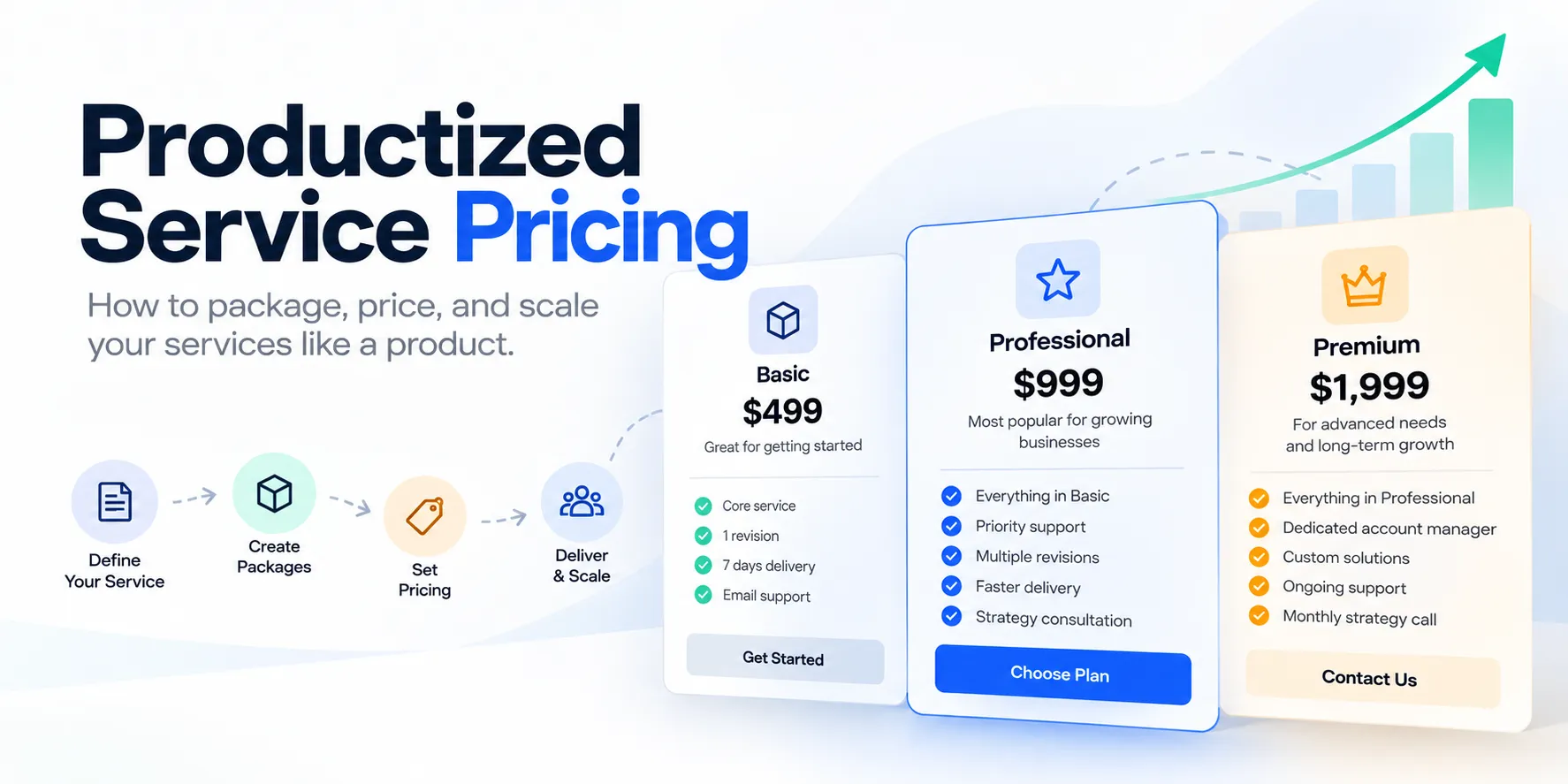
To price a productized service, start with a cost-based floor, build three tiers and price them so most buyers choose the middle one. Set Basic just above your true delivery cost, make Standard the best value for your ideal client, and price Premium high enough to anchor the other two.
You have decided to productize. The scope is fixed, the deliverables are clear and the process is repeatable. Then you hit the hardest question: what should each package cost? This guide shows exactly how to price a productized service in 7 steps, so you know how to price service packages with confidence, with a worked example, the most common mistakes and a simple way to put your tiers live.
Here is the Basic Standard Premium pricing strategy in five rules:
- Basic = your floor. Cost to deliver plus your minimum profit margin. Never lower.
- Standard = your target. The package you want most clients to buy, with the best value for money.
- Premium = your anchor. A high, fully loaded package that makes Standard look reasonable.
- Spacing: each tier is usually 1.5 to 2.5 times the price of the one below it.
- Difference: every tier adds clear outcomes, not just more hours.
Table of Contents
What Is Productized Service Pricing?
Productized service pricing means selling a service like a product: a fixed scope, a fixed price and a fixed timeline, usually in two to four packages. Clients pick a package instead of asking for a custom quote.
It sits between two classic approaches. Cost-plus pricing adds a markup to what the work costs you. Value-based pricing charges based on what the result is worth to the client. A good productized price uses cost to set the floor and value to set the ceiling.
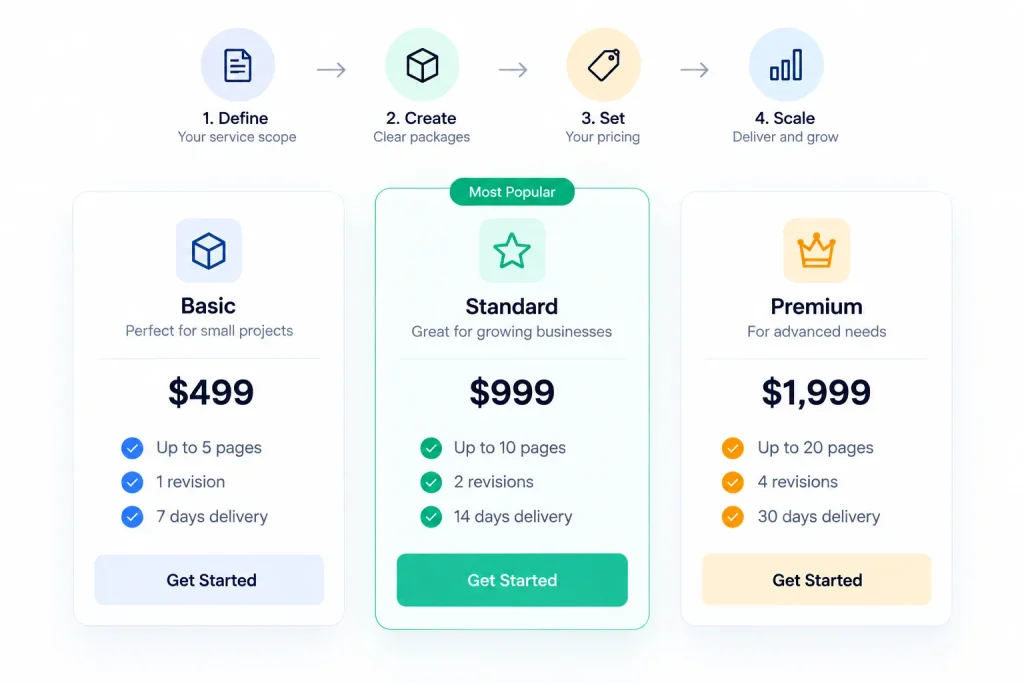
If you are still shaping what goes into each package, read our guide to building a productized service portfolio first. Tiered pricing for agencies is just one option. For a wider view of how agencies charge, see these digital marketing agency pricing models.
The Basic Standard, Premium Pricing Strategy
Three tiers work because they turn “Should I buy?” into “Which one should I buy?”. Each tier has one job.
| Tier | Job | How to price it | Who buys it |
|---|---|---|---|
| Basic | Protect your margin | Delivery cost plus minimum profit | Price-sensitive or first-time clients |
| Standard | Win most of your sales | Priced on the value of the core outcome | Your ideal client |
| Premium | Anchor and capture high-value buyers | 2 to 3 times Standard, with extras that cost you little to add | Clients who want speed, priority or done-for-you |
The Premium tier works through anchoring: seeing a high price first makes the next price feel more reasonable. A carefully designed tier can also act like the decoy effect, where a third option nudges buyers toward your preferred one.
Keep it to three. Beyond that, buyers can freeze from choice overload and pick nothing at all.
How to Price a Productized Service in 7 Steps
Follow these steps in order. Each one builds on the last, so you finish with prices backed by numbers instead of guesses.
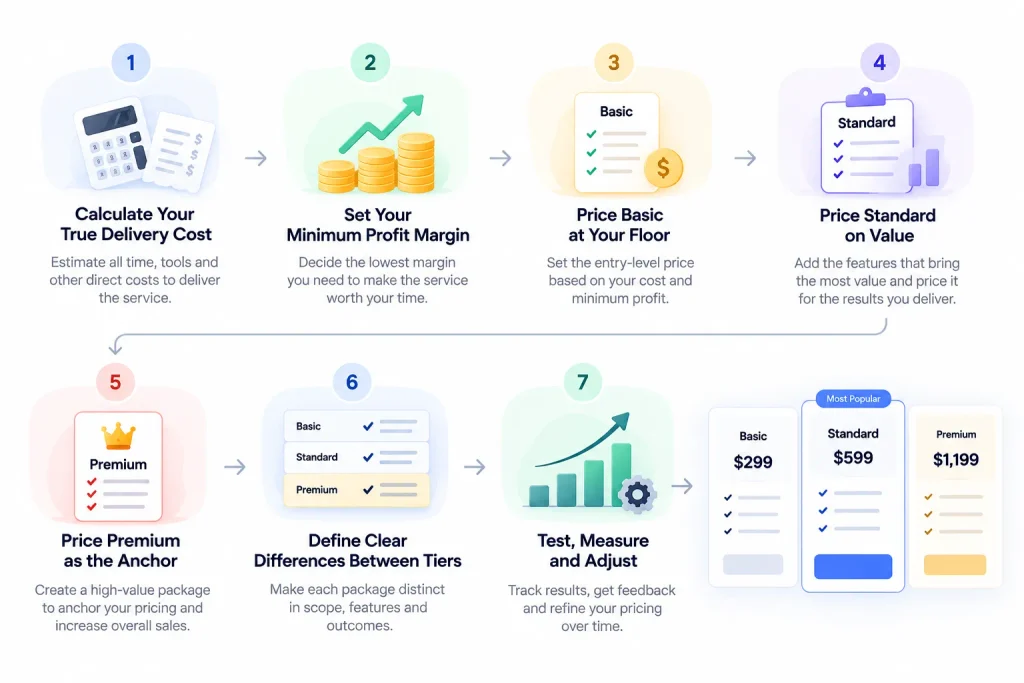
Step 1: Calculate Your True Delivery Cost
List every hour and expense that goes into one delivery: your team’s time, tools, subcontractors, revisions and client calls. Most people underestimate this. Use real data from past projects in time tracking, or estimate with a billable hours calculator.
Step 2: Set Your Minimum Profit Margin
Decide the lowest margin you will accept on any sale. Many service businesses aim for 30% to 50% gross margin, but your number depends on overheads. An agency profit margin calculator shows what you need to stay healthy.
Step 3: Price Basic at Your Floor
Basic = delivery cost + minimum margin. This is the lowest price you ever charge for this service. If the result feels too high for the market, reduce the scope of Basic instead of cutting the price.
Step 4: Price Standard on Value
Ask what the core outcome is worth to your ideal client: more leads, saved hours, faster launch. Standard should capture a fair share of that value and include everything most clients actually need. A service pricing calculator and a solo freelance rate calculator help you sanity-check the number.
Step 5: Price Premium as the Anchor
Make Premium 2 to 3 times Standard. Add extras with high perceived value and low delivery cost: priority turnaround, a strategy call, extra revisions, a dedicated channel or monthly reporting.
Step 6: Define Clear Differences Between Tiers
Write a feature checklist for each package. Every step up should add a visible outcome, not only more of the same. Clients should understand the difference in under 10 seconds.
Step 7: Test, Measure and Adjust
Launch, then review after 10 to 20 sales. If almost everyone picks Basic, Standard may be overpriced or under-featured. If nobody picks Premium, that is fine, it is doing its anchoring job. If most choose Premium, raise your prices.
Worked Example: Pricing an SEO Audit Package
Here is how to price a productized service step by step, using an SEO audit as the example. Costs assume an internal blended rate of $50 per hour.
| Criteria | Basic | Standard | Premium |
|---|---|---|---|
| Scope | Technical audit report | Technical + content audit with action plan | Full audit, action plan and 30 days of implementation support |
| Delivery time | 8 hours | 14 hours | 24 hours |
| Delivery cost | $400 | $700 | $1,200 |
| Price | $600 | $1,500 | $3,500 |
| Gross margin | 33% | 53% | 66% |
| Revisions | 1 round | 2 rounds | Unlimited for 30 days |
| Turnaround | 10 business days | 7 business days | 3 business days |
Notice the pattern. Basic covers cost with a modest profit, Standard earns the healthiest return for the work most clients need, and Premium adds speed and support that clients value highly. When you send these packages in a proposal, follow our guide on how to write a winning quote to present them clearly.
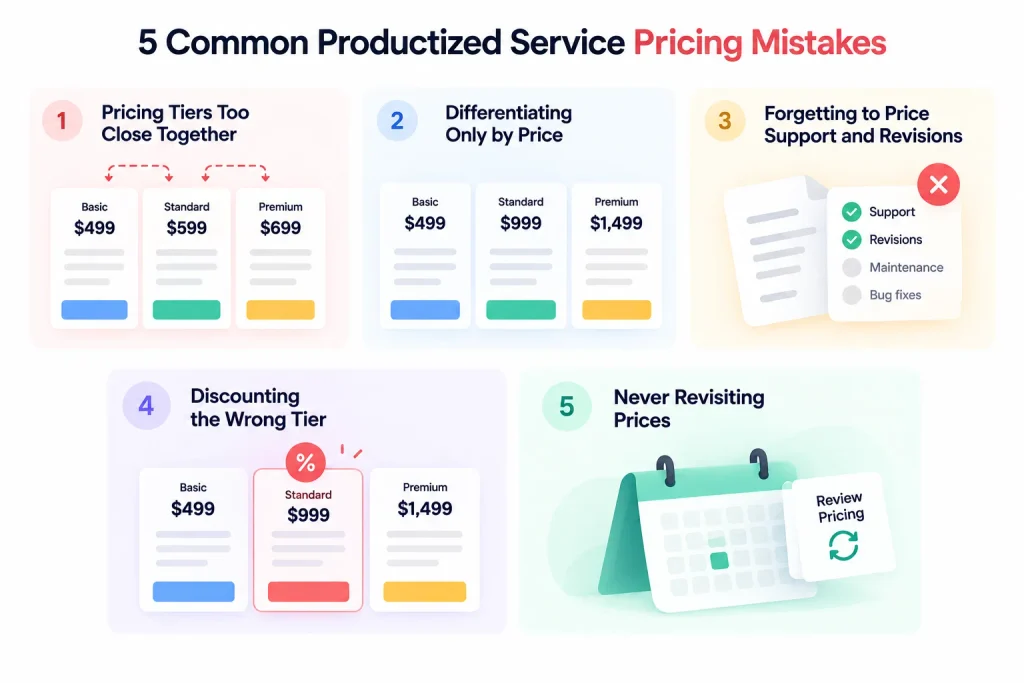
5 Common Productized Service Pricing Mistakes
Most pricing guides explain tier psychology but skip what goes wrong. Avoid these five.
1. Pricing Tiers Too Close Together
If Basic is $900 and Standard is $1,000, the gap feels random and clients take the cheaper option. Leave a clear jump, usually 1.5 to 2.5 times, so each tier feels like a real step up.
2. Differentiating Only by Price
Three packages with the same deliverables and different prices confuse buyers. Change outcomes, speed, support or access between tiers, not just the number at the bottom.
3. Forgetting to Price Support and Revisions
Unlimited revisions in Basic quietly erase your margin. Set a revision count for every tier and route extra requests through a formal change request.
4. Discounting the Wrong Tier
Permanent discounts on Standard train clients to wait for deals. If you run promotions, make them time-limited and tied to a clear reason. Our guide to discounts and coupons for agencies covers how to do it without hurting your margins.
5. Never Revisiting Prices
Costs, tools and your skills change every year. Review package prices at least twice a year and document the process in your agency SOPs so pricing stays consistent as your team grows.
How Taskip Handles Productized Service Pricing
Once your numbers are ready, Taskip turns them into packages clients can buy. Add unlimited packages to each service, attach a feature checklist, revision count and delivery time to every tier, and charge one-time or as a subscription. Clients check out through Stripe, PayPal or bank transfer, and each order can create the project, send the invoice and open their client portal automatically.
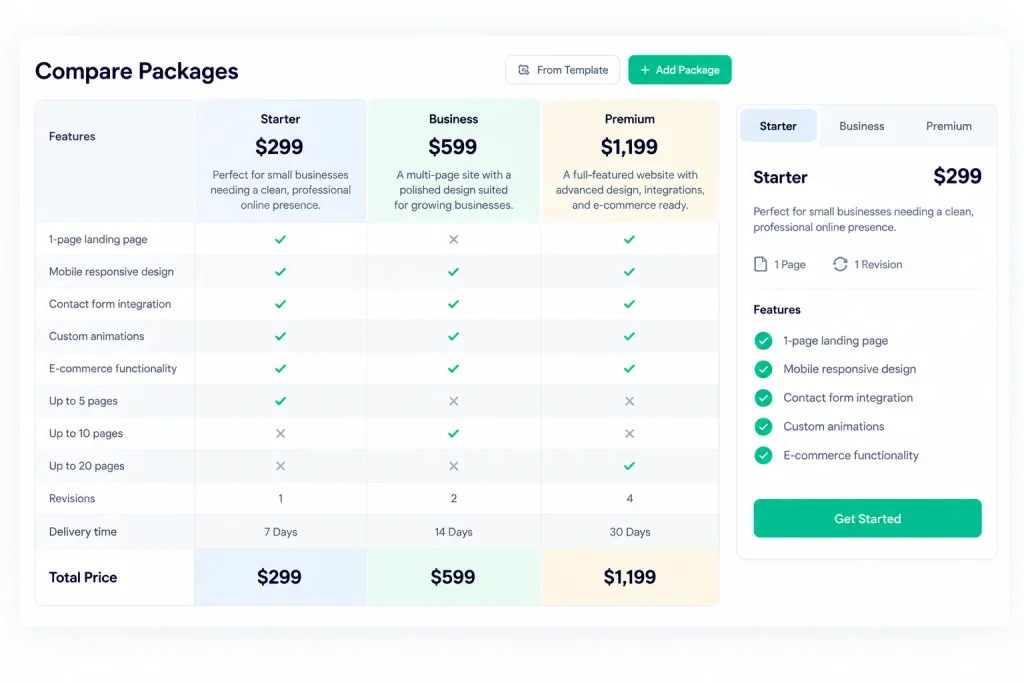
For custom deals, the same packages flow into quotation software. If you are setting up retainers, our client onboarding checklist and pricing guide shows how to structure them.
Ready to put your tiers live? Build tiered packages in Taskip’s Service Catalog, or compare plans to get started. Build your tiers →
Conclusion
Learning how to price a productized service comes down to three numbers and one rule. Basic protects your margin, Standard wins most of your sales, and Premium anchors the whole range. The rule: every tier must deliver a clearly different outcome, not just a different price.
Start with your real delivery cost, add a margin you can live with, price the middle tier on value and let the top tier do the anchoring. Then launch, measure what clients choose and adjust after your first 10 to 20 sales. Pricing is never finished, but with this framework it is never a guess either.
Need help with the numbers? Try Taskip’s free business tools, then put your packages live in minutes.
Frequently Asked Questions
How Do You Price a Productized Service?
Calculate your delivery cost, add a minimum margin to set the Basic price, price Standard on the value of the core outcome, and set Premium at 2 to 3 times Standard as an anchor. Review prices after 10 to 20 sales.
How Many Pricing Tiers Should a Productized Service Have?
Three tiers work best for most agencies and freelancers. Two can feel limiting, and more than three often leads to choice overload.
What Is the Best Pricing Strategy for Service Packages?
A Basic Standard Premium pricing strategy works best for most agencies: use cost-plus pricing for the floor and value-based pricing for the Standard and Premium tiers.
How Far Apart Should Package Prices Be?
Each tier is usually 1.5 to 2.5 times the price of the one below it, with clear differences in outcomes, speed or support.
Should Productized Services Be One-Time or Subscription?
One-time pricing suits fixed deliverables like audits, logos or websites. Subscriptions suit ongoing work like content, SEO or maintenance. Many agencies offer both.
How Do You Price Service Packages for Clients?
Start with your delivery cost and minimum margin, then build two or three packages with clearly different outcomes. Price the middle package on the value it delivers and use a higher top package as an anchor.