
A productized service portfolio is a set of real project examples, grouped by the exact package you sell, so prospects can see proof of that specific service before they buy.
However, building a tight service catalog- clear packages, clear pricing, a checkout button that works, and having traffic too doesn’t ensure a sale.
Nine times out of ten, it’s not the offer or the price; it’s proof. A prospect can read “SEO content package, $1,200/mo” and still not believe you can deliver it for a business like theirs. What convinces them is seeing you’ve already done it. Most businesses build a weak version of this and never realize it’s costing them sales.
- Group projects by service package, not by client or industry.
- Show four essentials: package tag, real project image, clear result, and proof link or file.
- Feature your strongest examples first, then refresh the portfolio at least quarterly.
- Keep portfolio, case studies, and testimonials separate: each serves a different purpose.
- Avoid five common mistakes: mixed-service grids, buried navigation, vague captions, gated proof, and outdated work.
- Link portfolio entries to your service catalog in Taskip to keep your proof aligned with the services you sell.
Table of Contents
What Is a Productized Service Portfolio?
It’s different from a regular agency portfolio. A traditional creative portfolio is organized by client, industry, or project type, and it’s built to show range: “look at everything we’re capable of.” A productized service portfolio is built to prove one specific, packaged offer works. If someone lands on your “Logo Design Package” page, the portfolio next to it should show logo design work only, not your best three case studies from unrelated services.
The narrower focus is the point. Productized services sell on predictability: a fixed scope, a fixed price, a fixed timeline. Your portfolio has to sell that same predictability. It should answer one question fast: if I buy this exact package, is this the kind of result I’ll get?
Why Do You Need a Productized Service Portfolio? – Benefits
A productized service portfolio shortens your sales cycle, builds trust before a prospect talks to a human, proves you can repeat results, and differentiates you from competitors selling the same package. It isn’t decoration. It does specific, measurable work for your business.
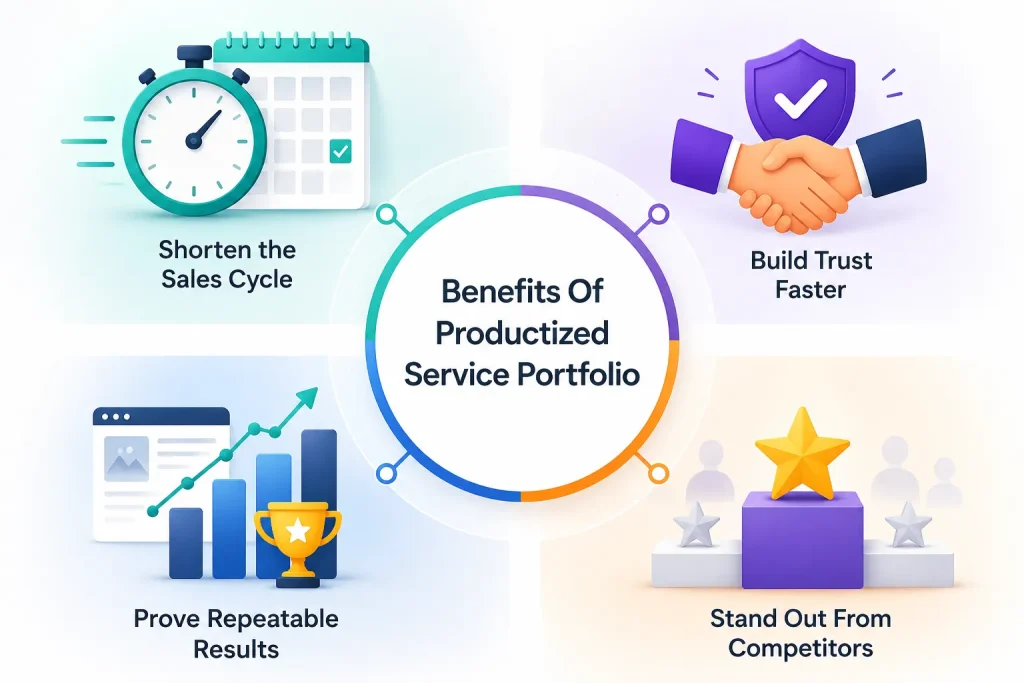
Shortening the Sales Cycle
Productized services are supposed to remove the back and forth of custom quoting. A vague or missing portfolio drags that friction right back in. Prospects end up asking, “Can I see examples?” before they’ll commit, which is exactly the conversation a self-serve packaged offer was supposed to skip.
Building Trust Before a Human Gets Involved
Most people won’t book a call or fill out a contact form just to ask if you’re any good. They’ll simply leave. A strong portfolio does that trust-building work automatically, at scale, without anyone on your team lifting a finger.
Proving You Can Repeat Results
One great case study says, “We did this once.” A portfolio full of similar packages and similar results across different clients says, “We can do this reliably.” That’s what a buyer is actually betting on when they pay for a productized service instead of hiring a freelancer or an in-house person: consistency.
Differentiating From Similar Competitors
Productized services live in crowded categories. There are dozens of agencies selling “one landing page a week” or “monthly SEO blog content.” When the offers look identical on paper, the portfolio is often the tiebreaker. Whoever shows the most convincing proof wins the client.
What’s the Difference Between a Portfolio, a Case Study, and a Testimonial?
Portfolio, case study, and testimonial are lumped together, but each one proves something different to a prospect, and mixing up their jobs is a common reason portfolio pages underperform.
| Differentiating Criteria | Portfolio | Case Study | Testimonial |
|---|---|---|---|
| Proves | A package delivers results | How one project unfolded, start to finish | How it felt to work with you |
| Format | Short and visual | Long-form and narrative | A short quote |
| Best for | Someone comparing options quickly | Someone already interested who wants the full story | Reinforcing trust alongside proof |
| Typical length | One image, one line | 500+ words | One to three sentences |
The three work together. Your portfolio is the shop window. Case studies are what a prospect clicks into when a specific portfolio piece catches their eye. Testimonials reinforce both. If you only have bandwidth to build one right now, start with the portfolio, since it’s what most visitors will actually see. For a template on structuring the long-form version properly, HubSpot’s case study guide is a solid starting point.
What Should You Include in a Productized Service Portfolio?
Every portfolio entry needs four things: a service or package tag, a real cover image of the deliverable, a result-driven description, and a proof file or live link. Keep each entry lightweight. This isn’t a full case study, but make sure it covers these four things.
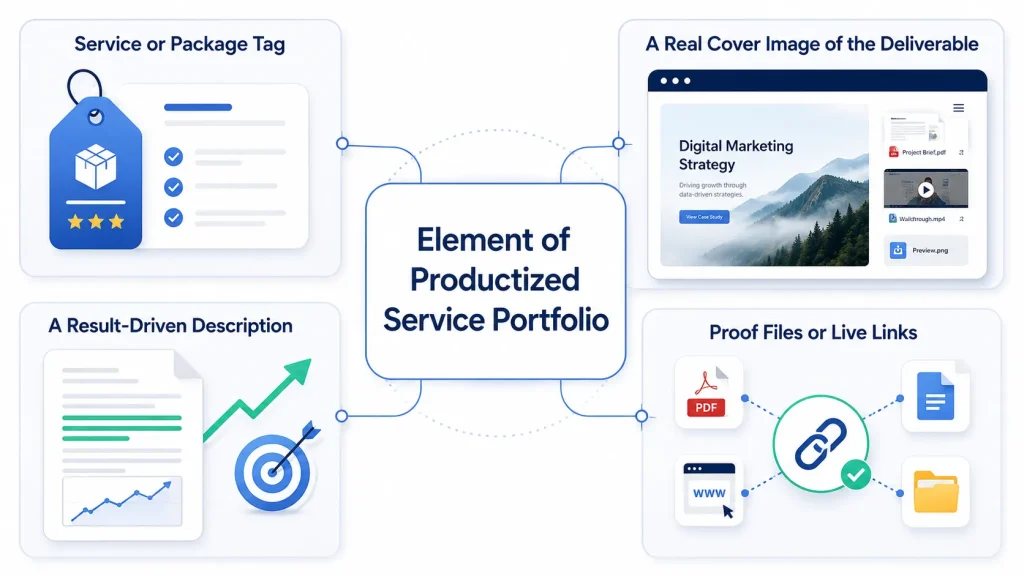
Service or Package Tag
Every portfolio piece should be tagged or filtered by which specific package it represents. If a prospect is browsing your “Website Audit” package, they should only see audit examples, not your entire work history.
A Real Cover Image of the Deliverable
Skip generic stock photography. Show the real output: a screenshot of the audit report, the actual landing page, the actual ad creative. Prospects are trying to picture the exact thing they’re about to receive.
A Result-Driven Description
“Redesigned homepage for a SaaS client” tells a prospect nothing they can act on. “Redesigned homepage for a SaaS client, cutting bounce rate by 24% in 60 days” gives them a number to anchor their expectations to. Where you have real metrics, use them. Where you don’t, describe the specific problem the work solved.
Proof Files or Live Links
A downloadable PDF of the actual report, a live link to the site you built, a short video walkthrough, anything that lets a skeptical prospect verify the work is real rather than take your word for it.
Quick reference: the 4 elements
| Element | What it does |
|---|---|
| Service or package tag | Filters proof to the exact package a prospect is browsing |
| Real cover image | Shows the actual deliverable, not stock photography |
| Result-driven description | Gives a specific outcome, not just a summary |
| Proof file or live link | Lets a skeptical prospect verify the work is real |
Should You Organize a Portfolio by Package or by Client?
Organize by package, not by client. Prospects are shopping for a specific service, and grouping proof by package is the single biggest difference between a portfolio that converts and one that just decorates the page.
Make it effortless for them to see proof of that exact package instead of making them dig through unrelated projects to find something relevant. Structuring by client feels natural because that’s how the work actually happened, but it optimizes for your convenience, not the buyer’s decision-making process. Structure by package, and let each package page pull only the entries tagged to it.
What Are the Best Practices for a High-Converting Portfolio?
The best-converting portfolios lead with the strongest result for each package, get updated every quarter, never include mockups or fake work, and stay skimmable in under 10 seconds.
Lead With Your Strongest Result, Not Your Newest
Recency feels honest, but a prospect doesn’t care what you shipped last week. They care about the best evidence you have. Put your strongest example first for each package, and keep updating it as you get better work.
Update It Every Quarter
A portfolio with three-year-old screenshots signals stagnation, even if you’re thriving. Set a quarterly reminder to swap in fresher examples, especially for packages that are selling well right now.
Never Use Mockups or Fake Work
It’s tempting to fill a portfolio gap with a “concept” piece when you’re just starting out. Don’t. One sniffed-out fake example does more damage to trust than an empty portfolio ever would. If you’re too new to have real work, use a founder-led project or a smaller pro bono piece instead; just make sure it’s real and labeled honestly.
Make It Skimmable in Under 10 Seconds
Most visitors are scanning, not reading. Use consistent formatting, short descriptions, and clear visual hierarchy so someone can judge your work in seconds, not minutes.
What Portfolio Mistakes Hurt Conversions?
The most common productized service portfolio mistakes are mixing packages together, burying the portfolio behind navigation, writing descriptions with no result, gating it behind a form, and letting it go stale. Most weak portfolios aren’t empty. They’re full of small mistakes that add friction without anyone noticing.
Mistake 1: Mixing packages together
A single unfiltered grid of “everything we’ve ever made” forces prospects to do the sorting work themselves. Most won’t bother.
Mistake 2: Burying the portfolio behind navigation
If it takes more than one click from a service page to see proof of that service, you’re losing people who would have converted.
Mistake 3: Writing descriptions with no result
A caption that only names the client and the deliverable reads like a file label, not evidence. Always answer “so what happened.”
Mistake 4: Gating it behind a form
Asking for an email before showing any proof adds friction at the exact moment you’re trying to build trust. Most prospects will leave rather than trade an email for a look at your work.
Mistake 5: Letting it go stale
An outdated portfolio next to a “starting at” price that’s clearly changed makes the whole page feel unmaintained, which quietly undermines trust in everything else on it.
What Does a Productized Service Portfolio Look Like by Service Type?
What belongs in a portfolio entry changes depending on what you sell: design packages lead with visuals, SEO and content packages lead with numbers, development packages lead with live links, ad management packages lead with performance data, and consulting packages lead with a redacted sample deliverable. A few starting points by category.
Design packages (logo, brand identity, web design): For design-based, productized service portfolios like web design agencies, lead with the final visual. Before-and-after comparisons work especially well here because they make the value obvious at a glance.
SEO and content packages: Screenshots of ranking improvements, traffic graphs, or a sample of the actual content delivered. Numbers matter more here than visuals.
Development packages (websites, apps, integrations): A live link is worth more than any screenshot. If the product still exists, link to it directly so prospects can interact with the real thing.
Ad management packages: Anonymized performance dashboards showing spend versus results. Specific numbers (cost per lead, ROAS) do more convincing than creative samples alone.
Consulting or audit packages: A redacted sample of the actual deliverable, like an audit report or strategy document, so prospects can see the depth of work rather than just a summary of it.
Top 10 Productized Service Software
Below, I have listed the top productized service software using which you can easily make your own productized service software:
For a full breakdown of features and pricing, see our complete productized service software comparison.
How to Build and Manage Your Portfolio in Taskip
Taskip is an all-in-one client portal, CRM, and service catalog platform built for agencies, freelancers, and productized service businesses. If your business runs through Taskip, your portfolio doesn’t have to live as a separate, hand-coded page you forget to update. Taskip’s client portal and service catalog let you attach real project outcomes directly to the packages you sell, so proof and pricing live in the same place a prospect is already evaluating.
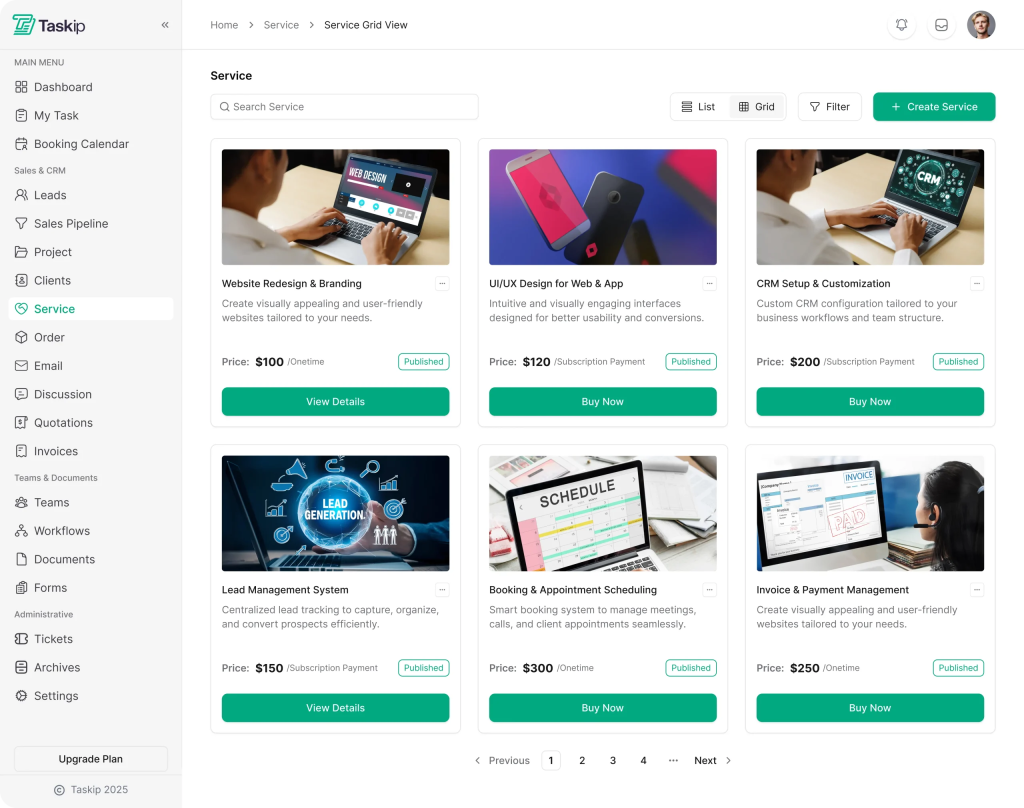
Taskip lets you organize your portfolio around services and packages, rather than a long list of past clients. Start by setting up your services in the Service Catalog.
Set Up Your Service Catalog
- Go to Services > Catalog to view and manage your packages.
- Click “+ Create Service” to create a new package.
- Choose a starting point: build from scratch or use a template with sample packages, FAQs, and intake fields.
- Add your service details, including the name, description, type, category, and pricing.
Attach Proof to Each Package
Connect completed projects to the relevant service so prospects see proof that matches the package they’re considering. This keeps your portfolio focused and more useful than a generic “Our Work” page.
After a prospect converts, you can continue the workflow with Taskip’s client onboarding guide. And if your business runs on a small team, the same principles apply whether you’re a solo operator using our guide for freelancers running productized services or a full studio referencing what works for creative agencies.
Conclusion
A great productized service deserves proof that’s just as sharp as the offer itself. The businesses winning in crowded, commoditized categories aren’t necessarily the ones with the best price or the flashiest packaging. They’re the ones a prospect can actually picture working with, because the portfolio already showed them.
Start small if you have to. Tag your best three projects to the right packages, write one result-driven line for each, and make sure they’re visible without a click-hunt or a form to fill out. Build from there, and review it every quarter so it never goes stale. If you’re already running your services through Taskip, your next completed project can become your next portfolio piece with no extra tools and no separate upload.
Start your free trial, no credit card required.
FAQs
Do I need a portfolio if I already have testimonials?
Testimonials tell a prospect how a client felt. A portfolio shows them what they actually got. Use both. They answer different questions and reinforce each other.
What if I’m a new productized service business with no completed projects yet?
Use founder work, pro bono projects, or personal projects that are honestly labeled as such. A small, real example beats an empty portfolio or a fabricated one. Prospects can usually tell the difference, and trust is hard to rebuild once it’s broken.
Should my portfolio be public or gated behind a form?
Public, in almost every case. A gated portfolio adds friction at exactly the moment you’re trying to build trust, and most prospects will simply leave rather than trade an email for a look at your work.
How often should I update my portfolio?
You must review the portfolio quarterly at minimum, and any time you land a result that’s clearly stronger than what’s currently featured. Packages that are actively selling deserve the freshest proof.
Is a portfolio the same as a proposal?
No, a portfolio is not the same as a proposal. A portfolio is proof you show everyone browsing your services. A proposal is a tailored pitch you send to one specific prospect, often referencing relevant pieces from your portfolio to back up your claims.