
To price a retainer service, calculate your total monthly delivery cost, divide by (1 − your target profit margin), then adjust for the value you deliver. Most agencies should target a 50–65% gross margin
If you have been looking for a clear framework on how to price retainer services without second-guessing yourself, this guide gives you exactly that!
It covers the five agency retainer pricing models used in 2026, a step-by-step fee calculation formula with real numbers, benchmarks by service type and agency size, scope protection strategies, and scripts for difficult pricing conversations. Let’s dive in:
Table of Contents
- Price retainers using the formula: Total Monthly Costs ÷ (1 − Target Margin) = Floor Price. With $2,000 in costs and a 40% margin target, your minimum is $3,333/month.
- 64% of agencies charge below $1,000/month, far below what their costs and value justify. Pricing on outcomes, not hours, is the biggest margin lever available.
- Always protect the scope in writing. A change request clause and monthly time tracking per client are non-negotiable.
Add up all monthly delivery costs: staff time, overhead, software, account management, and your own time as owner. Divide that total by one minus your target profit margin. For example, $2,000 in costs with a 40% margin target gives a minimum retainer price of $3,333 per month. Add a value premium above that floor based on the business results you deliver.
What Is a Retainer Service?
A retainer service is a recurring agreement where a client pays a fixed monthly fee in exchange for an ongoing, defined scope of work from an agency. Unlike project pricing tied to a single deliverable, a retainer creates predictable monthly income for the agency and continuous strategic support for the client.
Retainer arrangements can cover a set number of hours, a defined list of monthly deliverables, or a fixed level of strategic access to your team. The client knows exactly what they are paying. You know exactly what to deliver.
For agencies, the retainer model is the foundation of sustainable growth. It replaces unpredictable project revenue with consistent cash flow that makes hiring, team planning, and long-term business decisions far more manageable.
Retainer vs. Project Pricing: A Direct Comparison
| Factor | Retainer Model | Project Model |
|---|---|---|
| Revenue Predictability | High | Low |
| Client Relationship Depth | Deep and strategic | Transactional |
| Scope Management | Defined monthly | Per-project negotiation |
| Cash Flow | Predictable | Variable |
| Team Planning | Easier to resource | Reactive |
NB: Retainer pricing is the most widely used of the six digital marketing agency pricing models in 2026; roughly 78% of agencies use it as their primary structure. However, not sure a retainer is the right fit yet? See our retainer vs. project-based pricing comparison before you commit to a structure.
Why Most Agencies Get Agency Retainer Pricing Wrong
Most agencies underprice their retainers because they build fees around the hours required for visible work, completely ignoring the hidden costs that make up 30 to 50% of true delivery cost.
When you factor in account management time, client email threads, reporting hours, software subscriptions, and your own time as owner, the actual cost of one hour of delivered work is often two to three times what most agencies estimate. Pricing from hours alone guarantees thin margins from the start.
The industry calls the result the “busy but broke” agency. Fully booked, no available capacity, and no real profit to show for it.
Three specific reasons agencies consistently underprice in their agency retainer pricing:
- Fear of losing the client. Rates are set based on what the agency thinks the client will accept, not what the service genuinely costs to deliver.
- No per-client profitability data. Without time tracking per client, most agencies cannot identify which retainers are profitable and which are quietly bleeding cash every month.
- Vague scope. When deliverables are not documented clearly upfront, agencies routinely deliver 20 to 30% more than the retainer covers, converting a healthy engagement into a loss-maker within a few months.
According to the Ignition 2025 Agency and Cash Flow Report, 78% of agencies rarely or only sometimes charge for work done outside the agreed scope. That is a structural margin problem hiding in plain sight across the industry.
5 Agency Retainer Pricing Models for 2026
There are five primary agency retainer pricing models agencies use today. Choosing the right one is the first decision you need to make before setting any number.
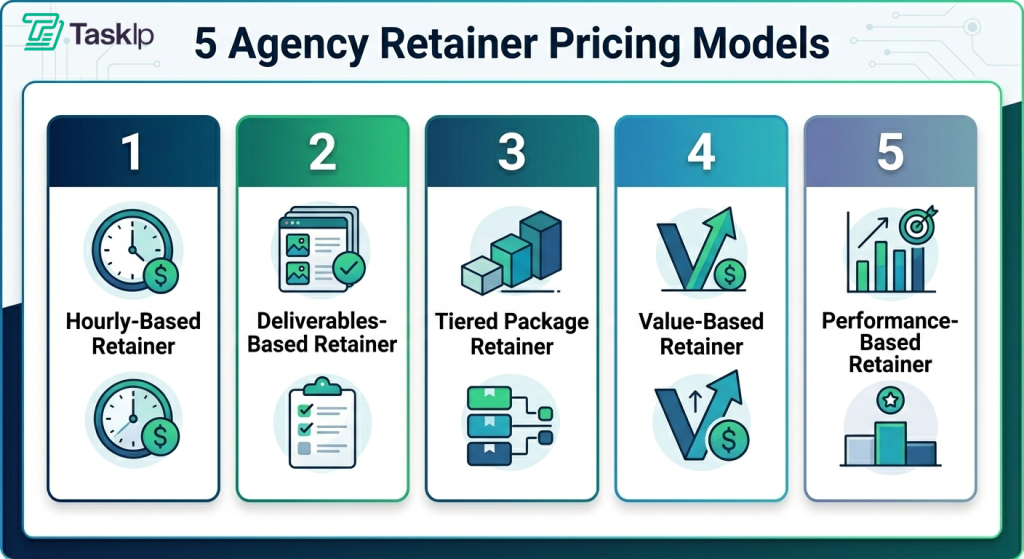
1. Hourly-Based Retainer
The client pays for a fixed block of hours each month at an agreed hourly rate. For example, 20 hours at $150 per hour equals a $3,000 monthly retainer. Unused hours do not roll over to the following month.
This is the most straightforward model and easiest to explain to clients. Its structural weakness is that it commoditizes your team’s time and creates a built-in conflict where clients want to consume every hour paid for, while you want to work efficiently.
Best for: New agencies and variable monthly support engagements.
Key rule: Always enforce a “use it or lose it” policy. Rollover hours destroy revenue predictability and reward inefficiency.
2. Deliverables-Based Retainer
You charge a fixed monthly fee for a defined set of outputs. For example, four blog posts, twelve social graphics, and one performance report per month for $4,500.
This eliminates the hour-counting conversation entirely. The client buys outcomes, not time. It works best when your delivery process is repeatable and consistent month over month.
Best for: Content agencies, SEO firms, and social media management teams.
Key rule: Specify revision rounds per deliverable and list exclusions in writing. Without a formal change request process, this model is the most vulnerable to scope creep of all five approaches.
3. Tiered Retainer Packages (Basic / Standard / Premium)
Most agencies structure their retainer packages into three tiers. For example, a Basic package ($1,500–$2,500/mo) covering core deliverables only, a Standard package ($3,000–$5,000/mo) adding strategy and reporting, and a Premium package ($6,000+/mo) adding priority turnaround and a dedicated account lead.
The anchor pricing psychology works strongly here. Most clients choose the middle tier when presented with three clear options. Designing that middle tier to be your highest-margin engagement is the key to making this model exceptionally profitable. For agencies that want to build their full-service offering around this approach, our guide on productized services covers the complete framework.
Best for: Growth-stage agencies ready to standardize and scale their delivery.
4. Value-Based Retainer
You set the price based on the business value delivered to the client rather than hours spent or outputs produced. If your SEO work consistently generates $40,000 in new monthly revenue for a client, charging $5,000 per month represents an 8x return on their investment.
This model produces the highest margins of any approach in agency retainer pricing. It requires the ability to quantify results in revenue terms and case studies that demonstrate repeatable outcomes.
Best for: Established agencies with strong, measurable track records.
5. Performance-Based Retainer
A base monthly fee is combined with performance bonuses tied to agreed KPIs. For example, $2,500 per month base plus $500 for every 10% increase in qualified lead volume above a defined baseline.
This model aligns your agency’s financial interests with the client’s business goals, which builds deep trust and makes renewals nearly effortless. It requires rigorous attribution tracking and a client who understands performance-linked pricing.
Best for: PPC, lead generation, paid media, and conversion optimization agencies.
All 5 Agency Retainer Pricing Models Compared
| Model | Margin Potential | Complexity | Best Stage |
|---|---|---|---|
| Hourly-Based | Low to Medium | Simple | New agencies |
| Deliverables-Based | Medium | Simple | Content and SEO firms |
| Tiered Packages | Medium to High | Moderate | Growth-stage agencies |
| Value-Based | Very High | Complex | Established with proven results |
| Performance-Based | High | Complex | PPC and lead gen specialists |
How to Price Retainer Services: A Step-by-Step Formula
To calculate your monthly retainer fee, total all true delivery costs, divide by one minus your target profit margin to establish a floor price, then add a value premium based on the business results you deliver. Never quote below the floor.
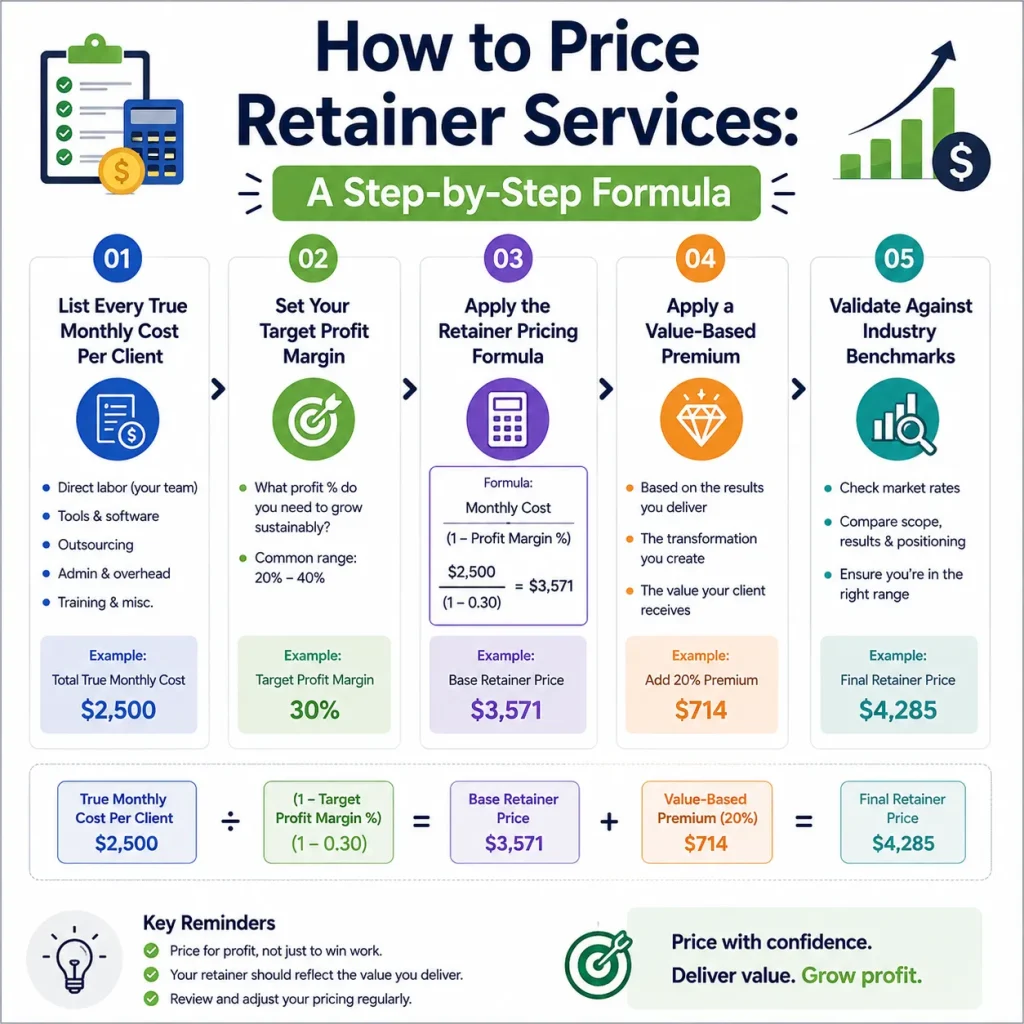
Step 1: List Every True Monthly Cost Per Client
Most agencies forget at least three cost categories when building retainer pricing. Start with a complete inventory:
- Staff delivery time (salary or freelancer fees for hours worked on this client)
- Account management, email, and call time
- Software and tools allocated to this client
- Reporting, analytics preparation, and presentation time
- Your own time as founder or director
- A proportional overhead share (rent, utilities, admin, business development)
Example cost breakdown:
| Cost Item | Monthly Amount |
|---|---|
| Staff delivery time | $1,200 |
| Account management and calls | $300 |
| Software and tools | $100 |
| Overhead share | $400 |
| Total Monthly Cost | $2,000 |
Step 2: Set Your Target Profit Margin
A healthy agency targets a gross margin of 50 to 65% on retainer work, the money left after paying direct delivery costs. For net profit after all overhead, aim for 20 to 35%.
Research from Parakeeto, which works exclusively with digital agencies on profitability, found that agencies in the $1.5M to $5M revenue range frequently fail to break 15% net margin. The most consistent cause is retainer pricing that was not built from true cost calculations.
Step 3: Apply the Retainer Pricing Formula
Total Monthly Costs / (1 minus Target Profit Margin) = Minimum Retainer Price
Worked example using the figures above:
- $2,000 / (1 minus 0.40)
- $2,000 / 0.60
- Minimum retainer price: $3,333/month
That is your floor. Quote below this, and you are working at a loss regardless of how busy you feel.
Step 4: Apply a Value-Based Premium
Ask what the business impact of your work actually is. If your content strategy generates 50 qualified leads per month and the client closes 10% of those at a $3,000 average deal value, your work produces $15,000 in monthly revenue for them.
Charging $3,333 for work worth $15,000 leaves enormous value uncaptured. Even charging $5,000 gives the client a 3x return, a compelling, easy-to-justify ROI that makes renewal conversations straightforward.
Step 5: Validate Against Industry Benchmarks
Once you have your number, check it against real market data.
The Ahrefs survey of 439 SEO professionals found that agency retainers average $3,209 per month across all SEO service types. The SE Ranking survey of 260 agencies found that only 13% of agencies charge between $2,000 and $5,000 per month, despite that range being precisely where most small-to-mid-size agencies should land based on their actual cost structures.
That gap between where agencies price and where they should price is the opportunity this framework is designed to close.
Retainer Pricing Calculator
Plug your own numbers into the formula below to find your minimum retainer price:
(Monthly hours × Fully-loaded cost per hour) ÷ (1 − Target margin) × (1 + Value premium) = Minimum Monthly Retainer
This gives you a floor, not a ceiling, check it against the benchmark table below before you send a quote.
- Monthly hours: hours you’ll spend on this client each month
- Fully-loaded cost per hour: (salary + overhead) ÷ working hours
- Target margin: the profit margin you want to protect (55% is a common target)
- Value premium: optional markup for outsized results or scarce expertise (0% if unsure)
Worked example: 20 hours × $60/hr ÷ (1 − 0.55) × (1 + 0%) = $2,667/month minimum
Agency Retainer Pricing Benchmarks: Monthly Retainer Fee for Agencies in 2026
Monthly agency retainer pricing varies significantly by size, service type, and geography. Here is what the current market data shows agencies are actually charging.
By Agency Size
Not all agencies price the same way, and they should not. Your size, team structure, and service depth all directly affect what you can charge and what clients expect to pay.
| Agency Type & Size | Monthly Retainer Range | Typical Scope |
|---|---|---|
| Solo / Boutique | $1,000 to $3,000 | One or two core services |
| Small Agency (2 to 10 people) | $2,500 to $7,500 | Multi-channel management |
| Mid-Size Agency (10 to 30 people) | $5,000 to $15,000 | Integrated strategy and execution |
| Enterprise Agency (30+ people) | $15,000 to $50,000+ | Full-service with dedicated teams |
As your agency grows, pricing power increases, not just because you can deliver more, but because your track record justifies higher fees. Agencies retaining clients for two or more years charge nearly double the rates of those with shorter relationships.
Monthly Retainer Fee for Agencies by Service Type
| Service | Typical Monthly Range | Key Pricing Driver |
|---|---|---|
| Web Design | $1,500–$4,000 | Project scope, design complexity, and number of pages |
| Web Development | $2,500–$8,000 | Technical complexity, integrations, and functionality |
| Website Maintenance | $200–$800 | Update frequency, support level, and website complexity |
| SEO | $1,500–$10,000+ | Competitive landscape and technical complexity |
| Content Marketing | $1,500–$8,000 | Volume and depth of content produced |
| Social Media Management | $1,000–$6,000 | Number of platforms managed |
| PPC / Paid Media | $1,500 + % of ad spend | Typically 10–20% of total managed budget |
| PR / Communications | $3,000–$20,000+ | Media tier access and relationship depth |
| Full-Service Digital | $5,000–$25,000+ | Service bundle scope and complexity |
1. 70% of agencies surveyed by SE Ranking had recently raised prices or planned to, driven primarily by inflation and higher operational costs.
2. Agencies retaining clients for two or more years charge nearly double the rates of agencies with shorter client relationships. Pricing power and retention are directly connected.
3. 40% of US and Canadian agencies charge over $125 per hour compared to just 6% of European agencies. Always benchmark against your own regional market.
Web Design & Web Development Agency Retainer Pricing (2026)
Web design and web development retainers work differently from marketing retainers. Clients typically pay for ongoing maintenance, design updates, development support, and a reserved block of hours rather than campaign management. Here’s what agencies typically charge by service type:
| Web Service | Monthly Retainer Range | What’s Usually Included |
|---|---|---|
| Website Maintenance | $200–$800 | CMS and plugin updates, backups, uptime monitoring, security checks, and minor content edits |
| Web Design Retainer | $1,500–$4,000 | New landing pages, design updates, A/B test variants, and creative asset updates |
| Web Development Retainer | $2,500–$8,000 | Feature development, bug fixes, integrations, and a reserved monthly block of development hours |
| Full-Stack Web Design + Development Retainer | $4,000–$12,000+ | Combined design and development support, roadmap ownership, and dedicated project management |
| Enterprise Web Platform Retainer | $12,000–$30,000+ | Multi-site or complex platform support, SLAs, and a dedicated senior team |
Use the same formula as above: (monthly hours × fully loaded hourly cost) ÷ (1 − target margin)
For the first 1–2 months, however, you may need to budget additional hours while the development team gets familiar with the client’s codebase and infrastructure. Many agencies add a 10–15% onboarding buffer to the first quarter’s retainer to account for this ramp-up work.
How to Structure Your Retainer to Prevent Scope Creep
Scope creep is the most common reason profitable retainers become unprofitable ones. It never starts with a large, unreasonable request. It starts with “can you just quickly…” and accumulates month after month until your team is delivering 30% more than what is covered by the monthly retainer fee.
The fix is not a difficult conversation. It is a written document completed before work begins, not a verbal understanding or email thread.
Every retainer scope document must contain:
- Specific deliverables with exact quantities (“4 blog posts per month, up to 1,200 words each”)
- Revision rounds included per deliverable
- Communication channels and response time expectations
- Number of meetings or calls included monthly
- A clear, explicit statement of what is NOT included
- A formal written process for requesting work outside the agreed scope
That last item is what most agencies omit.
“Work outside the agreed scope will be quoted separately at our standard rate and requires written approval before commencement.”
This single clause converts a recurring margin argument into a standard business transaction. For agencies building this kind of structured process across all client engagements, our guide on how to create agency SOPs covers the full approach.
What real agency professionals say about having proper retainer tracking systems in place, in G2 reviews:
“Billing management is better. Scope of work and quote creation. Looking at team capacity and utilisation reporting.”
What Is a Fair Retainer Fee for an Agency?
A fair monthly retainer typically falls between $1,000 and $15,000+, depending on agency size and service type. Solo or boutique agencies charge $1,000–$3,000, small agencies with 2–10 people charge $2,500–$7,500, and mid-size agencies with 10–30 people charge $5,000–$15,000. The right number for your agency is whatever covers your fully loaded costs plus a 50–65% gross margin, not a figure pulled from a table alone.
How to Present Your Retainer Pricing to Clients With Confidence
Knowing how to price retainer services internally is half the challenge. Presenting that price in a way that earns confident agreement is the other half.
Should You Present One Number or Multiple Options?
Never present a single number. Always present three tiers: Starter, Growth, and Scale. This reframes the client’s decision from “should I buy this?” to “which option fits my needs?”
Design each tier around meaningful scope differences rather than arbitrary price increments:
- Tier 1 (Starter): Core service, standard outputs, standard delivery speed
- Tier 2 (Growth): Additional channel, strategy layer, or faster turnaround
- Tier 3 (Scale): Full strategic partnership, dedicated team time, quarterly reviews
Show the top tier first. The middle tier immediately feels like the smart, cost-effective choice — which is exactly the engagement you should design to be your most profitable.
The Value Anchor Technique
Before revealing any price, walk the client through what your work is worth using their own revenue numbers. Current monthly leads, average close rate, average deal value- use the actual figures from your discovery conversation.
Show the gap your retainer is designed to close and what closing that gap means in revenue terms. Then present your fee as a clear fraction of that value.
A $4,500 monthly retainer becomes a straightforward yes when the client can see it is projected to deliver $22,000 in new pipeline. The fee stops feeling like a cost and starts functioning as an investment with a visible return.
How Do You Handle the 4 Most Common Pricing Objections?
“It’s too expensive.” Ask: “Compared to what?” Return to the value anchor and show the ROI calculation on paper. If the value is clearly there, the price is rarely the actual objection.
“We don’t need all of this every month.” Present Tier 1 as the entry point. Reducing scope is always available. Reducing your hourly rate is not.
“Can we start with a project to test things?” Offer a structured 90-day pilot at the Starter tier. Frame it as a low-commitment way to see results before agreeing to a longer engagement.
“We prefer project-based billing.” Run the true cost comparison over six months. Multiple project invoices almost always total more than six months of a well-scoped retainer, and deliver far less strategic continuity.
How to Move a Client From Hourly or Project Work to a Retainer
Moving a client from hourly or project-based work to a retainer requires more than simply offering a new pricing model. The transition works best when you introduce it at the right time and clearly show how an ongoing agreement benefits the client.
Frame It Around Their Benefit, Not Yours
Clients are more likely to accept a retainer when they understand what they gain from it. Focus the conversation on predictability, convenience, and access to your services.
Do not position the switch as a way to improve your cash flow. Instead, focus on what the client gains: predictable monthly costs, no surprise invoices, and guaranteed priority on your calendar. Clients are more likely to agree when a retainer solves a problem for them, not just for you.
Time It Around a Renewal or Scope Increase
The timing of your proposal can make a significant difference. Look for moments when the client is already considering future work or expanding their existing needs.
The best time to suggest a retainer is before a project renewal or when a client asks for work beyond the current scope. At both points, the client is already thinking about what comes next, making it easier to introduce a longer-term arrangement.
Offer a 60-Day Trial Retainer
A shorter trial period can reduce the client’s hesitation about committing to a long-term agreement. It gives them a chance to experience the benefits of a retainer before making a larger commitment.
If a client is hesitant, start with a shorter commitment. Offer a 60-day trial instead of asking them to commit to a typical 6- to 12-month term, while keeping the same rate you would normally charge. This reduces the perceived risk for the client while giving both sides time to see whether the retainer arrangement works.
How to Manage Retainer Clients for Long-Term Profitability
Winning a retainer is just the beginning. Keeping it profitable over 12, 18, and 24 months requires systems, not effort alone. Here is where most agencies let profitability slip after the first few months.
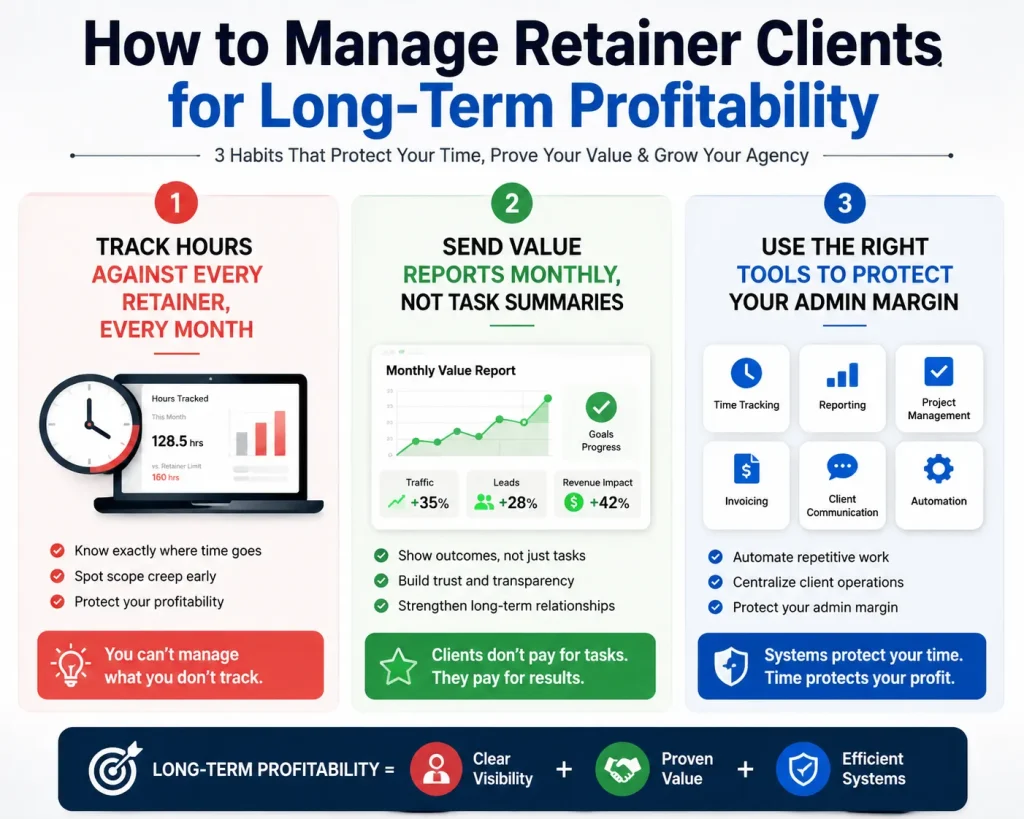
Track Hours Against Every Retainer, Every Month
This applies even if your retainer is not hourly-based. Per-client time tracking is the only reliable way to know which clients are generating profit and which are eroding it.
If a client is consistently consuming 20% more hours than their retainer covers, you need to choose: raise the price, tighten the scope, or accept lower margins. None of those decisions is possible without the data to support them.
Jeff S., an IT Support Manager at a small agency, described what changed when his team moved to a system with built-in retainer tracking in his Accelo G2 review:
“The retainer feature has truly helped us create and manage a quarterly workflow.”
Real-time visibility into retainer budget consumption allows you to address overservicing before it becomes the default rather than discovering it at billing time.
Send Value Reports Monthly, Not Task Summaries
The most common reason retainers get cancelled is not poor results. It is that clients stop seeing and feeling the value. When your monthly update is a task list, the retainer looks like an overhead cost. When it is a value report, it looks like a revenue-generating investment.
Reframe every monthly report around business outcomes the client actually cares about. “We published four blog posts” becomes “Organic traffic increased 14% and contributed 38 new leads to your sales pipeline.”
This framing makes every renewal conversation a results review rather than a price defence.
Use the Right Tools to Protect Your Admin Margin
The overhead of running retainer clients manually- tracking hours, chasing invoices, managing deliverables, and keeping clients informed- silently erodes the margin your agency retainer pricing was designed to protect.
Taskip is purpose-built for this. As an all-in-one agency management platform, Taskip lets you track tasks and hours against each retainer budget in real time, manage deliverables through a branded client portal, automate recurring invoices, and run workflow automations that keep clients updated without manual effort.
Agencies on Taskip report saving 10 or more hours per week on admin time redirected into delivery, strategy, and business development. See how the full automation system works in our guide to automating client onboarding.
Amalia U., an Account Manager at a small business agency, highlighted exactly this benefit in a verified G2 review:
“It is also facilitating the visibility of projects for clients. Makes it a very easy one stop shop to have everything together which is great!”
Client-facing transparency is precisely what builds the trust that keeps retainers renewing year after year. Our guide on AI tools for agency workflows in 2026 covers the full technology stack that leading agencies are using to manage this at scale.
When and How to Raise Your Retainer Prices
If you have not reviewed your retainer pricing in the last 12 months, you have effectively taken a pay cut. Inflation alone reduces purchasing power by 3 to 5% per year without any change to your workload or costs.
| Raise prices when: | Standard increase ranges: |
| Annually, as a minimum baseline aligned to inflation (3 to 8%) | 5 to 15% for annual renewals with established clients |
| After delivering results that measurably exceed what you are currently charging for | 15 to 25% after significant results milestones or expanded service capability |
| When team, tools, or operational costs have risen meaningfully | |
| When you are consistently over-delivering against your written scope |
“As we approach our next renewal period, we will be adjusting our monthly retainer to $X, effective [date]. This reflects our increased operating costs and our continued investment in delivering strong results for your business. I am happy to walk through the updated scope if that would be helpful.”
State the number, justify it in one sentence, and move forward. Over-explaining invites negotiation you do not need to have.
If a client leaves over a well-communicated, reasonable increase, it is a signal that the relationship was undervalued. It frees capacity for clients who recognise and pay for quality work.
7 Agency Retainer Pricing Mistakes to Avoid in 2026
Even experienced agencies make these mistakes. Run your current retainers against each one.
Mistake#1: Underpricing to win the deal
Low rates create a floor that is nearly impossible to raise without friction. They also teach clients to view your work as interchangeable with cheaper alternatives.
Mistake#2: Ignoring overhead and hidden costs
If software, admin time, account management, and business development are not factored into your pricing, you are subsidising each client without realising it.
Mistake#3: Selling hours instead of outcomes
Hourly pricing commoditises your expertise. Clients can compare hourly rates across agencies. They cannot easily compare outcomes and that is where your real competitive advantage lives.
Mistake#4: No written scope document
A verbal scope is an open invitation for scope creep. Document deliverables, revision rounds, and exclusions before work starts.
Mistake#5: No per-client profitability tracking
If you cannot identify right now which retainer clients are profitable, you are managing by intuition rather than data. Monthly time tracking per client is not optional if you want to protect your margins.
Mistake#6: Never reviewing or raising prices
Inflation erodes your real margin every year without any action on your part. A retainer priced in 2022 and untouched in 2026 is paying you meaningfully less in purchasing-power terms.
Mistake#7: Forcing every client into a retainer
Some clients are genuinely better served by project pricing. Forcing a retainer on clients with one-off or sporadic needs leads to early cancellations and damaged relationships. Know which model fits which client type.
What to Include in a Retainer Agreement: 2026 Checklist
A strong retainer agreement defines the full terms of the engagement and protects both parties when expectations diverge. Do not start work without one.
Every retainer agreement must include:
- Specific scope of work with deliverable quantities and formats
- Revision rounds included per deliverable
- Monthly fee, payment due date, and late payment penalty
- Contract duration and minimum commitment period
- Cancellation notice period (30 to 60 days is standard)
- Change request process for work outside the agreed scope
- Intellectual property ownership of all deliverables produced
- Confidentiality and non-disclosure terms
- Monthly reporting and quarterly review schedule
- Termination conditions for both parties
Red flags to watch for in any retainer agreement:
- No defined scope means everything the client asks for becomes included by default
- No revision limit implies unlimited free revisions
- No termination clause means there is no clean exit for either party
- No IP clause means ownership of creative work may be disputed
- No late payment fee removes the financial incentive for clients to pay on time
Don’t build your retainer agreement from scratch. Enter your scope, payment terms, and deliverables, and get a professional, ready-to-send contract in minutes, no signup required.
Taskip’s invoicing and quotation tools let you generate professional retainer proposals, including scope, payment terms, and renewal conditions in one place. Thus, it removes the document assembly problem from your sales process entirely.
Conclusion On Pricing Retainer Services
Knowing how to price retainer services correctly is one of the highest-leverage decisions you will make this year. A solid agency retainer pricing strategy protects your margins, funds your growth, and removes the financial pressure that kills creative work.
The formula is simple: know your costs, apply the right model, protect your scope in writing, and raise your monthly retainer fee at least once a year.
That is exactly what Taskip is built for. It is an all-in-one platform covering project management, client portals, invoicing, and workflow automation under one roof. Over 1,100 agencies use it to save 10 or more hours per week on admin time, redirected into delivery, strategy, and growth.
FAQs About How to Price Retainer Services
What is a typical monthly retainer fee for agencies in 2026?
Monthly retainer fees for agencies range from $1,000 to $3,000 for solo and boutique agencies, $2,500 to $7,500 for small agencies, $5,000 to $15,000 for mid-size agencies, and $15,000 or more for enterprise-level engagements. The right number depends on service type, scope complexity, and measurable value delivered.
How do I calculate a retainer fee?
Total your monthly delivery costs: staff time, tools, account management, and overhead. Divide by one minus your target profit margin. With $2,000 in costs and a 40% margin target, divide by 0.60 to get a $3,333/month minimum floor. Add a value premium above that floor based on client ROI.
What agency retainer pricing model works best for a new agency?
Deliverables-based or tiered package retainers are best for newer agencies. Both are easy to scope, straightforward to explain, and do not require the proven track record that value-based pricing demands. Shift toward value-based pricing as your case studies accumulate.
How do I transition from project pricing to retainer-based agency work?
Offer existing project clients a monthly support retainer to maintain and build on work already delivered. Most project clients have ongoing needs they currently handle through ad hoc requests — package those needs into a defined monthly fee. For all new business, lead with retainer proposals from the first proposal stage.
How long should a retainer contract be?
A three-month minimum is standard for a first engagement. It allows enough time to demonstrate meaningful results and build working rhythms with the client. After that initial term, offer six or twelve-month renewals with a 5 to 10% discount for the longer commitment.
What profit margin should a marketing agency target on retainers?
Target 50 to 65% gross margin and 20 to 35% net profit margin after overhead. Agencies consistently below 20% net are either undercharging for the scope they deliver or systematically overdelivering against what they agreed to.
How do I prevent scope creep from eroding my retainer margins?
Write a scope document before work begins listing exact deliverables, revision rounds, and explicit exclusions. Add a change request clause requiring all out-of-scope work to be quoted and approved in writing. Track hours per client every month to catch overservicing early, before it becomes a pattern.
Should I offer discounts for long-term retainer commitments?
A 5 to 10% discount for a twelve-month commitment is reasonable and widely used. It rewards client loyalty and improves your cash flow predictability. Do not discount beyond 15% as it signals that your standard rate is negotiable.
Is a retainer better than hourly billing for agencies?
Yes, for most agencies. Retainers provide predictable revenue, support better resource planning, and build deeper client relationships than hourly billing allows. Hourly billing keeps agencies in a time-for-money model that caps income and creates feast-or-famine cash flow. The exception is genuinely unpredictable, variable work that cannot be scoped reliably in advance.
How is the monthly retainer fee for agencies different from a project fee?
A monthly retainer fee covers ongoing, recurring services at a fixed monthly price. A project fee is a one-time charge for a defined piece of work with a clear start and end date. Retainers suit continuous services like SEO, content marketing, social media management, and paid media. Projects suit one-off work like website builds or brand identity creation.
What should happen if a client wants to cancel a retainer before the term ends?
Your agreement should specify a notice period of 30 to 60 days and the minimum commitment term. If a client cancels before the agreed notice period, the contract should define the payment owed for the remaining notice window. Always have this clause in writing and signed before any work begins.
How do I raise retainer prices without losing the client?
Give 30–60 days’ notice in writing, then walk them through it live rather than by email alone. Tie the increase to something concrete: added scope, inflation, or new deliverables, not just “costs went up.” Benchmark the new price against current market rates so it doesn’t look arbitrary, and offer long-standing clients a locked-in renewal rate as a retention lever.
Should retainers be billed in advance or in arrears?
In advance, typically on the 1st of the month, before work begins. Billing ahead protects your cash flow and removes the risk of doing a month’s work and then chasing payment. Arrears billing is more common for hourly or overage add-ons on top of a retainer, but the base fee itself should almost always be billed up front.
Do retainer agreements require an upfront deposit?
Not always, but it’s standard practice for new clients: one month’s retainer fee, or 25–50% of it, collected before work starts. A deposit protects you against non-payment and filters out clients who aren’t serious. For existing clients renewing a retainer, a deposit is less common since payment history already establishes trust.
What’s the difference between a pay-for-access and a pay-for-work retainer?
A pay-for-access retainer charges for guaranteed availability and priority. The client is buying your capacity, whether or not they use all of it that month. A pay-for-work retainer charges for a defined set of deliverables each period. The client is buying output. Access-based retainers suit advisors and fractional executives; work-based retainers suit agencies producing content, campaigns, or design each month.
Is it better tax-wise to charge monthly retainers or per-project fees?
For most agencies, there’s no inherent tax-rate advantage between the two. Both are ordinary business income. The real difference is timing: retainers spread revenue recognition evenly across the year, while a large project fee can land as a lump sum in one period, affecting estimated quarterly tax payments and cash planning. Talk to your accountant about which billing rhythm fits your accounting method before deciding based on tax impact alone.
How can I justify my retainer pricing to a client with data?
Show your math, not just your number: walk the client through the same cost-plus-margin formula used earlier in this guide, backed by benchmark ranges by agency size and service type so they can see you’re priced in line with or below the market. Then shift the conversation from cost to outcomes, pairing the price with a monthly report tying your work to results delivered.
What’s the ROI of an agency retainer, and how do I prove it?
ROI is the value the client gets back relative to what they pay each month: leads generated, revenue influenced, or hours of in-house work saved, divided by the retainer cost. Prove it with a simple monthly ROI line in your reporting, such as “$18,000 in attributed pipeline against a $4,000 retainer,” rather than a generic activity report.
Are retainers a good fit for freelancers and solo consultants, or only agencies?
Retainers work well for solo operators too, often better than for larger agencies, since a freelancer has less capacity to absorb feast-or-famine income swings. Use the same cost-plus-margin formula from this guide, just with a smaller cost base and a slightly higher margin target to account for the risk of being a single point of delivery.
What is a typical agency retainer fee?
A typical agency retainer ranges from $1,500 to $50,000+ per month, depending on the agency’s size, services, scope, and team. Most small to mid-sized agencies charge $2,500–$15,000 per month, while solo consultants and boutique agencies often start around $1,500. Enterprise-level engagements can exceed $50,000 per month.