
Running a service business on hourly billing and email threads gets harder to scale every quarter. Productized service software fixes that by packaging your offers into a storefront, automating the ordering and onboarding steps, and giving you one system to manage sales, delivery, and clients instead of five disconnected tools.
We evaluated 10 of the most widely used platforms in this category for 2026, including general client portal tools that agencies commonly adapt for productized delivery. Below you will find pricing, key features, honest pros and cons, and verified G2 ratings for each, plus a framework for picking the right one for your business model.
| Tool | Best For | G2 Rating | Starting Price | Free Plan or Trial |
|---|---|---|---|---|
| Taskip | Hybrid CRM plus productized delivery | 4.8/5 (6 reviews) | Free, paid from $12/mo | Yes, free plan |
| Wayfront (formerly Service Provider Pro) | Established agencies wanting depth | 4.7/5 (20 reviews) | $99/mo | 14 day trial |
| ManyRequests | Request-based service delivery | 4.5/5 (1 review) | $39/mo (annual) | 7 day trial |
| Zendo | Lightweight, modern interface | 4.9/5 (11 reviews) | Free plan, paid from $25/mo | Yes, free plan |
| SuiteDash | All in one business operations | 4.8/5 (618 reviews) | $19/mo | 14 day trial |
| Bonsai | Freelancers and solopreneurs | 4.3/5 (101 reviews) | $9/user/mo (annual) | No free plan |
| HoneyBook | Creative businesses and small teams | 4.5/5 (217 reviews) | $29/mo (annual) | 7 day trial |
| Dubsado | Custom workflow builders | 4.3/5 (76 reviews) | Free plan, paid from $35/mo | Yes, free plan (3 clients) |
| ClickUp | Teams that need heavy project management | 4.6/5 (12,921 reviews) | Free plan, paid from $7/user/mo | Yes, free plan |
| AgencyHandy | Purpose-built productized agency tool | 4.9/5 (19 reviews) | $19/mo | Trial available |
Ratings and review counts were checked live on G2 at the time of writing. A few tools here, notably ManyRequests, Wayfront, and AgencyHandy, have small review sample sizes, so treat the star rating as directional rather than statistically solid, and recheck the live page before you publish or quote a number.
Table of Contents
What Is Productized Service Software?
Productized service software is a category of business tools built for companies that sell fixed-scope, fixed-price services the way an e-commerce store sells products. Instead of quoting each project by hand, you list your services in a catalog with set pricing, let clients buy or request them directly, and route every order through a repeatable delivery workflow.
This is different from a general CRM or project management tool because the software is built around the buying moment itself: a storefront or order form, instant or fast checkout, and automated onboarding the moment a client pays. A regular CRM can be configured to approximate this, but productized service software starts from that assumption instead of bolting it on.
How We Evaluated These Platforms
Each tool below was scored against eight criteria that matter most for a productized service business: service catalog and storefront quality, checkout and self-serve buying, built-in CRM and pipeline features, onboarding automation, repeatable delivery workflows, branding and white label options, pricing transparency, and scalability as you add clients and team members.
Pricing was checked against each vendor’s current pricing page at the time of writing. Star ratings and review counts were pulled live from each tool’s G2 reviews page, linked below.
The 10 Best Productized Service Software Platforms for 2026
1. Taskip
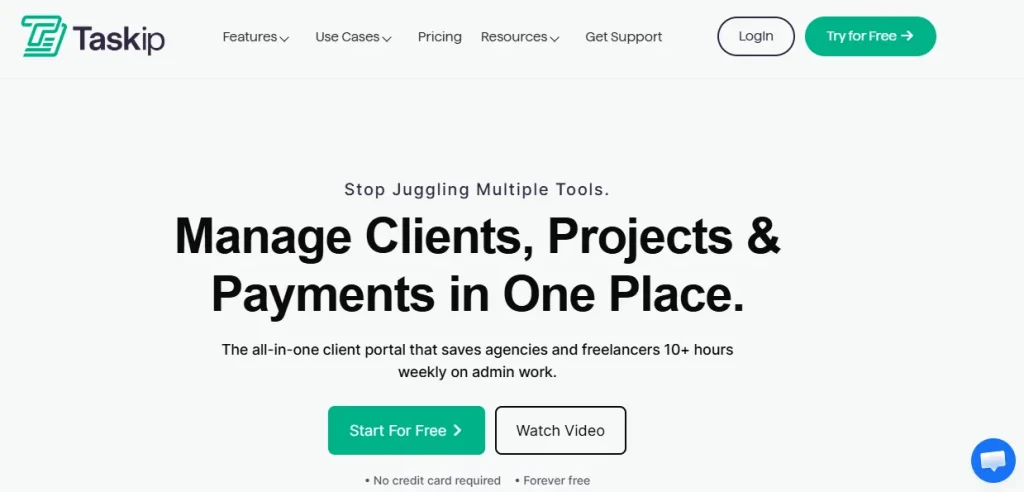
Taskip is built around the idea that most agencies do not sell purely productized work or purely custom work; they sell a mix of both. The service catalog handles self-serve buying for your packaged offers, while a built-in sales pipeline and leads system handle the custom deals that still need a human touch, so nothing falls outside a single workspace.
Best For
Agencies that want a single system for productized delivery and a full CRM, instead of running a catalog tool alongside a separate sales pipeline.
Key Features
- Public service catalog with self-serve checkout
- Built-in CRM: leads tracking and sales pipeline
- Quotations and invoices in the same workspace
- Branded client portal for every customer
- Automated onboarding once a client pays or accepts a quote
Pros and Cons
| Pros | Cons |
|---|---|
| – Catalog and CRM live in one tool, no second system needed – Free plan available to start – Handles both productized and custom sales in the same pipeline – Branded client portal included on paid tiers | – More setup steps than a narrow, single-purpose tool – Teams that only want a simple order form may not use the full CRM depth – Smaller G2 review sample size than more established competitors |
Pricing
Free Starter plan available. Paid plans: Freelancer $12/mo (1 seat), Startup Team $29/mo (10 seats), Growing Agency $59/mo (25 seats, 3 workspaces), Agency Pro $89/mo (unlimited team members, 5 workspaces). Annual billing saves roughly 35 percent. Full breakdown on the pricing page.
Rating and Reviews
4.8 out of 5 on G2 (6 reviews at time of writing).
Taskip has completely transformed the way our team manages projects. The interface is clean and intuitive, task management feels smooth and straightforward, and the collaboration features work flawlessly. The time tracking is accurate and easy to use, which makes it simple to stay on top of what’s being done. Overall, everything feels well thought out, dependable, and genuinely reliable.
2. Wayfront (Formerly Service Provider Pro)
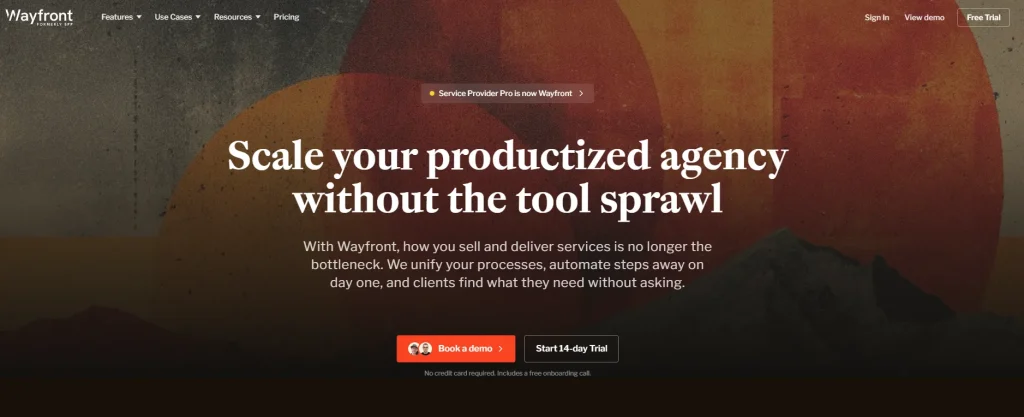
Service Provider Pro rebranded to Wayfront in February 2026. Same company, same product, same customer base; only the name changed, so if you see both names used elsewhere, this is why. For productized agencies, it remains one of the most feature-complete platforms available, built around highly customizable client portals and multi-step order workflows.
Best For
Established agencies with dedicated ops staff who want deep customization and can absorb a higher price point.
Key Features
- Deep client portal customization
- Multi-step, complex order workflows
- Team roles and permission controls
- White label branding across the client experience
- Support for high volume, multi-service agencies
Pros and Cons
| Pros | Cons |
|---|---|
| – Most feature-complete platform on this list – Strong for agencies running complex, multi-step services – Stable, long-standing product (formerly SPP) – Established review base on G2 | – Highest starting price of any tool reviewed here – Steeper learning curve than newer tools – Smaller teams often pay for capability they do not use |
Pricing
Base plan: $99/mo billed annually, or $129/mo billed monthly, 5 seats included. Pro plan: $249/mo annually, or $299/mo monthly, 10 seats included. Additional seats run $18 to $20/mo each.
Rating and Reviews
4.7 out of 5 on G2 (20 reviews at time of writing).
The ease of use for the product and that it can be used to facilitate the complete customer lifecycle as well as ensure we don’t lose on any customer communications.
3. ManyRequests
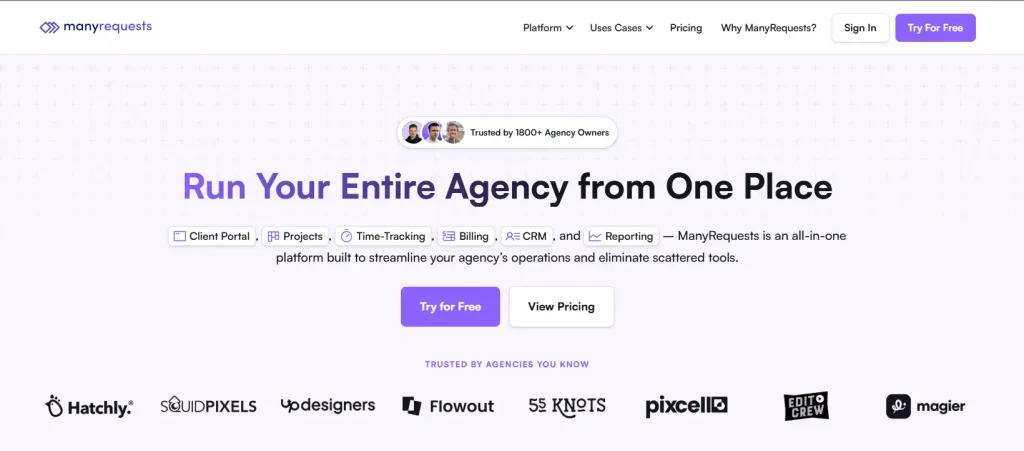
ManyRequests is built around request-based delivery. A client submits a request through a form, and it moves through a defined pipeline until it is delivered, which keeps the process simple for clients who are not technical.
Best For
Agencies running high volume, similar-shaped requests, like design or content delivery, that want a clean request pipeline.
Key Features
- Request-based order pipeline
- Unlimited clients with no per-client fee
- Client-facing dashboard for tracking requests
- File sharing and approval steps built into each request
- Team collaboration tools for routing work
Pros and Cons
| Pros | Cons |
|---|---|
| – Clean, simple pipeline for high-volume request work – No per client fees as you scale your customer base – Straightforward for non-technical clients to use | – Leans harder into requests than true self serve storefront selling – Most useful automation sits behind the higher Pro tier – Very small G2 review sample size at time of writing |
Pricing
Core plan: $39/mo billed annually, or $59/mo monthly, 1 seat included. Pro plan: $79/mo annually, or $99/mo monthly, 1 seat included. Enterprise starts at $1,000/mo with custom terms.
Rating and Reviews
4.5 out of 5 on G2, based on 1 review at the time of writing, so treat this rating as a very small sample.
We have been using manyrequests for almost a year now for our client projects and its one of the best project management system and a client portal we have used so far, it has almost all the customization options we require, time tracking, checklists, ticketing and feedback from our clients, which helps us to combine everything in one place.
4. Zendo
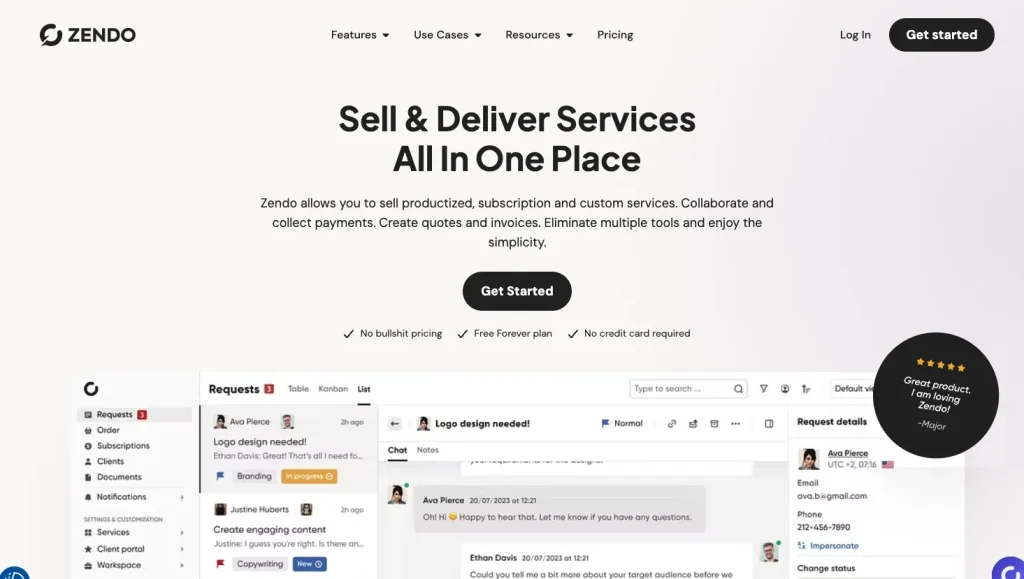
Zendo has one of the most modern interfaces in this category and, unlike most tools on this list, includes a genuinely usable free plan rather than a time-limited trial.
Best For
Agencies and freelancers who want to test the productized model without committing budget upfront.
Key Features
- Free forever Essential plan with core catalog features
- Modern, easy-to-navigate service catalog
- Real-time chat with clients on paid tiers
- White label branding on higher tiers
- Request management pipeline
Pros and Cons
| Pros | Cons |
|---|---|
| – Genuinely usable free plan, not just a trial – Modern, clean interface – Strong G2 rating relative to price point | – Sales pipeline and CRM depth are thinner than Taskip or Wayfront – Agencies with a significant custom sales motion may outgrow it – Support response times can lag during high-volume periods per reviewer feedback |
Pricing
Essential: free. Core: $25/mo annually, or $29/mo monthly. Pro: $49/mo annually, or $59/mo monthly, the most popular tier. Agency: $79/mo annually, or $99/mo monthly, fully white labeled.
Rating and Reviews
4.9 out of 5 on G2 (11 reviews at time of writing).
Finally, a moderately powerful (which is all I need) client portal that is intuitive to get around and easy to customize. The amount of functionality available in the free tier is excellent! Way more than enough for any freelancer to start with a few clients at a beginner to intermediate level in terms of centralizing communication, statuses, and assets. The web app is responsive as well…in fact the Kanban board actually works better on mobile. I will definitely recommend Zendo to colleagues.
5. SuiteDash
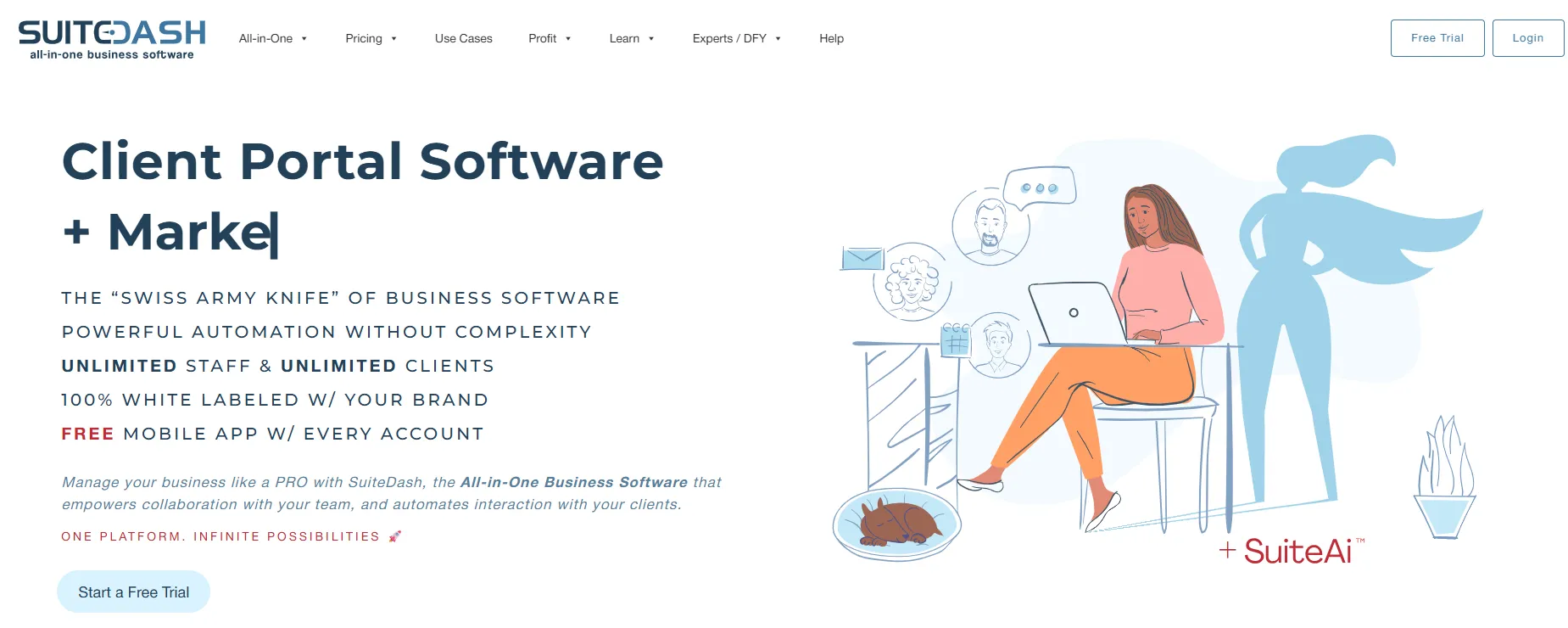
SuiteDash covers CRM, invoicing, project management, and client portals in a single system, and its entry tier is priced well below most competitors here.
Best For
Agencies that want a full-featured, all-in-one operations platform at one of the lowest entry price points in this category.
Key Features
- CRM with unlimited contacts
- Client portals with white label branding
- Email marketing and drip campaigns
- Proposals with e-signature support
- Learning management system on the top tier
Pros and Cons
| Pros | Cons |
|---|---|
| – One of the most affordable full-featured entry tiers on this list – Very large, well-established G2 review base – LMS and advanced automation available for agencies that also sell training | – No free plan, only a 14 day trial – Breadth of features means a longer setup process – Interface can feel dense compared to newer tools like Zendo |
Pricing
Start: $19/mo ($15/mo equivalent billed annually). Thrive: $49/mo. Pinnacle: $99/mo, includes LMS and full automation. See our SuiteDash reviews breakdown for more detail.
Rating and Reviews
4.8 out of 5 on G2 (618 reviews at time of writing), one of the largest review bases in this category.
Suitedash is a fully customizable Client Portal that integrates directly with our website. This allows us to have that client-first approach while also directing our existing clients to our website as this is our main source of advertising. Having our latest messaging in front of our clients on the daily is a game changer for us.
6. Bonsai
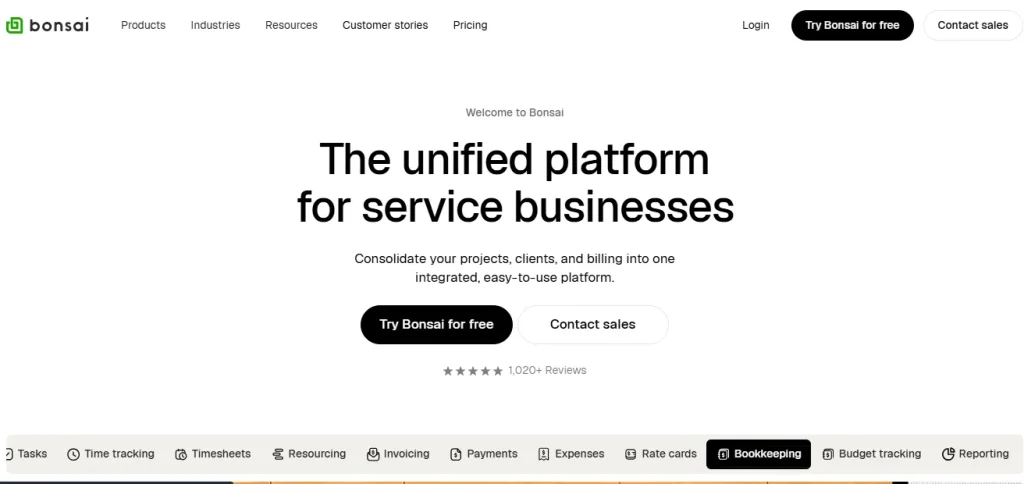
Bonsai built its reputation serving independent freelancers rather than agencies, so its contract, time tracking, and tax tools are stronger here than its productized catalog features.
Best For
Freelancers and solopreneurs who need contracts, invoicing, and a simple client experience, not a full agency-grade catalog.
Key Features
- Contract templates
- Time tracking
- Tax and expense tracking tools
- Invoicing and proposals
- Client-facing forms
Pros and Cons
| Pros | Cons |
|---|---|
| – Strong contract and tax tooling for independent freelancers – Large, established G2 review base – Straightforward for solo operators | – Strictly per-user pricing with no free plan – Gets expensive quickly for any team beyond a solo operator – Catalog and checkout features are lighter than dedicated tools like Zendo or ManyRequests |
Pricing
Basic: $9/user/mo billed annually, or $15/mo monthly. Essentials: $19/mo annually, or $25/mo monthly. Premium: $29/mo annually, or $39/mo monthly. Elite: $49/mo annually, or $59/mo monthly.
Rating and Reviews
4.3 out of 5 on G2 (101 reviews at time of writing).
Professional looking easy to use and implement timer, project/client set up and invoicing/chasing etc. Ability to log a partial payment and email client with updates, disable routine reminders if required and to tweak/suspend accrued interest again as necessary when negotiating with clients (without the overheads of a full accounting app if you’re only operating on a micro level). Basic CRM if payng for basic package. Reasonably priced and does what it says on the tin. Templates are useful and allow for limited personalisation. Customer support is always swift to reply and action any issues.
7. HoneyBook

HoneyBook is popular with creative and hospitality-focused service businesses, and the client-facing side of the product- proposals, contracts, and payments- is genuinely well designed.
Best For
Creative businesses, photographers, and small teams that want a polished, client-facing proposal and contract experience.
Key Features
- Proposal and contract workflow
- Branded client portal
- Scheduling and booking tools
- Integrated payment processing
- AI chat assistant on newer plans
Pros and Cons
| Pros | Cons |
|---|---|
| – Polished, premium feeling client experience – Strong proposal and contract workflow – Large G2 review base | – Prices rose sharply in 2025, by some estimates around 89.5 percent – Adds a 2.9 percent plus 25 cent transaction fee on top of subscription cost – No free plan, only a 7-day trial |
Pricing
Starter: $29/mo billed annually, or $36/mo monthly. Essentials: $49/mo annually, or $59/mo monthly. Premium: $109/mo annually, or $129/mo monthly. See our full HoneyBook pricing analysis for the breakdown behind the price hike.
Rating and Reviews
4.5 out of 5 on G2 (217 reviews at time of writing).
I love how HoneyBook simplifies my business processes, helps me stay organized, and automates client tasks that would normally take a ton of time. It integrates and connects with my other calendar, client photo delivery software, and finances as well. I love the simple interface where I can see everything in one place. and AI suggestions help me the AI automated email responses, and they’re super easy to adapt to fit my business as well.
8. Dubsado
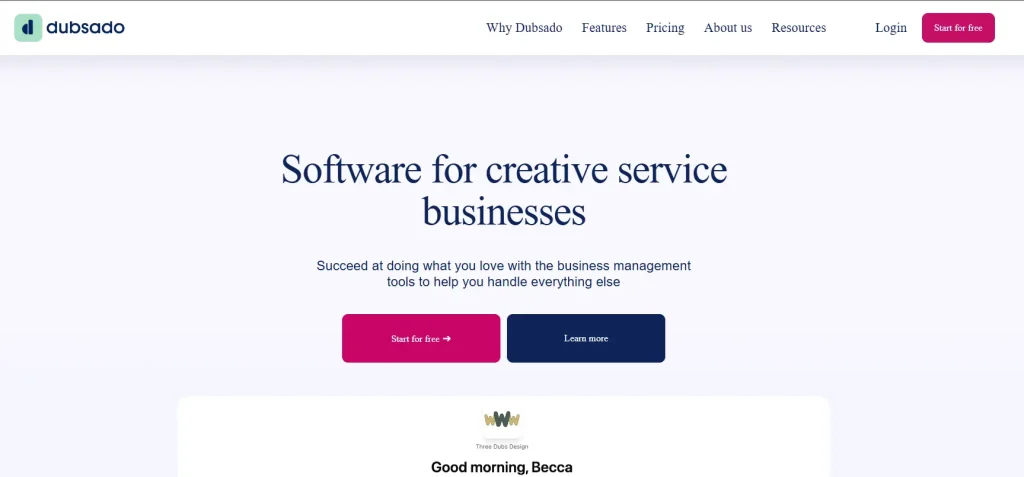
Dubsado‘s workflow builder lets you design multi-step automations, covering forms, emails, scheduling, and invoicing, with more granular control than most tools on this list.
Best For
Service providers who want to build very specific, custom automation without writing code.
Key Features
- Custom workflow builder for forms, emails, and scheduling
- Lead capture forms
- Client portal
- Invoicing and contracts
- Free plan for up to 3 clients
Pros and Cons
| Pros | Cons |
|---|---|
| – One of the few tools here with a genuinely usable free plan – Deep, granular workflow automation – Strong fit for service providers with very specific process needs | – Steep learning curve before workflows are fully built out – Catalog and storefront experience is less polished than purpose-built productized tools – New users commonly report significant setup time |
Pricing
Free plan: up to 3 clients. Starter: $35/mo. Premier: $55/mo. See our full Dubsado pricing breakdown and Dubsado reviews for more detail.
Rating and Reviews
4.3 out of 5 on G2 (76 reviews at time of writing).
I really like the calendar scheduling system in Dubsado. It’s a great feature because it allows me to send a link to my clients, making it easy for them to pick a day and time that suits them for mutual meetings. This feature eliminates the need for back and forth email conversations about suitable dates and times. I also find the online payment feature really good, as it makes taking payments quick and easy. Clients can pay their invoices with just a couple of clicks of a button.
9. ClickUp
ClickUp is a general project management platform, not a purpose-built productized service tool, so agencies that use it for this purpose typically build their own catalog, forms, and client-facing experience using its more general building blocks.
Best For
Teams that already run internal project management in ClickUp and want to extend it for client-facing, productized work rather than run a second system.
Key Features
- Custom statuses and workflows
- Automations
- Client-facing forms
- Gantt charts and workload views
- Free plan with unlimited tasks and members
Pros and Cons
| Pros | Cons |
|---|---|
| – Most affordable option per seat on this list – Genuinely usable free plan – Massive G2 review base and long track record – Flexible enough to extend existing internal workflows | – Not purpose built for productized service selling – Requires manual setup to build a client facing catalog and checkout experience – No native storefront or self serve buying flow out of the box |
Pricing
Free plan available. Unlimited: $7/user/mo billed annually. Business: $12/user/mo billed annually. AI add ons available separately from $9 to $28/user/mo. See our best kanban project management tools roundup if project tracking, not client facing sales, is your priority.
Rating and reviews
4.6 out of 5 on G2 (12,921 reviews at time of writing), the largest review base of any tool in this list.
10. AgencyHandy
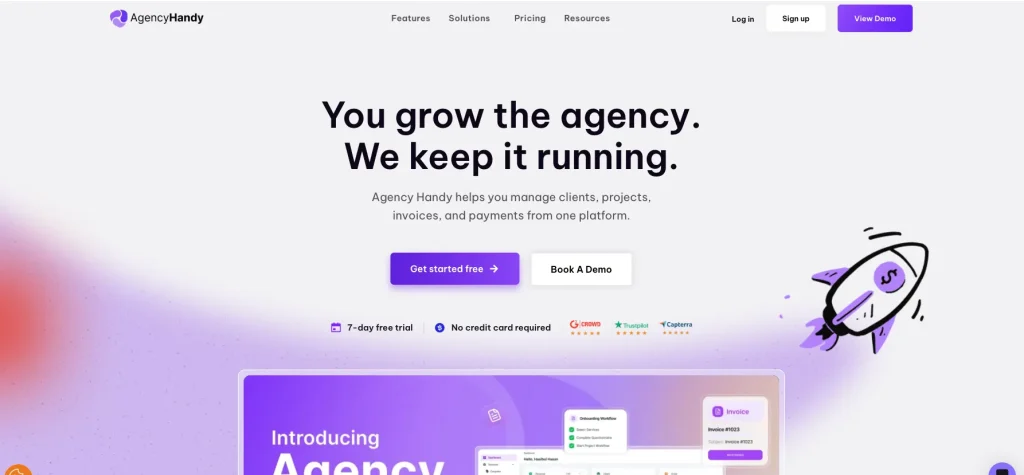
AgencyHandy is a newer platform designed specifically for the productized agency model, so the catalog, checkout, and client portal experience does not require the workaround setup that general tools like ClickUp need.
Best For
Agencies that want a purpose-built productized workflow without extra CRM overhead.
Key Features
- Purpose-built service catalog
- Client-facing checkout
- Client portal
- Team seat-based plans built for scaling agency headcount
Pros and Cons
| Pros | Cons |
|---|---|
| – Purpose-built for productized agencies from the ground up – No workaround setup needed for a client-facing catalog – Strong G2 rating | – Smaller user base and review volume than more established competitors – Steep jump in price from the Freelancer to Team Starter plan – Fewer third party integrations than larger platforms |
Pricing
Freelancer: $19/mo, solo use only. Team Starter: $99/mo, 2 seats. Business Pro: $199/mo, larger teams. See our Agency Handy alternatives roundup if you want to compare it against other options first.
Rating and Reviews
4.9 out of 5 on G2, based on 19 reviews at the time of writing.
The ability to consolidate our entire agency tech stack into one platform. I am managing my clients onboarding, subscriptions, invoicing, and Kanban project boards in a single, white-labeled portal. It completely eliminates the need to duct-tape multiple SaaS tools together just to run our daily operations
How to Choose the Right Productized Service Software: Key Feature Considerations
1. Service Structure That Feels Like a Storefront
Your catalog should read like a store, not a rate card. Clients should be able to browse, understand what they get, and buy or request without a call.
2. Fast, Self-Serve Checkout
The gap between “client wants this” and “client has paid and started” should be minutes, not days. Look for instant checkout or, at minimum, a fast quote-to-payment flow.
3. Built-In CRM for Full Pipeline Control
Even productized agencies close some custom deals. A tool with a real sales pipeline means you are not running two systems side by side.
4. Automated Onboarding (Zero Manual Start)
Once a client pays, onboarding forms, welcome emails, and kickoff tasks should fire automatically, not depend on someone remembering to send them.
5. Repeatable Delivery Workflows
Delivery should follow a template every time a given service is ordered, so quality and turnaround time stay consistent regardless of who is on the account.
6. Branding and White Label Experience
Your client portal and checkout should look like your business, not the software vendor’s. White labeling matters more as you scale and start selling to larger clients.
7. Scalability Without Hidden Costs
Check per-seat pricing and client limits carefully. Several tools on this list, including Bonsai and Wayfront, get significantly more expensive as your team or client count grows, so model your cost at your expected size, not just the entry tier.
| Business Type | Platform | Why It’s a Good Fit |
|---|---|---|
| Solopreneurs & Freelancers | Bonsai or Dubsado (Free Tier) | Best if your primary needs are contracts, proposals, and invoicing rather than a full service catalog. |
| Small Teams (2 to 10 People) | Zendo or Taskip (Freelancer & Startup Team) | Offers a complete service catalog, CRM, and client management at an affordable price without a steep upgrade cost. |
| High-Volume Service Catalogs | ManyRequests or SuiteDash | Designed to handle repeatable service requests and standardized fulfillment workflows efficiently. |
| Agencies with Custom Sales Processes | Taskip | Combines a service catalog, CRM, sales pipeline, and client portal in one platform, eliminating the need for a separate CRM. |
| Established Agencies with Dedicated Operations Teams | Wayfront | Provides advanced workflow management and enterprise-level features for larger agencies with the budget to support them. |
Traditional CRM vs. Productized Service System: The Scalability Angle
A traditional CRM is built around deals and pipelines: every prospect is a unique opportunity that a salesperson manually moves forward. That model works well for high-touch, custom sales, but it does not scale cleanly to a business selling repeatable, fixed-scope services, because every new client still requires manual setup.
A productized service system flips the default. The catalog, pricing, and delivery workflow are already built, so growth means more clients moving through an existing system rather than more manual work per client. This is the core reason agencies that outgrow a plain CRM tend to move toward a platform like Taskip that combines both models instead of choosing one or the other.
Why Productized Service Software Is Growing Fast in 2026
Client expectations have shifted toward fixed-price, transparent engagements. Industry coverage of the consulting and agency space, including Consultancy.uk’s reporting on the shift from hourly billing to productized advisory, points to fixed-price packages becoming the default preference for a growing share of buyers, with agencies reporting improved margins once delivery is standardized rather than quoted from scratch each time.
Real Productized Services in Action
Software aside, it helps to see what a productized service actually looks like once it is built. Design Pickle turned graphic design into a flat monthly subscription instead of per-project billing. WP Buffs did the same for WordPress maintenance, packaging support into fixed tiers rather than hourly retainers. Both are commonly cited examples because they show the model working at real scale: a defined menu of services, fixed pricing, and a delivery process that does not require a custom quote for every request.
If you are still shaping your own service menu before choosing software, our guide on how to price retainer services is a useful next step, and our productized services overview covers the model in more depth.
Who Should (and Should Not) Use Productized Service Software?
Good fit: agencies and consultancies with at least one or two repeatable service offers, freelancers ready to move off custom hourly quoting, and teams that want a single system for sales, delivery, and client management instead of three disconnected tools.
Not a great fit yet: businesses whose work is still highly bespoke on every engagement, with no repeatable scope to package. Productization works best once you can describe a service in a sentence and price it without a discovery call.
Common Implementation Mistakes to Avoid
- Trying to productize your entire service offering instead of starting with your most repeatable service.
- Copying a competitor’s service catalog instead of validating what your own clients want.
- Skipping onboarding automation and recreating manual work after the sale.
- Choosing software based on price alone instead of workflow fit (storefront, request-based, or hybrid).
- Launching too many services at once instead of refining a few high-performing offers first.
Final Verdict: Which Productized Service Software Is Best for Your Business Model?
The best platform depends on how your business sells. If you mainly need contracts and invoicing, Bonsai or Dubsado’s free tier are solid starting points. Zendo and Taskip are ideal for small teams that need both a service catalog and CRM at an affordable price. For high-volume, repeatable service requests, ManyRequests and SuiteDash are strong options, while Wayfront suits larger agencies that need advanced operational features.
If your agency sells both packaged services and custom projects, Taskip stands out. It combines a service catalog, CRM, sales pipeline, and client portal in one platform, so you don’t need separate tools as your business grows.
Start free with Taskip and build your first service catalog today. No credit card required.
FAQs on Productized Service Software
What is productized service software?
It is software that lets a service business package its offers into a fixed price, fixed scope catalog, then automate the buying, onboarding, and delivery process around that catalog.
How is it different from a CRM?
A CRM tracks deals and relationships for a sales team. Productized service software adds a client facing storefront, self serve or fast checkout, and automated delivery workflows on top of that, built specifically for repeatable, packaged services.
Is Wayfront the same as Service Provider Pro?
Yes. Service Provider Pro (SPP.co) rebranded to Wayfront in February 2026. It is the same company, product, and pricing structure under a new name.
Who should use productized service software?
Agencies, consultancies, and freelancers who have at least one repeatable, packageable service and want to reduce the manual work involved in selling and delivering it.
Can I still offer custom services?
Yes. Most platforms on this list, especially Taskip and Wayfront, support a mix of catalog based packages and custom quoted work in the same system.
What are the main benefits of productized services?
Faster sales cycles through self-serve buying, consistent delivery quality through repeatable workflows, and less manual admin work per client as you scale.
How much does productized service software cost?
Entry pricing on this list ranges from free (Taskip, Zendo, Dubsado, and ClickUp all offer usable free plans) up to around $19 to $39/mo for most dedicated tools, with premium tiers running $99 to $299/mo for larger teams and more advanced features.
Can productized service software replace my CRM entirely?
For many agencies, yes, particularly with tools like Taskip that include a full sales pipeline alongside the catalog. If your sales process is highly custom and consultative, you may still want dedicated CRM depth beyond what any tool on this list offers.
Is Taskip productized service software?
Yes. Taskip combines a service catalog, checkout, CRM, and client portal in one platform built specifically for productized and hybrid service businesses.