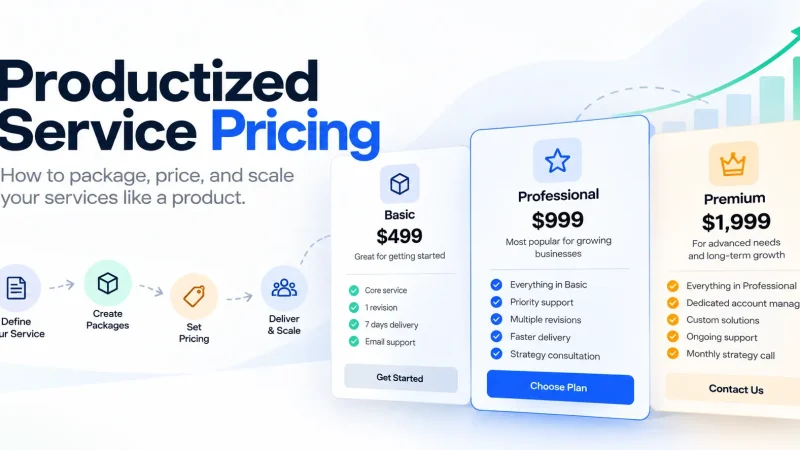

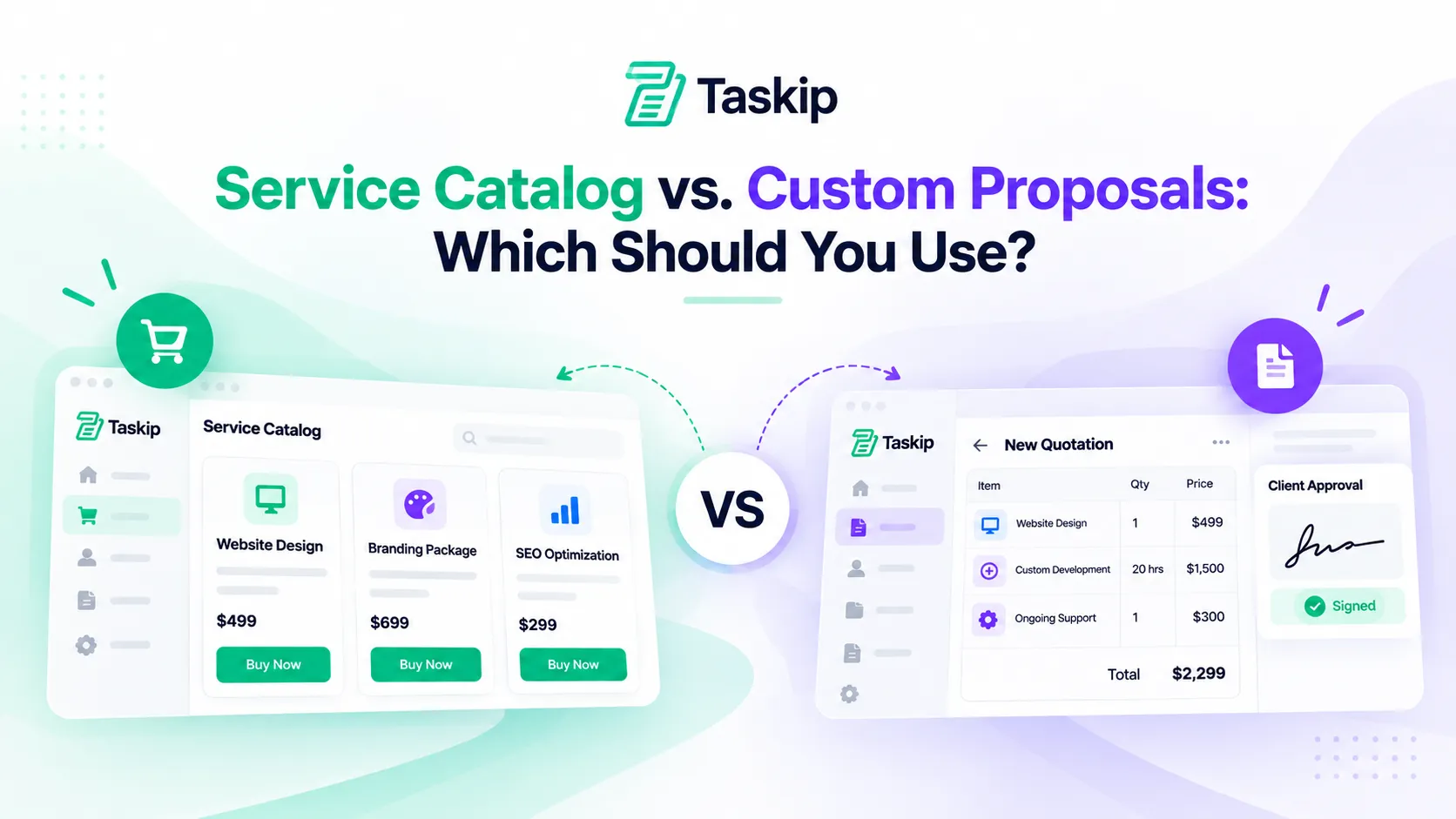
Use a service catalog when the work is repeatable, the scope is predictable and buyers want to purchase fast. Use custom proposals when every project is different, the deal is large or several stakeholders must approve it. Most growing agencies end up using both: a catalog for standard packages and proposals for bespoke work.
The service catalog vs custom proposals question, often framed as productized services vs custom quotes, comes up the moment an agency starts to grow. Writing a fresh proposal for every lead takes hours, but forcing every client into a fixed package can lose the big deals. This guide compares both models side by side and gives you 5 proven signals to choose the right one for each service you sell.
Choosing between a service catalog and custom proposals depends mainly on how repeatable and complex your services are.
- Service catalog: A menu of productized services with fixed scope, pricing and online checkout, often offered in Basic, Standard and Premium tiers.
- Custom proposal: A tailored document outlining the project scope, timeline, pricing and terms for a specific client.
- Choose a service catalog when: The work is repeatable, the scope is clear, the buyer can make a quick decision and the price is typically under a few thousand dollars.
- Choose a custom proposal when: The project is highly customized, high-value, involves multiple stakeholders or requires several weeks of discussion.
- Use the 5-signal test: Score each service for repeatability, price point, buyer type, sales cycle and discovery needs. If 3 or more signals favor a catalog, consider packaging the service.
- Best approach for agencies: Use a hybrid model. Sell repeatable services through a catalog and use custom proposals for bespoke projects.
- Tools that support both: Platforms like Taskip combine service catalogs, quotation tools and e-signatures in one workspace.
Table of Contents
What Is a Service Catalog vs a Custom Proposal?
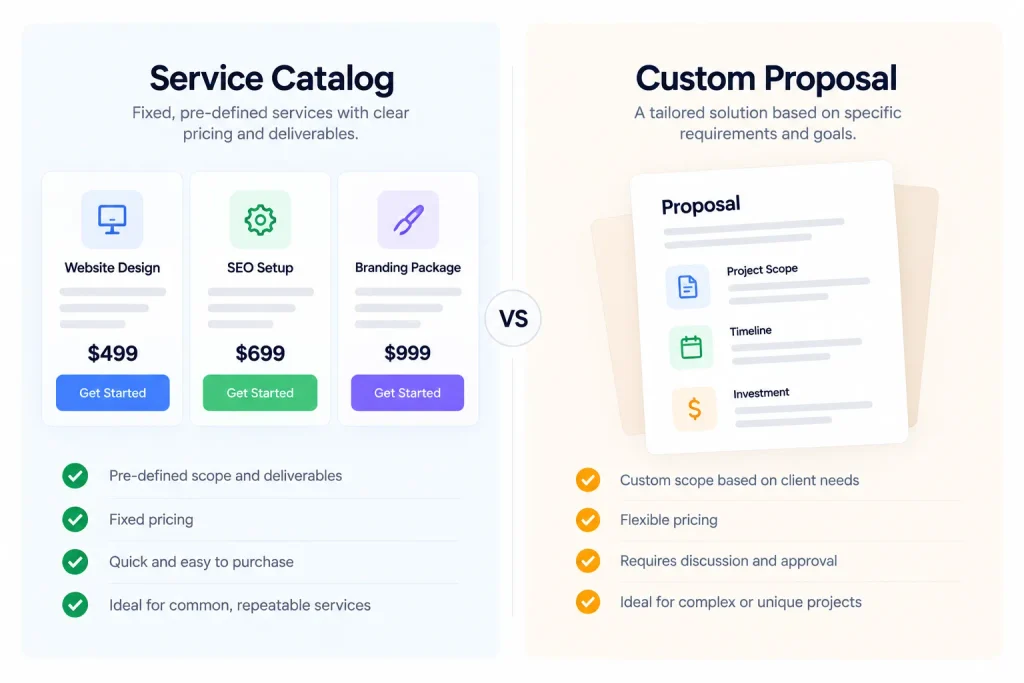
A service catalog sells fixed, ready-made service packages that clients buy instantly, while a custom proposal prices one tailored project for one client. For most growing teams, a service catalog for agencies handles the repeatable work while proposals cover the rest.
Service Catalog
A service catalog is a menu of productized services, each with a fixed scope, price and delivery time. Clients browse the packages, pick one, answer a few intake questions and pay online. Think of it as an online store for your services. If you are new to the idea, our guide to building a productized service portfolio explains how to package your work.
Custom Proposal
A custom proposal is a tailored document written for one client. It explains their problem, your approach, the team, the timeline and a price built for that specific scope. It often comes with a formal statement of work and a detailed quote. A free proposal generator helps you draft one faster. If the line between a quote, an estimate and an invoice still feels blurry, read quote vs invoice vs estimate.
Service Catalog vs Custom Proposals: Custom Proposal vs Package Pricing Compared
Service catalogs win on speed, low admin and scalability. Custom proposals win on flexibility and deal size.
| Factor | Service catalog | Custom proposal |
|---|---|---|
| Scope | Fixed and standardized | Tailored to each client |
| Pricing | Fixed packages (Basic, Standard, Premium) | Built per project, often value-based |
| Time to sell | Minutes, self-serve checkout | Days or weeks, calls and revisions |
| Typical deal size | Small to mid | Mid to large |
| Admin per sale | Very low | High |
| Best for | Audits, setups, monthly retainers, fixed deliverables | Websites, rebrands, strategy, enterprise work |
| Risk | Under-pricing complex requests | Losing leads while you write |
| Scalability | High, easy to delegate | Limited by senior time |
In the productized services vs custom quotes debate, neither model is better in every case. The right choice depends on how repeatable the work is and how much the client needs to customize.
When to Use a Service Catalog for Your Agency
Use a service catalog when the work is repeatable, the price is predictable and buyers want to purchase without a sales call.
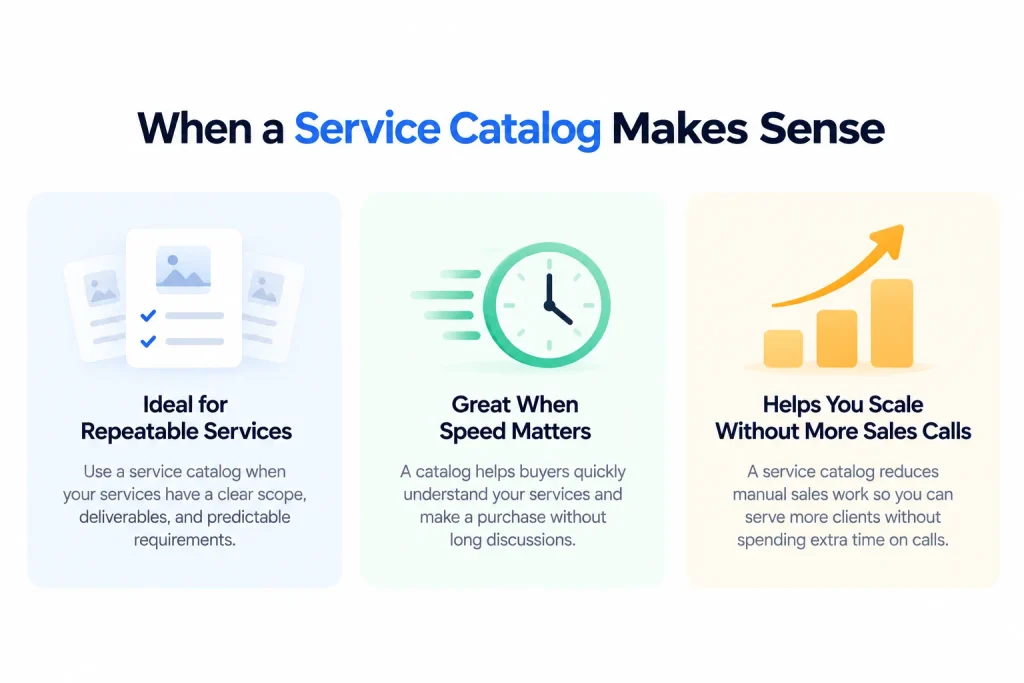
You Sell Repeatable Services
If you deliver the same outcome the same way most of the time, turn it into a package.
SEO audits, logo packages, website maintenance, monthly content plans and social media management all follow a repeatable process. Once the steps are documented in your agency SOPs, you can price and sell them as products.
Speed Matters to Your Buyers
A catalog lets clients buy the moment they are ready, which is when they are most likely to convert.
Small businesses and startups often want to buy now, not after three calls. Speed also matters to you: Harvard Business Review research found that firms contacting leads within an hour were nearly seven times as likely to qualify them as firms that waited even an hour longer. A catalog lets clients buy at the moment their interest is highest.
You Want to Scale Without More Sales Calls
Fixed packages are easier to sell, delegate and deliver, so you can grow without adding more sales calls.
Fixed packages are easier to delegate, easier to deliver and easier to sell. Pricing tiers also help clients choose: a higher anchor package makes the middle option feel reasonable. Keep it to three tiers to avoid choice overload.
When to Use Custom Proposals
Use custom proposals when the scope is unique, the deal is large or several stakeholders must approve it.
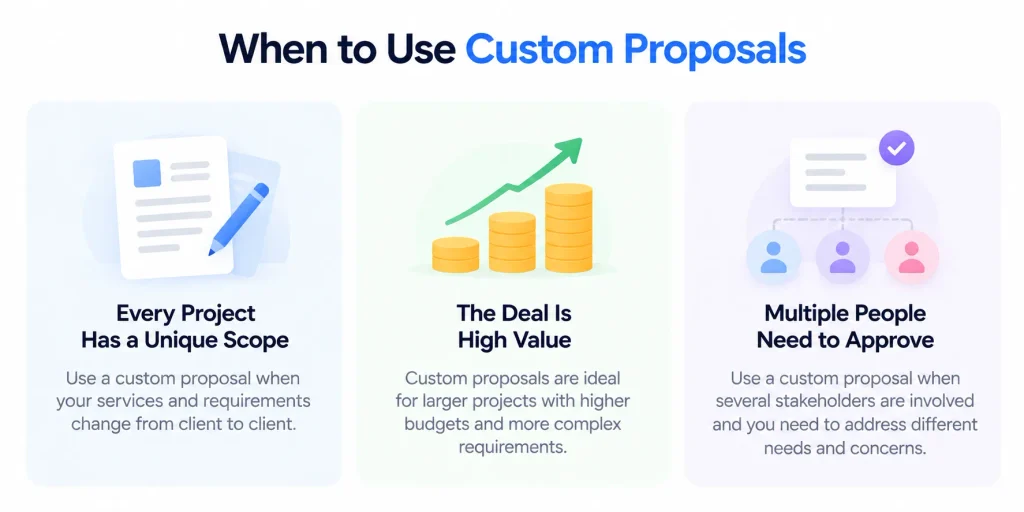
The Scope Changes Every Time
If no two projects look alike, fixed packages will either under-price complex work or over-price simple work. A tailored scope protects you from scope creep and sets clear expectations. Start with a free scope of work generator to define deliverables.
The Deal Is Large
Big projects deserve bigger thinking. A proposal lets you use value-based pricing, tying the price to the result rather than a fixed menu. Our guide to digital marketing agency pricing models explains when that approach pays off. This is the core of custom proposal vs package pricing: packages cap the price, proposals let it follow the value.
Several People Must Approve
Corporate buyers, procurement teams and boards need a document they can share, compare and sign. A clear proposal with a detailed quote answers their questions in one place. For the quote itself, follow our guide on how to write a winning quote.
5 Proven Signals to Choose the Right Model
Score each service on repeatability, price point, buyer type, sales cycle and discovery needs. Three or more catalog signals means it should become a package.
Ask these five questions about each service you sell. Three or more “catalog” answers means it should become a package.
| Signal | Choose the service catalog if… | Choose a custom proposal if… |
|---|---|---|
| 1. Repeatability | You deliver it the same way most of the time | Every project needs a new plan |
| 2. Price point | It sells for a few hundred to a few thousand | It is a five-figure project or more |
| 3. Buyer | One decision maker, often a small business | Multiple stakeholders or procurement |
| 4. Sales cycle | Clients decide in days | Clients take weeks to approve |
| 5. Discovery | A short intake form covers what you need | You need calls and research before pricing |
Track which leads become catalog sales and which need proposals. Knowing the difference between lead management and pipeline management helps you route each inquiry to the right path from day one.
The Hybrid Model: Use Both and Win More Deals
Yes, you can use both: sell standard packages through a service catalog and send custom proposals only for bespoke work.
The smartest answer to service catalog vs custom proposals is often “both”. Here is how a hybrid setup works:
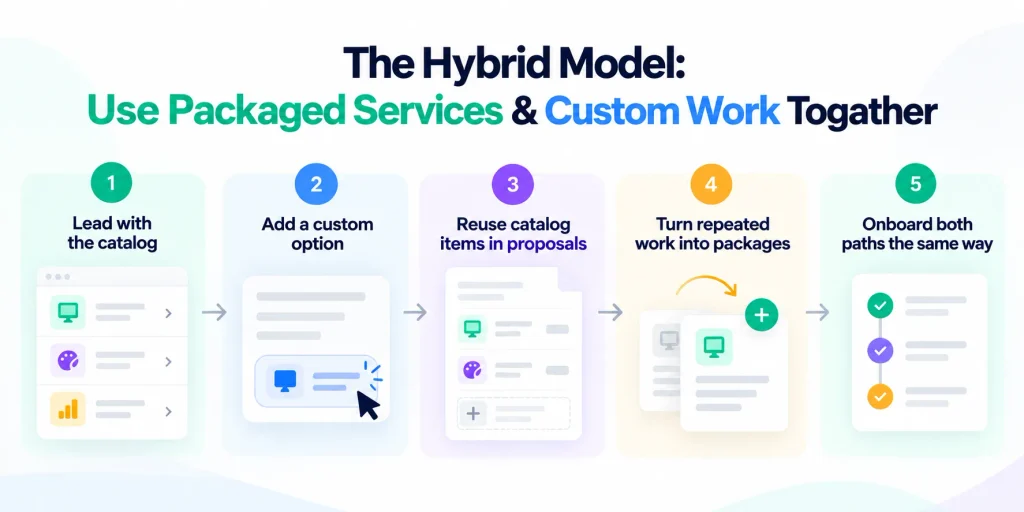
- Lead with the catalog. Publish 3 to 6 packages for your most common services, so small buyers can purchase instantly.
- Add a “Need something custom?” option. Route larger or unusual requests to a discovery call.
- Reuse catalog items inside proposals. Build bespoke proposals from your standard packages plus custom line items, so quoting stays fast.
- Turn repeated custom work into new packages. If you write the same proposal three times, productize it.
- Onboard both paths the same way. A consistent client onboarding checklist keeps delivery smooth no matter how the client bought.
This gives small clients speed and big clients attention, without your team writing every document from scratch.
How Taskip Supports Both Models
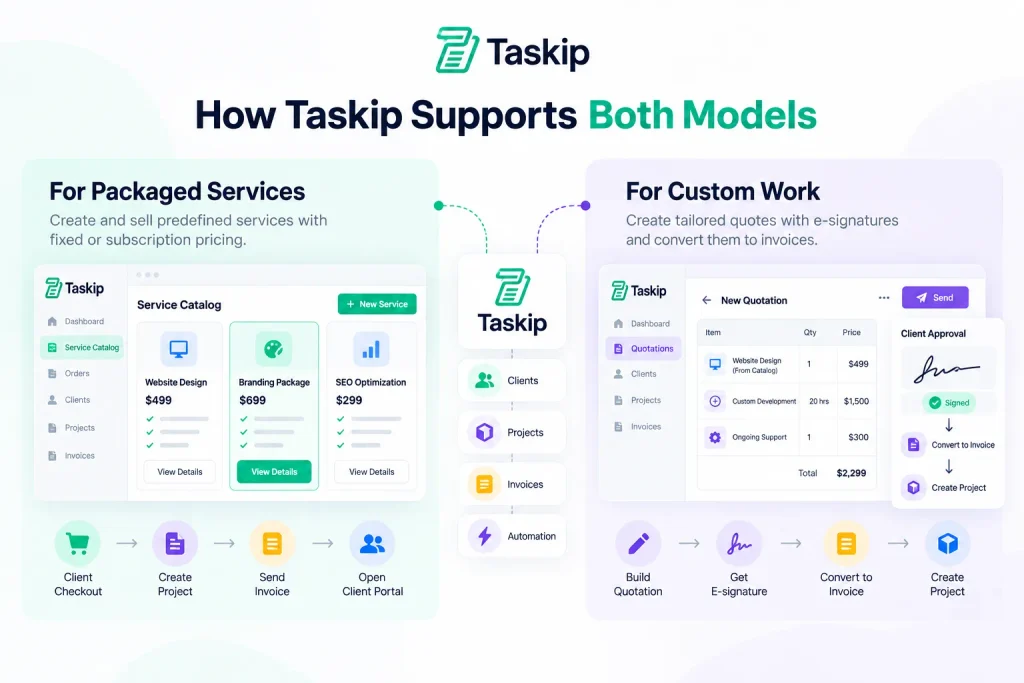
Taskip runs a service catalog and custom quotes with e-signatures in one workspace, so packaged and bespoke sales share the same clients, projects and invoices.
For Packaged Services
Taskip’s service catalog for agencies supports unlimited packages per service, feature checklists per tier and one-time or subscription pricing. Clients check out without creating an account, pay through Stripe, PayPal or bank transfer, and each order can automatically create a project, send an invoice and open their client portal. You can share a service page by link or place it on your website with embeds.
For Custom Work
Build tailored quotes in quotation software using your catalog items plus custom line items, then collect approval with e-signatures. Accepted quotes convert into invoices in one click, and workflow automation handles the follow-up steps.
Ready to set it up? Compare Taskip plans to get started.
Conclusion
The service catalog vs custom proposals decision is not a one-time choice for your whole agency. It is a choice you make service by service. Package the work you repeat, propose the work you customize, and turn repeated proposals into new packages over time.
Start by running the 5 signals against your top three services. The ones that pass become items in your service catalog for agencies this month. The rest stay as proposals, built faster from reusable pieces. Your small clients get speed, your big clients get attention and your team gets hours back every week.
Frequently Asked Questions
What Is the Difference Between a Service Catalog and a Custom Proposal?
A service catalog sells fixed packages with set scope and pricing that clients can buy instantly. A custom proposal is a tailored document with a scope and price built for one client’s specific project.
Is a Service Catalog Better Than Custom Proposals?
Not always. A service catalog is better for repeatable, lower-priced services and fast sales. Custom proposals are better for complex, high-value or multi-stakeholder projects. Many agencies use both.
Can I Use a Service Catalog and Custom Proposals Together?
Yes. A hybrid model sells standard packages through a catalog and routes bespoke requests to proposals, often reusing catalog items as building blocks.
How Many Packages Should a Service Catalog Have?
Start with 3 to 6 core services, each with up to three tiers such as Basic, Standard and Premium. Add more only when clients keep asking for the same thing.
When Should an Agency Switch From Proposals to Productized Packages?
When you find yourself writing nearly identical proposals for the same type of project, that service is ready to become a package.
When to Use a Service Catalog Instead of Proposals?
Use a service catalog when the work is repeatable, priced under a few thousand dollars, bought by one decision maker and sold in days rather than weeks.