How to Offer White Label Services for Agencies in 2026: A Proven, Profitable Strategy
If your team already delivers strong SEO, PPC, web design, or content work, you are sitting on an asset most agencies urgently need: reliable fulfillment capacity. Learning how to offer white-label services for agencies turns that capacity into a predictable, high-margin B2B revenue stream. Instead of chasing individual end clients, you sell your production engine wholesale to agencies that resell it under their own brand.
This guide walks through the complete step-by-step strategy for becoming a white label provider- how to productize your services, price them sustainably, protect both brands legally, position yourself to win reseller partners, and scale fulfillment without losing quality.
TL;DR
- White label services for agencies are fulfillment services produced by a provider but delivered entirely under the partner agency’s brand.
- As a provider, you earn recurring B2B revenue by selling wholesale production capacity instead of competing for retail clients.
- The model only works when services are productized: fixed scopes, timelines, and revision limits.
- Profitability depends on disciplined wholesale pricing that protects your margin while leaving the reseller room to mark up.
- Brand invisibility; white-labeled onboarding, reporting, and client portals are what make agencies trust you and stay.
Table of Contents
What Are White Label Services for Agencies?
White label services for agencies are third-party fulfillment services completed by a specialized provider and delivered under the partner agency’s own brand name. The agency manages strategy, communication, and billing with the end client; the provider does the production work invisibly in the background.
In simple terms, three things define the model:
- The end client sees only the agency’s brand.
- The white label provider — you — completes the actual work.
- The agency controls retail pricing, communication, and the client relationship.
According to Statista’s IT Outsourcing Market Forecast, global IT outsourcing spend is projected to reach roughly US$634 billion by 2026, reflecting steady demand for scalable external expertise. White label fulfillment is the agency-facing slice of that demand: it lets agencies expand their service catalog without hiring, and it lets providers monetize spare or specialized capacity. The model is most common in SEO, PPC management, web development, content marketing, social media management, and AI automation.
Callout Insight
White label fulfillment is not simply “outsourcing.” The defining difference is brand ownership — the end client never interacts with the fulfillment provider unless the agency explicitly arranges it.
How White Label Fulfillment Works
A white label partnership is a business-to-business (B2B) operational model in which one specialized provider fulfills client work under the brand name of a reseller agency. The provider stays anonymous while the agency owns the client relationship, sets retail pricing, and delivers completed assets under its own logo. This lets the agency expand its catalog instantly without building an in-house production team — and lets the provider build recurring wholesale revenue.
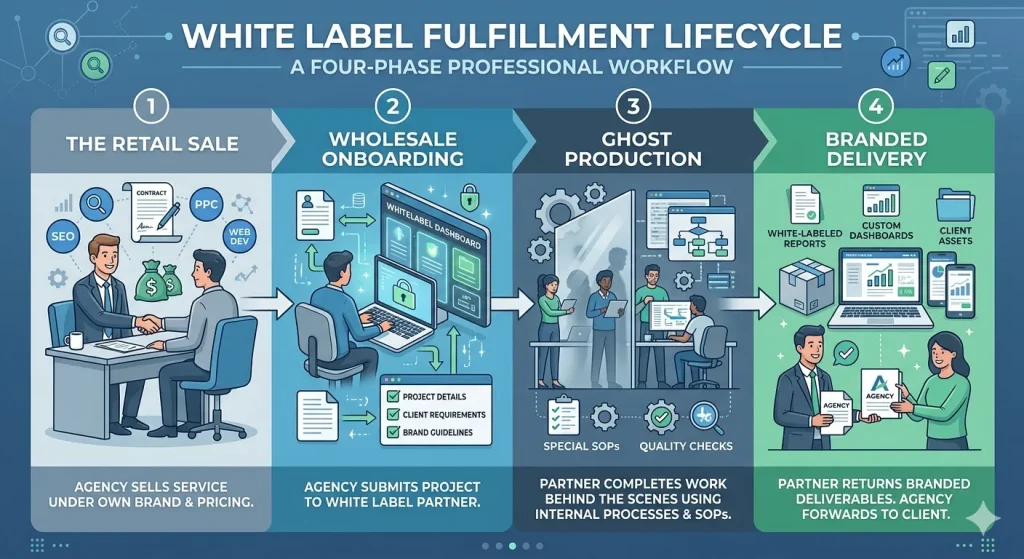
A standard white-label fulfillment lifecycle runs across four core phases:
- The Retail Sale: The agency signs a client and sells a service like SEO, PPC, or web development under its own brand and pricing structure.
- Wholesale Project Onboarding: The agency submits project details, client requirements, and brand guidelines to the white-label provider through a dedicated dashboard or workflow system.
- Ghost Production: The white label provider completes the work behind the scenes using its internal processes and Standard Operating Procedures (SOPs), without directly communicating with the client.
- Branded Delivery: Once the work is completed, the deliverables are returned to the agency with the agency’s branding. Reports, dashboards, and assets are white-labeled before being shared with the client.
Operational Insight
A successful partnership depends on clear communication boundaries. As the provider, you should never communicate directly with the end client. Holding that line is what lets the agency keep full brand ownership and client trust.
White Label Provider vs Outsourcing Vendor vs Freelancers
White label fulfillment is a structured, brand-safe delivery model: services are produced by a third-party provider but fully delivered under the agency’s brand. Unlike traditional outsourcing or freelancing, it prioritizes consistency, scalability, and complete brand invisibility.
Traditional outsourcing is usually cost-driven and project-based, and often lacks strict branding control and standardized delivery systems. Freelancers operate independently and suit small, task-based work rather than scalable, repeatable operations. The real difference between the three models is control, predictability, and systemization.
| Factor | White Label Provider | Traditional Outsourcing | Freelancers |
| Brand protection | Fully white-labeled under agency brand | Sometimes partially visible | Independent personal branding |
| Scalability | High — system-driven capacity | Medium — depends on vendor | Low — limited by individual capacity |
| Quality control | Standardized SOPs + QA layers | Varies by provider | Self-managed, inconsistent |
| Pricing predictability | Fixed wholesale pricing | Variable or hourly | Hourly or project-based |
| Operational control | High, systemized | Medium | Low |
| Best use case | Scalable, recurring agency services | One-off cost-saving projects | Small or one-off tasks |
Callout Insight
White label systems only work when internal execution and client-facing communication stay completely separate. Clarity in workflow is what protects your margins and the agency’s brand.
To manage these layered workflows, many providers use structured workspace tools like Taskip to create isolated project environments, manage approvals, and ensure clean handoffs between fulfillment teams and partner agencies — without exposing backend systems or breaking the white-label experience.
White Label Provider Models: Which One Should You Run?
White label provider models are the operational frameworks that define how an anonymous fulfillment provider delivers services through a reseller partner. There are three standard configurations:
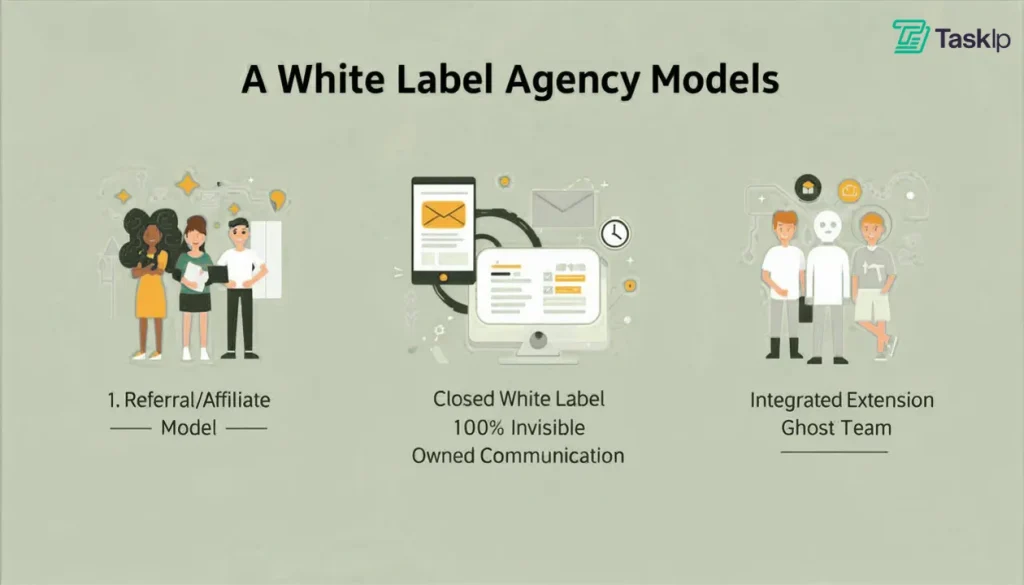
1. Referral Model (Affiliate Reseller)
The partner introduces the client directly to you in exchange for a recurring commission or markup. Lightest operational load, but the partner gives up brand ownership.
2. Closed Model (100% Invisible)
You operate entirely behind the scenes. The reseller agency handles all client communication, scoping, and feedback. Lowest risk of brand leakage.
3. Integrated Model (Front-Facing Ghost Team)
Your team interacts directly with end clients, fully disguised under the agency’s brand, using aliased email domains and branded channels. Higher revenue per partner, but demands trained account managers.
Operational Insight
The Closed Model carries the lowest risk of brand leakage. The Integrated Model earns more per account but requires account managers specifically trained to maintain strict brand anonymity.
Why Agencies Are Looking for White Label Providers in 2026
Agencies are increasingly turning to white label providers to protect profit margins while scaling delivery without adding headcount. As AI-driven competition intensifies across digital services, pricing pressure is pushing agencies away from hiring-heavy structures — and toward partners like you.
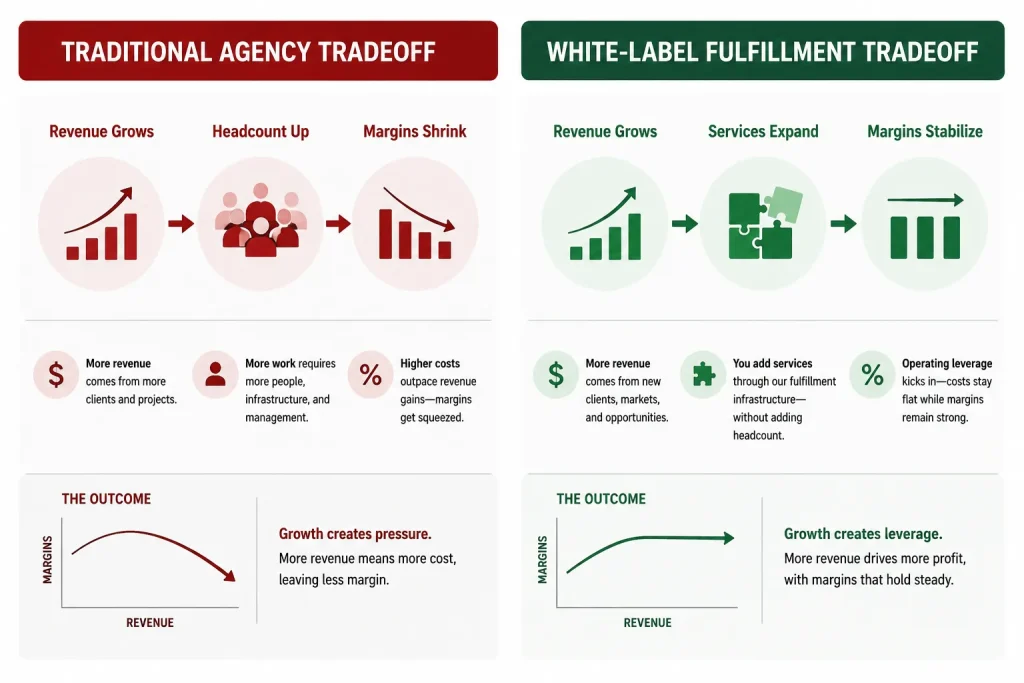
According to Promethean Research’s 2026 State of Digital Services report, digital agencies average roughly a 13% after-tax net margin, which underscores how hard agencies must work to protect profitability. Understanding what drives that demand is the foundation of selling to it. These five agency motivations are also your strongest selling points:
- Reduced operational overhead
Agencies replace fixed salary liabilities with variable, per-project fulfillment costs, protecting cash flow during seasonal slowdowns.
- Instant service expansion
Agencies can add SEO, PPC, or AI automation to their retail catalog immediately, with no internal training phase.
- Scalable bandwidth
You absorb sudden spikes in project volume, removing recruitment delays and capacity bottlenecks.
- Predictable margins
Your fixed wholesale pricing lets agencies apply consistent markups, commonly 50–100%, because their cost of goods sold is locked in.
- Access to specialized expertise.
Agencies reach senior technical specialists and enterprise tooling without paying full-time senior salaries.
Why Agencies Choose White Label Over Hiring In-House or Freelancers
For most agencies, building an in-house team means months of recruiting, fixed salaries that must be covered even in slow months, and management overhead. Whereas freelancers are cheaper but inconsistent, hard to scale, and risky for brand-sensitive work.
White label fulfillment sits between the two: it offers in-house-level consistency with freelancer-level flexibility. That gap, consistent quality without fixed cost, is exactly the value you sell as a provider.
How to Offer White Label Services for Agencies: Step-by-Step
Becoming a white label provider means shifting from custom, ad-hoc projects to a productized, repeatable delivery model. To offer white-label services successfully, you must decouple technical execution from client-facing communication. Your team becomes the anonymous engine room; the partner agency becomes the client-facing account layer. That division is what unlocks predictable, recurring B2B revenue. Here is the step-by-step setup.
Step 1: Productize Your Services
White-label fulfillment only works when services are standardized. Many providers fail because they keep treating every project as a custom engagement, which creates inconsistent timelines, unstable margins, and fulfillment bottlenecks. Convert each service into a clearly defined package with fixed deliverables, production timelines, and revision limits.
The most scalable white label services are repeatable and process-driven, including white label SEO and local SEO management, PPC campaign management, technical SEO audits, link building, content production, and website maintenance. Instead of selling vague “custom marketing,” build structured fulfillment tiers you can run repeatedly with minimal friction. The goal is not just to do work — it is to build a production system.
If you are still building service workflows manually, structure scalable productized offers before expanding into white-label fulfillment. (Internal link: guide on how to build productized services.)
Step 2: Identify the Right Agency Partners
Your ideal partners are agencies with strong sales capability but limited internal fulfillment capacity; for instance, boutique digital agencies, web design firms, SEO consultants, and branding studios that want recurring services without building specialized teams.
The best partnerships happen when an agency already sells a service but struggles to fulfill it consistently. A web design agency selling SEO with no internal SEO team is a far stronger long-term partner than a generic, price-shopping client. Positioning matters: competing purely on low price makes you replaceable, while solving a specific operational problem makes your infrastructure valuable.
Step 3: Build Sustainable Wholesale Pricing
Pricing decides whether your operation scales or destabilizes. Before setting reseller pricing, total every internal production cost – labor, software, reporting infrastructure, project management time, revision handling, and QA review.
Your wholesale price must leave the agency room for a healthy retail markup while protecting your own margin. Use this wholesale pricing formula:
Wholesale Price = Total Production Cost ÷ (1 − Target Margin %)
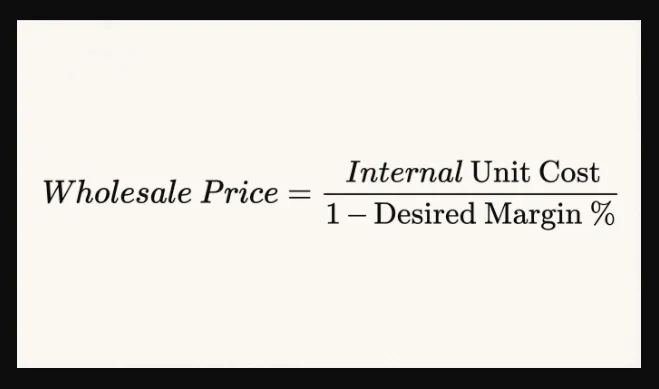
Example: if a service costs you $200 to produce and you target a 50% margin: $200 ÷ (1 − 0.50) = $400 wholesale price. The agency then applies its own markup — for example, reselling at $700–$800 retail.
Many providers underprice to win partners quickly. That usually leads to delivery pressure, inconsistent quality, excessive revisions, and partner churn. Healthy margins create operational stability.
Step 4: Establish Legal Protection and Brand Separation
White-label fulfillment runs on trust. Partners need confidence that you will stay invisible throughout the client relationship. Every partnership should operate under agreements that prohibit direct client solicitation, unauthorized communication, and disclosure of the fulfillment relationship.
At a minimum, your legal framework should include Non-Disclosure Agreements (NDAs), Master Service Agreements (MSAs), anti-solicitation clauses, and confidentiality protections. Your partners are not just paying for execution; they are paying for backend infrastructure they can safely fold into their own brand.
Step 5: Standardize the Onboarding Process
Poor onboarding creates delays, communication gaps, and unnecessary revisions. Scalable providers fix this with structured onboarding systems that collect everything upfront: access credentials, technical requirements, target audience data, brand assets, and project objectives.
A strong onboarding system typically includes intake forms, technical questionnaires, asset request templates, onboarding checklists, and project briefing documents. Everything should be fully white-labeled so agencies can send materials straight to their clients without exposing your operations. The smoother the onboarding is, the more agencies will route work through you.
Taskip Deal
Instead of third-party forms that expose your tool stack, Taskip lets agencies deploy fully white-labeled intake forms under their own branding and domain, keeping your backend invisible while centralizing onboarding, asset collection, and project intake in one system.
Step 6: Build White-Labeled Reporting Infrastructure
Reporting is one of the most important parts of recurring fulfillment. Partner agencies need clear visibility into progress and performance, but your internal branding should never appear in deliverables, dashboards, or reports.
Strong white-label systems ensure reports use the partner’s branding, dashboards inherit the partner’s logos, documents stay unbranded internally, and deliverables are client-ready on handoff. The agency should never have to clean formatting or strip branding before forwarding work. The more invisible your fulfillment, the more scalable the relationship.
A dedicated client portal becomes essential here. Taskip lets you replace all default branding with the partner agency’s logos, brand colors, and custom domain. When end clients log in to view milestones, download files, or review invoices, they experience an environment that looks 100% built by the reseller.
Step 7: Create SOPs and QA Workflows
As volume grows, undocumented processes create inconsistency fast. Document every operational task in Standard Operating Procedures (SOPs) covering onboarding, fulfillment, revisions, approvals, reporting, and escalations. This reduces dependence on individual team members and improves consistency across accounts.
Quality assurance is equally critical. Every deliverable should pass an internal review layer that verifies technical accuracy, formatting consistency, completeness, and strict white-label compliance. Long-term partnerships are retained through consistency, not complexity.
Step 8: Centralize Fulfillment Operations
Email threads and spreadsheets become liabilities once partner volume grows. Centralize fulfillment in a structured project management system where agencies can submit briefs, upload assets, track milestones, request revisions, and monitor active work without constant follow-up.
A strong operational system provides isolated partner workspaces for data separation, centralized communication with a full task history, workflow tracking with organized asset management, and recurring fulfillment visibility for retention metrics. This separation keeps fulfillment organized while protecting brand invisibility.
Step 9: Launch With Pilot Agency Partners
A pilot partner is a small, trusted group of initial agency clients you onboard to test and refine your setup before a wider launch. Pilots surface weaknesses in onboarding, communication, reporting, QA, and turnaround before you expose the infrastructure to a larger network.
This phase is also where you collect testimonials, case studies, workflow benchmarks, partner feedback, and performance data. Strong white-label businesses are built through operational refinement first, then scaled second.
The Logistical Backbone: Streamlining White-Label Delivery via Taskip
Managing multiple white-label pipelines becomes risky when you rely on fragmented tools, shared dashboards, or unstructured communication. A single exposed notification, mislabeled file, or mixed workspace can break the white-label separation entirely.
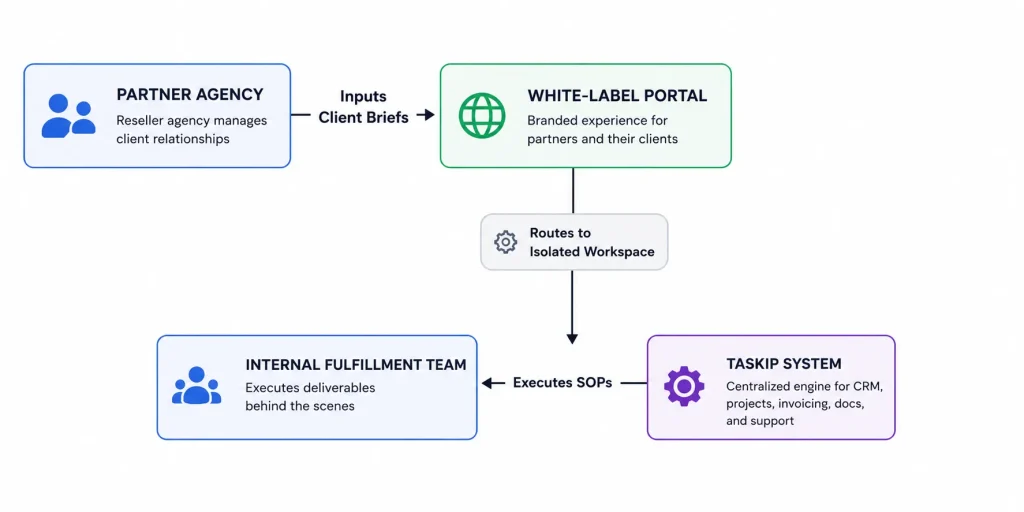
Taskip centralizes the operational layer behind white-label fulfillment by combining CRM, project management, invoicing, onboarding, document signing, and support workflows in one connected system. Instead of stitching together third-party tools, you manage fulfillment internally while giving partner agencies access to a fully white-labeled client portal under their own branding — keeping your production infrastructure invisible while operations stay organized and scalable.
Which White Label Services Are Most Profitable to Offer in 2026?
The most profitable white label services in 2026 are scalable, recurring, and repeatable through a productized system. As a provider, prioritize services that generate monthly recurring revenue rather than one-off projects. Here are the strongest categories to add to your catalog.
White Label SEO Fulfillment
White label SEO is one of the most in-demand services because it drives long-term client retention and recurring revenue — making it ideal for stable provider income. Core deliverables include technical SEO, on-page optimization, link building, local SEO, and SEO reporting.
White Label PPC Campaign Management
White label PPC lets agencies offer paid advertising without managing campaigns themselves. Common deliverables include Google Ads management, Meta Ads campaigns, conversion tracking, landing page optimization, and performance reporting.
Callout Insight
PPC requires constant optimization, so margins depend on tight, repeatable management workflows — price for ongoing labor, not a fixed setup.
White Label Web Design and Development
Web design and development stay in high demand as agencies expand digital offerings. Common deliverables include business websites, landing pages, ecommerce stores, WordPress development, and website maintenance. Maintenance retainers are especially attractive for recurring revenue.
White Label Content Marketing and Copywriting
Content fuels SEO, branding, and lead generation, making it a reliable recurring service. Common deliverables include blog writing, SEO copywriting, website copy, email campaigns, and case studies.
White Label Social Media Management
Social media management helps agencies maintain consistent output across platforms. Typical deliverables include content creation, caption writing, scheduling, community management, and performance reporting.
White Label AI Automation and Lead Generation
AI automation is one of the fastest-growing white label opportunities. Popular deliverables include AI chatbots, CRM automation, lead qualification workflows, automated follow-ups, and AI-powered customer support. Because the category is newer, specialized providers can command higher margins.
As you expand into multiple service categories, fulfillment and communication get harder to manage. Platforms like Taskip help you organize onboarding, approvals, recurring tasks, and white-label workflows from a single workspace.
How to Price White Label Services Profitably
Profitable pricing starts with knowing your true cost of delivery, then layering a deliberate margin on top, never pricing reactively against competitors.
Begin with a full cost audit per service: production labor, software and tooling, QA time, project management overhead, revision allowance, and a buffer for support. Add a realistic share of fixed costs so high-volume months do not quietly erode your margin. Once you know the loaded cost, apply the wholesale formula from Step 3 —
Wholesale Price = Total Production Cost ÷ (1 − Target Margin %)
Aim for margins around 40–50% so the business remains healthy even when projects take longer than expected or revisions increase. Whenever possible, prioritize recurring retainers over one-off projects. Predictable monthly revenue creates stability, improves forecasting, and makes scaling far easier. Create tiered packages like Starter, Growth, and Scale so agency partners can resell services without requiring constant custom quotes.
Most importantly, control the scope aggressively. Define revision limits clearly and charge for overages. Unlimited revisions are one of the fastest ways to erode profitability.
Finally, review pricing every 6–12 months. Labor costs, tools, and fulfillment expenses change constantly, and profitable agencies adjust pricing proactively instead of absorbing cost increases silently.
How to Attract Agency Partners for Your White Label Services
Agencies choose a white label provider based on reliability, communication, and systems — not the lowest price. Every criterion an agency uses to evaluate you is a positioning opportunity. Build your pitch and your operation around the five points below.
a. Set Communication and Responsiveness Standards Agencies Trust
Agencies cannot afford long backend delays when their clients ask for updates or revisions. Make speed a visible feature: offer a dedicated account manager, publish clear response-time commitments, and run organized communication channels so nothing gets lost.
Callout Insight
Most white label partnerships fail because of communication breakdowns, not technical skill gaps. Reliability is your strongest differentiator.
b. Build a Portfolio and Case Studies That Close Deals
Agencies need proof before they trust you with their clients. Maintain anonymized sample deliverables, campaign reports, and case studies in your core niches, and lead with measurable outcomes, traffic growth, ranking gains, and conversion improvements across different industries.
c. Make Reporting and Transparency a Selling Point
Agencies should never have to chase updates or guess at progress. Offer organized reporting that clearly shows completed work, active deliverables, and next steps. Transparent reporting lets partners manage their clients confidently without micromanaging you, and that ease is what earns renewals.
d. Commit to Turnaround Times You Can Defend
Turnaround speed directly affects your partner’s client satisfaction. Publish standardized turnaround windows for each package and revision type, then defend them with capacity planning. Predictable timelines let agencies confidently quote deadlines to their clients.
e. Showcase Your QA Process as a Differentiator
Agencies should not have to act as your final proofreading layer. A structured, multi-stage QA process, technical review, editing, compliance check, white-label verification is a powerful selling point. Make it visible in your pitch; it signals you are a system, not a freelancer.
How to Manage White Label Projects Efficiently
Efficient management of white label projects depends on systems that keep many partner pipelines organized while keeping each one fully isolated and brand-safe.
Create Clear Partner Communication Systems
Give each partner agency a single, structured channel for briefs, questions, and approvals, not scattered emails. Centralized communication preserves a full task history, prevents missed requests, and keeps each partner’s work walled off from the others.
Build Repeatable SOPs
Document every workflow onboarding, fulfillment, revisions, reporting, and escalation so delivery does not depend on any single team member. Repeatable SOPs are what let you add partners without quality dropping.
Track Deliverables and Deadlines
Use a project management system that shows every active deliverable, owner, and due date at a glance. Visible deadlines prevent the bottlenecks that damage partner retention and erode project margin.
Manage Revisions and Approvals
Define a clear revision cap per package and a structured approval flow. Track revision requests so you can bill overages and spot partners whose accounts are quietly running unprofitably.
Use Workflow Automation Tools
Automate repetitive steps intake confirmations, status updates, recurring task creation, and invoice reminders. Automation reduces manual follow-up, lowers error rates, and frees your team to focus on production rather than coordination.
Essential Tools to Run a White Label Provider Operation
The right tool stack keeps fulfillment organized, protects brand invisibility, and lets you scale partner volume without operational chaos.
Project Management Platforms
A project management platform is the core of your operation, used to assign work, track milestones, and give partners isolated workspaces. Look for white-label capability so dashboards never expose your brand.
Reporting and Analytics Tools
Reporting tools turn raw campaign data into client-ready, partner-branded reports. Automated, white-labeled reporting saves hours and keeps every deliverable consistent.
Team Collaboration Software
Internal collaboration tools keep your production team aligned on briefs, assets, and feedback, kept strictly separate from partner-facing channels to protect brand boundaries.
CRM and Partner Management Systems
A CRM tracks your partner agency pipeline, contracts, renewals, and recurring revenue — helping you focus retention efforts on your most valuable partners.
Automation and Productivity Tools
Automation tools handle intake, notifications, invoicing, and recurring task creation. Consolidating these, as Taskip does by combining CRM, project management, invoicing, onboarding, and support in one system, removes the risk of fragmented tools breaking white-label separation.
For a category-by-category breakdown of specific platforms — covering project management, branded reporting, SEO tracking, social media, and CRM — see our full guide to the best white label tools for agencies.
Key Metrics Every White Label Provider Should Track
Tracking the right metrics tells you whether your provider business is actually profitable and stable, not just busy.
- Profit Margin Per Service: Net margin on each productized service after fully loaded costs. It reveals which services to scale and which to reprice or retire.
- Partner Retention Rate: The percentage of partner agencies that stay month over month. Recurring retention, not new sales, is what compounds provider revenue.
- Fulfillment Turnaround Time: Average time from brief to delivery. Rising turnaround is an early warning of capacity strain.
- Revision Rate: Average revisions per deliverable. A high rate signals onboarding gaps or unclear scopes, and quietly destroys margin.
- Average Revenue Per Partner: Total revenue divided by active partners. Growing this through upsells is cheaper than constant partner acquisition.
Common Mistakes White Label Providers Make
Avoiding these recurring mistakes is often the difference between a stable provider business and one that churns partners.
- Mistake-1: Underpricing to win partners fast: Cheap pricing attracts price-sensitive partners and leaves no margin for revisions or QA, leading to burnout and churn.
- Mistake-2: Selling before processes exist. Taking on partners without SOPs and QA in place guarantees inconsistent delivery and damaged trust.
- Mistake-3: Breaking brand invisibility. A single exposed notification, branded file, or stray email can break the white-label promise and lose a partner permanently.
- Mistake-4: Weak quality control. Forcing partners to act as your proofreading layer erodes confidence faster than almost anything else.
- Mistake-5: Poor communication with partners. Slow or unstructured updates cause partners to lose trust even when the actual work is good.
Real-World Example: Scaling a White Label Provider
The clearest way to see the white label model work is to follow one provider through the transition. The example below traces the typical path a small services studio takes from retail delivery to wholesale fulfillment. The figures are illustrative, but they reflect realistic ranges for a studio of this size.
The Starting Point
A four-person SEO studio spent its first three years serving end clients directly — about seven active accounts paying $1,500 to $2,500 per month, for roughly $13,000 in monthly revenue. The founder still ran every sales call, scoped each project, and reviewed most deliverables personally. Because each client had a slightly different scope, project margin swung between 25% and 45% depending on how many revision rounds a job absorbed. Two strong months were regularly followed by a slow one whenever a client churned.
The Transition (Months 1–6)
Over six months, the studio rebuilt itself as a white label provider. It collapsed its custom work into three fixed packages — a $650/month Local SEO retainer, a $1,200/month Growth SEO retainer, and a one-time $900 Technical SEO Audit — each priced with the 50% margin formula and a three-revision cap. It signed NDAs and MSAs with five boutique web design and branding agencies that already sold SEO but had no in-house team, then moved all fulfillment into a single white-labeled portal.
The launch was not frictionless. The first pilot partner nearly walked after a reporting delay in week three, and an early audit was sent out with the studio’s own logo still on page one — a near-miss brand leak. Both failures traced back to missing checklists, which became the studio’s first two documented SOPs.
Revenue and Margin Improvements (Months 6–12)
By month twelve, the five partners were routing 19 client accounts through the studio at an average wholesale rate of about $1,050 per month, roughly $20,000 in recurring revenue, with a pipeline that no longer depended on the founder’s sales calls. Fixed scopes lifted average project margin from the mid-30s to the mid-50s in percentage terms, and revenue was finally stable enough to hire a second SEO specialist.
Workflow Changes That Improved Delivery
Isolated partner workspaces, twelve documented SOPs, and a two-stage QA review, a technical check followed by a white-label compliance check, cut the revision rate from an average of 2.4 rounds per deliverable to under one. The founder shifted from reviewing every deliverable to spot-checking work and managing partner relationships.
Lessons Learned
Three decisions made the growth sustainable: productizing before adding partners, capping revisions in the contract, and piloting with two partners before opening to the rest. The studio’s own takeaway was that the slow first six months, spent fixing SOPs rather than selling, were exactly what allowed the next six to scale.
Conclusion
Learning how to offer white label services for agencies is ultimately about building scalable, recurring revenue without expanding internal overhead. Agencies that succeed in white label fulfillment focus on productized services, predictable margins, operational efficiency, and consistent delivery systems.
The strongest white label partnerships are built on clear communication, reliable fulfillment, strong SOPs, and complete brand invisibility. When those systems are in place, agencies can scale faster while maintaining healthy profit margins and long-term client retention.
To manage onboarding, fulfillment, reporting, invoicing, and partner collaboration more efficiently, many agencies use Taskip as their centralized operational workspace. Start your free trial and build a white label system designed for long-term agency growth.
Frequently Asked Questions
What does it mean to offer white label services?
Offering white label services means producing work — such as SEO, PPC, or web design — that another agency resells to its clients under its own brand. You stay invisible to the end client, while the agency manages communication, pricing, and the relationship.
How do white label providers make money?
White label providers earn revenue by selling production capacity wholesale to agencies at a fixed price. Profit comes from the margin between your loaded production cost and your wholesale rate, multiplied across recurring monthly retainers with multiple partner agencies.
How do I start offering white label services to agencies?
Start by productizing your services into fixed packages, setting sustainable wholesale pricing, and putting NDAs and MSAs in place. Then standardize onboarding and reporting, document your SOPs and QA, and launch with a small group of pilot agency partners.
Which white label services are most profitable to offer?
The most profitable white label services are recurring and repeatable — white label SEO, PPC management, content marketing, social media management, website maintenance, and AI automation. Recurring retainers generate far more stable provider revenue than one-off projects.
How do I find agency partners?
Target agencies that already sell a service but struggle to fulfill it consistently — boutique digital agencies, web design firms, and branding studios. Solving a specific operational gap makes you more valuable than competing on price alone.
How do I keep my brand invisible to the end client?
Keep your brand invisible by white-labeling every touchpoint: intake forms, reports, dashboards, and client portals carry the partner’s branding. Never contact the end client directly, and use legal agreements to formalize brand separation.
How is offering white label services different from outsourcing?
Outsourcing is typically cost-driven and project-based with limited branding control. White label fulfillment is a systemized, brand-safe model: work is delivered entirely under the agency’s brand with standardized processes, QA, and predictable pricing.
Is running a white label provider business profitable?
Yes — when services are productized and priced with a healthy margin. Profitability depends on disciplined wholesale pricing, capped revisions, strong QA, and high partner retention, since recurring retainers compound revenue over time.


Get Summary On: