
Graphic design pricing usually follows one of five models: hourly, day rate, fixed project fee, value-based pricing or a monthly retainer. To set your own price, work out the hourly rate that covers your target income, overhead and unbilled time, estimate the hours a project will take, then price the project (not the hours) and present it in a clear quote or proposal. Market data gives you a sanity check: Upwork lists median graphic designer rates of $15–$35 an hour on its marketplace, while Clutch reports that most US graphic design companies charge $100–$149 an hour.
This graphic design pricing guide covers how to price design work as a freelancer or design consultant, how agencies price bigger engagements, and how to present a number so clients say yes. You’ll also find pricing examples, a free template and tips for beginners and small business clients. The examples use US dollars, but the method works the same way in pounds (£) if you design for UK clients.
Note: Market rates below were checked in November 2026 on Upwork, Clutch and the US Bureau of Labor Statistics. Figures are in US dollars unless stated.
Table of Contents
- Five pricing models: hourly, day rate, fixed project fee, value-based pricing and monthly retainers. Most designers combine two or three.
- Market benchmarks: Upwork lists a median of $15–$35/hr on its marketplace. Clutch reports most US graphic design companies charge $100–$149/hr and UK companies $50–$99/hr.
- Employee wages are not freelance rates: the BLS median for employed US graphic designers is $30.27/hr ($62,960/yr), and it excludes the self-employed.
- Your rate formula: (target income + business costs) ÷ billable hours, plus a profit margin.
- Price the project, not the hours: estimate hours per phase, add revisions and a 10–20% buffer, then round.
- Present it well: send a clear quote or proposal with three options, a deposit and set revision rounds.
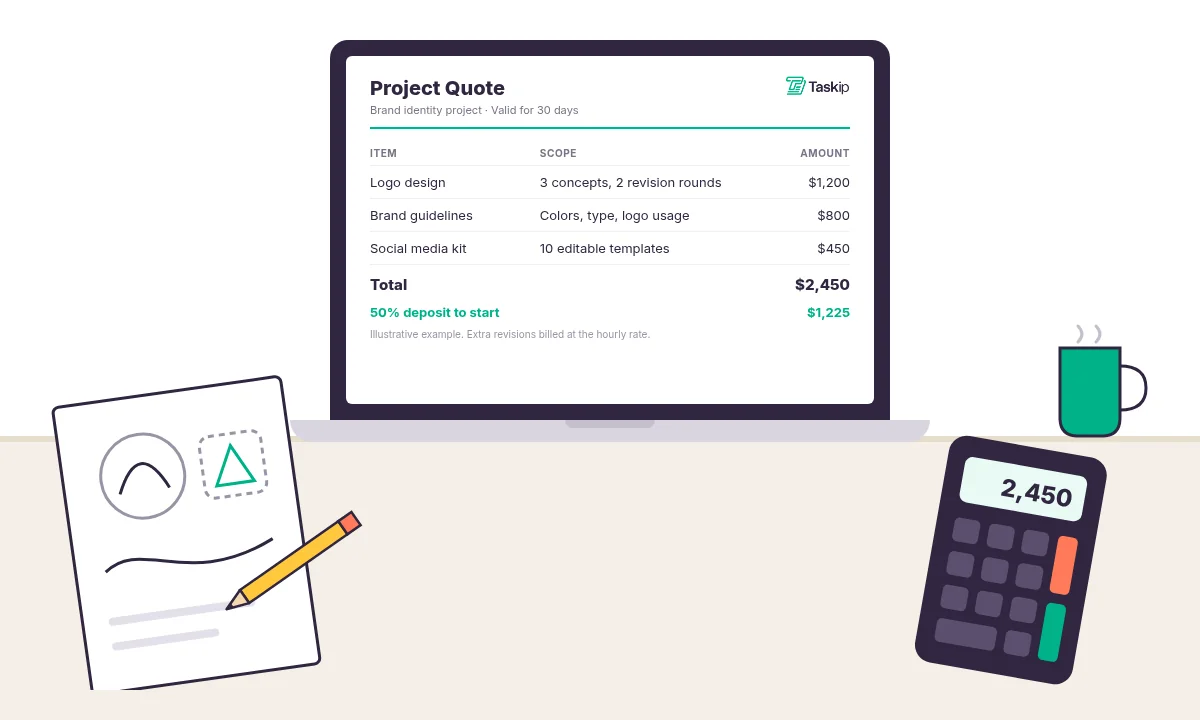
Graphic Design Pricing 2026: How Much Does Design Cost?
Published rates vary a lot because they measure different things. A marketplace average, an agency directory and a government wage survey all answer different questions about what graphic design costs. Here’s what four sources we checked in November 2026 actually report.
| Source | What it measures | Reported figure |
|---|---|---|
| Upwork | Hourly rates on its freelance marketplace (worldwide contracts) | Median $15–$35/hr; rates range from $15 to $150/hr |
| Clutch | Hourly rates of graphic design companies listed on Clutch | US: $100–$149/hr. UK: $50–$99/hr. Canada and Australia: $100–$149/hr |
| Clutch | Typical project size reviewed on Clutch | Under $10,000 for most graphic design projects |
| US Bureau of Labor Statistics | Wages of employed (not self-employed) graphic designers, May 2025 | Median $62,960 a year, or $30.27 an hour |
Two things to keep in mind when you read these numbers:
- Employee wages are not freelance rates. The BLS figure is what employers pay staff designers. It doesn’t include self-employed workers, who make up about 20% of US graphic designers according to the same BLS page. As a freelancer you pay your own taxes, software, equipment, health cover and unpaid admin time, so your hourly rate has to be well above an employee’s wage to earn the same.
- Marketplace medians skew low. Upwork’s median reflects worldwide contracts, including designers in lower-cost markets. If your clients are US, UK, German or Dutch businesses, the agency rates on Clutch are a more useful ceiling, and your own costs are the floor.
Use benchmarks as a gut check, not as your price. Your rate should come from your own numbers, which we’ll calculate below.
What Are the 5 Graphic Design Pricing Models?
Most designers combine two or three of these. The best graphic design pricing model for you depends on how well the scope is defined and how long the relationship will last.
1. Hourly Pricing
You bill for the time you track. It’s simple and low risk for you when the scope is fuzzy, such as small edits, ongoing production work or a client who keeps changing direction. The downside is that it punishes speed: the better you get, the less you earn per task, and clients often watch the clock instead of the result. Hourly works best for open-ended support and as the “extra revisions” rate in your contracts.
2. Day Rate
A day rate is a fixed fee for a working day, often used for on-site work, workshops, agency overflow or when a studio books you to sit inside its team. It’s common in the UK and Europe, where many freelancers quote a daily rate instead of an hourly one. Define what a “day” means (for example, 7.5 hours) and whether a half-day rate exists.
3. Fixed Project Pricing
You quote one price for a defined set of deliverables, such as a logo suite, a 12-page brochure or a packaging range. Clients like it because they know the cost up front. You like it because you keep the upside if you work efficiently. The risk is scope creep, so a project price only works with a written scope, a set number of revision rounds and a change-request rate for anything outside it.
4. Value-Based Pricing
You price based on what the work is worth to the client rather than how long it takes. A brand identity for a funded startup about to launch nationally is worth more than the same hours spent on a local bakery’s flyer. Value-based pricing needs a good discovery call: what the project is for, what success looks like and what it’s worth to the business. It’s the model with the highest ceiling, but you still need your hourly cost as a floor so you never price below what the work costs you to deliver.
5. Retainer Pricing
The client pays a fixed monthly fee for a set amount of capacity or a defined bundle of deliverables, such as 20 hours of design or a set number of social and ad assets each month. Retainers smooth out your income and reduce the time you spend selling. Spell out what happens to unused hours (roll over or expire), the response time and the notice period. For a full comparison of the two main models, see our guide to retainer vs project-based pricing.
| Model | Best for | Main risk |
|---|---|---|
| Hourly | Small edits, unclear scope, ongoing production | Caps your income; clients focus on time |
| Day rate | On-site work, workshops, agency overflow | Unclear definition of a “day” |
| Fixed project | Logos, brand identity, print and packaging | Scope creep and unlimited revisions |
| Value-based | High-impact brand and launch work | Needs strong discovery and confidence |
| Retainer | Ongoing marketing and content design | Unused hours and blurred priorities |
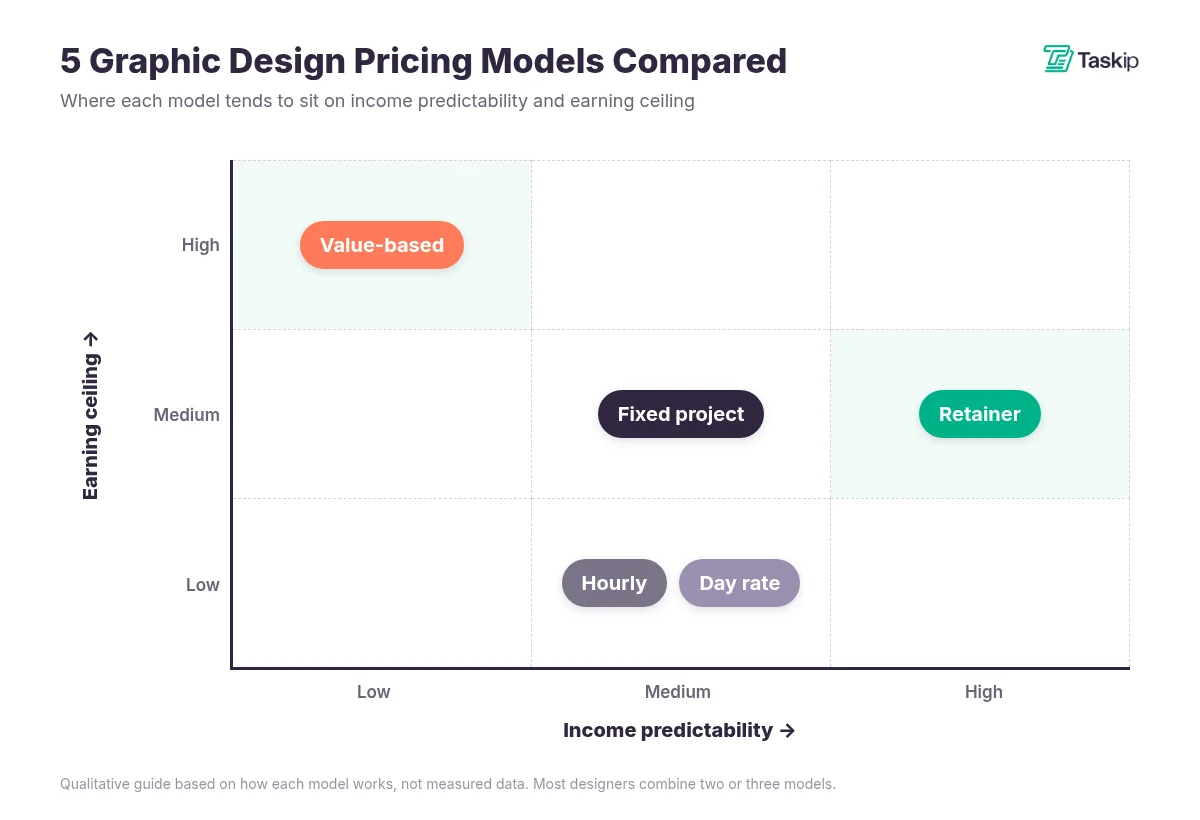
Choosing Your Graphic Design Pricing Strategy
Your graphic design pricing strategy should match the stage you’re at and the clients you serve.
For beginners: Start with your minimum hourly rate, then move to fixed project prices as soon as you’ve tracked a few projects. Graphic design pricing for beginners works best when you price by project early, because your income then grows as you get faster.
For consultants: A design consultant usually sells advice, direction and workshops rather than files. A day rate or a monthly advisory retainer fits this kind of work better than an hourly rate.
For small business clients: Graphic design pricing for small business clients works best with clear packages and fixed prices. Small business owners like knowing the full cost up front, and a three-tier offer lets them choose a budget that fits. Cheap graphic design pricing can look appealing to a new business. A fair, clearly scoped price usually gives better value because it includes revisions, proper files and support.
Alternatives to hourly billing: If hourly billing caps your income, the main alternatives are fixed project fees, value-based pricing and productized packages. Most designers keep an hourly rate only for extra revisions and small edits.
How to Price Design Work: Calculate Your Rate in 5 Steps (Great for Beginners)
Even if you never show a client an hourly rate, you need one. It’s the number behind every project quote and retainer. If you’re starting out, this is the most useful part of graphic design pricing for beginners. Here’s the method.
- Set your target annual income: This is what you want to pay yourself before tax, the equivalent of a salary.
- Add your yearly business costs: Include software subscriptions, fonts and stock licenses, hardware, insurance, accounting, a co-working desk, marketing and payment processing fees. In the US, add self-employment tax planning. In the UK, remember that once your taxable turnover goes over the £90,000 VAT threshold you must register for VAT (GOV.UK), which affects what you charge clients.
- Estimate your billable hours: Start from the weeks you’ll actually work after holidays and sick days, then remove the time spent on sales, admin, email, invoicing and learning. Many freelancers find that only part of their working week is billable, so measure your own split for a month if you can.
- Divide: (Target income + business costs) ÷ billable hours = your minimum hourly rate.
- Add profit and check the market: Add a margin on top of the minimum, then compare the result with the benchmarks above and with what clients in your niche pay.
A Worked Example
These numbers are only an illustration. Swap in your own.
- Target income: $75,000
- Business costs: $10,000
- Billable hours: 1,000 a year (about 22 hours a week across 46 working weeks)
- Minimum rate: $85,000 ÷ 1,000 = $85 an hour
- With a 20% margin: about $102 an hour
If you’d rather not do this on paper, use one of the free graphic design pricing tools covered below. Taskip’s free service pricing calculator works out a time-based, value-based or tiered package price from the same inputs.
How to Turn Your Rate Into a Project Price
Clients rarely want to buy hours. To price a project:
- Break the project into phases: discovery, research, concepts, refinement, final artwork and file prep.
- Estimate hours for each phase, including meetings and presentations.
- Add the revision rounds included in the price.
- Add a contingency buffer for feedback delays and unknowns, for example 10–20%.
- Multiply by your hourly rate, then round to a clean number.
- Ask whether the result reflects the value to this client. If the work is high stakes, price up.
Track actual hours against your estimate on every project. After five or six projects you’ll know your real numbers for a logo, a brand guide or a packaging range, and your quotes get faster and more accurate.
Graphic Design Pricing Examples
These graphic design pricing examples use the $102 hourly rate from the worked example above and add a 15% buffer. They’re illustrations, not market rates.
| Project | Estimated hours | With 15% buffer | Project price (rounded) |
|---|---|---|---|
| Logo design (discovery, concepts, refinement, final files) | 22 | 25.3 | $2,600 |
| 12-page brochure | 30 | 34.5 | $3,500 |
| Monthly social design retainer | 20 per month | Not applied | $2,000 per month |
Swap in your own rate and hours. Then compare the result against the value of the project to the client.
Free Graphic Design Pricing Template
Copy this graphic design pricing template into a document or spreadsheet and fill in your numbers.
GRAPHIC DESIGN PRICING SHEET

Target annual income: [amount]
Yearly business costs: [amount]
Billable hours per year: [number]
Minimum hourly rate: (income + costs) ÷ billable hours = [amount]
Profit margin: [percentage]
Working hourly rate: [amount]

PROJECT: [name]
Phase 1, Discovery: [hours]
Phase 2, Concepts: [hours]
Phase 3, Refinement and revisions: [hours]
Phase 4, Final artwork and files: [hours]
Subtotal hours: [number]
Buffer (10–20%): [hours]
Total hours x rate: [amount]
Rounded project price: [amount]
Deposit: [percentage or amount]
Extra revision rate: [amount per hour or round]
Design Agency Pricing: How Do Studios and Agencies Price Work?
Design agency pricing works on the same principles but adds team costs and account management. Here’s how agencies usually structure it.
Blended Rates and Rate Cards
Most agencies keep an internal rate card per role, such as creative director, senior designer, designer and project manager. For client quotes they either show a phase-by-phase fee or use a single blended hourly rate. A blended rate is easier for clients to understand and hides internal staffing changes.
Phase-Based Fees
Larger projects such as a rebrand are often priced by phase: strategy, identity design, guidelines and rollout. Each phase has its own fee, deliverables and approval gate. This lets the client approve budget in steps and gives the agency a natural point to re-scope.
Retainers and Minimum Engagements
Agencies rely on retainers for predictable revenue and capacity planning. Many also set a minimum project size so small jobs don’t tie up a senior team. If you’re growing from freelancer to studio, a minimum engagement is one of the easiest ways to raise your average project value.
Pass-Through Costs and Markups
Printing, photography, stock images, font licenses and illustration subcontractors are usually billed on top of design fees. Agencies often add a handling markup to cover the admin and risk of managing third-party suppliers. State this in the quote so it isn’t a surprise on the invoice.
Productized Packages
Some studios sell fixed packages, such as “Startup Brand Kit” or “Monthly Social Design”, at a set price with a defined scope. Packages make selling easier and suit online graphic design pricing, where clients browse a service catalog, choose a package and pay online.
Free Graphic Design Pricing Tools
You don’t need expensive software to price well. These free graphic design pricing tools cover most of the work:
- A pricing calculator: Taskip’s free service pricing calculator turns your costs and hours into time-based, value-based or tiered prices.
- A spreadsheet: Track estimated against actual hours on every project so your next quote is more accurate.
- A quote and proposal builder: Send branded quotes with three options, collect e-signatures and turn accepted quotes into invoices.
- A client portal: Keep quotes, contracts, files and payments in one place so clients can approve and pay online.
How to Present Your Price So Clients Say Yes
The way you present a price matters as much as the number. A figure dropped into an email invites haggling. A clear document anchors the conversation in scope and outcomes.
Quote, Estimate or Proposal?
- Estimate: a rough, non-binding guide used early on, when the scope isn’t settled.
- Quote: a fixed price for a defined scope, usually valid for a set number of days.
- Proposal: a fuller document that explains the problem, your approach, the timeline, the options and the price. Use it for anything larger than a quick job.
Our guide to quotes vs invoices vs estimates explains when to use each, and how to write a winning quote walks through the structure line by line.
Offer Three Options
Tiered pricing gives clients a choice of “how much” instead of “yes or no”. For example:
- Essential: logo, color palette and basic usage sheet
- Standard: everything above plus stationery, social templates and a short brand guide
- Complete: everything above plus a full guidelines document, launch assets and a month of support
Make the middle option the one you want most clients to pick, and make each tier’s scope and revisions explicit.
Include the Terms That Protect You
Every quote or proposal should state the deposit (for example, 50% up front), the payment schedule, the revision rounds included, the rate for extra work, what happens if the project is cancelled, and when usage rights pass to the client. These terms then carry into your contract.
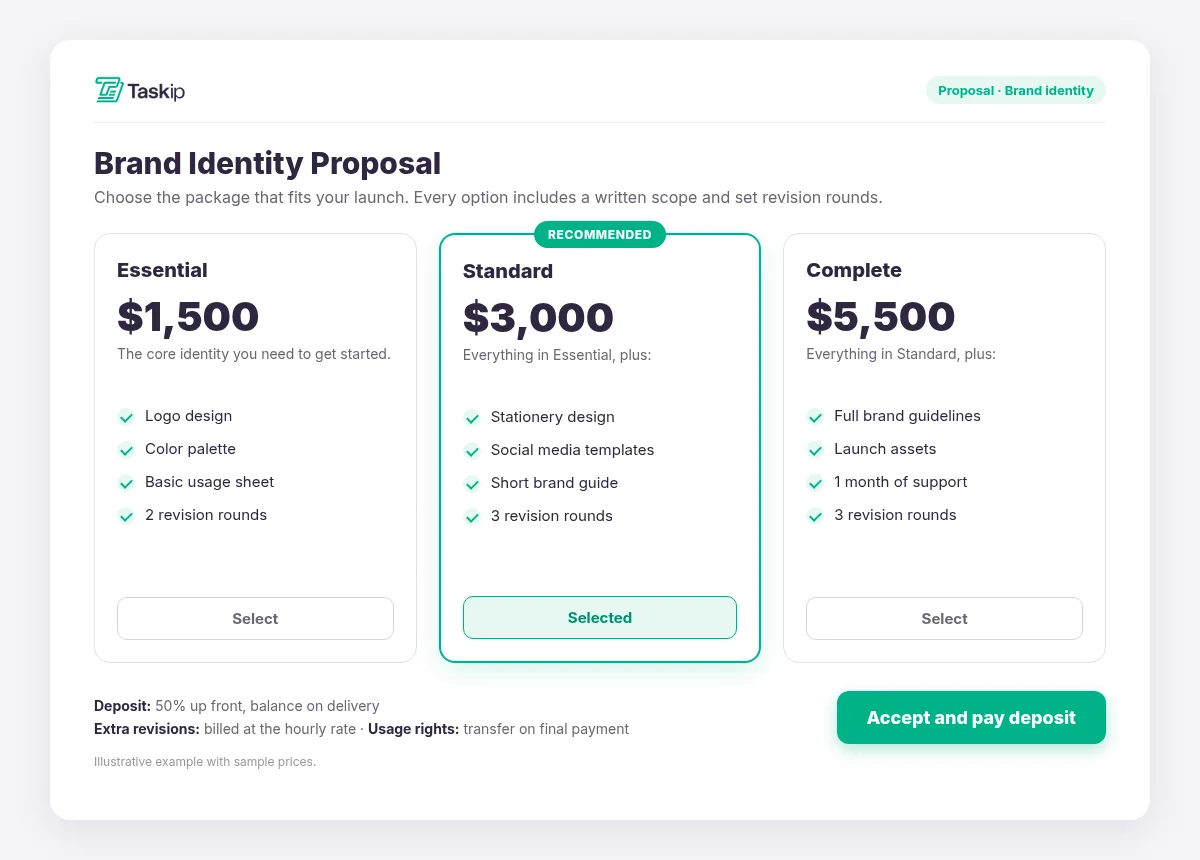
Taskip lets you build branded quotes and proposals, collect e-signatures, convert an accepted quote into an invoice and take payment through Stripe or PayPal, all inside a client portal. See Taskip’s plans, including a free-forever starter plan.
Top Graphic Design Pricing Mistakes to Avoid
- Pricing from competitors instead of your costs. Benchmarks tell you what’s normal, not what you need to earn. Start from your own rate.
- Forgetting non-billable time. Email, calls, file prep and invoicing all take time. If you don’t account for them, you’ll undercharge on every project.
- Unlimited revisions. “Revisions until you’re happy” turns a fixed price into an open-ended commitment. Include a set number of rounds and a rate for more.
- Starting without a deposit. A deposit confirms the client is serious and protects you if the project stalls.
- Handing over all rights before full payment. Transfer ownership or the license when the final invoice is paid, not when files are sent.
- Not raising prices. Review your rate at least once a year and when your demand outgrows your capacity. Give existing clients notice before increases.
- Vague scope. “Website graphics” can mean five images or fifty. List every deliverable, format and size.
- Ignoring currency and tax. If you work with UK, EU or US clients, say which currency you bill in and whether VAT or sales tax applies.
Final Thoughts
Good graphic design pricing starts with your own numbers, not a competitor’s price list. Work out the hourly rate that covers your income, costs and unbilled time, use market benchmarks only as a sanity check, and then price each project on its scope and value. That approach works in 2026 whether you’re a beginner, a consultant or a growing agency.
How you present the price matters just as much. A clear quote or proposal with three options, a deposit and a set number of revision rounds gets more yeses and fewer disputes than a number in an email.
Ready to price, quote and get paid in one workflow? Start with Taskip for free and send your first branded quote today, or compare Taskip plans.
FAQs on Graphic Design Pricing
How much do graphic designers charge per hour?
It depends on the market. Upwork lists a median of $15–$35 an hour on its worldwide marketplace, while Clutch reports that most US graphic design companies charge $100–$149 an hour and UK companies $50–$99 an hour. Your own rate should come from your costs and target income, not just these benchmarks.
How much should I charge for graphic design as a beginner?
Calculate your minimum rate from your living costs, business costs and realistic billable hours, then compare it with market data. Upwork reports median marketplace rates of $15–$35 an hour, but if you work with US or UK businesses, aim to price by project as soon as you can so your rate grows with your speed.
Is it better to charge hourly or per project for graphic design?
Per project is usually better for well-defined work like logos, brand identity and print, because clients know the cost and you’re rewarded for working efficiently. Hourly suits small edits and open-ended support. Many designers quote projects but keep an hourly rate for extra revisions.
How do design agencies price their services?
Agencies typically use phase-based project fees, monthly retainers and blended hourly rates built from an internal rate card. Clutch reports that most US graphic design companies charge $100–$149 an hour and UK companies $50–$99 an hour.
How much deposit should a graphic designer ask for?
There’s no fixed rule, but a deposit of somewhere between a third and a half of the fee before work starts is a common setup, with the balance due on delivery or split across milestones. For larger projects, tie each payment to an approved phase. Whatever you choose, put it in the quote and the contract.
Should I show my hourly rate to clients?
Not necessarily. For project and value-based work, show the price, the scope and the outcome. Use your hourly rate internally to check the project price covers your time, and show it only for out-of-scope work.
How often should I raise my design prices?
Review your pricing at least once a year, and sooner if you’re fully booked. Raise prices for new clients first, then give existing clients notice before applying the new rate.
How do I find graphic design pricing near me?
Look at local agencies on directories like Clutch and filter by your city or country. Then compare those rates with your own minimum rate. Local rates are a useful benchmark, but your price should still start from your own costs.
What is the best graphic design pricing model?
For well-defined work, fixed project pricing is usually best. For ongoing work, a retainer is better. Many designers combine both and keep an hourly rate for extra revisions.
How should design consultants price their services?
Consultants usually charge a day rate for workshops and strategy sessions, or a monthly retainer for ongoing advice. Price on the value of the decisions you help the client make, with your hourly cost as the floor.
Is there a free graphic design pricing template?
Yes. Use the pricing sheet template above, or Taskip’s free service pricing calculator, to work out your rate and project prices.