
To write a winning quote, restate the client’s goal, define the scope and exclusions, price on value, offer two or three options, add proof, set clear terms with an expiry date, make acceptance one click, and follow up within 48 hours. Most quotes don’t lose on price. They lose on clarity, speed and trust.
A quote is often the first document a client sees from you. It shows how you think, how organized you are and how easy you will be to work with. Whether you need to know how to write a quote for a one-off job or a monthly retainer, this guide explains how to write a winning quote step by step, with a checklist, a before-and-after example, follow-up scripts and a free quotation template.
Table of Contents
- Speed matters: reply fast. Leads cool quickly, so send the quote while interest is high.
- Mirror the client: open with their goal in their own words, not your service list.
- Be specific: list deliverables, exclusions, timeline and revisions.
- Offer options: two or three packages make “which one?” easier than “yes or no?”.
- Make yes easy: online acceptance and e-signatures remove friction.
- Follow up: a polite nudge on day 2, day 5 and day 10 wins many “maybe” deals.
- Use software: quotation software tracks views, statuses and converts accepted quotes into invoices.
Quote vs Estimate vs Proposal: Which One Do You Need?
Before you learn how to write a winning quote, make sure a quote is the right document. Clients often use these terms- quote vs estimate vs proposal interchangeably, but they set different expectations.
| Document | What it is | How binding | Best for |
|---|---|---|---|
| Quote | A fixed price for a clearly defined scope | Firm for a set period | Well-scoped jobs, repeat services |
| Estimate | An approximate cost range | Not fixed, may change | Early conversations, uncertain scope |
| Proposal | A persuasive document covering approach, team, timeline and price | Varies | Larger projects and competitive bids |
For bigger projects, many agencies send a short proposal with a detailed quote attached. For smaller, well-defined jobs, a clear quote on its own usually wins faster. If the scope is still fuzzy, start with a scope of work first or a formal statement of work.
What Should a Winning Quote Include?
Every winning quote answers the client’s questions before they ask them. Use this checklist:
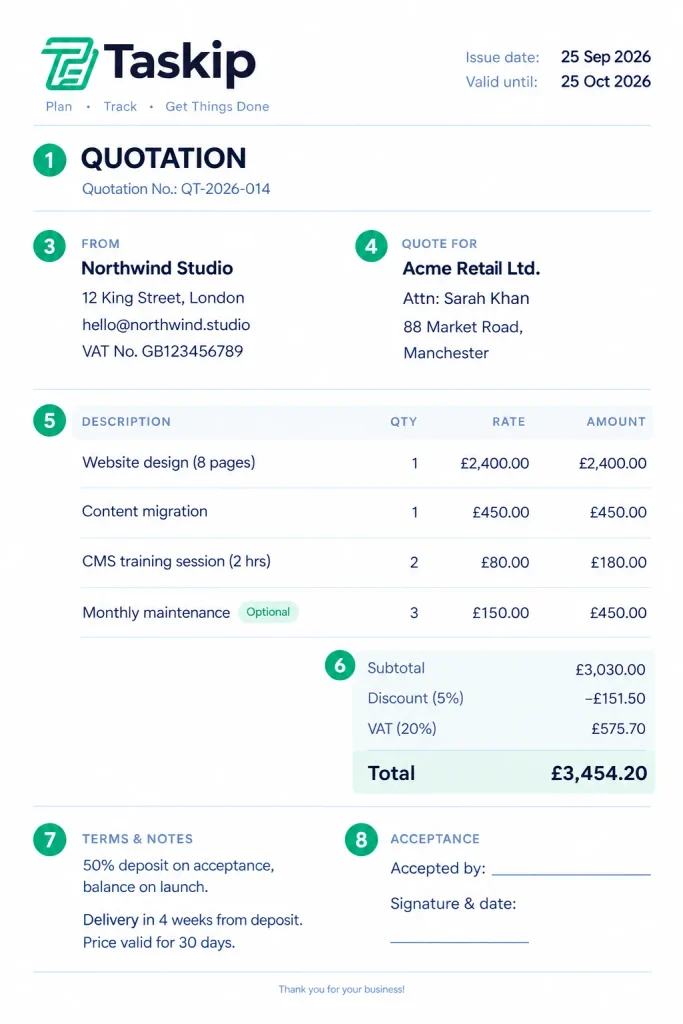
- Your business name, logo and contact details
- Quote number, issue date and expiry date
- Client name, company and contact person
- A one-line project summary in the client’s words
- Deliverables, listed one by one
- Exclusions (what is not included)
- Itemized pricing, discounts, taxes and total
- Timeline and key milestones
- Payment terms and deposit
- Number of revisions included
- Terms and conditions
- A clear next step: “Accept online” or “Sign here”
Missing even one of these can slow a decision. Vague scope leads to back-and-forth emails, and a missing expiry date removes any reason to decide now. Taskip’s quotation software builds most of these fields into every quote automatically, including taxes, discounts and multi-currency totals.
How to Write a Winning Quote in 7 Steps
Here is how to write a winning quote that clients understand, trust and accept.
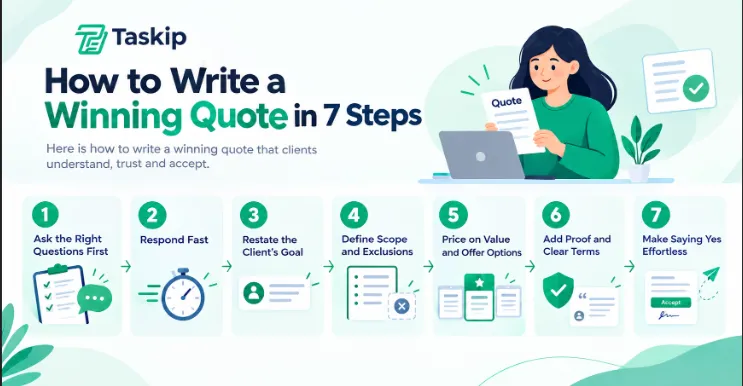
Step 1: Ask the Right Questions First
A winning quote starts before you open a template. Ask about goals, budget range, deadline, decision-makers, and what success looks like. A discovery questionnaire or client intake form keeps these questions consistent, and a form builder saves the answers straight to the lead record.
Step 2: Respond Fast
Speed is one of the easiest ways to win. Research published in Harvard Business Review found that firms contacting potential customers within an hour of an inquiry were nearly seven times as likely to qualify the lead as those that waited even an hour longer. Ready-made templates and a service catalog of standard packages let you send a quote the same day.
Step 3: Restate the Client’s Goal
Open with one or two sentences that summarize the client’s problem in their own words. “You need a new website that brings in more booking requests before your spring launch” shows you listened. A list of your services doesn’t.
Step 4: Define Scope and Exclusions
List each deliverable, the number of revisions and what is not included. Clear exclusions prevent scope creep later. If the client asks for more after approval, a formal change request keeps things fair.
Step 5: Price on Value and Offer Options
Work out a sustainable rate with a freelance rate calculator or service pricing calculator, then frame the price around results, not just hours.
Offer two or three packages, such as Basic, Standard and Premium. However, more than three can backfire, a pattern known as choice overload. The higher option acts as an anchor that makes the middle option feel reasonable, an effect closely related to the decoy effect. Options also change the client’s question from “Should I hire them?” to “Which package do I want?”
Step 6: Add Proof and Clear Terms
Include a short testimonial, a relevant result or a link to a case study. Then set terms: deposit, payment schedule, revisions and an expiry date, usually 14 to 30 days. A deposit protects your cash flow, since late payment is common for freelancers: IPSE research found 35% of self-employed workers had not been paid on time by a client in the previous 12 months.
Step 7: Make Saying Yes Effortless
Send the quote as a shareable link, not just a PDF attachment. Let the client accept online and sign with a legally recognized electronic signature in the US, under the ESIGN Act. Once accepted, convert it into an invoice in one click with invoicing software, and kick off the project from your project management board.
Winning Quote Example: Before and After
Here is the same web design quote written two ways.
| Element | Before (loses) | After (wins) |
|---|---|---|
| Opening | “Website design services” | “A 6-page website that turns visitors into booking requests before your spring launch” |
| Scope | “Website design and development” | Home, About, Services, Pricing, Blog and Contact pages, mobile responsive, 2 revision rounds |
| Exclusions | Not mentioned | Copywriting, photography and hosting not included |
| Price | One total: $3,000 | Three options: Starter $2,200, Growth $3,000, Premium $4,500 |
| Timeline | “About 4 to 6 weeks” | Design by week 2, build by week 4, launch by week 5 |
| Terms | “Payment on completion” | 40% deposit, 60% on launch, quote valid for 21 days |
| Proof | None | One short client testimonial with a result |
| Next step | “Let me know” | “Click Accept to reserve your start date” |
The “after” version costs the same to deliver. It simply removes uncertainty, gives the client a choice and makes the next step obvious. Want to start from a ready-made layout? Use the free quotation generator or browse our quotation templates.
How to Write a Quote for Services and Consulting Work?
Service and consulting work is harder to quote than products. There is no fixed unit price, scope can shift, and clients are buying expertise they can’t see yet. Here is how to write a quote for each.
How to Write a Quote for Services?
For agencies and freelancers, the first decision is the pricing model:
| Pricing model | Best for | How to quote it |
|---|---|---|
| Fixed price | Clearly scoped projects like a website or logo | List deliverables, revisions and exclusions, then one price per package |
| Hourly | Open-ended or exploratory work | Give an hourly rate, an estimated range of hours and a cap |
| Retainer | Ongoing work like SEO, content or maintenance | Monthly fee, hours or deliverables included, and how extra work is billed |
For hourly and retainer quotes, back your numbers with real data. A billable hours calculator and time tracking on past projects show how long similar work actually takes. For recurring work, pair the quote with a retainer agreement and set up recurring invoices.
How to Write a Consulting Quote?
Consulting clients pay for outcomes, not hours. A strong consulting quote usually:
- Leads with the business problem and the result, such as “reduce onboarding time from 3 weeks to 1”
- Splits the work into phases: discovery, recommendations, implementation support
- Uses value-based pricing, linked to the result rather than the hours spent
- Prices discovery separately, so you are paid for the diagnosis even if the client implements alone
- Defines access and responsibilities, including what the client must provide and by when
Add an NDA when you need sensitive data, and a contract or independent contractor agreement once the quote is accepted. Consultants and service businesses can send all of this, quote, contract and invoice, from Taskip’s quotation software.
How to Follow Up on a Quote Without Being Pushy?
Knowing how to write a winning quote is only half the job. Many quotes are accepted after a follow-up, not before. Use a simple rhythm:
- Day 2: check the quote arrived and offer to answer questions
- Day 5: share one useful extra, such as a relevant example or a quick idea for their project
- Day 10: a friendly reminder that the quote expires soon, with an easy way to say yes or no
Sample Follow-Up Email
Hi Sarah, just checking that the website quote came through. Happy to walk you through the three options on a quick call this week. The quote is valid until the 25th, so your spring launch date stays reserved until then.
Quote view tracking helps you time this well. If a client has opened the quote three times, they are likely comparing options and ready for a call. A follow-up email generator gives you more friendly drafts, and a meeting scheduler lets them book that call in one click.
When the Client Says “It’s Too Expensive”
Don’t cut your price straight away. Ask which part of the scope matters most, then offer a smaller package or a phased plan. This keeps your rate intact and the deal alive.
How to Create and Send Winning Quotes in Taskip?
Taskip’s quotation software puts every step above into one workflow, from first inquiry to paid invoice.
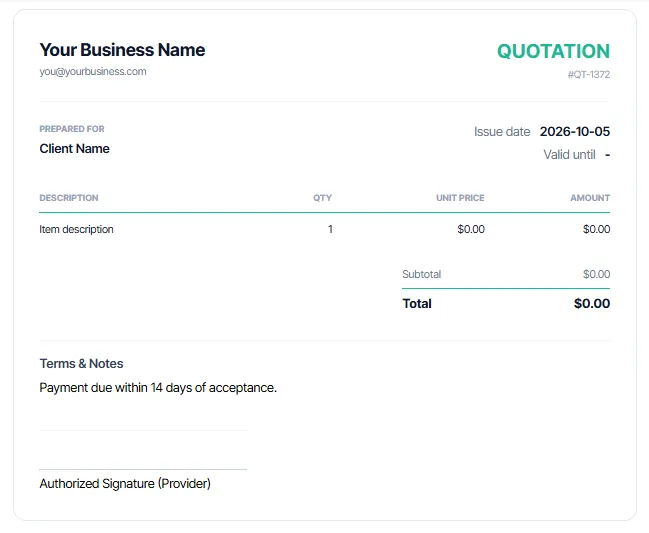
1. Set Up Your Services Once
Add your packages and rates to the service catalog, so every quote starts with accurate line items.
2. Pick a Branded Template
Choose from 9+ quotation templates and add your logo, brand colors and digital signature. Taxes, discounts and multi-currency totals are calculated automatically.
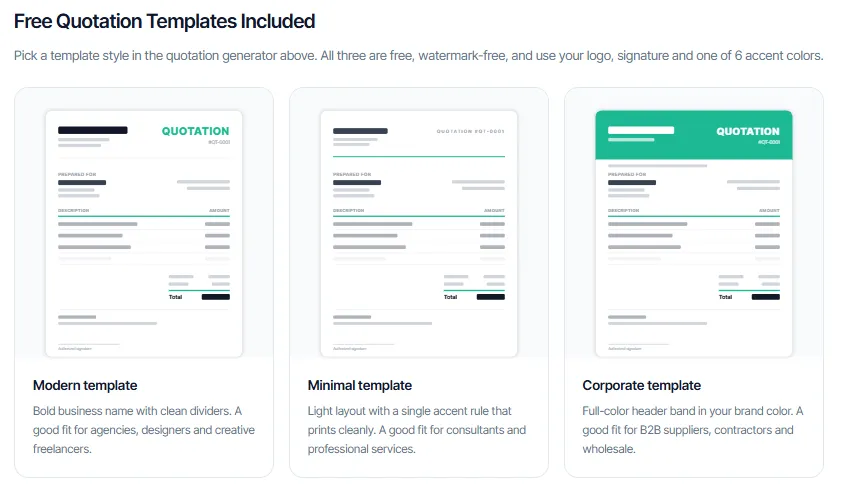
3. Send a Shareable Link
Share the quote by link, email or PDF. Clients can review it in your branded client portal.
4. Track Views and Status
See when a client opens the quote and how often, with clear statuses: Draft, Sent, Pending and Accepted. Keep every deal moving in your sales pipeline.
5. Convert to an Invoice in One Click
When the client accepts, turn the quote into an invoice with all line items carried over, then collect payment online through integrations like Stripe and PayPal.
You can also let the Taspi AI agent draft client replies and follow-ups, while you stay in control of what is sent. Compare Taskip plans or book a demo to see it in action.
Final Thoughts
Learning how to write a winning quote is less about clever wording and more about removing doubt. Show you understand the goal, make the scope and price crystal clear, give the client a choice, and make saying yes take one click.
Start with the free quotation generator for your next quote. When you are ready to send, track and convert quotes in one place, try Taskip’s quotation software and compare plans.
FAQs on How To Write a Quote
How do you write a winning quote?
Restate the client’s goal, define the scope and exclusions, price on value, offer two or three options, add proof, set terms with an expiry date and make acceptance easy. Then follow up within 48 hours.
How do you write a quote for services?
Choose a pricing model first: fixed price, hourly or retainer. Then list deliverables, exclusions, revisions, timeline, payment terms and an expiry date. For hourly work, include an estimated range and a cap.
How do consultants write a quote?
Consultants lead with the client’s business problem and the expected result, split the work into phases, price discovery separately and often use value-based pricing instead of hourly rates.
What should a quote include?
Your details, the client’s details, quote number and dates, deliverables, exclusions, itemized pricing with taxes, timeline, payment terms, revisions and a clear next step.
What is the difference between a quote and an estimate?
A quote is a fixed price for a defined scope, valid for a set period. An estimate is an approximate cost that may change as the project becomes clearer.
How long should a quote be valid?
Most service businesses use 14 to 30 days. A shorter window encourages a decision and protects you if your costs change.
How soon should I follow up on a quote?
Check in after 2 days, add value around day 5 and send a friendly expiry reminder around day 10.
How can I increase my quote acceptance rate?
Respond fast, mirror the client’s goal, offer tiered options, include proof, and let clients accept and sign online. Track which quotes are viewed and follow up on those first.
What is the best software for writing quotes?
Look for branded templates, automatic tax calculations, online acceptance, view tracking and one-click conversion to invoices. Taskip offers all of these alongside CRM, projects and a client portal.