


A marketing agency client onboarding checklist is the one document that decides whether a new client relationship starts calm or chaotic. Most agencies write one, use it twice, then let it rot in a shared drive while every account manager quietly builds their own version. This guide fixes that, and it also answers the question every one of the top-ranking pages on this topic skips: what should client onboarding actually cost?
Table of Contents
Key takeaways
- A solid client onboarding checklist covers contracts, access handoff, discovery, strategy delivery, and reporting setup, not just a welcome email.
- Agencies commonly charge $500 to $2,500 as a one-time onboarding fee, structure it into month one of the retainer, or waive it for longer contracts.
- Average onboarding for a marketing agency runs 2 to 4 weeks, depending on scope and how many platforms need access.
- The biggest gaps in most onboarding checklists are legal ownership of ad accounts, a real access and security handoff, and a way to measure whether onboarding actually worked.
- A free, ready-to-use client onboarding checklist generator is linked further down so you do not have to build one from scratch.
What Is A Marketing Agency Client Onboarding Checklist?
A marketing agency client onboarding checklist is a step-by-step list that a team follows between a signed contract and the first real deliverable. It usually spans the kickoff call, the questionnaire, account access, brand assets, the first strategy document, and the reporting setup.
The point of the checklist is not to look thorough. It is to stop the same three failures that kill new accounts: the client has no idea what happens next, the agency is missing a login it needed three weeks ago, and nobody agreed on what “done” looks like for the first month.

How Much Does Client Onboarding Pricing Cost For A Marketing Agency?
Client onboarding pricing for a marketing agency typically runs $500 to $2,500 as a one-time fee, though many agencies fold it into the first month of the retainer instead of billing it separately. A detailed breakdown of agency labor costs puts the internal cost of manually onboarding one client at $4,000 to $7,000 in staff time, which is exactly why a chunk of that gets passed on as a fee rather than absorbed for free.
There are three common structures, and each one solves a different problem.
| Pricing structure | How it works | Best for |
|---|---|---|
| Flat one-time fee | Client pays $500 to $2,500 upfront, separate from the retainer | Agencies with a heavy strategy or audit phase up front |
| Folded into month one | Onboarding cost is baked into a higher first month invoice | Agencies that want a simpler sales conversation |
| Waived for longer contracts | Fee is dropped for 6- or 12-month commitments | Agencies competing on annual retainers |
Should Client Onboarding Be Free Or A Paid Fee?
Charging for onboarding filters out clients who are not serious, and it covers the real hours a strategist spends before any ad runs or any post gets published. Making it free works better as a sales incentive when you are trying to win a client against a competitor who does charge for it. Neither choice is wrong. The mistake is not deciding on purpose and then discounting the fee every time a prospect pushes back.
Onboarding Fee Structures By Agency Size And Service
Smaller agencies and freelancers tend to sit at the low end of that $500 to $2,500 range, since one person is running discovery and setup. Agencies handling paid media, SEO, and web work together for a client often charge toward the top of the range or higher, because there are more accounts to configure and more people involved in the kickoff. One example from a breakdown of hidden agency fees puts a $1,500 setup fee as reasonable for a client already spending $2,000 a month on ads, which lines up with the idea that the fee should scale with the size of the account, not sit at one fixed number for every client.
How To Set Up The First Invoice, Deposit, And Payment Terms?
Send the first invoice the day the contract is signed, not the day work starts. A 50 percent deposit before any access request is a normal ask, and it protects cash flow if a client stalls right after signing. Set payment terms in the contract itself (net 7 or net 15 works better for onboarding than net 30, since you want the account funded before the real work begins). Taskip’s invoicing feature can automate this so the deposit invoice goes out the moment a deal closes in your CRM, instead of relying on someone to remember.
What To Do If A Client Pushes Back On An Onboarding Fee
Explain what the fee actually covers (strategist time, account audits, the first roadmap) rather than just holding the line on price. If a prospect still refuses, a smaller partial fee or folding it into a slightly higher first month rate usually closes the gap without giving away the work for free.
What Should Be Included In A Marketing Agency Client Onboarding Checklist?
A complete client onboarding checklist covers eight areas: the signed contract and deposit, the kickoff call, the discovery questionnaire, access and credentials, brand assets, the first strategy document, an internal handoff meeting, and the reporting setup. Miss any one of these, and something breaks in month two, usually the reporting or the access.
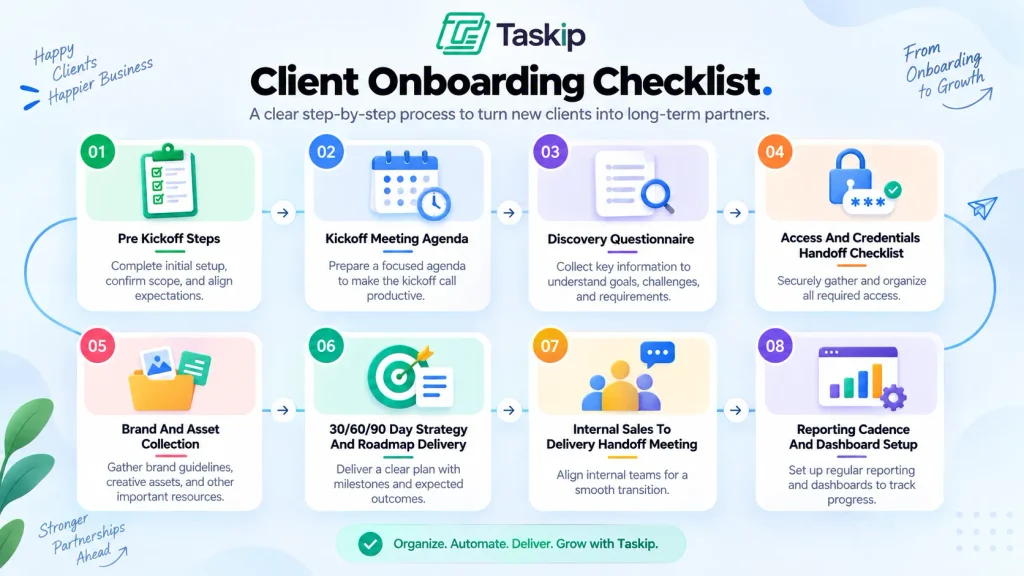
1. Pre-Kickoff Steps
Before the kickoff call happens, confirm the contract is signed, the deposit has cleared, and an internal owner is assigned to the account. Skipping this step is how agencies end up doing unpaid strategy work for a client who never finalizes the paperwork.
2. Kickoff Meeting Agenda
A kickoff call should cover five things in under 45 minutes: introductions, the client’s goals in their own words, the 30/60/90 day plan at a high level, who owns what on both sides, and the communication channel going forward. Send the agenda ahead of time so the client comes prepared instead of improvising answers.
3. Discovery Questionnaire
Do not rely on a generic form. Ask for the client’s current numbers (traffic, conversion rate, average deal size if they know it), their top three competitors by name, past agency experience and what went wrong, and any non-negotiables around brand voice or messaging. A client management system built for freelancers can store these answers against the client record so nobody has to dig through old emails to find them later.
4. Access And Credentials Handoff Checklist
This is the section every one of the top-ranking articles on this topic treats as an afterthought, and it is usually where onboarding stalls. Request access to:
- Google Ads and Meta Business Manager
- Google Analytics 4 and Google Tag Manager
- Domain registrar and DNS settings
- CMS or website hosting login
- Social media accounts and scheduling tools
Use a password manager to receive and store these credentials rather than emailing them in plain text, and turn on two-factor authentication wherever the platform supports it. A white-label client portal gives the client one secure place to drop these credentials and files instead of scattering them across email threads.
5. Brand And Asset Collection
Collect logos in vector format, brand guidelines if they exist, past creative that performed well, and any tone of voice notes. If none of this exists yet, say so in the kickoff call and set expectations that the first two weeks will include building a lightweight brand brief.
6. 30/60/90 Day Strategy And Roadmap Delivery
Deliver a short roadmap by the end of week one that states what happens in the first 30, 60, and 90 days. This does not need to be a 40-page strategy deck. A one-page document that a client can actually read builds more trust than a long one they will skim once and forget.
7. Internal Sales To Delivery Handoff Meeting
Before the delivery team touches the account, the salesperson who closed the deal should brief them on anything said during the sales process that is not in the contract, including pricing sensitivities, promises made informally, and red flags noticed during the pitch.
8. Reporting Cadence And Dashboard Setup
Agree on the reporting schedule (weekly for the first month, then monthly is common) and set up the dashboard before the first deliverable ships, not after the client asks where their report is.
What Legal And Contract Steps Do Marketing Agencies Miss During Onboarding?
Agencies most often skip four legal steps during onboarding: a proper master service agreement, clear ad account ownership, a basic data privacy policy, and cancellation terms that apply specifically to the onboarding window. Each one turns into a dispute later if it is not written down at the start.
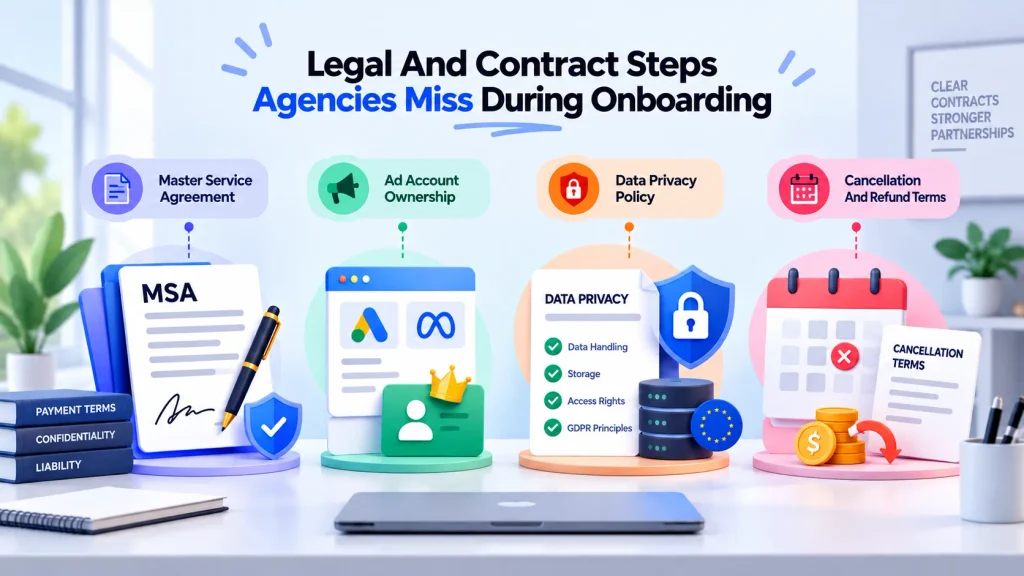
Master Service Agreement vs. One-Off Statements Of Work
A master service agreement covers the ongoing relationship (payment terms, confidentiality, liability), while a statement of work covers the specific deliverables for a project or month. Use both. Signing a new SOW for each phase of work is far less painful than renegotiating the whole contract every time scope changes.
Who Owns The Ad Accounts And Creative IP After The Engagement Ends?
The client should own the ad accounts, the domain, and any creative assets built specifically for them, with the agency holding manager-level access rather than full ownership. Write this into the contract before the campaign launches, not after the relationship ends badly. This single clause prevents most of the ugliest disputes agencies deal with.
Data Privacy Basics For Client Data
If you are handling customer data on a client’s behalf (email lists, analytics, CRM exports), a short data processing clause referencing GDPR principles protects both sides even if the client is not based in the EU, since it forces a real conversation about how data gets stored and who can access it.
Cancellation And Refund Terms During The Onboarding Window
State clearly what happens if a client cancels mid-onboarding: whether the deposit is refundable, at what point work becomes non-refundable, and how much notice is required. Vague cancellation terms are the single most common source of billing disputes agencies deal with in the first 90 days.
An e-signature workflow that tracks exactly when each document was signed makes all four of these points easier to enforce, since there is a timestamped record instead of a “we talked about it on a call” argument.
What Is The Client Responsible For During Onboarding?
The client is responsible for providing brand assets, answering the discovery questionnaire, approving the first roadmap, and granting access within an agreed number of business days, usually five to seven.
A Simple Responsibility Table
| Task | Owner | Deadline |
|---|---|---|
| Sign contract and pay deposit | Client | Day 0 |
| Complete discovery questionnaire | Client | Day 3 |
| Grant platform access | Client | Day 5 |
| Deliver brand assets | Client | Day 5 |
| Deliver 30/60/90 day roadmap | Agency | Day 10 |
| Approve roadmap | Client | Day 12 |
How To Set Deadlines That Do Not Slip
Attach a deadline to every client task, not just agency deliverables, and put it in writing during the kickoff call so it is not a surprise later. A shared checklist in a client portal, with visible due dates, does more to keep a client on schedule than a reminder email ever will.
What To Do When A Client Goes Unresponsive During Onboarding
Set a rule in advance: after two missed deadlines, the paid onboarding clock pauses and restarts once the client responds, rather than letting the agency absorb the delay for free. State this in the contract, not just verbally, so it does not feel like a punishment when it happens.
How Does Client Onboarding Differ By Service Type?
Onboarding for an SEO client looks different from onboarding for a paid media client because the first deliverable, the access needed, and the timeline to first results are not the same.
| Service type | First access needed | Typical time to first deliverable |
|---|---|---|
| SEO | GA4, Search Console, CMS login | 2 to 3 weeks (audit and roadmap) |
| Paid media (PPC) | Ad accounts, billing access, GA4 | 3 to 7 days (first campaign live) |
| E-commerce | Store platform admin, product feed, GA4 | 1 to 2 weeks (tracking and catalog setup) |
| Local or service business | Google Business Profile, CRM, phone tracking | 1 to 2 weeks (listing and review setup) |
A CRM built for creative agencies or one built around a project management workflow with a client portal makes it easier to run different onboarding templates per service line instead of forcing every client through one generic checklist.
What Tools And Automation Speed Up Client Onboarding?
The tools that speed up onboarding fall into three categories: client portals for centralizing access and files, e-signature and payment tools for the contract and deposit, and workflow automation for repetitive steps like welcome emails and task creation.
Client Portals And Project Management Tools
A branded client portal replaces a mess of email threads with one place for files, invoices, and project status. This matters more during onboarding than at any other stage, since it is when the client forms their first impression of how organized the agency actually is.
E-Signature And Payment Automation
Combining e-signatures with automated invoicing means a client can sign a contract and pay a deposit in the same sitting, which shortens the gap between “yes” and “kickoff call scheduled.”
CRM To Project Handoff Automation
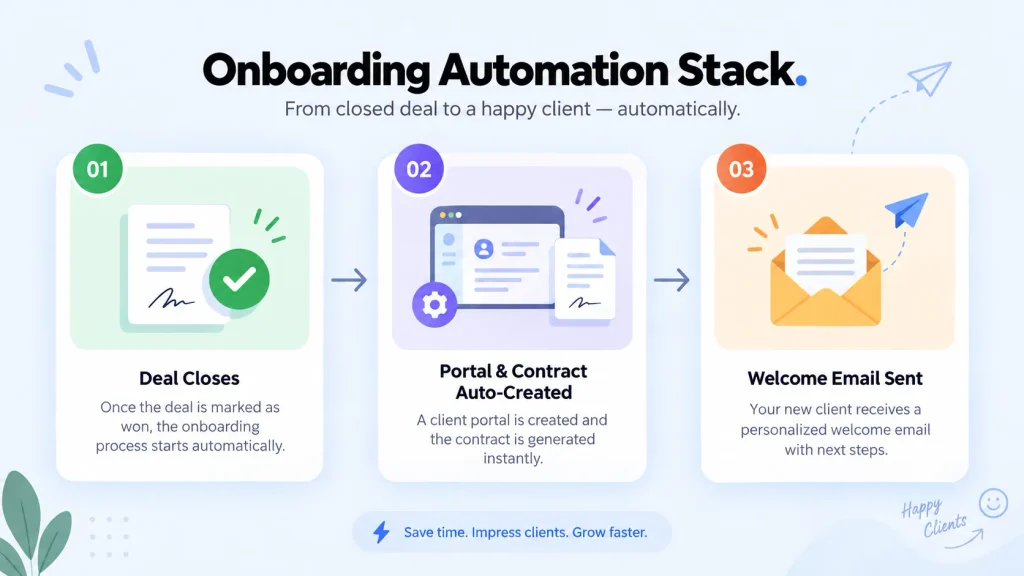
When a deal closes in the CRM, a workflow automation rule can create the onboarding project, assign the account owner, and send the welcome email automatically, so nothing depends on someone remembering to do it manually at 5 pm on a Friday.
Where AI Actually Helps In 2026
The genuinely useful AI applications in onboarding right now are intake chatbots that pre-fill a discovery questionnaire before the kickoff call, automatic meeting note summaries from the kickoff call itself, and first draft strategy documents that a strategist edits rather than writes from a blank page. None of this replaces the judgment calls a human still has to make, but it removes a lot of the typing. A step-by-step guide to automating client onboarding walks through exactly where these tools fit into the process if you want to set this up rather than just read about it.
How Long Does Client Onboarding Take For A Marketing Agency?
Marketing agency client onboarding typically takes 2 to 4 weeks, according to industry benchmark data, though a single-channel engagement like paid media can move faster while a multi-service engagement with SEO, web, and content together tends to sit at the longer end.
A shorter onboarding window is not automatically better. Rushing access collection and skipping the discovery questionnaire to hit an aggressive timeline is exactly how agencies end up building the wrong strategy for the first month.
How Do You Measure Whether Client Onboarding Is Working?
Track four numbers to know if an onboarding process is actually working: time to first deliverable, onboarding completion rate, client satisfaction at 30/60/90 days, and how many clients churn during onboarding itself versus after it.
- Time to first deliverable: how many days between the signed contract and the first real piece of work reaching the client.
- Onboarding completion rate: the percentage of new clients who make it through every checklist step without a stall or a missed deadline.
- 30/60/90 day satisfaction: a short survey or a simple 1 to 10 score asked at each milestone, not just at the end of the first quarter.
- Early churn rate: clients who cancel during onboarding almost always point to a specific, fixable breakdown (usually access delays or unclear expectations), so track this separately from normal retainer churn.
5 Most Common Client Onboarding Mistakes
Mistake 1: Sending a generic welcome email and calling it onboarding. Fix: replace it with a short, personalized kickoff agenda that references the client’s actual goals from the sales call. Those kickoff notes also land better when they arrive from a dedicated business email rather than a personal address.
Mistake 2: Not requesting access to every platform on day one. Fix: send the full access checklist in the first email after the contract is signed, before the kickoff call even happens.
Mistake 3: Letting the client set an unrealistic timeline for results. Fix: state the typical 2 to 4 week onboarding window and the realistic time to first results directly in the kickoff call, in writing.
Mistake 4: No clear owner on the agency side. Fix: name one account owner before the kickoff call, and put their name and contact details in the welcome message.
Mistake 5: Treating onboarding as free, unbilled work. Fix: either charge the fee outlined earlier in this guide or fold it into month one, but decide on purpose instead of by default.
Free Marketing Agency Client Onboarding Checklist Template
A static PDF client onboarding checklist template goes stale the moment your process changes. A generator does not, which is the real reason to skip the blog post checklists and build one instead of copying one.
Taskip’s client onboarding checklist generator is free, needs no signup, and adjusts to your service line rather than forcing every client through the same generic list. What you actually get:
- A structured checklist across five phases, from kickoff through handoff, so nothing gets skipped between the signed contract and the first delivered strategy.
- Separate templates for SEO, paid media, e-commerce, and local service clients, matching the segmentation covered earlier in this guide, instead of one checklist stretched to fit every client type.
- A document ready to hand to a new account manager on day one, so the process lives somewhere other than one person’s memory.
Update it once when your process changes and every future client gets the new version, which is the one thing a static template can never do.
Final Word
A client onboarding checklist only works if someone actually follows it past the third client. Put a price on it, put the access and legal steps in writing, and track whether it is actually shortening the time to the client’s first real result. That is the difference between a checklist that sits in a shared drive and one that protects the agency’s time and the client’s trust from week one.
Frequently Asked Questions
What does client onboarding pricing typically look like for a marketing agency?
Most agencies charge $500 to $2,500 as a one-time fee, fold it into a higher first month invoice, or waive it entirely for clients signing longer contracts.
How much should a marketing agency charge for client onboarding?
Base it on scope. A single channel engagement sits at the lower end of $500 to $2,500, while a multi-service engagement with more accounts to configure justifies the higher end.
Is client onboarding usually free or paid?
Both models are common. A paid fee filters out low-commitment prospects and covers real strategist hours, while free onboarding works better as a sales incentive against competitors.
How long should agency client onboarding take?
Around 2 to 4 weeks on average, moving shorter for single-channel work like paid media and longer for multi-service engagements.
What questions should be in a client onboarding questionnaire?
Ask for current performance numbers, top competitors by name, past agency experience and what went wrong, and any non-negotiables around brand voice, at minimum.
What’s the difference between onboarding and a kickoff call?
The kickoff call is one meeting inside the onboarding process. Onboarding is the full sequence from signed contract through the first delivered strategy and reporting setup.
Who should own ad accounts, the agency or the client?
The client should own the ad accounts and grant the agency manager-level access, which avoids disputes over account ownership if the relationship ends.
What happens if a client doesn’t complete onboarding tasks on time?
Set a rule in the contract that the paid onboarding timeline pauses after a set number of missed deadlines, rather than letting the agency absorb the delay unpaid.