
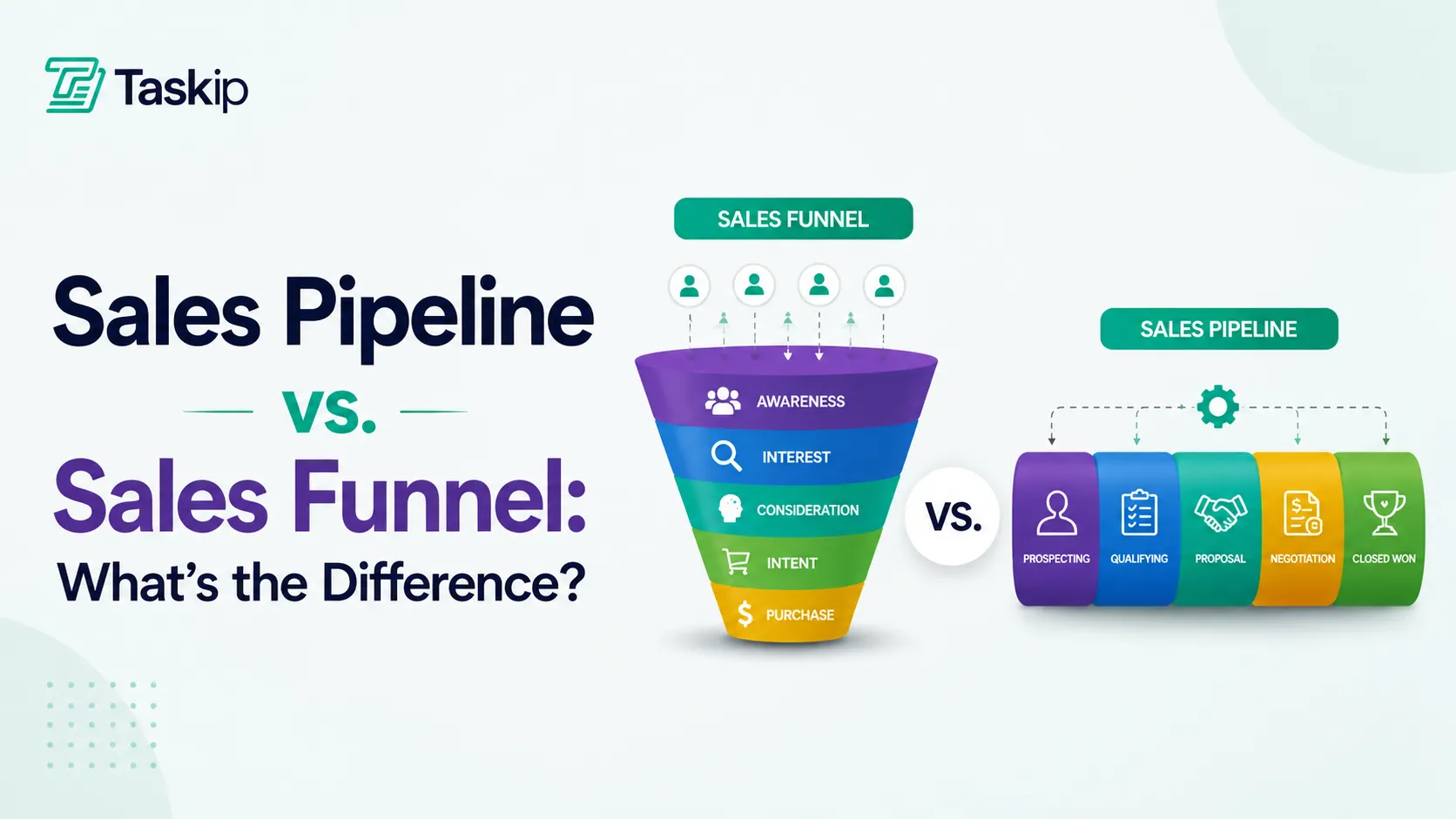
A sales pipeline is not the same as a sales funnel. A pipeline tracks what the seller does to move a deal forward, stage by stage, deal by deal. A funnel, on the other hand, tracks what the buyer experiences, showing how many prospects convert or drop off at each stage of the journey. In short, a pipeline is an operational tool for managing deals, while a funnel is an analytical lens for understanding conversion.
This guide breaks down the real difference between Sales pipeline vs. sales funnel, stage by stage. Additionally, you will learn how the two work together, which one your business needs first, and the metrics that matter for each.
- A sales pipeline is seller-focused and tracks individual deals through stages like Prospecting, Proposal, and Closed Won.
- A sales funnel is buyer-focused and tracks conversion rates as a group of leads narrows toward a purchase.
- The funnel feeds the pipeline: a lead qualifies through the funnel, then becomes an active pipeline opportunity.
- Pipeline metrics show how well you close deals. Funnel metrics show how well you attract and convert leads. Therefore, you need both to diagnose a revenue problem.
Table of Contents
What Is a Sales Pipeline?
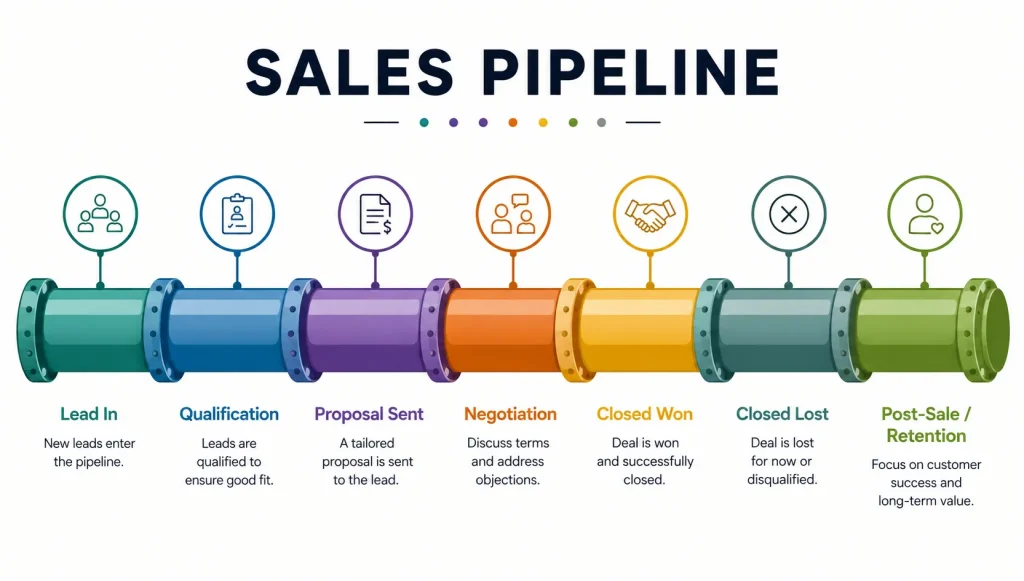
A sales pipeline is a visual map of every stage a deal moves through, from the first conversation with a prospect to a closed deal. It is built around the seller’s actions.
In other words, a pipeline answers one question: what does a rep need to do next to keep this opportunity alive?
Sales leaders use pipelines to forecast revenue, spot deals that have gone quiet, and measure how individual reps are performing against quota. So, if you have ever heard someone ask “how much is in the pipeline this quarter,” they are talking about the total value of every open deal sitting across these stages.
Stages of Sales Pipeline
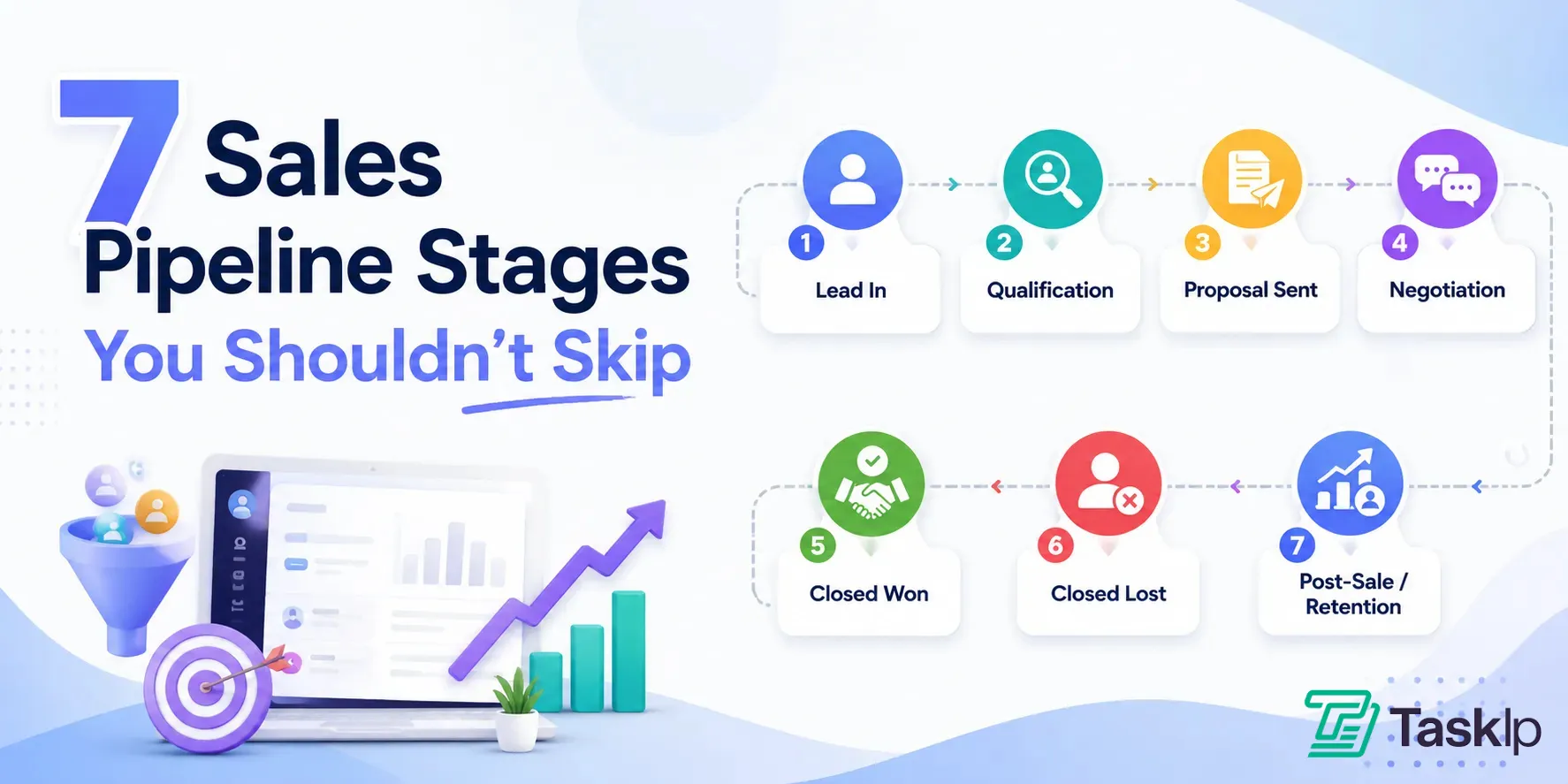
Most sales pipelines follow a version of these seven stages:
- Lead In
- Qualification
- Proposal Sent
- Negotiation
- Closed Won
- Closed Lost
- Post-Sale / Retention
Pipelines live inside a CRM, and they are owned by sales reps and sales managers. Each deal sits in exactly one stage at a time, and moving it forward is a deliberate action rather than something that happens automatically. As a result, a pipeline works like a to-do list disguised as a chart.
What Is a Sales Funnel?
A sales funnel is a visualization of how a large pool of prospects narrows down into a much smaller group of paying customers. Unlike a pipeline, a funnel tracks volume and conversion rate at each stage of the buyer’s journey instead of individual deals.
The funnel shape itself tells a story. It starts wide, with a large number of leads at the awareness stage, and narrows as prospects drop off along the way. That narrowing is the whole point: a funnel exists to show you where you are losing people, so you can fix the leak instead of guessing at it.
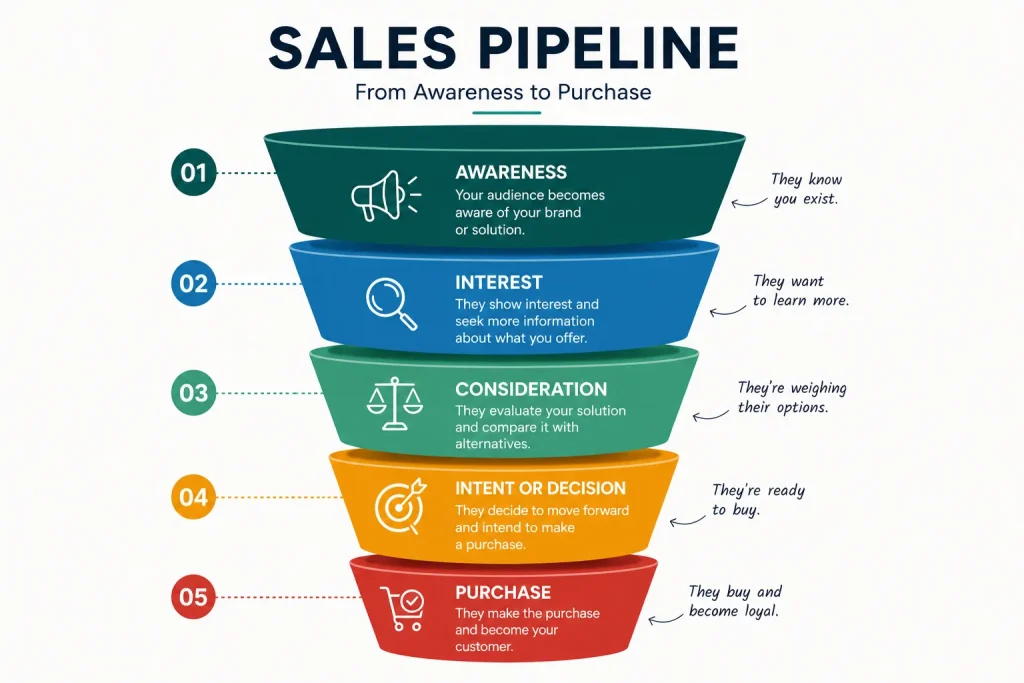
Stages of Sales Funnel
A typical sales funnel includes five stages:
- Awareness
- Interest
- Consideration
- Intent or decision
- Purchase
Some teams add a sixth stage, loyalty or advocacy, to capture what happens after the sale. Funnels are usually a shared responsibility between marketing and sales, since marketing owns the top of the funnel, attracting attention, while sales owns the bottom, closing the deal.
If you want a deeper look at how marketing teams build and manage that top-of-funnel demand, this roundup of digital marketing agency tools breaks down the platforms agencies use to run funnels end to end.
Sales Pipeline vs. Sales Funnel: 6 Key Differences Explained
A sales pipeline and a sales funnel differ across six main dimensions: perspective, visualization, stages, metrics, ownership, and purpose. A quick comparison table gives you the fast answer, and the breakdown below explains why each difference exists.
| Criteria | Sales Pipeline | Sales Funnel |
|---|---|---|
| Perspective | Seller focused: what the rep does | Buyer focused: what the prospect experiences |
| Shape / visual | Linear, horizontal stages | Narrowing, inverted cone |
| Measures | Deal count, deal size, sales cycle length, win rate | Conversion rate per stage, drop-off rate, lead volume |
| Owned by | Sales | Marketing and sales together |
| Purpose | Manage and forecast active deals | Diagnose and optimize the buyer journey |
| Data direction | Tracks individual deals moving forward | Tracks aggregate volume narrowing down |
| Time orientation | Real-time, deal-by-deal snapshot | Cohort based, trend over time |
| Best for | Day to day deal management | Top of funnel strategy and reporting |
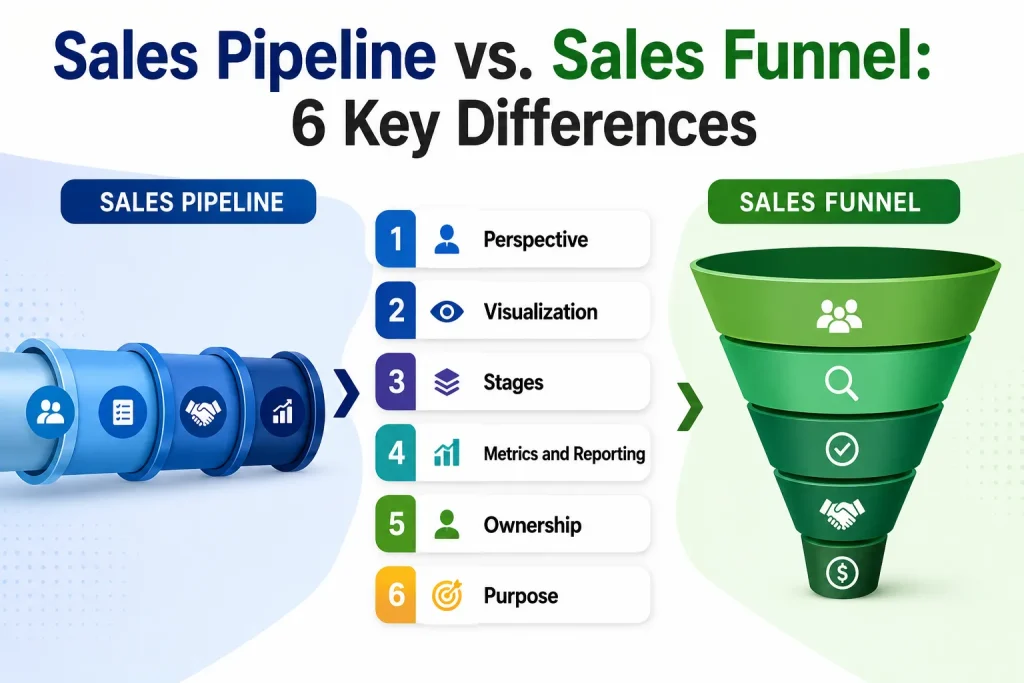
1. Perspective: Does It Track the Seller or the Buyer?
The pipeline tracks the seller. The funnel, in contrast, tracks the buyer. This is the single biggest distinction between the two, and it is worth sitting with.
A pipeline answers the question “what does my rep need to do next on this deal?” A funnel, meanwhile, answers a completely different question: “how is a typical prospect experiencing our sales process, and where do we lose them?”
Picture the same prospect showing up in both views. In the pipeline, that prospect looks like “Deal #4521, Proposal stage, twelve thousand dollars, expected to close in nine days.” In the funnel, however, that same prospect is just one data point: “one of three hundred and forty leads currently sitting in the Consideration stage.” Same person, two completely different framings, because the two tools answer two different questions.
2. Visualization: Why Is a Funnel a Cone and a Pipeline a Bar?
A pipeline is drawn as a linear bar because it shows where deals sit right now, spread across stages like cars parked in different lanes. On the other hand, a funnel is drawn as a narrowing cone because it shows how much volume is lost as prospects move from one stage to the next.
If you sketched both side by side, the pipeline would look like a row of boxes and the funnel would look like a triangle standing on its point. That visual difference is a fast way to remember which tool you are looking at: boxes for pipeline, triangle for funnel.
3. Stages: Rep Actions vs. Buyer Behavior
Pipeline stages describe things a rep completes. Funnel stages, however, describe a shift happening inside the buyer’s mind. Put the two lists side by side, and the difference becomes obvious:
Pipeline stages (rep actions):
- Prospecting
- Qualification
- Meeting or demo
- Proposal
- Negotiation
- Closed won or lost
Funnel stages (buyer behavior):
- Awareness
- Interest
- Consideration
- Intent or decision
- Purchase.
A rep completes pipeline stages directly: send a proposal, schedule a call, negotiate terms. A buyer, in contrast, moves through funnel stages psychologically: they become aware of a problem, get interested in solving it, start weighing options, and eventually decide.
That reframing matters because it explains why you cannot manage a funnel the way you manage a pipeline. You cannot force a prospect to “move” from Awareness to Interest the same way a rep moves a deal from Proposal to Negotiation. You can only influence it.
4. Metrics and Reporting: Deal Velocity vs. Conversion Rate
Pipeline metrics measure deal velocity, whereas funnel metrics measure conversion rate. Here is a scenario that trips up a lot of sales teams: a rep can have a full, fast-moving pipeline while the funnel feeding that pipeline is quietly leaking.
Deals close on schedule, win rates look healthy, and the forecast seems solid. Meanwhile, eighty percent of leads never even make it to the rep’s pipeline in the first place, because they dropped out somewhere between awareness and qualification.
A pipeline report alone will never show you that leak. Only funnel data will. As a result, relying on pipeline metrics as your only signal of sales health is risky, since a strong pipeline this quarter does not guarantee a strong pipeline next quarter if the funnel above it is thinning out.
5. Ownership: Sales Team vs. Marketing and Sales Together
The pipeline belongs to individual reps and sales managers, and it lives inside the CRM as part of daily deal work. The funnel, however, is a shared responsibility.
Marketing owns the top of the funnel, attracting and nurturing leads, and the middle, qualifying interest. Sales, meanwhile, owns the bottom: closing.
That shared ownership is exactly where handoff friction tends to show up. A marketing qualified lead, or MQL, becomes a sales qualified lead, or SQL, and that handoff point is where a lot of good leads quietly go cold if the two teams are not aligned on what “ready” actually means.
6. Purpose: Operational Tool vs. Diagnostic Lens
The pipeline exists to move deals forward. The funnel, by comparison, exists to explain why deals do or don’t reach the pipeline in the first place.
Ultimately, a pipeline is where you manage what you already have, while a funnel is how you understand what you are missing.
How Do Sales Pipelines and Funnels Work Together?
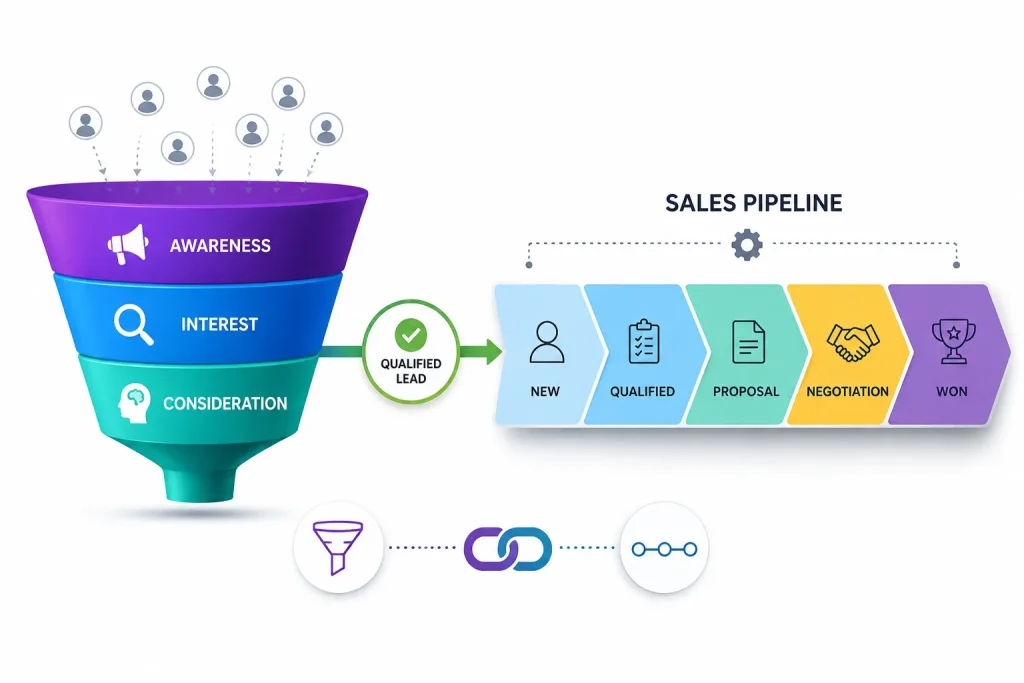
A sales funnel feeds a sales pipeline. A lead moves through the funnel- awareness, interest, consideration- and becomes a pipeline opportunity once it is qualified enough for a rep to actively work it. Pipelines and funnels are not competing tools, and treating them that way is a mistake. The relationship breaks down into three parts:
The Funnel Feeds the Pipeline
A lead starts at the top of the funnel and moves through awareness, interest, and consideration before it is ready for a rep. Once it clears that bar, it enters the pipeline as an active, working opportunity.
The MQL to SQL Handoff Is the Critical Moment
The point where a marketing qualified lead becomes a sales qualified lead is one of the most important moments in your entire revenue process. Get it wrong, and reps waste time chasing unqualified leads, or good leads sit ignored in a marketing tool nobody checks.
Tracking Both Gives You the Complete Picture
- The funnel tells you whether you are generating and converting enough interest in the first place.
- The pipeline tells you whether you are closing what you already have.
- A business that only watches its pipeline is flying blind on demand generation.
- A business that only watches its funnel has no idea if its reps are actually converting the leads they are handed.
If you are running an agency or a small sales team and want both views connected in one place instead of juggling spreadsheets and a separate marketing tool, a CRM built for that handoff makes the difference. Tools designed for agencies, like the ones compared in this CRM for web design agencies guide, typically build pipeline and lead tracking into the same system so nothing falls through the cracks between marketing and sales.
Sales Pipeline vs. Sales Funnel: Which One Does Your Business Need?
Most businesses need both eventually. However, where you start depends on where your business is right now.
If you are early stage or mostly inbound, start with the funnel. You need to understand where prospects are dropping off before you have enough deal volume to justify a heavily managed pipeline.
If you have dedicated reps and active deal flow, the pipeline is your daily tool instead. You already have leads coming in reliably, so the priority shifts to managing and closing what is already there.
If you are scaling and have both marketing and sales functions, track both, connected inside the same CRM. This is the stage where the MQL to SQL handoff starts to matter a lot, and where disconnected tools start to cost you real revenue. Agencies growing past this point often find it useful to see how others structured the shift, like this guide on building a successful digital marketing agency.
What Metrics to Track: Sales Pipeline vs. Sales Funnel
Pipeline metrics measure how well you close deals you already have:
- Pipeline value: total dollar value of open deals
- Average deal size
- Win rate
- Sales cycle length
- Pipeline velocity: how fast deals move through stages
Funnel metrics, meanwhile, measure how well you attract and convert leads:
- Conversion rate per stage
- Cost per lead
- MQL to SQL conversion rate
- Funnel drop-off rate: where you lose the most prospects
Tracking pipeline metrics without funnel metrics tells you how well you close. Tracking funnel metrics without pipeline metrics tells you how well you attract. Therefore, you need both halves of the story to actually diagnose a revenue problem.
Common Mistakes When Mixing Up Pipeline and Funnel Data
Treating the two terms as interchangeable in team conversations. When “pipeline” and “funnel” get used loosely, reporting gets confusing fast. For example, a sales leader asking about “funnel health” and a rep answering with pipeline numbers are talking past each other.
Building a pipeline with no funnel data feeding it. If you cannot see how leads enter your pipeline, you have no visibility into whether there is enough top-of-funnel demand to hit next quarter’s number.
Tracking funnel conversion only in aggregate. Looking at one blended conversion rate hides which lead sources or channels are actually working. Instead, break it down by source, and the picture gets a lot more useful.
How Taskip Helps You Manage Your Sales Pipeline and Funnel Together
Most of the mistakes covered above happen because a pipeline and a funnel end up living in two different tools, or worse, in a spreadsheet nobody updates. Taskip closes that gap by building both into the same workspace, so a growing agency or service business does not have to stitch data together by hand.
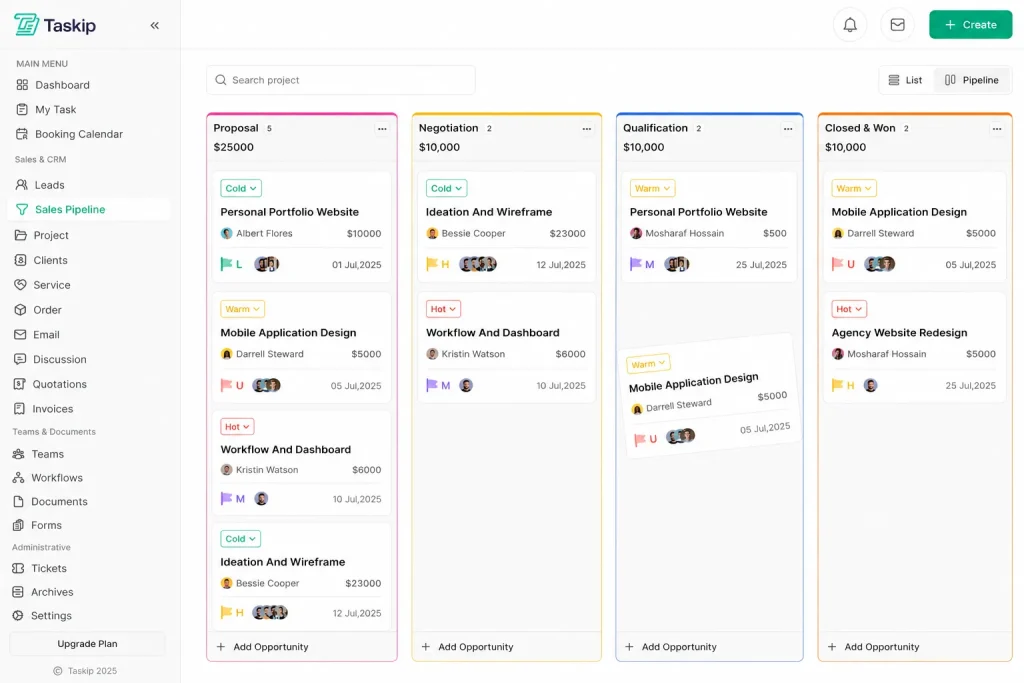
Specifically, Taskip gives you:
- A built-in sales pipeline to track deals stage by stage, from first contact to closed won, without switching tools.
- Leads management to capture, automate, and organize incoming leads before they are ready to enter the pipeline, which is exactly where the funnel-to-pipeline handoff described earlier tends to break down.
- A CRM for prospect tracking, so marketing and sales are looking at the same lead data instead of two different systems.
- Quotes, proposals, and invoicing connected to the deal itself, so a closed-won pipeline stage flows straight into billing instead of a manual handoff.
- A branded client portal, so once a lead converts, the relationship continues in the same platform rather than starting over somewhere else.
In other words, the funnel and the pipeline are not just concepts you track on a whiteboard. Instead, they live inside one system, which means a leaking funnel or a stalled pipeline shows up immediately rather than months later in a missed quota.
The Bottom Line: Is a Sales Pipeline the Same as a Sales Funnel?
A sales pipeline and a sales funnel are not the same thing. They measure two different things from two different angles. The pipeline is seller-focused and operational: it tells you what to do next on every open deal. The funnel, by contrast, is buyer-focused and diagnostic: it tells you where prospects are dropping off and why.
Neither one replaces the other. Ultimately, the strongest sales operations track both, connected, so a healthy-looking pipeline never hides a leaking funnel underneath it. If you are choosing tools to manage this for a growing agency or sales team, it is worth comparing options built specifically for that, like the picks in this CRM for creative agencies roundup, rather than trying to stitch pipeline and funnel tracking together across disconnected spreadsheets.
FAQs: Sales Pipeline vs. Sales Funnel
Is a sales pipeline the same as a sales funnel?
No. A pipeline tracks the actions a seller takes to move a deal forward. A funnel, however, tracks how a group of prospects narrows down through the buyer’s journey, measured by conversion rate at each stage.
What are the stages of a sales pipeline?
Most pipelines follow six stages: Prospecting, Qualification, Meeting or demo, Proposal, Negotiation, and Closed won or lost.
What are the stages of a sales funnel?
A typical funnel has five stages: Awareness, Interest, Consideration, Intent or decision, and Purchase.
Which comes first, the funnel or the pipeline?
The funnel comes first. A lead moves through funnel stages before it becomes qualified enough to enter the pipeline as an active opportunity.
Can a small business skip having a formal pipeline?
Early on, a lightweight funnel view may be enough if deal volume is low. Once you have a dedicated rep working active deals, however, a formal pipeline becomes necessary to avoid deals slipping through the cracks. If you are also managing client work alongside sales, it is worth reading about how a client management system compares to a CRM before you decide which tool to formalize first.