Retainer vs Project-Based Pricing: What’s Best for Your Agency in 2026?
The retainer vs project-based pricing decision is one of the most consequential choices an agency makes, and most owners get it wrong by defaulting to whatever closed the last deal.
Here is what the numbers show: agencies with retainer-dominant revenue models report 35 to 40 percent more predictable monthly income than project-dependent peers. Retainer clients have a lifetime value 3 to 5 times higher than one-off project clients. And yet, over 60 percent of small agencies still rely on project work as their primary billing model, many without a clear plan to change that.
Both models have a place. Projects build proof. Retainers build businesses. The right choice depends on your service type, delivery maturity, and where your agency is right now. This guide compares both side by side with real agency benchmarks, pricing data, and direct input from agency owners, so you can make the call with confidence in 2026.
TL;DR
- The retainer vs project-based pricing decision shapes your agency’s revenue, scalability, and client relationships.
- Project-based pricing is easier to sell and works best for one-time deliverables like websites, audits, and branding.
- Retainer pricing creates predictable monthly revenue and works best for ongoing services like SEO, PPC, and content marketing.
- Most successful agencies in 2026 use a hybrid model: projects to start relationships, retainers to grow them long term.
- In simple terms: Projects build proof. Retainers build stable agencies.
Table of Contents
What Is Retainer Pricing?
A retainer is a recurring monthly agreement between an agency and a client. The client pays a fixed fee each month in exchange for an agreed set of services, deliverables, or hours. Unlike project work, a retainer has no defined end date. The relationship continues as long as results and value are being delivered.
Retainers are most common in services where results build over time: SEO, paid media, content marketing, ongoing design, and technical support. The agency accumulates deep knowledge of the client’s business, audience, and competitive landscape, which makes the work more effective every month. From the agency side, retainers create predictable revenue, which is the one thing most service businesses lack.
| Retainer Type | Monthly Deliverables | Typical Pricing |
| SEO Retainer | Content + optimization | $1,500 to $5,000 |
| Design Retainer | Fixed design hours | $800 to $3,000 |
| Content Marketing | Blogs + strategy | $1,000 to $8,000 |
| PPC Management | Campaign management + reporting | $1,500 to $6,000 |
If you are considering moving to monthly pricing, this guide on pricing retainer services profitably explains how agencies structure retainers without leaving money on the table.
What Is Project-Based Pricing?
Project-based pricing means a client pays a fixed fee for a defined deliverable with a set timeline. The scope is agreed upon up front, work begins, and the engagement ends when the project is delivered. Payment is typically structured as a deposit plus a completion payment, or split across milestones.
This model suits services with a clear start and finish: website builds, brand identity, audits, migrations, and app development. It is also the default model for most agencies when they start out, because it requires less trust and commitment to close. The appeal for clients is clarity. They know what they are getting, when it will be done, and what it costs.
| Project Type | Typical Timeline | Average Pricing |
| Website Redesign | 4 to 8 weeks | $3,000 to $25,000 |
| SEO Audit | 1 to 2 weeks | $500 to $5,000 |
| Brand Identity | 2 to 6 weeks | $2,000 to $15,000 |
| App Development | 8 to 20 weeks | $10,000 to $80,000 |
For a broader view of how agencies structure their fees, the agency pricing models guide covers hourly, value-based, performance, and hybrid approaches alongside these two.
Retainer vs Project-Based Pricing: The Real Differences Agencies See in 2026
This is where the decision actually lives. Understanding the definitions is easy. Understanding which model serves your agency’s growth, operations, and client relationships in practice is harder. Here is a direct look at every dimension that matters.
Revenue Predictability and Cash Flow
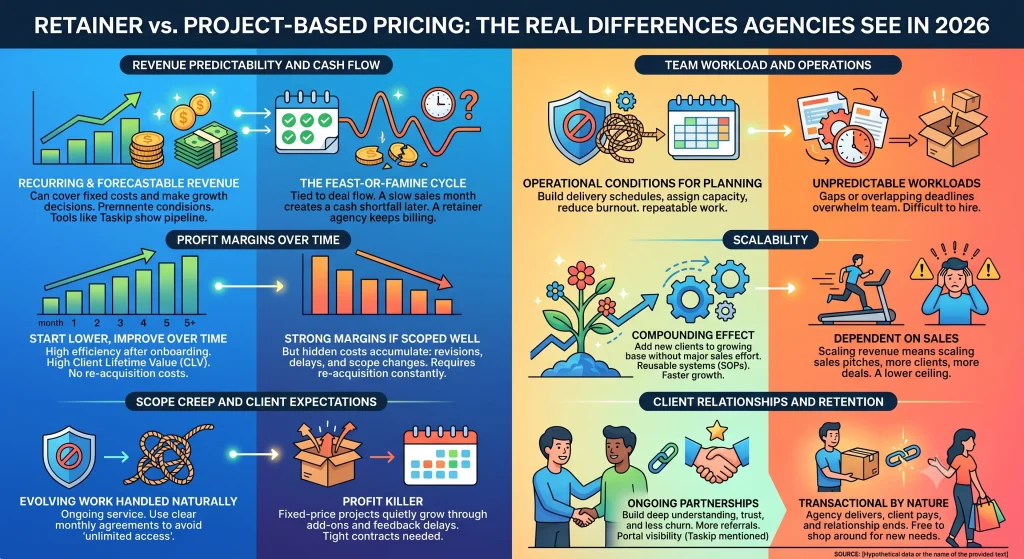
Retainer-based pricing: It gives agencies something project work rarely provides: a reliable number to build around. When 60 to 70 percent of your monthly revenue is contracted and recurring, you can forecast headcount, cover fixed costs, and make growth decisions with real confidence.
Tools like Taskip make this easier by giving agencies a single place to track active retainer clients, monitor outstanding invoices, and see their pipeline at a glance, so the revenue picture is always clear, not just at billing time.
Project-based pricing: Project-based agencies live in a different reality. Revenue is tied to deal flow. A strong sales month creates a strong delivery period six weeks later. A slow acquisition month creates a cash shortfall two months out. Many agency owners call this the feast-or-famine cycle, and it is one of the most common reasons growth stalls, even for agencies doing good work.
The gap becomes especially visible during slower periods. A retainer agency keeps billing. A project agency stops earning.
Profit Margins Over Time
Retainer-based pricing: Retainer pricing often looks less profitable in month one, particularly during onboarding when systems are being set up, and the agency is learning the client’s business. By month four or five, delivery becomes more efficient, the team understands the client deeply, and margin improves without any additional sales cost. The client lifetime value of a retainer account typically outperforms a project client significantly over a 12-month window.
One factor that often goes unaccounted for: acquiring a new project client costs time, energy, and marketing budget every single time. A retained client requires no re-acquisition.
Project-based pricing: Project work can produce strong margins when scoped well. A $15,000 website build completed in five weeks at low overhead is profitable. But the hidden costs accumulate: extra revision rounds, unclear briefs, client feedback delays, and scope additions that were never priced. Unless the contract is airtight, agencies absorb those costs silently.
Scope Creep and Client Expectations
Retainer-based pricing: Retainers handle evolving work more naturally because the model is built around ongoing service rather than a fixed deliverable. That said, retainers without clearly defined monthly deliverables create a different problem: clients start treating the engagement as unlimited access. The solution is a well-structured retainer agreement that defines what is included each month and what falls outside the scope.
Project-based pricing: Scope creep is one of the most consistent profit killers in agency work, and it hits project-based agencies hardest. A fixed-price website project that started at $8,000 can quietly become a $12,000 effort through additional pages, content rewrites, last-minute feature requests, and extended feedback cycles. Without a tight contract, agencies absorb those costs.
Team Workload and Operations
Retainer-based pricing: Retainers create the operational conditions for proper planning. When you know which clients need what each month, you can build delivery schedules, assign capacity in advance, and reduce the reactive workload that burns people out. It also makes training easier because the work is repeatable, not different every engagement.
Project-based pricing: Project-based delivery creates unpredictable workloads. Two large projects landing at the same time overwhelm the team. A gap between closings leaves people underutilized. For small agencies, this inconsistency makes it difficult to hire confidently or build a stable team.
Scalability
Retainer-based pricing: Retainer agencies scale differently. Once a client is signed and onboarded, the revenue continues without additional sales effort. Adding a new retainer client grows the recurring base. Delivery systems and SOPs built around recurring work become reusable, making each new client easier to serve. The compounding effect of retainer revenue is one of the main reasons agencies that make the shift tend to grow faster after the transition than before it.
Project-based pricing: Project-based delivery creates unpredictable workloads. Two large projects landing at the same time overwhelm the team. A gap between closings leaves people underutilized. For small agencies, this inconsistency makes it difficult to hire confidently or build a stable team. Scaling a project-based agency means scaling sales. More revenue requires more clients, more pitches, more deals. The ceiling hits quickly because growth depends entirely on winning new business rather than deepening existing relationships.
Client Relationships and Retention
Retainer-based pricing: Retainers create ongoing partnerships. The agency develops an understanding of the client’s business that a new competitor cannot replicate quickly. That depth builds trust and makes churn less likely. Retainer clients also tend to refer more often because the relationship has had time to become something beyond a transaction.
Project-based pricing: Project work is transactional by nature. The agency delivers, the client pays, and the relationship ends. Some project clients return, but there is no structural reason they have to. They are free to shop around every time a new need arises.
Platforms like Taskip support this with a dedicated client portal where retainer clients can log in, check project progress, view invoices, and communicate directly. And thus give them visibility that reinforces confidence in the relationship every month.
If you want to see all six digital marketing agency pricing models side by side before narrowing down, we’ve covered the full breakdown separately.
Agency Growth Stage: Which Model Fits Where
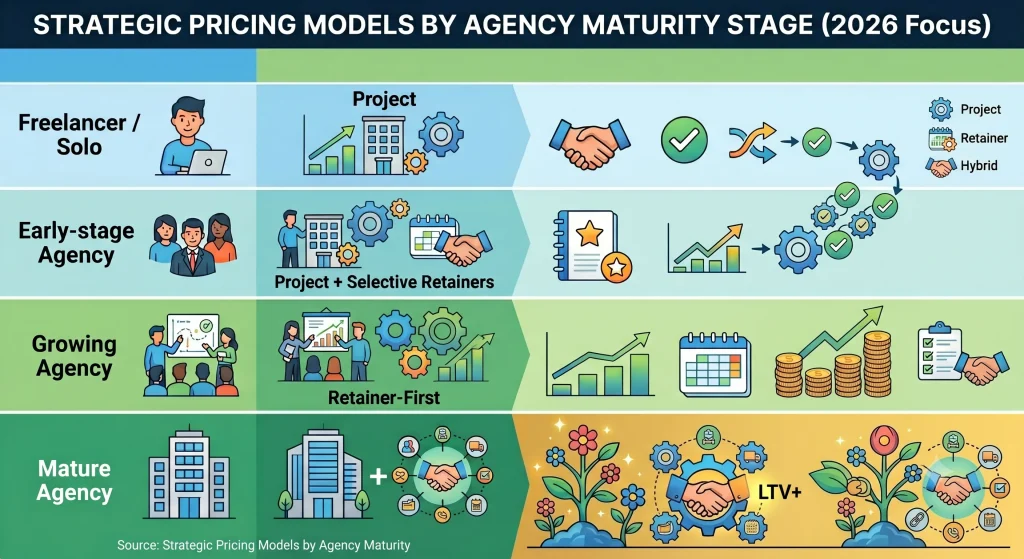
The right model is not just about the service type. It is also about where the agency currently sits.
| Growth Stage | Better Fit | Why |
| Freelancer/solo | Project | Lower sales barrier, flexible commitment |
| Early-stage agency | Project + selective retainers | Portfolio building, proving results |
| Growing agency | Retainer-first | Revenue predictability, team planning |
| Retainer + hybrid | Operational efficiency, higher LTV |
A new agency closing its first clients on projects makes complete sense. Projects are easier to sell because the commitment is limited and the deliverables are clear. But staying in project mode past the point where retainers are viable is where agencies leave significant recurring revenue behind.
What Real Agency Owners and Clients Say About Retainer vs Project-Based Pricing
The lived experience of agencies using both models reveals patterns that benchmarks do not always capture.
Derek Chew, a senior digital marketing strategist of Full Moon Digital, shows his client-side retainer frustration, saying:
“
“You’re not paying for marketing results. You’re paying rent on infrastructure you don’t need. The invoice arrives like clockwork on the first of the month. Win or lose. Hit targets or miss.”
Besides, Victoria Chomicki from FunctionFox expresses her opinion about project-based income reality, saying:
“
“With project-based pricing, your income tends to spike and dip unpredictably. One month might be a windfall, the next a ghost town. Retainers, on the other hand, offer consistent revenue — giving you breathing room to plan ahead and invest in growth.”
The pattern across Reddit, G2, and Trustpilot is consistent. Project work is a strong entry point, but retainers produce better outcomes for agencies that have operational systems in place. The negative retainer experiences almost always trace back to unclear deliverables, poor reporting, or underpriced agreements rather than the model itself. AgencyAnalytics covers the profitability differences between the two models in more detail.
Full Comparison Table
| Factor | Retainer Pricing | Project-Based Pricing |
| Revenue Stability | High | Inconsistent |
| Cash Flow | Predictable | Irregular |
| Profit Over Time | Grows with LTV | Peaks at delivery |
| Scope Risk | Lower (with clear contracts) | Higher |
| Scalability | Easier | Harder |
| Client Lifetime Value | Higher | Lower |
| Sales Pressure | Lower ongoing | High and constant |
| Operational Predictability | Strong | Weak |
| Upsell Potential | Strong | Moderate |
| Best For | Ongoing services | One-time deliverables |
When Retainer Pricing Works Best
Retainer pricing is not the right model for every client or service. It works best when the following conditions are true:
- The service requires ongoing attention to produce results (SEO, PPC, content marketing, social media management)
- Results compound over time rather than being delivered once and finished
- Reporting, analysis, and strategy are recurring parts of the engagement
- The agency has documented workflows and delivery systems
- The client is growth-focused and thinks in quarters, not one-off projects
- There is continuous communication, optimization, and iteration involved
Industries and service types where retainers consistently perform well include SEO agencies, paid media teams, SaaS marketing agencies, technical support and maintenance providers, PR firms, and content studios with established production processes.
The key signal on the client side is whether their need is continuous. A client who needs SEO results over 12-months is a retainer client. A client who needs a one-time site audit is not.
When Project-Based Pricing Makes More Sense
Project pricing is the right choice in specific situations, and experienced agencies know how to identify them:
- The deliverable has a clear start, finish, and defined output
- The client relationship is new, and trust has not yet been established
- The work does not require ongoing optimization or monthly reporting
- The client has a one-time budget rather than a recurring marketing spend
- The agency is building a portfolio and needs completed case studies
- The project has high-ticket value that justifies a one-time fee (brand strategy, large-scale development, major redesign)
Common service types that fit project pricing well include website redesigns, branding and identity work, one-time audits, app development, video production, and campaign launches with defined end dates.
Project work is also a smart entry point into new client relationships. Many agencies use a discovery project or audit to demonstrate value before proposing a retainer. The project builds trust. The retainer sustains it.
Why Many Agencies Use a Hybrid Pricing Model in 2026
The most practical answer to the retainer vs project-based pricing question in 2026 is often: both, in sequence.
A growing number of agencies run a project-to-retainer pipeline where a one-time engagement leads directly into ongoing work. An SEO audit becomes a six-month retainer. A website build rolls into a monthly maintenance and optimization agreement. A brand strategy project transitions into a content retainer. The project lets both sides test the relationship. The retainer is the natural next step once results begin.
Managing this pipeline well requires visibility into where every client sits in the journey. Taskip’s sales pipeline lets agencies track leads and deals from first contact through project close, making it easy to flag which completed-project clients are ready for a retainer conversation, without letting those opportunities slip through the cracks.
| Client Stage | Best Pricing Model |
| Discovery/audit | Project |
| Setup/build | Project |
| Growth / ongoing execution | Retainer |
| Optimization/advisory | Retainer |
The hybrid model also gives agencies flexibility when a retainer client occasionally needs a larger one-off piece of work, such as a redesign, a new campaign launch, or a market entry project, that falls outside the monthly scope. That work gets priced separately as a project, keeping the retainer clean and preventing scope creep from eroding margins.
Agencies building structured service offerings around this approach often move toward productized service packages, which make the transition from project to retainer easier to systematize and sell.
Common Agency Pricing Mistakes
Most pricing problems in agencies are not about choosing the wrong model. They are about executing the chosen model poorly.
| Mistake | Impact | Fix |
| Underpricing retainers | Margin erosion that worsens over time | Audit your true cost of delivery before setting monthly fees |
| Undefined monthly deliverables | Scope creep, client frustration, disputes | Define outputs clearly in the retainer agreement from day one |
| Charging hourly without limits | Unpredictable income, poor client expectations | Move to deliverable-based or value-based pricing |
| Fixed project with no scope control | Profit loss from unmanaged revisions | Include revision limits and change order terms in all project contracts |
| Not tracking profitability per client | Retaining accounts that are actually losing money | Review client-level margins every quarter |
The most expensive mistake is underpricing retainers at the start of a relationship and then struggling to raise rates six months later. Pricing a retainer before calculating the true cost of delivery, including time for reporting, client communication, and account management, is where the majority of agencies go wrong.
An all-in-one platform like Taskip helps here by centralizing time tracking, invoicing, and client communication in one place, making it straightforward to see whether each retainer account is actually profitable before problems compound.
Building delivery SOPs alongside your pricing structure prevents these problems from repeating. A documented process for each service type makes it easier to estimate accurately and deliver consistently. The agency SOPs guide covers how to build these from the ground up.
How to Choose the Right Retainer vs Project-Based Pricing Model for Your Agency
The decision comes down to four variables: your service type, your operational maturity, your client acquisition capacity, and where you want the business to be in 12 months.
Use this framework to evaluate your current situation:
| If Your Agency Needs… | Better Model |
| Predictable monthly revenue | Retainer |
| Faster client acquisition | Project |
| Easier team planning and hiring | Retainer |
| Portfolio and case study building | Project |
| Long-term client relationships | Retainer |
| High-ticket one-off work | Project |
| Operational scalability | Retainer |
| Lower sales pressure month to month | Retainer |
If you are an early-stage project, it gives you the speed and flexibility to build proof. If you have delivery systems in place and want to grow without constantly selling, retainers are the logical next move.
One practical test: look at your current client list and identify which relationships have continued past a single project. Those are retainer-ready clients. The conversation to transition them does not have to be a hard sell. It is a natural proposal based on the results you have already delivered.
Once you decide on a model, a structured client onboarding process ensures every new engagement starts cleanly and sets expectations from day one.
Retainer vs Project-Based Pricing: Final Verdict
Project work helps agencies build credibility. Retainers help them build stability. The most successful agencies are not choosing one model over the other. They use projects to earn trust, then turn proven relationships into long-term retainers that create predictable revenue.
But even the right pricing model breaks down without the right systems behind it. That is why many agencies are moving toward platforms like Taskip, an all-in-one workspace that combines client management, projects, invoices, pipelines, and communication in one place.
Instead of juggling disconnected tools, agencies can manage their entire operation from a single system and save hours every week in the process. Over 1,100 agencies and freelancers already use Taskip to run their businesses more efficiently.
FAQs: Retainer vs Project-Based Pricing
Which pricing model is best for new agencies?
Project-based pricing is the more practical starting point. It has a lower sales barrier because clients are committing to a defined deliverable rather than an open-ended relationship. Once you have delivered results and built trust, transitioning those clients to retainers becomes a much easier conversation.
Are retainers more profitable than project-based pricing?
Over time, yes. Retainers produce higher client lifetime value, lower acquisition costs per dollar of revenue, and improve delivery efficiency as the agency learns the client’s business. Project work can generate strong short-term margins but requires constant reselling to maintain revenue levels.
How do agencies transition from project to retainer clients?
The best moment to propose a retainer is at the end of a successful project. Frame it around continuity of results rather than an upsell. Show the client what ongoing work would achieve that a one-time project cannot sustain. Clients who have had a good project experience are usually open to the conversation.
What services work best on a retainer model?
Services that require ongoing optimization and produce compounding results are the strongest fit. SEO, paid media, content marketing, social media management, PR, and technical support all work well because the work is continuous, and results improve over time.
Can freelancers use retainer pricing?
Yes, and many do. Freelancers who offer retainers typically structure them around a set number of monthly hours or a fixed list of deliverables. The stability of recurring income is as valuable for a solo operator as it is for an agency, and clients who work with freelancers on an ongoing basis are often receptive to a structured monthly agreement.


Get Summary On: