6 Proven Digital Marketing Agency Pricing Models: Which One to Use in 2026?
Digital marketing agencies use six main pricing models in 2026: hourly rates ($75–$400/hr), monthly retainers ($1,500–$50,000/mo), project-based fixed fees, performance-based structures, value-based pricing, and hybrid models. The right choice depends on whether you need ongoing work, a one-off project, or results-linked accountability.
This guide breaks down major digital marketing agency pricing models used in 2026, what each model involves, when it makes sense, and how to negotiate it. Whether you’re a startup founder choosing your first marketing partner or an established business looking to renegotiate your agency contract, this is the decision framework you need.
At a Glance: All 6 Pricing Models
| Pricing Model | Best For | Typical 2026 Range |
|---|---|---|
| Hourly | One-off audits, testing a new agency | $75–$400/hr |
| Monthly Retainer | Ongoing SEO, content, social media | $1,500–$30,000/mo |
| Project-Based | Website launches, defined campaigns | $2,500–$100,000 |
| Performance-Based | Lead gen, e-commerce with clear attribution | 10–30% of results |
| Value-Based | Strategic transformation, proven agencies | 10–20% of projected ROI |
| Hybrid | Scaling businesses, multi-channel work | Base + performance bonus |
Most agencies in 2026 are moving toward transparent, hybrid structures that combine predictable base fees with performance incentives.
Table of Contents
What Determines Agency Pricing in 2026?
Before comparing structures, it helps to understand what actually drives agency fees. Unlike
Traditional advertising with standard rate cards, digital agency pricing varies dramatically based on
on four interconnected factors.
| Factor | Description | Typical Cost Range | Key Note |
| Agency Size & Expertise | Scale, reputation, and track record | $500–$20,000+/month | Larger agencies: more resources. Smaller: budget-friendly but limited scope. |
| Service Complexity | Single vs multi-channel strategy | $1,000–$30,000+/month | Multi-channel campaigns with analytics and optimisation cost significantly more. |
| Geographic Location | Market still affects pricing, even remotely | $50–$400+/hr | 2026 trend: gradual standardisation due to remote collaboration. |
| Industry Specialisation | Regulated sectors command a premium | 20–40% above generalist rates | Healthcare, finance, and legal require compliance expertise that justifies the uplift. |
The Industry-Wide Push for Pricing Transparency
One of the most significant shifts in the agency landscape over the past few years has been the
move toward transparent pricing. Clients now demand clear breakdowns of costs, deliverables,
and expected outcomes before committing to any engagement, and rightly so.
What transparent agency pricing looks like in practice:
- Detailed proposals with specific, measurable deliverables
- Clear separation of what’s included vs. what triggers add-on fees
- KPIs tied directly to costs, so you know what your money is buying
- Regular reporting on a defined schedule
- Upfront disclosure of any costs that could escalate
For agencies, this transparency isn’t just ethically sound; it’s a competitive advantage. Clients who value honesty consistently become better long-term partners than those who select on headline price alone.
The 6 Digital Marketing Agency Pricing Models
Digital agencies primarily use six fee structures, each with distinct advantages, trade-offs, and ideal use cases. Understanding all six is the foundation of any smart agency negotiation. These build on the traditional digital marketing agency pricing models (retainer, hourly, project-based, performance, and value-based) but adapt them for AI-era delivery costs.
1. Hourly Rate Pricing
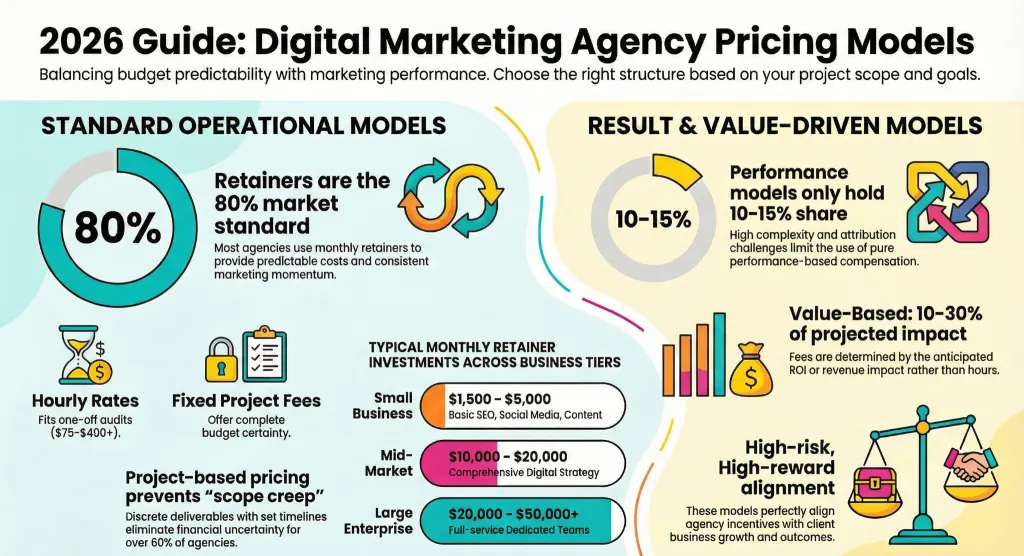
The hourly model is the most straightforward structure: the agency tracks time and bills accordingly. In 2026, hourly rates for digital marketing work range from $75 to over $400 per hour, depending on the practitioner’s expertise, their location, and the complexity of the service.
How it works: Agencies log time using project management tools and bill either on completion or against predetermined hourly budgets. Some provide upfront estimates; others require client approval before exceeding agreed limits.
Typical 2026 hourly rate ranges:
- Junior specialists and freelancers: $50–$100/hr
- Mid-level practitioners and boutique agencies: $100–$200/hr
- Senior strategists and specialist consultants: $200–$300/hr
- Premium agencies and industry-recognised leaders: $300–$400+/hr
Best suited for: One-off projects such as website audits, campaign reviews, consulting sessions, short-term strategic planning, troubleshooting specific challenges, and testing a new agency relationship before committing to something larger.
Advantages: Full transparency into what you’re paying for. Easy to scale up or down based on need. Detailed time logs justify every invoice line.
Disadvantages: Total costs are hard to predict or budget for. Slower work costs more for the same output. Limited earning upside for the agency can create misaligned incentives over time.
Pro tip: Always request detailed time logs and agree on hard hourly caps upfront. Require written approval before the agency exceeds any estimated hours. This prevents invoice surprises and keeps the relationship professional from day one.
2. Monthly Retainer Pricing
Monthly retainers are the dominant pricing structure in the industry. According to agency industry research, approximately 78% of digital marketing agencies use retainers as their primary or supplementary model. Under this structure, clients pay a fixed monthly fee for a predetermined set of services or an allocated bank of hours.
How it works: Both parties agree on a monthly fee covering specific deliverables, service categories, or a defined block of hours. The retainer creates predictable costs for clients and stable revenue for agencies, a foundation that benefits both sides.
Typical 2026 monthly retainer ranges:
| Business Size | Monthly Retainer | Typical Services Included |
| Small businesses | $1,500–$5,000 | Basic SEO, social media, and content creation |
| Growing SMBs | $5,000–$10,000 | Basic SEO, social media, and content creation |
| Mid-market companies | $10,000–$20,000 | Comprehensive digital strategy and optimisation |
| Large enterprises | $20,000–$50,000+ | Full-service with a dedicated account team |
Best suited for: Ongoing marketing needs continuous SEO optimisation, regular content creation, social media management, campaign optimisation, brand building, and long-term strategic partnerships.
Advantages: Predictable monthly costs simplify budgeting. Priority access to agency resources. Deeper business understanding develops over time. Typically, a better value per hour compared to ad hoc work.
Disadvantages: You’re committed to monthly payments even during quieter periods. Scope creep is a common risk when boundaries aren’t clearly defined. Ongoing value needs to be clearly demonstrated by the agency on an ongoing basis.
Expert insight: The most durable retainer relationships include clearly defined monthly deliverables, regular performance reviews, flexibility to adjust scope as priorities evolve, and transparent reporting that makes ROI tangible. Agencies that communicate proactively and adapt their strategies based on data retain clients significantly longer — and for good reason.
3. Project-Based (Fixed Fee) Pricing
Project-based pricing involves a flat fee for a specific initiative with a defined scope, agreed deliverables, and a set timeline. According to Clutch’s 2024 agency industry report, over 60% of digital agencies offer project-based pricing as a primary or supplementary option.
How it works: The agency estimates the time, expertise, and resources required, then quotes a single fixed price. The client knows the total cost upfront, removing financial uncertainty regardless of how long the actual work takes.
Typical 2026 project fee ranges:
- Website audits and technical SEO reviews: $2,500–$10,000
- Website design and development: $5,000–$50,000
- Comprehensive content marketing campaigns: $5,000–$25,000
- Brand strategy and repositioning: $10,000–$50,000
- Marketing automation setup and integration: $7,500–$30,000
- Large-scale marketing initiatives: $25,000–$100,000+
Best suited for: Website launches or redesigns, campaign creation with defined deliverables, one-time strategic planning, marketing audits, content library builds, and any work with a clear start and end point.
Advantages: Complete cost predictability. A clear scope prevents misunderstandings. Ability to test an agency before a long-term commitment. No ongoing obligations once the project is delivered.
Disadvantages: Scope expansion mid-project creates friction and renegotiation. Agencies working to a fixed price may rush to protect margins. Estimating complex requirements accurately at the outset is genuinely difficult.
Best practice: A detailed project scope with specific deliverables, milestones, revision rounds, and a clear exclusions list prevents disputes later. Always include a formal change order process for anything outside the original scope. For Taskip users, project-based engagements map naturally onto task management workflows; each deliverable becomes a trackable task with clear ownership and a deadline.
4. Performance-Based Pricing
Performance-based pricing ties agency compensation directly to measurable results. In theory, this model perfectly aligns incentives; in practice, it accounts for approximately 10–15% of agency pricing arrangements, primarily because of attribution complexity. (HubSpot Agency Trends Report, 2024)
How it works: Payment is triggered when predetermined KPIs are achieved — leads generated, revenue increases, ranking improvements, or conversion rate gains. Common structures include base fees plus performance bonuses, pure commission on results, or tiered payments tied to achievement levels.
Typical performance-based structures:
- Cost-per-lead (CPL): $10–$500 per qualified lead, depending on industry
- Cost-per-acquisition (CPA): $50–$5,000+ per customer acquired
- Revenue share: 5–20% of attributed revenue generated
- Bonus structures: Base fee + 10–30% bonus for exceeding agreed targets
Best suited for: Lead generation campaigns with clean attribution, e-commerce with trackable sales, paid advertising where results are directly measurable, and mature businesses with established baseline metrics.
Advantages: Perfectly aligns agency and client incentives. Minimises upfront financial risk. Creates powerful motivation for agencies to drive measurable results.
Disadvantages: Significant agency risk during algorithm updates or market shifts outside their control. Requires sophisticated tracking and attribution infrastructure. What counts as a “qualified result” is frequently disputed. Short-term metric incentives can crowd out longer-term brand-building work.
Critical note: Performance-based models work reliably only when success factors are largely within the agency’s control, attribution can be clearly established, baseline metrics exist for comparison, and both parties agree on precise definitions before work begins. Many agencies now prefer hybrid structures, a modest base fee plus performance incentives, to distribute risk more fairly between both parties.
5. Value-Based Pricing
Value-based pricing is the most consultative of all fee structures. Instead of calculating cost by time spent or activities performed, the fee is set based on the anticipated business value the agency’s strategies will generate, typically expressed as a percentage of projected first-year impact (usually 10–30%).
How it works: The agency assesses the potential revenue uplift, cost savings, or competitive advantage their work will create, then sets fees as a share of that projected value. This shifts the conversation entirely from “what does this cost to deliver?” to “what is this worth to the client?”
Example in practice: If an agency’s SEO and content strategy is projected to generate $500,000 in additional annual revenue, they might charge $75,000–$100,000 (15–20% of projected value). Both parties are invested in the same outcome from day one.
Best suited for: Strategic consulting and business transformation, clients with clear revenue or cost-saving opportunities, agencies with proven track records backed by strong case studies, and mature relationships built on established trust.
Advantages: Rewards agencies for expertise and outcomes rather than hours logged. Incentivises innovative thinking over billable time. When results materialise, clients feel the pricing was entirely justified.
Disadvantages: Requires deep business understanding and financial transparency from the client. Projecting value precisely upfront is genuinely difficult. Disputes arise if results fall short of projections. Demands mature, well-established trust on both sides.
Making it work: Thorough discovery, collaborative goal-setting, transparent reporting, and regular strategy check-ins are non-negotiable. This model works best when the agency genuinely thinks and operates as a business partner, not a vendor fulfilling a brief.
6. Hybrid Pricing
Hybrid pricing combines two or more fee structures into a single arrangement. It’s the fastest-growing model in 2026 because it distributes risk fairly; the agency gets a predictable base, the client gets performance accountability, and neither side carries all the exposure.
How it works: A fixed base fee covers core services and guaranteed agency availability. On top of that, variable components like performance bonuses, ad spend percentages, or project add-ons kick in when specific conditions are met. Both parties agree on the exact triggers and thresholds before work begins, making the structure fully transparent from day one.
Best suited for: Scaling businesses that need pricing to grow with results; clients running a mix of strategic and execution-heavy work; agencies that want a fair baseline while staying incentivised to overdeliver; and any relationship that has moved past the initial testing phase into a genuine partnership.
Advantages: Balances cost predictability with performance accountability. Agencies are motivated to exceed targets, not just hit them. Easier to justify the budget internally when there’s a fixed floor. Naturally evolves as the relationship deepens without requiring a full contract renegotiation.
Disadvantages: More complex to set up, every variable trigger needs a precise definition upfront. Attribution disputes can still arise over what “counts” toward a bonus. Requires both parties to be comfortable with slightly more administrative overhead (tracking, reporting, sign-off on bonuses).
Expert insight: The most effective hybrid contracts are written in plain language, not legal jargon. Every clause should pass the “read it back” test; if either party can’t explain in one sentence what triggers a bonus or adjustment, rewrite it before signing. Agencies using Taskip can tie performance milestones directly to task completion, making bonus triggers objective and verifiable for both sides rather than a source of end-of-month friction.
4 Popular Hybrid Pricing Models for Digital Marketing Agencies
The most sophisticated agency relationships in 2026 don’t fit neatly into a single pricing category. Hybrid structures combine elements from multiple models to create flexible, fair arrangements that evolve alongside the client’s business.
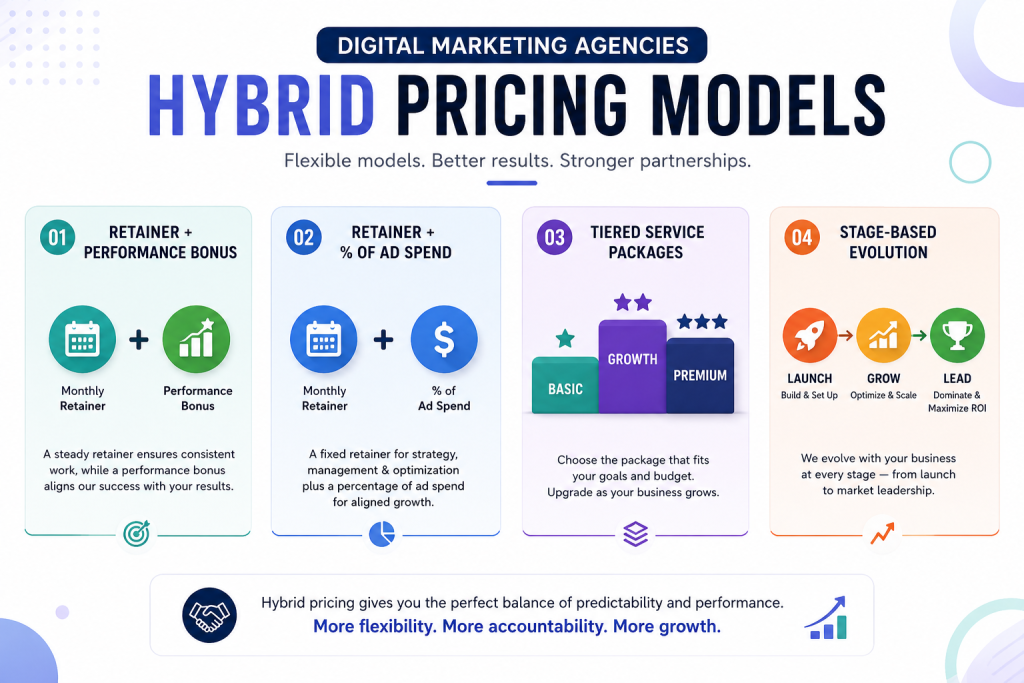
Most popular hybrid structures:
| Structure | Base Fee | Variable Component |
|---|---|---|
| Retainer + performance bonus | $3,000–$10,000/mo | 10–30% bonus when KPIs are exceeded |
| Retainer + % of ad spend | $2,000–$5,000/mo | 8–15% of monthly media spend |
| Tiered service packages | $3,000–$15,000/mo | Fixed tiers with defined upgrade paths |
| Stage-based evolution | Starts retainer-based | Shifts toward performance/value as trust builds |
a. Base Retainer Plus Performance Bonuses
The most widely adopted hybrid model. Clients pay a monthly base fee covering core services and guaranteed agency availability, with bonuses triggered when campaigns exceed predetermined targets.
Example: $8,000/month base + $1,500 bonus per 25% increase in qualified leads above baseline. The base covers operational costs; bonuses reward outstanding results without putting the whole engagement at risk.
b. Base Retainer Plus Percentage of Ad spend
Works especially well for paid media management. A lower base fee plus a percentage of media spend means the agency’s compensation grows naturally as campaigns scale.
Example: $3,000/month base + 10% of advertising spend. As campaigns grow, agency compensation grows proportionally, at a lower percentage than pure commission models.
c. Tiered Service Packages
Predefined service levels at different price points create clear upgrade paths and straightforward decision-making for clients.
- Starter ($3,000/month): Core services with standard monthly deliverables
- Growth ($7,500/month): Expanded services with optimisation, analytics, and reporting
- Premium ($15,000/month): Comprehensive strategy with a dedicated senior strategist and priority support
d. Stage-Based Evolution
Pricing that matures alongside the relationship. Year one uses fixed monthly fees while building a strategy and learning the business. Year two introduces performance bonuses as the agency proves its impact. Year three moves toward value-based or percentage models as the partnership deepens into a genuinely strategic one.
When Hybrid Models Make the Most Sense
Hybrid pricing structures work particularly well when:
- Both parties value transparency, shared goals, and measurable success metrics.
- Your business is growing, and you need a pricing model that scales alongside results.
- You want predictable monthly costs while still holding providers accountable for performance.
- Your projects involve both long-term strategy and measurable execution.
- Strategic planning, consulting, and ongoing guidance are a significant part of the engagement.
- Campaigns have clear performance goals such as leads, sales, conversions, or revenue targets.
- You want to balance financial stability for service providers with outcome-based incentives.
For teams using Taskip, hybrid models integrate seamlessly with operational workflows. Retainer deliverables become recurring tasks with clear deadlines. Performance bonuses tie directly to completed milestones that hit specific metrics. The pricing structure and the work itself become one visible, accountable system, removing ambiguity for both sides.
Implementing Hybrid Pricing Successfully
Transparency is the foundation of any hybrid arrangement. Every hybrid contract should specify in plain language: what the base fee covers, how performance metrics are defined and measured, when and how bonuses are triggered, the reporting frequency and format, and how the arrangement can be adjusted as circumstances change.
Regular reviews ensure the pricing structure continues to serve both parties fairly as the relationship develops. Agencies that proactively recommend adjustments, rather than waiting to be asked, build far more durable client relationships.
Comparing Agency Fee Structures: A Decision Framework
No single model is universally superior. The right choice depends entirely on your specific situation, goals, and constraints.
| Your Situation | Best Pricing Model | Why It Works |
| Testing a new agency | Project-based or hourly | Limited commitment, clear scope, easy exit |
| Ongoing marketing needs | Monthly retainer | Predictable costs, consistent momentum |
| Tight budget, results-focused | Performance-based | Pay for outcomes, minimise upfront risk |
| One-time campaign launch | Project-based fixed fee | Clear deliverables, known total cost |
| Strategic transformation | Value-based | Fees align directly with business impact |
| Scaling paid advertising | Base + % of ad spend | Grows proportionally with campaign success |
| Complex multi-channel marketing | Hybrid (retainer + performance) | Balances stability with performance incentives |
 Taskip
Managing a Retainer?
Track Every Deliverable in Taskip
Once you’ve picked your pricing model, keeping clients informed is what makes it stick. Taskip gives agencies a shared workspace where retainer tasks, project milestones, and invoices all live in one place — so clients always see what they’re paying for.
Sign Up for FREE!No credit card is required!
How to Compare Agency Proposals When Prices Look Nothing Alike
One of the most common frustrations when evaluating agencies: you request three proposals and get back three completely different documents with different line items, different definitions of “deliverables,” and prices that range from $2,000 to $15,000 a month for what sounds like the same work. Here’s how to cut through that.
Step 1: Strip everything back to cost-per-deliverable
Ignore the package name and monthly total. List every specific deliverable each agency has committed to, the number of blog posts, ad campaigns managed, reports delivered, and hours of strategy time, and divide the monthly fee by that output. An agency charging $8,000/month for 12 deliverables is cheaper per unit than one charging $5,000/month for 4.
Step 2: Identify what each proposal excludes
The cheapest proposal almost always excludes something the others include. Look specifically for: ad spend (is it included or billed separately?), creative assets (who produces them?), reporting (how detailed, how often?), and revision rounds (are they capped?). Add the realistic cost of anything excluded back into the headline price.
Step 3: Normalise the success metrics
Each agency will define “results” differently. Force them onto the same terms by asking: What specific, measurable KPI will this engagement be judged against at month 3 and month 6? If one agency commits to 50 qualified leads per month and another commits to “improving brand awareness,” you’re not comparing equivalent offers regardless of price.
Step 4: Check the contract for flexibility
A lower monthly fee with a 12-month lock-in and no exit clause can be more expensive than a higher monthly fee with a 3-month initial term. Assess total contractual exposure, not just the monthly number.
Step 5: Request one reference call per finalist
Ask specifically: Did the agency deliver what the proposal said they would? Were there scope creep disputes? How did they handle months where performance fell short? Proposals sell the best case; references reveal the real case.
AI and Automation Pricing For Digital Marketing Agency: The 2026 Addition
A growing number of agencies now offer AI-augmented or AI automation service packages, and they price them differently from traditional models. Understanding this category is increasingly important when comparing proposals.
What these packages typically include:
- AI-assisted content production at higher volume (5–10x standard output at similar cost)
- Automated campaign optimisation and bid management
- AI-powered reporting and insight generation
- Workflow automation that reduces manual account management hours
How agencies price AI-integrated services in 2026?
The AI automation pricing varies depending on the services. complexity, cost, and duration it takes.
| Package Type | Typical Monthly Cost | What You’re Paying For |
|---|---|---|
| AI-augmented retainer | $2,000–$8,000/mo | Higher-volume deliverables at similar price to traditional lower-volume retainers |
| Automation setup + management | $5,000–$20,000 upfront + $1,500–$3,000/mo | One-time build of automated workflows, then ongoing management |
| Productized AI marketing packages | $500–$3,000/mo fixed | Standardised, templated services delivered at scale with minimal customisation |
| AI + human hybrid retainer | $3,000–$12,000/mo | Automated production with human strategy, QA, and a client communication layer |
What to watch for: Some agencies use “AI-powered” as a marketing term to justify lower delivery costs while maintaining legacy pricing. The right question to ask is:
What specifically is automated, what is still done by a human strategist, and how does that split affect the work quality and turnaround time?
Key Questions to Ask Before Signing Any Agency Contract
Before committing to any pricing model, work through these questions carefully, both internally and with your prospective agency.
About Your Own Needs
- What specific marketing outcomes do you need to achieve, and in what timeframe?
- Are your marketing needs ongoing, or project-based with a defined endpoint?
- Do you have baseline metrics established that an agency can be measured against?
- What is your realistic monthly or project budget, including any contingency?
- How important is cost predictability versus paying primarily for results?
About the Agency’s Capabilities
- Can they provide case studies with measurable, comparable results in your industry or at your scale?
- How do they track, attribute, and report on performance metrics?
- What happens contractually if results fall short of agreed projections?
- How flexible are they in adapting scope, strategy, or approach as your needs evolve?
About the Engagement Structure
- What is explicitly included, and what situations trigger additional fees?
- What is the commitment period, and what are the exit or pause clauses?
- How often will you receive performance reports, and in what format?
- How are scope changes, new requests, and out-of-scope work handled?
Red Flags and Hidden Fees to Watch in Any Agency Contract
Pricing transparency is improving across the industry, but certain agency billing practices still cost clients significantly more than the headline rate suggests. These are the most common ones to check before signing.
Ad spend marked up without disclosure
Some agencies charge a percentage on top of your actual media spend without making this explicit. Always ask: Do you receive any rebates, volume discounts, or platform incentives from ad networks, and do those flow back to me?
Vague deliverable language
“Social media management” in one proposal might mean 3 posts per week; in another, it might mean 15. Any deliverable that isn’t expressed as a specific number, frequency, or output is a negotiation problem waiting to happen.
Automatic contract renewal clauses
Many agency contracts renew automatically for 6 or 12 months unless you cancel within a 30-day window. Miss the window, and you’re locked in for another year. Read the renewal and cancellation clauses before anything else.
Scope creep billed at premium hourly rates
Retainer contracts often specify that any work outside the defined scope is billed hourly at a premium rate, sometimes $200–$350/hr. If the original scope is loosely defined, you’ll consistently get invoices for “out of scope” work that seems like it should have been included.
Ownership of assets
Who owns the creative work, the ad accounts, the data, and the website code if the engagement ends? Some agencies retain ownership of assets developed during the engagement. Get explicit written confirmation that all assets will transfer to you at any point.
Reporting that shows activity but not outcomes
Monthly reports that list “published 12 blog posts, ran 4 campaigns, responded to 200 social comments” without connecting any of that activity to revenue, leads, or growth are designed to look busy rather than prove value. Require outcome-based reporting from day one.
How Task Management Drives Real Pricing Transparency
Modern task management platforms have fundamentally changed the agency-client dynamic by making the work itself visible, regardless of which pricing model you’ve agreed on.
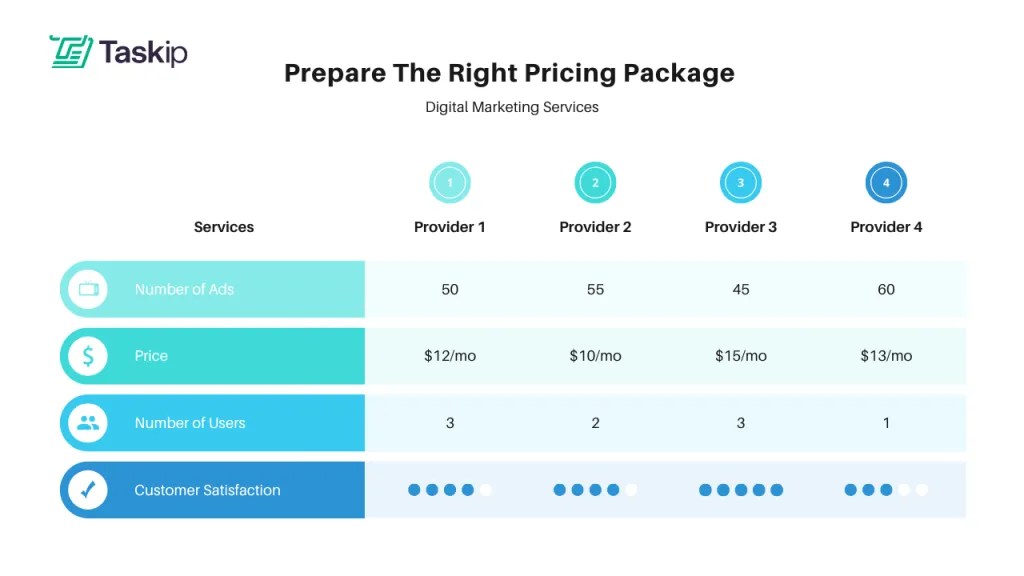
When agencies use a robust task management system, clients gain genuine real-time visibility into work progress, task completion rates, time allocation across activities, and the status of every deliverable. This operational transparency directly supports pricing transparency; you can see exactly what you’re paying for at any given moment, without needing to ask.
For agencies, platforms like Taskip provide the documentation needed to justify costs, demonstrate ongoing value, and build trust through consistent accountability. Retainer deliverables become recurring tasks with clear owners and deadlines. Project work breaks into trackable milestones. Performance bonuses tie directly to completed tasks that hit defined metrics.
This integration of pricing structure and operational workflow creates a level of accountability that benefits everyone and makes contract disputes significantly less likely.
Industry-Specific Pricing: What to Expect in Your Sector
Agency pricing varies considerably across industries because of different competitive landscapes, customer acquisition costs, regulatory requirements, and revenue models.
B2B vs. B2C Marketing Costs
B2B marketing typically commands higher fees than B2C, reflecting longer sales cycles, higher customer lifetime values, and more complex buying journeys. B2B agency retainers typically range from $5,000–$20,000/month; B2C services for comparable-sized businesses often fall between $2,000–$10,000/month.
B2B campaigns require more sophisticated lead nurturing, account-based marketing, thought leadership content, and sales enablement materials, all more resource-intensive than typical consumer-focused work.
E-commerce Marketing
E-commerce businesses frequently use performance-based or spend-percentage models because attribution is cleaner and ROI is more immediately quantifiable. Typical structures include 10–20% of advertising spend plus management fees, revenue share of 3–10% of attributed sales, or monthly retainers of $3,000–$15,000 depending on catalogue size and marketing complexity.
Specialist services such as product feed optimisation, shopping campaign management, and marketplace advertising add to the overall investment, but typically deliver measurable, directly trackable returns.
Local Business Marketing
Local businesses work with tighter budgets but still require a comprehensive digital presence. Local packages typically range from $1,000–$5,000/month and usually cover local SEO and Google Business Profile optimisation, reputation management and review generation, local directory listings, social media management, and basic website maintenance.
Typical small business digital marketing package breakdown (2026):
| Budget Level | Monthly Spend | What’s Realistic to Expect |
|---|---|---|
| Entry ($1,000–$2,000/mo) | Freelancer or small agency | 1 channel focus (SEO or social), basic reporting, limited strategy |
| Core ($2,000–$5,000/mo) | Boutique agency | 2–3 channels, monthly strategy calls, regular reporting |
| Growth ($5,000–$10,000/mo) | Mid-size agency | Full-funnel approach, dedicated account manager, paid + organic |
| Scaling ($10,000+/mo) | Full-service agency | Multi-channel, custom creative, advanced analytics, proactive strategy |
The most common mistake small businesses make is choosing a budget-tier package from a large agency, where their account gets passed to the most junior team. A mid-tier boutique agency with proven small business case studies will outperform a large agency where your $3,000 retainer is a rounding error on their monthly revenue.
SaaS and Technology Companies
SaaS companies are among the highest digital marketing spenders, with mature companies typically allocating 15–30% of revenue to marketing activities (Gartner CMO Spend Survey, 2024). Agency retainers for SaaS clients frequently range from $10,000–$50,000+/month, reflecting the need for sophisticated demand generation, product marketing, customer lifecycle campaigns, content at scale, and advanced analytics.
SaaS marketing demands real expertise in metrics like customer acquisition cost (CAC), lifetime value (LTV), churn, and expansion revenue, specialist knowledge that commands a justified premium.
How to Negotiate Better Agency Rates
Understanding the pricing models is only half the equation. Knowing how to discuss pricing confidently creates better, more durable arrangements for both sides.
Strategies That Work
Start with specific goals: Document your objectives, success metrics, timeline, and budget constraints before any pricing conversation begins. Specific, detailed briefs lead to more accurate proposals and more honest conversations about what’s actually achievable within your budget.
Request itemised proposals: Ask agencies to break down pricing by service category, estimated hours, and expected deliverables. Itemised proposals reveal where costs concentrate and create space to adjust scope for budget fit without sacrificing the most important work.
Explore volume and commitment incentives: Longer commitments, six-month or annual agreements, often unlock 10–20% discounts compared to rolling month-to-month arrangements. Multiple services bundled together, or prepayment arrangements, can also reduce the headline rate.
Negotiate value-adds before discounts: If an agency cannot reduce their fee, they may be able to include additional services, more frequent reporting, or priority support, increasing your overall value without cutting into their margin.
Building Long-Term Pricing Relationships
The best agency-client pricing evolves over time. Early engagements typically use well-defined, conservative structures to build mutual trust. As the agency proves its value and deepens its understanding of your business, the arrangement can shift toward more strategic, performance-linked models.
Regular pricing reviews, transparent budget conversations, and genuine flexibility on both sides are the hallmarks of successful agency relationships that consistently deliver results over time.
Conclusion: Choosing Your Ideal Pricing Model
Agency fee structures have evolved significantly, moving away from opaque hourly billing toward transparent, flexible arrangements that align agency and client incentives far more honestly. The right model for your business depends on your unique situation: your budget, your goals, the complexity of your marketing needs, and how deeply you want to invest in the partnership.
Most businesses find the best results with monthly retainers or hybrid models that combine a predictable base with performance incentives. These structures balance cost certainty with genuine accountability. Project-based pricing works well for discrete campaigns or when evaluating a new agency partner. Performance models make sense when attribution is solid, and risk-sharing is a genuine priority for both sides.
Whatever model you choose, prioritise transparency. Request proposals that clearly show what’s included, how performance will be measured, how reporting will be delivered, and how scope changes are handled. The agency partnerships that deliver the most value over time are built on clear expectations, open budget conversations, and pricing structures that make both sides want exactly the same outcomes.
FAQs About Digital Marketing Agency Pricing Models
1. What is the most common pricing model for digital marketing agencies in 2026?
Monthly retainers remain the most widely used structure, adopted by approximately 78% of agencies as their primary or supplementary model. Many agencies now combine retainers with performance bonuses for added accountability, making hybrid retainer arrangements the single most common structure now.
2. How much should a small business budget for digital marketing services?
Small businesses typically invest between $1,500 and $5,000 per month. The right number depends on service complexity, your competitive landscape, and your specific growth goals, not just what you can afford. Starting with a focused, well-scoped retainer and scaling up as results prove out is usually the most practical approach.
3. What’s the difference between performance-based and value-based pricing?
Performance-based pricing pays the agency when specific, pre-agreed KPIs are achieved, leads generated, sales made, or search rankings improved. Value-based pricing sets fees as a proportion of the broader business value or projected ROI that the agency’s work is expected to generate. The first is transactional and short-term measurable; the second is strategic and requires more trust and business transparency upfront.
4. Why are hybrid pricing models growing in popularity?
Hybrid models distribute risk more fairly than either retainer or performance pricing alone. A base retainer gives agencies the stability to properly plan and invest in your account, while performance bonuses keep them consistently motivated to exceed targets. The combination is more durable and tends to produce better long-term results than either structure on its own.
5. How can I ensure I’m getting genuine transparency from my digital marketing agency?
Request detailed proposals with itemised deliverables, defined reporting schedules, and full cost breakdowns. Use a project management platform like Taskip that gives you real-time visibility into work in progress, so you can always see exactly what is being done on your account, and when, without needing to chase for updates.
6. How do I price my digital marketing services as an agency?
Start by calculating your hourly cost (salary + overhead ÷ billable hours), then add a margin of 30–50%. Most agencies begin with hourly pricing to understand how long work actually takes, then transition to monthly retainers once they have recurring clients. Remember, retainers are more predictable for both sides. Once you’ve worked with a client for 3–6 months and have baseline metrics, you can introduce performance bonuses on top of the base retainer. Avoid jumping straight to value-based pricing without established trust and clear attribution data because it requires both parties to agree on projected outcomes upfront, which is hard to do without a track record.
7. What percentage of revenue should a business spend on digital marketing?
A widely used benchmark: B2B companies typically allocate 5–10% of revenue to marketing; B2C companies 10–20%. Early-stage or fast-growth businesses often spend 15–30% to build traction quickly. Of that total marketing budget, digital typically accounts for 50–75% depending on the industry. Keep in mind these are averages: a SaaS startup competing in a crowded market may need to spend more aggressively, while an established local business with strong word-of-mouth can often spend less. The right number is whatever generates a positive return, tracks cost per acquisition, and adjusts from there.
8. How much does a digital marketing agency charge per month on average?
Most small-to-mid-sized businesses pay between $2,500 and $12,000 per month for agency retainers in 2026. Here’s a quick breakdown by tier: entry-level packages from freelancers or small agencies run $1,000–$3,000/month and typically cover one or two channels. Mid-range boutique agencies charge $3,000–$8,000/month for multi-channel campaigns with dedicated account management. Full-service agencies working with mid-market and enterprise clients charge $10,000–$50,000+/month. The biggest variable isn’t agency size, it’s scope. A clear, narrow brief almost always gets you better pricing than a vague “do everything” retainer.



Get Summary On: