Free Trial Services: A Complete Guide for Agencies and Freelancers in 2026
Free trial services are a limited, defined piece of paid work that an agency, freelancer, or consultant delivers to a prospective client at no cost, so the client can evaluate the quality of the work before signing a contract. Unlike a software free trial, which gives temporary product access, this is scoped human labor: a real deliverable with the price waived, not the work removed.
TL;DR
- Free trial services let prospects experience your actual work before they commit, which builds trust faster than a pitch or portfolio can.
- They only work when the scope, timeline, and conversion point are defined in writing before the trial starts.
- The biggest risks are underpricing your work, attracting the wrong clients, and letting the scope quietly expand.
- Custom, high-ticket, or discovery-heavy work is usually better suited to a paid strategy session than a free trial.
- Treating trial clients like real projects, with proper onboarding, tracking, and invoicing, is what determines whether a trial converts.
Table of Contents
What Are Free Trial Services?
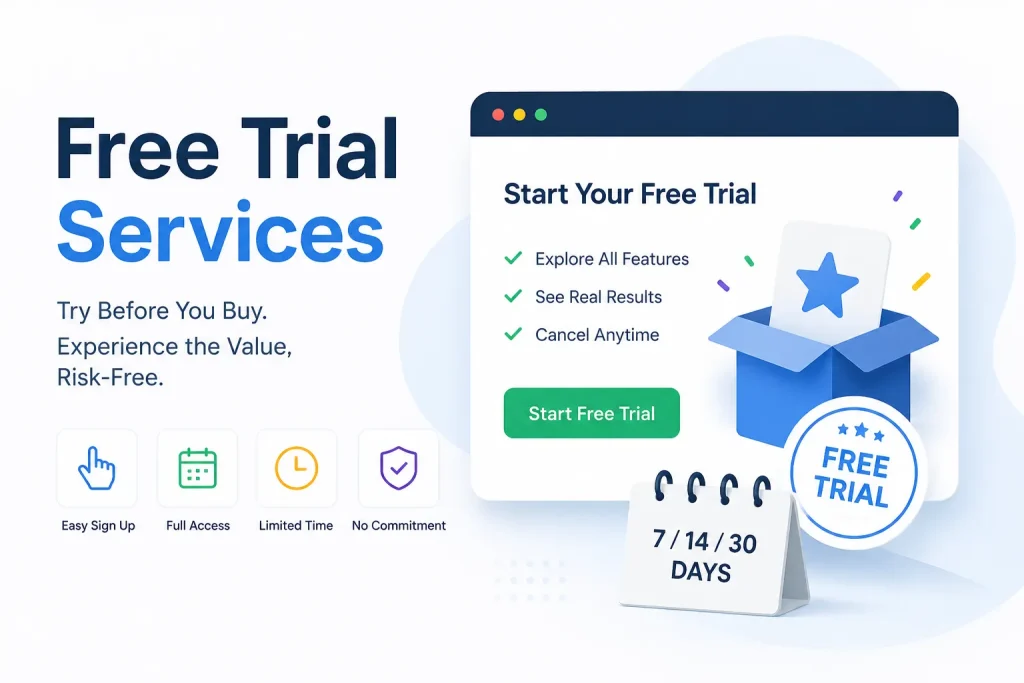
A free trial service is a small, self-contained unit of paid work, such as an audit, a single deliverable, or a short engagement, that a service provider completes for free so a prospect can judge the quality of the work firsthand. It is a sales tool disguised as generosity: you absorb the cost of one deliverable in exchange for a much higher chance of winning a signed contract.
This model has become common across service industries that used to rely purely on portfolios and testimonials. A marketing agency might run one free SEO audit. A designer might mock up one free concept. A law firm might review one contract at no charge. The logic is the same in every case: showing is more persuasive than telling.
Free Trial vs. Free Consultation vs. Paid Discovery Call
A free consultation is a conversation, a free trial is a deliverable, and a paid discovery call is a deliverable you charge for, because the scoping itself has real value. Mixing these up creates mismatched expectations: a prospect expecting a finished asset will be unhappy with a 30-minute call, and a prospect expecting only conversation will be caught off guard by an invoice.
| Model | What the Client Gets | Cost to You | Best For |
|---|---|---|---|
| Free Trial | An actual deliverable (audit, sample, mini project) | Real time and labor | Productized, repeatable services |
| Free Consultation | A conversation about their needs | Low time cost | Early-stage lead qualification |
| Paid Discovery Call | A paid strategy or scoping session | None, it is billed | High-ticket, custom, or complex engagements |
Benefits of Offering Free Trial Services
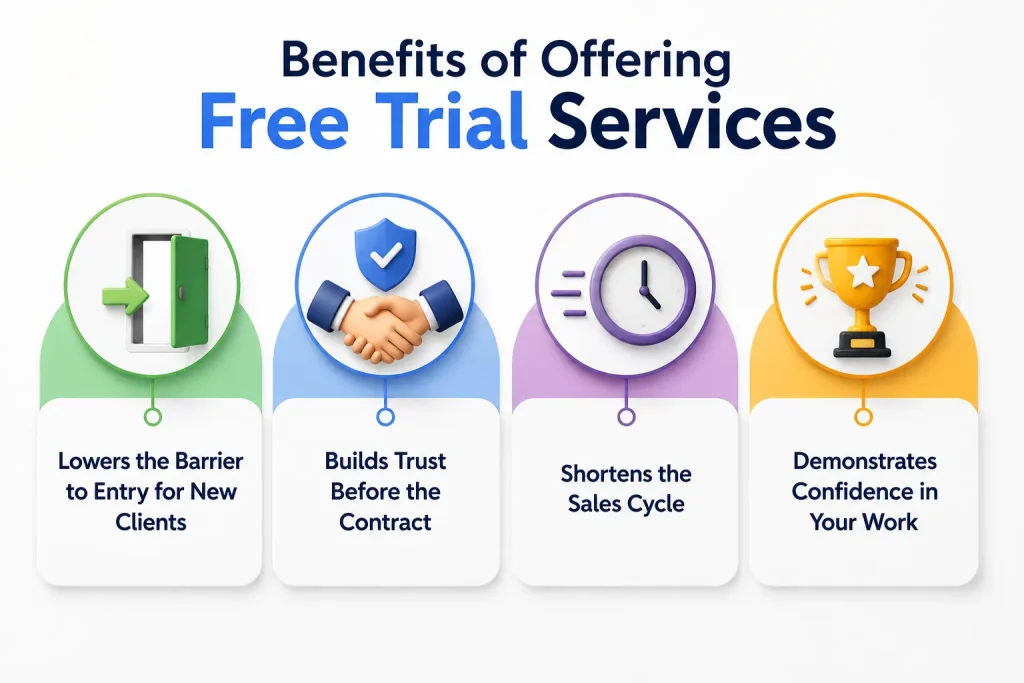
Lowers the Barrier to Entry for New Clients
A trial removes a prospect’s biggest objection: not knowing whether the work will actually be good. Many service buyers have been burned before by an agency that overpromised in a sales call and underdelivered on the project. A trial sidesteps that objection, because the prospect only has to look at your work, not trust your words.
Builds Trust Before the Contract
Clients believe a finished deliverable more than they believe a sales pitch. A completed audit, a working prototype, or a drafted contract review carries evidence a proposal document cannot match, which matters most in industries where trust is the actual product, like legal services and high-end creative work.
Shortens the Sales Cycle
A trial collapses the usual pitch, proposal, and negotiation steps into one. Instead of asking a prospect to imagine the finished work, you hand them the work itself, and the buying decision becomes a reaction to something real rather than a leap of faith.
Demonstrates Confidence in Your Work
Offering real work before being paid signals that you are confident the output will hold up on its own. It also filters your own business in a healthy way, since teams that cannot deliver strong work quickly tend to stop offering trials fast, before a client ever pays for weak output.
Potential Drawbacks of Free Trial Services
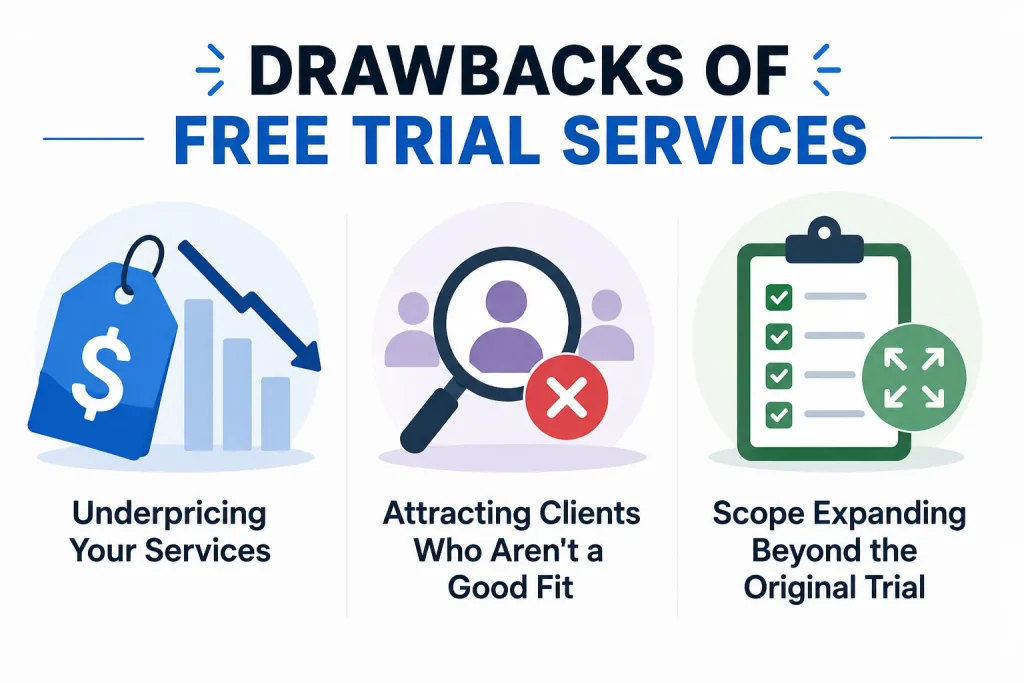
Underpricing Your Services
If a trial is not clearly framed as paid work with the price waived, clients quietly start to anchor on “free” as the baseline. Always state the trial’s real value on the deliverable itself, such as “normally a $400 audit, offered free for a limited time,” so the client understands what they are getting at no cost.
Attracting Clients Who Aren’t a Good Fit
Free offers attract price-sensitive prospects as easily as serious buyers. Without a qualification step in front of the trial, your best hours can go to people who were never going to become paying clients, while more qualified leads never get prioritized.
Scope Expanding Beyond the Original Trial
A trial that starts as “one free landing page” can quietly turn into ongoing revisions and unofficial support, simply because no hard stop was ever defined. Written scope is the only reliable defense, and it needs to exist before the first deliverable goes out.
Is a Free Trial Right for Your Business?
A free trial service is a small, self-contained unit of paid work, such as an audit, a single deliverable, or a short engagement, that a service provider completes for free so a prospect can judge the quality of the work firsthand. It is a sales tool disguised as generosity: you absorb the cost of one deliverable in exchange for a much higher chance of winning a signed contract.
This model has become common across service industries that used to rely purely on portfolios and testimonials. A marketing agency might run one free SEO audit. A designer might mock up one free concept. A law firm might review one contract at no charge. The logic behind all of it traces back to the reciprocity principle: once a prospect has received something of real value, they feel a natural pull to return the favor by giving you the business.
How to Structure a Free Trial Service
Choose a Specific, Self-Contained Deliverable
Avoid offering something as loose as “a free week of work.” Offer one named output instead: one SEO audit, one landing page, one week of scheduled content. A specific deliverable has a natural finish line, which makes hours easy to estimate and the trial easy to close out.
Define the Scope and Timeline in Writing
Put the deliverable, included revisions, and start and end dates into a short written agreement, even a confirmation email. This single step protects you more than anything else on this list, giving you something concrete to point to the moment a client asks for extra work outside what was agreed.
Qualify Prospects Before the Trial Begins
A short intake form or brief call before the trial starts filters out people who are not realistic buyers, whether due to budget, timeline, or genuine need. This step takes fifteen minutes and routinely saves hours of trial work on leads that were never going to convert.
Set a Clear Conversion Point
Decide in advance exactly what happens when the trial ends, whether that is a proposal call, a pricing reveal, or a direct retainer offer, and build it into the trial agreement. Trials that end ambiguously lose momentum fast, and by the time anyone follows up, the prospect has often moved on.
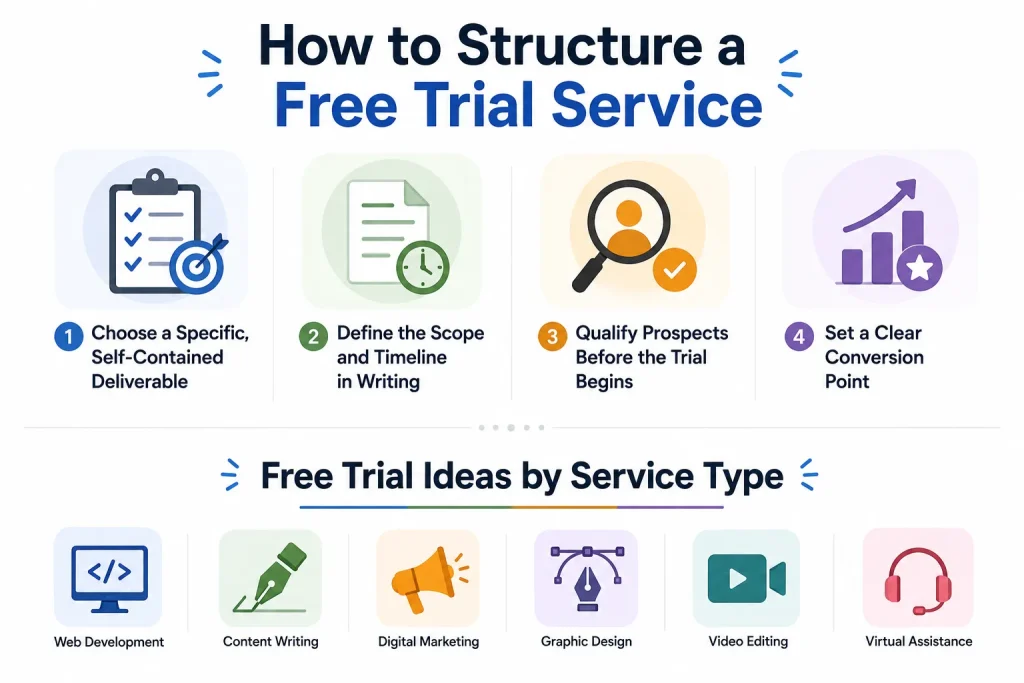
Free Trial Ideas by Service Type
Marketing and creative agencies: a single SEO audit, one ad creative set, or one landing page design. Agencies running several of these tend to lose track of who is mid-trial and who has converted, which is exactly the visibility problem a dedicated CRM for creative agencies is built to solve.
Software and development agencies: a scoped technical audit, a small proof of concept feature, or a single code review. These work well alongside the broader stack of digital marketing agency tools many dev-adjacent agencies already use to manage lead flow.
Law firms and consultants: an initial case review or a single contract review, clearly positioned as a limited free service rather than an open-ended consultation. Firms handling more than a few of these at once typically need a proper client portal for law firms to keep trial and retained matters separated.
Freelancers and solopreneurs: one design concept, one week of support, or one written article. Since freelancers usually run trials solo, a simple client portal for freelancers makes it easier to track deliverables without added admin overhead.
Free Trial vs. Paid Discovery Call: Which to Offer
| Factor | Favors Free Trial | Favors Paid Discovery Call |
|---|---|---|
| Deal size | Lower, repeatable | Higher, custom |
| Deliverable | Easy to scope in isolation | Requires deep context first |
| Client sophistication | Comparison shopping | Already sold on working with an expert |
| Your capacity | Can absorb some unpaid hours | Time is better spent on paid strategy work |
Some businesses use both, offering a free trial for smaller, productized packages while reserving paid discovery calls for larger custom engagements. This lets the trial serve as a volume lead magnet while the paid call protects time-intensive, high-value work from being given away.
Managing Free Trial Clients Efficiently
Trial clients still need to be tracked like real projects, with scope, hours, deadlines, and communication living in one place rather than scattered across email and spreadsheets. Once a few trials are running at once, informal tracking breaks down and prospects who were close to converting fall through the cracks.
A structured client portal onboarding process makes the handoff from trial to paying client smooth, giving both sides a clear record of what was delivered and what happens next. Pairing that with proper invoicing software means a converted client can be billed the moment they sign, with no manual setup delay.
This is the workflow taskip.net is built around: client onboarding, project tracking, and billing living in one workspace, so a trial project and a paying client exist in the same system instead of two disconnected ones.
How to Convert Free Trial Clients into Paying Customers
Introduce the offer before the trial ends. Flag the transition to a paid engagement around the midpoint of the trial, so the eventual pitch feels like a natural continuation rather than a sudden sales moment.
Show the value you delivered. Recap what was produced and connect it directly to the client’s original goal. A summary that shows what you found, what you built, and what it means for them converts better than a generic pitch.
Make the next step easy. Have the proposal, contract, and pricing ready before the trial ends. Any delay at this stage gives an interested client time to hesitate or look elsewhere.
Conclusion
Free trial services can be one of the fastest ways for an agency or freelancer to earn trust and win new clients, but only when treated like a real, scoped project rather than an open-ended favor. Define the deliverable, qualify the prospect, set a clear endpoint, and track the trial the same way you would track any paying engagement. Done this way, a free trial stops being a risk to your time and pricing, and becomes one of the most reliable tools in your sales process.
Frequently Asked Questions
Should agencies and freelancers offer free trials?
It depends on the service. Repeatable, easily scoped work such as audits or single deliverables tends to convert well as a trial. Highly custom or strategic work usually converts better through a paid discovery call.
How long should a free trial service last?
Most effective trials run five to seven days around a single, clearly defined deliverable. Longer trials tend to lose momentum and invite extra requests.
What is the difference between a free trial and a free consultation?
A free trial produces a real, finished deliverable the client keeps. A free consultation is a conversation about the client’s needs, with no work product attached.
Do free trials help you win better clients?
They can, but only when paired with a qualification step. Without one, free trials attract price-sensitive leads as easily as serious, well-budgeted buyers.
How do you keep a free trial from becoming ongoing unpaid work?
Put the scope, deliverable, and timeline in writing before the trial starts, and set a specific end date with a defined next step, rather than leaving it open-ended.

Get Summary On: