Digital Marketing Campaign Scope of Work Template
Define channels, deliverables, budget approval, and timelines for every paid, organic, and email campaign, then send it for e-signature in minutes.
Scope of Work Template
Campaign Objectives & KPIs
Every digital marketing campaign SOW should open with a plain-language statement of what the campaign is meant to achieve, written in business terms rather than marketing jargon. Is the goal to generate a set number of qualified leads, hit a target return on ad spend, grow email list size, or launch a new product to a defined audience within a quarter? Name a single primary KPI (for example, cost per qualified lead under $45, or a 3.5x blended ROAS) and list two or three supporting metrics, such as click-through rate, email open rate, or organic keyword rankings, that the team will monitor but that are not themselves the definition of success. Record the current baseline for each metric where one exists, since 'grow traffic' is not measurable without a starting point. This section should also state the measurement window (a full quarter, a single product launch, a 90-day always-on retainer) so both sides agree on when results get evaluated, and it should note which platform's native analytics (Google Analytics 4, Meta Ads Manager, an email platform's dashboard) will be treated as the source of truth if numbers ever get disputed. Finally, note any external factors that can legitimately move the KPI, such as a planned price change, a seasonal demand swing, or a site migration happening mid-campaign, so a slow month tied to a factor outside marketing's control doesn't get read as underperformance.
This template also covers:
- Scope of Channels & Deliverables
- Media Spend, Budget Approval & Ad Account Access
- Timeline, Flight Dates & Milestones
- Pricing, Fees & Payment Terms
- Reporting Cadence & Success Metrics
- Roles, Responsibilities & Approval Workflow
- Assumptions, Exclusions & Change Orders
- Signatures & Acceptance
What is a Digital Marketing Campaign Scope of Work Template?
A Digital Marketing Campaign Scope of Work Template outlines the channels, deliverables, timeline, budget, and approval process for a marketing campaign so agencies and clients agree on exactly what is, and is not, included before work starts.
A Digital Marketing Campaign Scope of Work Template is a contract-ready document that defines the channels, deliverables, timeline, budget, and success metrics of a marketing engagement before work begins. It sets clear boundaries between the agency or freelancer and the client, preventing scope creep and disputes over ad spend or extra channels.
- Typically 3 to 6 pages once channels, budget, and reporting cadence are filled in
- Used before a digital marketing campaign kicks off, right after the proposal is accepted
- Signed by the agency or freelancer's authorized representative and the client's budget owner
- Usually paired with a Marketing Services Agreement or Retainer Agreement and a first-milestone invoice
- Covers SEO, PPC, paid social, email, and content channels individually so nothing gets bundled into one vague line item
What's Inside This Template
9 structured sections, ready to fill in for your project.
Campaign Objectives & KPIs
Every digital marketing campaign SOW should open with a plain-language statement of what the campaign is meant to achieve, written in business terms rather than marketing jargon. Is the goal to generate a set number of qualified leads, hit a target return on ad spend, grow email list size, or launch a new product to a defined audience within a quarter? Name a single primary KPI (for example, cost per qualified lead under $45, or a 3.5x blended ROAS) and list two or three supporting metrics, such as click-through rate, email open rate, or organic keyword rankings, that the team will monitor but that are not themselves the definition of success. Record the current baseline for each metric where one exists, since 'grow traffic' is not measurable without a starting point. This section should also state the measurement window (a full quarter, a single product launch, a 90-day always-on retainer) so both sides agree on when results get evaluated, and it should note which platform's native analytics (Google Analytics 4, Meta Ads Manager, an email platform's dashboard) will be treated as the source of truth if numbers ever get disputed. Finally, note any external factors that can legitimately move the KPI, such as a planned price change, a seasonal demand swing, or a site migration happening mid-campaign, so a slow month tied to a factor outside marketing's control doesn't get read as underperformance.
Scope of Channels & Deliverables
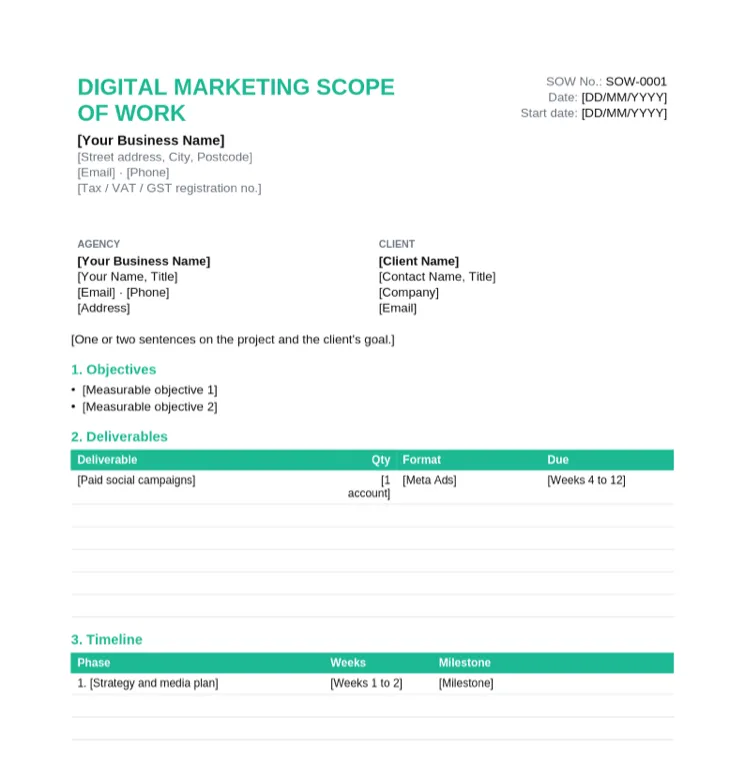
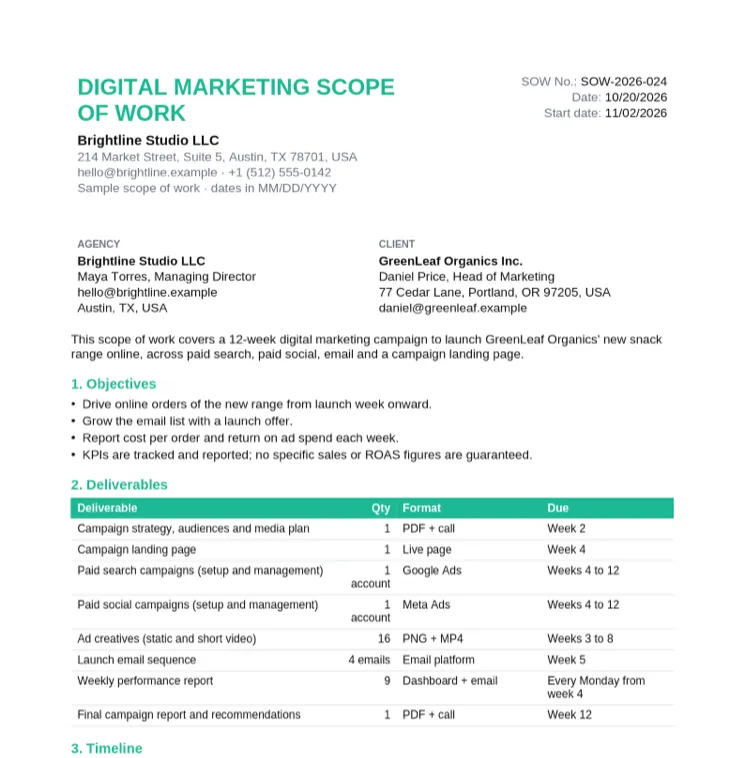
List every channel included in the engagement as its own subsection with its own deliverables, rather than one catch-all 'digital marketing' line. For SEO: target keyword count, on-page optimizations per month, technical audit frequency, and link-building volume. For paid search (PPC): number of campaigns and ad groups managed, ad copy variants tested, and landing page optimization scope. For paid social: platforms covered (Meta, TikTok, LinkedIn, Pinterest), number of ad creative sets produced per month, and audience/retargeting setup. For email marketing: number of campaigns or automations built, list segmentation work, and template design. For organic social and content: posting cadence per platform, content calendar ownership, and whether copywriting, graphic design, and video editing are in-house or outsourced. Just as important as what is included is stating what is explicitly out of scope, such as influencer outreach, paid PR, or website development, so a client cannot reasonably assume those are covered under the same fee. Where a deliverable depends on a third-party tool or platform, for example a specific email service provider or a paid SEO software license, name it directly and clarify whether the license cost is included in the fee or billed separately, since assuming the client already has (or will pay for) the right tooling is one of the most common causes of a stalled campaign kickoff.
Media Spend, Budget Approval & Ad Account Access
This is the section most generic scope of work templates skip, and it is the one that causes the most digital-marketing-specific disputes: who owns and controls the advertising accounts, and who approves changes to spend. State plainly whether the client pays ad platforms (Google Ads, Meta Ads, LinkedIn Campaign Manager) directly from their own billing account, or whether the agency fronts spend and invoices it back, since the tax and cash-flow implications differ significantly. Specify the monthly media budget as a distinct line item from the agency's management fee, and set an explicit approval threshold, for example, any single-month overage above 10 percent of the approved budget requires written client sign-off before the agency spends it. Document who holds admin access to each ad account and analytics property during the engagement, and, critically, what happens to that access, the pixel data, and the audience lists when the contract ends: does the client retain full ownership and admin rights, or is the account tied to an agency-owned business manager that the client cannot easily take with them? Naming this upfront avoids the common end-of-engagement standoff where a client discovers their retargeting audiences and conversion history live inside an account they never controlled. It's also worth stating who is financially responsible for platform errors outside either party's control, such as a rejected ad triggering an account review, or a compromised login causing unauthorized spend, so liability for third-party platform issues isn't left to be argued after the fact.
Timeline, Flight Dates & Milestones
Set a start date, an end date (or a note that the engagement is ongoing and reviewed quarterly), and the specific flight dates for any time-bound pushes, such as a holiday sale or a product launch window that cannot slip. Break the engagement into milestones with target dates: strategy and account setup in week one, first creative assets approved by week two, campaigns live by week three, first optimization pass at day 30. For always-on retainers, state the recurring monthly cadence (content calendar delivered by the 25th of the prior month, ad reports delivered by the 5th business day) rather than leaving delivery timing implied. Include a clause on how delays caused by late client feedback, missing brand assets, or slow platform approval (ad account reviews in particular can take days) affect the timeline, so the agency is not penalized for delays outside its control.
Pricing, Fees & Payment Terms
Separate the professional service fee from any pass-through media spend, since combining them makes it impossible for either party to tell whether a monthly invoice reflects good management or simply higher ad spend. State whether the fee is flat monthly, hourly with a cap, or a percentage of managed ad spend, and if percentage-based, name the exact percentage and whether it is calculated before or after platform fees. List the invoice schedule (net 15, net 30, due on the 1st of each month), accepted payment methods, and any late-payment terms. If a portion of the fee is due upfront before work begins, such as a 50 percent deposit for a one-time campaign build, state that explicitly along with what happens if the client cancels after the deposit is paid but before deliverables are finished.
Reporting Cadence & Success Metrics
Define exactly how often the client receives performance updates, in what format (a live dashboard, a PDF report, a monthly review call), and which metrics appear in every report by default. Tie the report format back to the KPIs named in the objectives section so the client is not left to interpret raw platform screenshots on their own. State who is responsible for building and maintaining any shared dashboard, and specify the review cadence for adjusting strategy, for example a monthly optimization call plus a full quarterly business review where the campaign's overall direction can be revisited.
Roles, Responsibilities & Approval Workflow
Name the primary point of contact on both sides and the maximum expected response time for approvals, since a client who sits on ad creative for two weeks directly extends the timeline. List what the client is responsible for providing (brand guidelines, product photography, platform admin access, legal disclaimers for regulated industries) and by when. Document the creative approval workflow: how many rounds of revisions are included per deliverable, how feedback should be submitted (a single consolidated document rather than scattered comments), and what happens if a deliverable is not approved within an agreed number of business days, such as it being considered approved by default.
Assumptions, Exclusions & Change Orders
List the assumptions the scope and pricing are built on, such as the client already owning a functioning website and analytics tracking, or the campaign targeting one primary market and language. State explicitly what falls outside the current scope, for example website redesign, SEO content written from scratch versus optimized only, or new ad account creation and verification. Include a short change-order process: any request that adds a new channel, extends the flight dates, or increases media spend beyond the approved threshold requires a written addendum with updated pricing and timeline before work on it begins, rather than being absorbed silently into the existing fee.
Signatures & Acceptance
Close with a signature block for an authorized representative of the agency or freelancer and the client's budget owner, along with the date of execution. Reference the effective date, the total contract value or estimated monthly spend, and note that this SOW operates under the terms of any separate Marketing Services Agreement or Master Services Agreement already in place. Once both parties sign, both should retain an accessible, dated copy so it can be referenced quickly if a dispute over deliverables or spend comes up mid-campaign.
Without a Template vs. With This One
| Aspect | Without a Scope of Work | With This Template |
|---|---|---|
| Ad spend approval | Budget overages surface only when the invoice arrives, straining the client relationship. | A documented approval threshold means the client signs off on any spend increase before it happens. |
| Ad account ownership | It's unclear who controls the account after the engagement, risking lost audiences and history. | Ownership and post-engagement access are named upfront, so data transfers cleanly if the relationship ends. |
| Channel deliverables | One vague 'digital marketing' line item leaves each side assuming something different is included. | Every channel gets its own deliverables and cadence, so scope is unambiguous from day one. |
| Reporting expectations | Clients ask for updates ad hoc, pulling time away from campaign work. | A fixed reporting cadence tied to agreed KPIs keeps updates predictable for both sides. |
| Scope changes mid-campaign | New requests get absorbed informally, quietly eating into margin and timeline. | A change-order clause requires a written addendum with updated pricing before new work starts. |
Who This Template Is For
Built for the people who actually write and send scope of work documents — here's why it fits each of them.
Creative Agencies
- Scope multi-channel retainers without underselling strategy and creative hours
- Set ad account access and budget approval terms before spend starts
- Attach the SOW to a Marketing Services Agreement during client onboarding
Freelance Marketers
- Protect against scope creep when a client asks for just one more channel
- Price deliverables per channel instead of one flat, unclear fee
- Send the SOW alongside a proposal to close deals faster
Freelance Social Media Managers
- Define exactly which platforms, posting cadence, and ad boosts are included
- Separate organic content work from paid social management billing
- Set a clear revision limit on creative and caption drafts
Marketing Teams
- Align internal stakeholders and outside agencies on the same deliverables list
- Use the document as a handoff between strategy and execution teams
- Track campaign flight dates against a shared, dated timeline
Agency Founders
- Standardize how every account manager scopes new campaigns
- Reduce disputes over ad spend overages with a documented approval threshold
- Reuse one template across every new digital marketing client
E-commerce Brands
- Scope seasonal campaign pushes, like BFCM or product launches, with a clear end date
- Clarify who owns ad accounts and pixel data after the engagement ends
- Tie campaign KPIs to revenue and ROAS targets, not just impressions
How to Use This Template
Define campaign objectives and KPIs
Start with the single primary metric the campaign is judged on, plus two or three supporting metrics and their current baselines, so success is measurable rather than assumed.
Break down deliverables by channel and set the timeline
List SEO, PPC, paid social, email, and content deliverables as separate line items with their own cadence, then set start, end, and milestone dates.
Set media spend, budget approval, and ad account access terms
Separate the management fee from ad spend, name a spend-overage approval threshold, and document who owns each ad account and its data during and after the engagement.
Add pricing, payment terms, and reporting cadence
State the fee structure, invoice schedule, and exactly how and how often the client will receive performance reports tied back to the agreed KPIs.
Send for e-signature and save it to a free Taskip account
Share the finished scope of work for e-signature directly from Taskip, then save the signed copy to your free Taskip account so it's attached to the client record for the life of the campaign.
Related
Explore More Templates
SaaS · Design & Branding
SaaS Design & Branding Scope of Work Template
Clearly define the scope of a design or branding project before work starts: objectives, deliverables, timeline, responsibilities, and approval steps, all in one adaptable document.
Marketing · Strategy & Execution
Marketing Strategy & Execution Scope of Work Template
Define the full scope of a marketing engagement before work starts: research, strategy, campaigns, deliverables, timeline, reporting, and budget, all in one document.
Web · Design & Development
Website Design Scope of Work Template
Define the full scope of a website or app project before work starts: design, development, testing, launch, post-launch support, and payment terms, all in one document.
Marketing · Social Media
Social Media Management Scope of Work Template
Define the full scope of a social media management engagement before work starts: strategy, content calendar, community management, reporting, and pricing, all in one document.
Design · Brand Identity
Brand Identity & Graphic Design Scope of Work Template
Define the full scope of a brand identity or graphic design project before work starts: logos, typography, color palette, deliverables, revisions, and payment terms, all in one document.
Marketing · Email & Automation
Email Marketing & Automation Scope of Work Template
Define the full scope of an email marketing and automation engagement before work starts: strategy, campaigns, automation flows, segmentation, reporting, and pricing, all in one document.
Marketing · SEO
SEO Audit & Optimization Scope of Work Template
Define the full scope of an SEO engagement before work starts: technical audit, on-page optimization, off-page strategy, reporting, and pricing, all in one document.
Marketing · Content
Content Writing & Blog Strategy Scope of Work Template
Define the full scope of a content writing and blog strategy engagement before work starts: topics, deliverables, revisions, SEO optimization, reporting, and pricing, all in one document.
Marketing · Paid Ads
PPC Campaign Setup & Management Scope of Work Template
Define the full scope of a paid advertising engagement before ads launch: campaign setup, targeting, ad creation, budget management, reporting, and pricing, all in one document.
Technology · CRM
CRM Implementation & Data Migration Scope of Work Template
Define the full scope of a CRM deployment before work starts: platform setup, data migration, integrations, training, and pricing, all in one document.
Design · Mobile App
Mobile App UI/UX Design Scope of Work Template
Define the full scope of a mobile app design project before work starts: user research, wireframes, prototypes, visual design, handoff, and pricing, all in one document.
Marketing · Funnel Design
Landing Page & Funnel Design Scope of Work Template
Define the full scope of a landing page and funnel project before work starts: strategy, design, copy, integrations, A/B testing, and pricing, all in one document.
FAQs — Digital Marketing Campaign Scope of Work Template
What is a Digital Marketing Campaign Scope of Work Template?
It's a document used before a marketing engagement begins that defines the channels, deliverables, timeline, budget, and KPIs both parties agree to. Unlike a proposal, which is used to win the client, the scope of work is used to execute the campaign, setting boundaries around what is and is not included so neither side has to guess later.
How is a digital marketing SOW different from a marketing proposal?
A proposal is a persuasive, pre-sale document that pitches strategy and pricing to win the business. The scope of work is a post-sale, operational document that locks in the specific deliverables, timeline, budget approval process, and reporting cadence once the client has already agreed to move forward, and it's typically referenced whenever a dispute over what's included comes up.
Who owns the ad accounts during and after a digital marketing campaign?
This should be stated explicitly in the SOW rather than assumed. Best practice is for the client to own the ad account, analytics property, and pixel data outright, with the agency granted admin or partner-level access for the length of the engagement. If the agency's own business manager hosts the account instead, the SOW should state what happens to campaign history, audiences, and access when the contract ends.
What should be included in the budget approval section of a marketing SOW?
Separate the agency's management fee from ad spend as distinct line items, then set a clear overage threshold, for example any monthly spend increase above 10 percent requires written client approval before it happens. Also note who holds the platform billing relationship, since that determines whether spend is paid directly by the client or invoiced back through the agency.
How do you handle scope creep in a digital marketing campaign?
Name what falls outside the current scope, such as new channels, additional creative revisions beyond the agreed limit, or expanded ad spend, and build in a short change-order process: any addition requires a written addendum with updated pricing and timeline before the agency begins work on it, rather than being folded silently into the existing retainer fee. This protects margin on the agency side and gives the client a fast, predictable path to approve genuinely valuable additions instead of an informal back-and-forth over email.
How long should a digital marketing campaign SOW be?
Most run three to six pages once every channel's deliverables, the budget and approval terms, the timeline, and the reporting cadence are filled in. Shorter, single-channel engagements (an email-only build, for instance) can run closer to two pages, while multi-channel retainers covering SEO, paid media, and content together tend to run longer.
Do I need a lawyer to review a digital marketing SOW before sending it?
For a standard engagement built on clear objectives, deliverables, budget terms, and payment schedule, most agencies and freelancers use a reviewed template without individual legal sign-off each time. It's worth having a lawyer review the underlying Marketing Services Agreement it attaches to once, and revisiting legal review for unusually large budgets, regulated industries, or custom liability terms.
Can one SOW cover multiple digital marketing channels at once?
Yes, and for retainer-style engagements this is the norm. Keep each channel, such as SEO, PPC, paid social, and email, as its own clearly separated subsection with its own deliverables and cadence, rather than combining them into one vague scope, so it's obvious which line items belong to which channel if the client wants to drop one later, renegotiate pricing on it, or expand it independently of the rest of the retainer down the road.
What happens if the client misses a creative approval deadline?
The SOW should set a maximum response window for approvals, commonly two to three business days, and state what happens if it's missed, such as the deliverable shifting to the next available slot in the content calendar or being considered approved by default. Without this clause, a slow approval turnaround from the client's side quietly becomes the agency's fault for a delayed launch.
Digital Marketing Campaign Scope of Work Template — free to download, no credit card required